Top OpenClaw Workflows for AI Brand Voice Consistency Monitoring
Consistent branding can increase revenue by up to 33%, but most marketing teams still enforce voice guidelines manually, if at all. This guide covers five OpenClaw workflows that automate brand voice definition, content generation, competitive monitoring, and multi-platform tone adaptation, plus how to persist voice profiles across agent sessions so nothing gets lost between runs.

Why Brand Voice Monitoring Still Breaks at Scale
Consistent brand presentation can increase revenue by up to 33%, according to a Lucidpress study of over 200 organizations. That is the upside of consistency. The problem is how few teams actually achieve it once content production scales beyond a single writer and a single channel.
Every new writer, platform, and AI-generated draft introduces another opportunity for your voice to drift. Style guides sit in shared documents that nobody opens before writing. Tone rules live in someone's head but never make it into the prompts feeding your language models. Standalone brand monitoring tools only flag inconsistencies after publication, when the off-brand content is already live and indexed.
OpenClaw's skill ecosystem works from the other direction. Skills like Brand Voice Writer learn your exact tone and vocabulary from your best-performing content, then enforce those patterns across everything your agent produces. Combined with competitive monitoring through Scout and multi-platform adaptation through Social Poster, you can build automated workflows that prevent brand voice drift rather than just detecting it after the fact.
The five workflows below cover the full brand voice lifecycle: defining your voice, generating content that matches it, monitoring how competitors position themselves, adapting your voice across platforms, and persisting everything so your agent never starts from scratch.
Related guides
- How to Use a Canva Brand Kit with Clay GTM WorkflowsAbout 85% of companies say they have brand guidelines, yet nearly two-thirds admit those rules are not enforced. A...
- How to Build Claude Cowork WorkflowsAgentic workflows handle repetitive data processing, but setting them up requires structure. Learn how to build Claude...
- Best OpenClaw Workflows for Content Calendar Planning and Editorial AutomationContent teams using manual editorial workflows lose 3.7 of every 4.7 approval-cycle days to status-chasing and...
- Best OpenClaw Workflows for AI Customer Case Study and Success Story GenerationCase studies influence 73% of B2B purchase decisions, yet only 34% of companies produce them consistently. OpenClaw's...
- Top OpenClaw Workflows for AI Image Generation with Brand ConsistencyAbout one in four companies have AI agents fully integrated into their marketing stack. For the rest, brand consistency...
- Best OpenClaw Workflows for AI Image Generation PipelinesOpenClaw 2026.4.5 turned agents into image producers. The native image_generate tool supports 10 providers out of the...
More on this subject: OpenClaw Workflows and Integrations (69 guides)
How We Evaluated These Workflows
We tested each workflow against five criteria:
- Voice fidelity. How accurately does the workflow reproduce your defined brand tone, vocabulary, and personality?
- Monitoring scope. What gets checked, how often, and how specific is the feedback?
- Platform coverage. How many output channels does the workflow span?
- Automation depth. How much runs without manual review at each stage?
- Persistence. Can the workflow maintain voice profiles and monitoring data across agent sessions and restarts?
We prioritized workflows built from skills confirmed in official OpenClaw documentation and the ClawHub skill registry. Each workflow below lists the specific skills involved, how they connect, and where human review fits in.
1. Brand Voice Writer to Content Forge Pipeline
This is the foundation workflow. It splits brand voice consistency into two phases: voice definition and voice-constrained generation.
Brand Voice Writer learns your brand's exact tone, vocabulary, and personality from examples of your best content. Feed it 15 to 20 high-performing blog posts, emails, or marketing pages, and it generates a reusable brand voice guide that captures your sentence patterns, preferred vocabulary, and personality markers. The guide persists across sessions, so you define your voice once and every downstream skill can reference it.
Content Forge handles full-lifecycle content production using your voice profile. It includes adjustable strictness controls so you can dial between loose creativity (useful for brainstorming) and tight compliance (suited for regulated industries or strict brand guidelines). You can also define forbidden phrases, terms or constructions your brand avoids, and Content Forge flags or replaces them automatically during generation.
How the pipeline works:
You start by feeding Brand Voice Writer your top-performing content samples. It generates a voice guide covering tone descriptors, vocabulary preferences, and sentence pattern examples. Content Forge then references that guide whenever it produces new content, adjusting strictness and filtering forbidden phrases according to your settings.
The difference from standalone AI writers is structural. Content Forge does not rely on a single system prompt to approximate your tone. It works from a structured voice profile built by analyzing your actual content patterns. The strictness control gives you a spectrum between creativity and compliance rather than a binary on/off toggle.
For teams with multiple writers or agents producing content in parallel, this pipeline becomes the single source of truth for brand voice. Every piece of content, regardless of who or what generates it, passes through the same voice constraints.
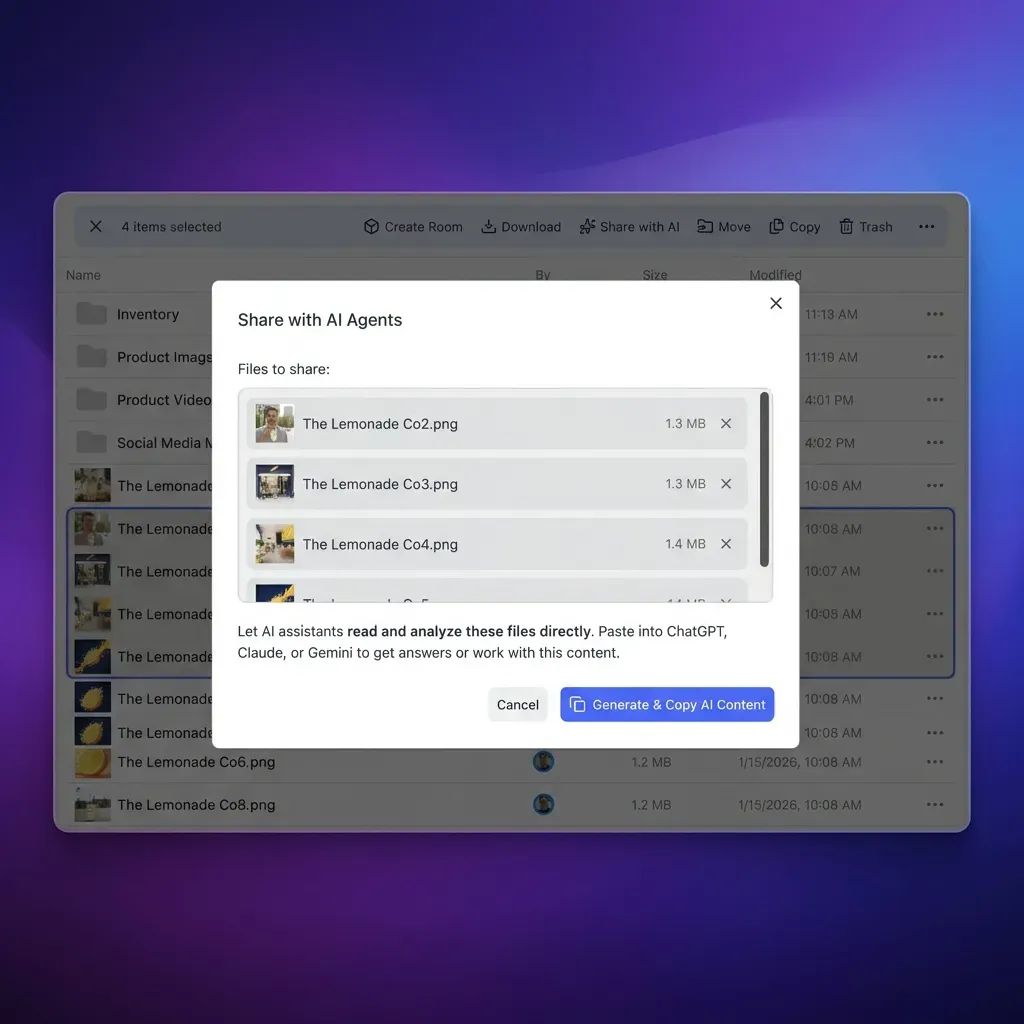


Keep your brand voice profiles in one workspace
Fastio gives your OpenClaw agent persistent storage, semantic search across voice guides once Intelligence is enabled, and MCP access from any session.
2. Scout Competitive Voice Monitoring
Brand voice does not exist in isolation. When a competitor pivots from "enterprise-grade platform" messaging to "developer-first toolkit" positioning, your brand needs to respond. If you miss the shift, you risk either echoing language that is now associated with a competitor or missing a clear opportunity to differentiate.
Scout monitors competitor websites on a daily or weekly schedule using the Browser skill. It filters noise like cookie banner updates and cache timestamp changes, focusing only on meaningful content modifications. Every Monday, Scout delivers a weekly intelligence brief covering four categories: new features, pricing experiments, positioning language shifts, and job postings with strategic interpretation.
The positioning language component is what matters most for brand voice work. Scout tracks how competitors describe themselves, which terms they emphasize, and when their messaging changes direction.
Using Scout for brand voice monitoring:
- Point Scout at your top 3 to 5 competitors' marketing pages and blog feeds
- Configure weekly monitoring with a focus on positioning language
- Review Monday briefs for language shifts that overlap with or contradict your current brand voice
- Feed competitor intelligence back into your Content Forge workflow to update forbidden phrases or adjust voice emphasis
Scout does not generate content. It provides the competitive context your brand voice needs to stay differentiated. Pair it with the Brand Voice Writer pipeline from Workflow 1 for a closed loop: Scout detects a competitor's messaging shift, you update your voice guide to avoid overlap or capitalize on a gap, and Content Forge applies the updated guidelines to every new piece of content going forward.
3. Social Poster Multi-Platform Tone Adaptation
Platform adaptation is where brand voice consistency breaks down most visibly. A LinkedIn thought leadership post and an X thread need different formats, lengths, and levels of formality, but they still need to sound like the same brand. Most teams solve this by rewriting content from scratch for each platform, which introduces voice drift with every rewrite.
Social Poster takes a single master post and reformats it into seven platform-specific variations. The skill applies platform constraints automatically: character limits for X, professional formatting and longer-form structure for LinkedIn, visual-first caption framing for Instagram. It schedules posts at optimal times based on historical engagement data from your accounts.
What makes this a brand voice workflow, not a scheduling tool:
The master post carries your brand's tone and vocabulary, established through your Brand Voice Writer profile. Social Poster changes length, structure, and formality level for each platform without changing the underlying voice. Every variation derives from the same voiced source rather than being written independently.
Setup steps:
- Generate a master post using Content Forge with your brand voice profile active
- Pass the master post to Social Poster
- Social Poster creates seven platform-specific variations
- Review variations to confirm voice consistency across formats
- Schedule or publish across channels
For teams already running the Brand Voice Writer to Content Forge pipeline, Social Poster adds the distribution layer. Content Forge generates voiced content, and Social Poster adapts it across channels without losing what makes it recognizably yours. The result is consistent brand voice from a single content source, regardless of how many platforms you publish.
Building the Complete Brand Voice Monitoring Chain
The three workflows above handle individual stages of brand voice management. The real payoff comes from chaining them into a continuous loop where your agent handles voice from definition through distribution and back.
The complete chain:
- Define. Brand Voice Writer analyzes your best content and generates a voice guide
- Generate. Content Forge produces new content using the voice guide with configurable strictness
- Monitor. Scout watches competitors weekly for positioning language shifts
- Adapt. Social Poster reformats voiced content across seven platforms
- Iterate. Scout's Monday briefs feed back into your voice guide, Content Forge recalibrates, and the cycle repeats
This chain runs inside a single OpenClaw agent environment. The agent maintains context across skills, so the voice guide directly informs Content Forge outputs, Scout intelligence triggers voice guide updates, and Social Poster distributes the final content.
Voice Agents for Audio Brand Consistency
For teams operating voice channels like phone support or chatbot interactions, OpenClaw's voice agent pipeline extends brand consistency to audio. The general flow connects speech-to-text on the input side, OpenClaw processing in the middle, and text-to-speech on the output side.
Brand consistency in voice channels depends heavily on the TTS provider you choose. Providers like ElevenLabs and Play.ht offer voice cloning so your brand sounds the same whether a customer calls support, chats with a voice bot, or receives a voice note. Pair a cloned voice with your Content Forge voice profile, and the words your agent speaks match your brand's written tone while the voice itself matches your brand's sonic identity.
Persisting Voice Profiles Across Sessions
Every workflow above generates artifacts that need to survive between sessions: voice guides, forbidden phrase lists, competitor monitoring reports, and content performance data. Without persistent storage, your agent rebuilds context from scratch every time it starts.
Fastio provides persistent workspaces where your OpenClaw agent stores and retrieves brand voice assets through the MCP server. Upload your voice guide and content samples to a workspace, and your agent pulls them into any skill across sessions. Once Intelligence is enabled for the workspace, uploaded files are indexed for semantic search, so your agent can query "find the latest brand voice guide" or "what positioning changes did Scout flag last week" and get a cited answer from your own files.
Storage alternatives include local files (lost between sessions or agent restarts), cloud object storage like S3 (no semantic search, requires custom integration), and consumer cloud drives like Google Drive or Dropbox (limited API access for autonomous agents). Fastio combines persistent storage with semantic search once Intelligence is enabled and MCP-native access so your agent can read and write files without custom integration work.
A 14-day Business Trial is available to test workspaces (credit card required; see pricing). Set up your brand voice workspace at fast.io/storage-for-openclaw.
Sources
References used to verify factual claims in this guide.
-
Consistent brand presentation can increase revenue by up to 33%
-
Brand Voice Writer learns brand tone, vocabulary, and personality from content examples
-
Content Forge includes adjustable voice strictness controls and forbidden phrase definitions Scout delivers weekly intelligence briefs covering positioning language shifts Social Poster reformats a single master post into seven platform-specific variations
-
ElevenLabs and Play.ht offer voice cloning for brand consistency
Frequently Asked Questions
How does OpenClaw maintain brand voice consistency?
OpenClaw maintains brand voice through two complementary skills. Brand Voice Writer learns your tone, vocabulary, and personality from 15 to 20 examples of your best content, generating a reusable voice guide. Content Forge then uses that guide to produce all new content with a configurable strictness parameter ranging from 0.3 for creative flexibility to 1.0 for strict compliance. Forbidden phrase lists add another layer by automatically flagging or replacing terms your brand should never use.
What is the Brand Voice Writer skill in OpenClaw?
Brand Voice Writer is a ClawHub skill that analyzes examples of your best content and generates a structured brand voice guide capturing your tone, vocabulary preferences, sentence patterns, and personality markers. The guide persists across sessions, so you define your voice once and reference it from any downstream content generation skill. It is designed for teams with multiple writers or agents that need consistent output.
Can OpenClaw monitor brand voice across platforms?
Yes, through a combination of skills. Social Poster adapts a single master post into seven platform-specific variations while preserving your core voice characteristics. Scout monitors competitor websites for positioning language shifts that might affect your brand differentiation. Together, these skills create a monitoring and adaptation loop that keeps your voice consistent across every channel you publish.
How do I store brand voice profiles between OpenClaw sessions?
Brand voice profiles, forbidden phrase lists, and competitor monitoring reports need persistent storage that your agent can access across sessions. Fastio workspaces provide MCP-native storage with semantic search once Intelligence is enabled for the workspace. Upload your voice guide to a workspace, and your agent retrieves it at the start of any session. Teams can start with a 14-day Business Trial (credit card required; see /pricing/).
What is the difference between Brand Voice Writer and Content Forge?
Brand Voice Writer handles voice definition by analyzing your content samples and generating a structured voice guide. Content Forge handles voice application by producing new content that follows that guide. Brand Voice Writer is the skill that learns how you write, and Content Forge is the skill that applies those lessons to every new piece of content. Most teams use both together in a pipeline.
Related Resources

Keep your brand voice profiles in one workspace
Fastio gives your OpenClaw agent persistent storage, semantic search across voice guides once Intelligence is enabled, and MCP access from any session.