How to Use Claude AI for Marketing: Campaigns, Content, and Automation
Eighty percent of marketing teams feel pressure to adopt AI, but only 6% have embedded it into actual workflows. Claude Cowork closes that gap by running multi-step marketing tasks directly on your desktop, from competitive research with parallel sub-agents to scheduled weekly performance reports. This guide walks through the specific workflows that make Claude practical for campaign coordination, content production, and reporting automation.


The 6% Problem in Marketing AI Adoption
Supermetrics surveyed over 3,000 marketers for their 2026 Marketing Data Report and found that 80% feel pressure to adopt AI, but only 6% have fully embedded it into their workflows. The remaining 74% use AI for isolated tasks like drafting copy or brainstorming headlines, then switch back to manual processes for everything else.
The bottleneck is not the AI itself. It is the gap between asking a chatbot a question and running an end-to-end workflow that touches files, data sources, and deliverables. Most marketing AI tools stop at text generation. They produce a draft, then hand you back to your spreadsheet, your slide deck, and your reporting dashboard to finish the job yourself.
Claude Cowork is Anthropic's answer to that gap. Instead of running in a browser tab, Cowork operates as a desktop agent that reads your local files, connects to tools like Google Ads, Slack, and HubSpot, and produces finished deliverables: formatted spreadsheets, slide decks, briefing documents, and campaign plans. You describe the outcome you want, and Cowork handles the extract-compile-reformat work in between.
That distinction matters for marketing teams because the actual time sink is rarely "write me a headline." It is pulling last week's ad spend from three platforms, normalizing it into a single sheet, calculating pacing against budget, and formatting it for a stakeholder meeting. Cowork automates that entire chain.

Related guides
- Best OpenClaw Skills for AI Affiliate Marketing Content AutomationNearly 80% of affiliate marketers now use AI for content creation, but most tools handle only one step of the pipeline....
- Top 7 OpenClaw Skills for Marketing AutomationMarketing automation often just means scheduling posts. OpenClaw skills let AI agents do more: they run campaigns,...
- How to Build Claude Cowork Client Portals for AI AutomationA Claude Cowork client portal gives agencies a branded staging area for their autonomous agents. The agents securely...
- Claude Cowork Features, from File Access to Scheduled TasksA Growth Unhinged survey found that 32% of GTM operators now use Cowork as their primary Claude product, matching both...
- How to Create a Claude Cowork Shared Workspace for TeamsA Claude Cowork Shared Workspace lets teams and AI agents manage files together in one place. The standard Claude app...
- How to Integrate MCP with Claude - Complete Setup GuideClaude MCP integration connects Anthropic's Claude AI to external tools and data sources through the Model Context...
More on this subject: Claude and Claude Code (278 guides)
How to Set Up Claude Cowork for Marketing Workflows
Open the Claude desktop app and switch to the Cowork tab. The first step is building your context architecture, the set of files, folders, and connected tools that Cowork references during execution. For marketing teams, this typically includes:
- Brand guidelines document (voice, tone, approved terminology)
- Campaign performance exports from Google Ads, Meta Ads, or your analytics platform
- Content inventory or editorial calendar
- Competitor tracking documents
- CRM data exports from HubSpot, Salesforce, or similar
Upload these files directly or point Cowork at a local folder. You can also connect external tools through Cowork's integrations with Slack, Gmail, Google Workspace, and Notion.
A good rule for deciding between Claude's chat mode and Cowork: use chat for quick questions, brainstorms, and gut checks. Use Cowork when the task produces a deliverable someone else will open, touches multiple files or data sources, or should run on a recurring schedule.
Anthropic's own best practices guide recommends a five-ingredient test for Cowork tasks. The task should involve multiple inputs, produce a file output, recur on a schedule, have quality standards you can recognize quickly, and contain a boring middle section where the real time gets burned. Weekly performance reports, competitive briefings, and campaign planning documents all pass that test.
Before starting a complex workflow, prompt Cowork to confirm alignment: "Before we begin, repeat my ask back to me so we're aligned, then ask me as many clarifying questions as you have." This prevents wasted runs on misunderstood briefs.
Structuring Your Project Memory
Cowork maintains persistent project memory across sessions. Create a dedicated project for each major marketing function: one for competitive intelligence, one for campaign reporting, one for content production. Each project retains folder context, prior task history, and your preferred output formats.
This matters because the first run of any workflow takes the longest. Cowork needs to learn your brand voice, your reporting format, and your stakeholder preferences. Subsequent runs in the same project pick up where the last one left off. Reports that used to take three or four hours come back in minutes once the project context is established.
Six Marketing Workflows That Actually Work in Cowork
Cowork ships with a Marketing plugin that includes six ready-made workflows: Brand Review, Campaign Plan, Email Sequence, Performance Report, Competitive Brief, and Draft Content. You can use these as starting points and customize them with your own skills, which are reusable markdown instruction sets that define how Cowork should handle a specific task type.
Here are the workflows marketing teams are getting the most value from, based on documented use cases from practitioners. Each one follows the same pattern: define your inputs, set your output format, and let Cowork handle the middle. Start with a single workflow, run it for two weeks, and refine before adding more.
Competitive Intelligence with Sub-Agents
This is where Cowork's architecture gives it an edge over standard AI chat. When you ask Cowork to research five competitors, it can spawn parallel sub-agents, each investigating one company simultaneously. One agent pulls pricing changes, another tracks product launches, a third monitors messaging shifts, and they all report back into a single synthesized briefing document.
The output is a competitive battle card or briefing deck, not a chat response you need to copy-paste into a document. A typical prompt looks like: "Research [Competitor A], [Competitor B], and [Competitor C]. For each, pull their current pricing, recent product announcements from the last 90 days, and positioning changes. Synthesize into a battle card document with a comparison table."
Teams running this workflow weekly report that it replaces what used to be a half-day research task handled by a junior analyst.
Scheduled Performance Reporting
The most immediately useful Cowork feature for marketing ops is scheduled tasks. You can set up a workflow with /schedule to run at a fixed cadence: "Every Monday at 9am, pull last week's campaign data and generate a performance summary."
One documented example from a marketing ops manager shows a daily funnel briefing running at 10:30 AM on weekdays. It pulls conversion rates across segments, flags any that need attention, and delivers the summary before the morning standup. The entire workflow, which previously required 30 minutes of manual data pulling, runs without human input.
For weekly reporting, connect Cowork to Google Search Console and your ad platforms. It reconciles data into a single spreadsheet with 7-day versus prior-7-day comparisons, country-level breakdowns, and flags for statistically meaningful movement. A marketing manager who documented this workflow said it cut a 30-minute weekly task down to a 5-minute review.
Campaign Brief Generation
Feed Cowork your campaign objectives, target audience data, budget parameters, and past performance benchmarks. It produces a structured campaign brief with channel recommendations, audience segmentation, messaging frameworks, and a timeline. The output is a formatted document or presentation, not a text response.
The practical advantage is speed on iteration. When a stakeholder wants to see "what if we shifted 20% of budget from paid social to email," you re-run the brief with updated parameters instead of rebuilding the document manually.
Content Calendar and Production
Cowork can chain content workflows end to end. Start with a keyword research input or a list of topics from your editorial calendar. Cowork generates outlines, drafts, and formatted posts across channels. One practitioner documented a workflow that pulls Google Search Console data and a content inventory, then recommends which pages to create, refresh, or consolidate based on performance trends.
For social media specifically, Cowork drafts posts from meeting transcripts, blog summaries, or product announcements, then formats them for each platform's requirements. The output maintains voice consistency because it references your brand guidelines document throughout.
Email Sequence Creation
Personalized emails generate 139% higher click-through rates than generic sends, according to Campaign Monitor research. Cowork builds email sequences by incorporating real user data and segmentation attributes from your CRM exports. You provide the sequence goal (onboarding, re-engagement, upsell), audience segment, and brand voice document, and Cowork produces a multi-email sequence with subject lines, body copy, and send timing recommendations.
The key difference from using chat-based AI for email: Cowork outputs the sequence as a formatted document or spreadsheet ready for import into your email platform, not as a conversation you need to reformat.
Budget Pacing Dashboard
Connect Cowork to your ad platform exports and it builds a pacing dashboard as a spreadsheet: daily spend, running totals, pace against monthly budget, projected end-of-month spend, and variance alerts. Schedule it to run daily and you catch overspend before it becomes a problem.
This workflow replaces the manual export-copy-paste routine that most marketing teams still run in Google Sheets. Cowork pulls the data, calculates the metrics, and updates the spreadsheet automatically.


Store and share your Cowork marketing deliverables in one workspace
An intelligent workspace with built-in AI search. Upload competitive briefs, campaign reports, and content drafts, then query them in natural language. Monthly plans start with a free trial of up to 14 days.
Where Cowork Fits in Your Existing Marketing Stack
Cowork is not a replacement for your marketing automation platform, your CRM, or your analytics suite. It sits on top of them as an orchestration layer that reads from and writes to your existing tools.
Most marketing teams already use some combination of Google Analytics, a CRM like HubSpot or Salesforce, an email platform like Klaviyo or Mailchimp, and a project management tool like Asana or Notion. Cowork connects to these through its integrations and connector ecosystem, which supports over 400 data sources.
The practical positioning: your marketing automation platform handles execution (sending emails, serving ads, triggering workflows based on user behavior). Cowork handles preparation and analysis (building the briefs, generating the reports, synthesizing the competitive intelligence that informs your next campaign).
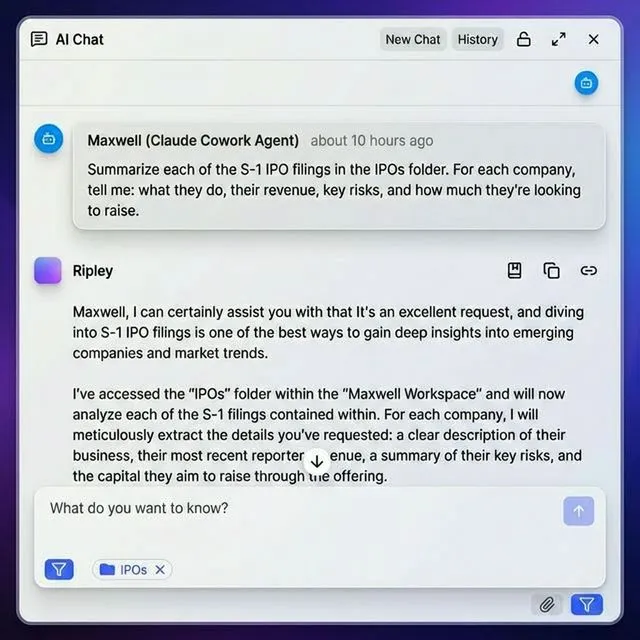
For teams that need persistent file storage and collaboration on the deliverables Cowork produces, Fast.io provides an intelligent workspace where both humans and AI agents can work on the same files. Cowork generates a competitive briefing deck, you upload it to a Fast.io workspace, and the team reviews it with built-in AI search and summarization through Intelligence Mode. Plans include storage, monthly AI credits, and multiple workspaces, and monthly plans start with a trial of up to 14 days. Fast.io also exposes an MCP server so AI agents can read, write, and share files programmatically.
Other options for storing marketing deliverables include Google Drive for teams already embedded in Google Workspace, Dropbox for simple file sharing, or S3 for teams with engineering support who want raw cloud storage. Fast.io's advantage is the intelligence layer: files are automatically indexed for semantic search and AI-powered Q&A once Intelligence Mode is enabled, which means your competitive briefs and campaign reports become queryable knowledge, not just stored documents.
How to Build Reusable Marketing Skills
Skills are Cowork's mechanism for turning one-off workflows into repeatable processes. A skill is a markdown file with structured instructions that tells Cowork exactly how to handle a specific task type: what inputs to expect, what format to use, what quality checks to run, and what the output should look like.
For marketing teams, useful skills include:
- Weekly performance report: Defines which metrics to pull, what comparisons to make, how to format the output spreadsheet, and what thresholds trigger an alert flag
- Competitive brief: Specifies which competitors to track, what dimensions to compare (pricing, positioning, features, recent announcements), and the battle card template
- Content audit: Lists the data sources to check (Search Console, content inventory, analytics), the criteria for recommending create/refresh/consolidate, and the output format
- Campaign post-mortem: Defines the performance data to pull, the questions to answer (what worked, what did not, what to change), and the stakeholder-ready summary format
Once you build a skill, you can schedule it to run on a cadence or trigger it manually. The skill ensures consistent output quality across team members and across runs. A junior marketer using a well-built competitive brief skill will produce the same caliber of output as the senior strategist who wrote the skill's instructions.
Skills also compound over time. Start with a simple version, review the output, and refine the skill based on what you want done differently. After three or four iterations, most marketing skills produce output that needs minimal human editing.
Sharing Skills Across Your Team
Skills are just markdown files, which makes them easy to share. Store them in a shared folder, a Git repository, or a workspace that your whole marketing team can access. When one team member builds a skill that produces great competitive briefs, the entire team benefits immediately.
This is where a shared workspace like Fast.io adds value beyond simple file storage. Upload your marketing skills library to a Fast.io workspace, enable Intelligence Mode, and team members can search for the right skill by describing what they need in natural language rather than browsing folder structures.
Practical Limits and What to Keep Human
Cowork is strong at structured, repeatable tasks where the inputs and desired outputs are well defined. It struggles with work that requires subjective judgment, brand intuition, or stakeholder politics.
Keep these tasks human-driven:
- Brand strategy decisions: Cowork can synthesize competitive data, but the strategic response (how to position against a competitor's move) requires human judgment about brand identity and market dynamics
- Creative direction: Use Cowork to draft options, but creative selection, the choice between three headline approaches or two visual directions, stays with a human
- Stakeholder communication: Cowork can build the deck, but presenting it, reading the room, and adjusting the narrative in real time is a human skill
- Crisis response: Speed matters, but so does tone sensitivity and institutional knowledge. Use Cowork to draft holding statements, then have a senior team member review before anything goes out
Also watch for data quality issues. Cowork is only as good as the data you feed it. Dirty CRM exports, incomplete analytics data, or outdated competitor information will produce misleading reports. Build data validation checks into your skills: flag when a data source is missing, when numbers fall outside expected ranges, or when the reporting period does not match expectations.
Marketing automation delivers $5.44 in returns for every $1 spent over three years, according to Gartner research. But nearly all of that return comes from teams who invested time building their context architecture, their skills library, and their data connections before running their first automated workflow. The teams that skip setup and jump straight to "write me a blog post" land back in the 6% gap.
Sources
References used to verify factual claims in this guide.
-
80% of marketers feel pressure to adopt AI, but only 6% have fully embedded it into their workflows
-
Marketing automation delivers $5.44 per $1 spent over three years
-
Personalized emails generate 139% higher click-through rates
Frequently Asked Questions
Can Claude AI help with marketing?
Claude handles a wide range of marketing tasks including competitive research, content drafting, campaign planning, performance reporting, and email sequence creation. Claude Cowork extends this by running multi-step workflows autonomously on your desktop, producing finished deliverables like spreadsheets, presentations, and formatted reports rather than just text responses.
How do I automate marketing reports with Claude Cowork?
Set up a scheduled task in Cowork using /schedule with your desired cadence, such as 'Every Monday at 9am, pull last week's campaign data from Google Ads and Search Console, calculate week-over-week changes, and generate a formatted spreadsheet with alerts for metrics outside normal ranges.' Cowork connects to your data sources, runs the analysis, and produces the report automatically. The first run requires setting up your project context and data connections, but subsequent runs execute without manual input.
Is Claude good for content marketing?
Claude is strong at content research, outline generation, draft creation, and content auditing. For content marketing specifically, Cowork can chain workflows end to end: analyze your Search Console data, identify content gaps, generate drafts that reference your brand guidelines, and format outputs for your CMS. The key is providing good context (brand voice documents, audience data, performance history) so outputs match your standards. Plan on editing and reviewing AI-generated content before publishing.
Can Claude Cowork create marketing presentations?
Cowork produces slide decks, HTML presentations with charts, and formatted briefing documents. You provide the data sources (campaign performance exports, competitive research, brand guidelines) and describe the presentation structure you want. Cowork assembles the content, applies formatting, and outputs a finished file. For recurring presentations like monthly business reviews, build a skill that defines the template, data sources, and formatting rules, then schedule it to run before each meeting.
What is the difference between Claude chat and Claude Cowork for marketing?
Claude chat is best for quick questions, brainstorming, and single-turn tasks like writing a headline or explaining a concept. Cowork is built for multi-step tasks that produce deliverables: competitive briefs that pull from multiple sources, campaign reports that connect to ad platforms, or content audits that analyze your entire inventory. If the task touches multiple files, produces an output someone else will open, or should run on a schedule, use Cowork.
How much does Claude Cowork cost for marketing teams?
Claude Cowork is available on all paid Claude plans through the desktop app. Anthropic offers individual Pro plans and team-level plans with shared billing and admin controls. Download the Claude desktop app from claude.com/download to access Cowork. For storing and sharing the deliverables Cowork produces, Fast.io plans include storage, monthly AI credits, and multiple workspaces, and monthly plans start with a free trial of up to 14 days (credit card required).
Related Resources

Store and share your Cowork marketing deliverables in one workspace
An intelligent workspace with built-in AI search. Upload competitive briefs, campaign reports, and content drafts, then query them in natural language. Monthly plans start with a free trial of up to 14 days.