Best OpenClaw Workflows for AI Interior Design and Room Rendering
AI rendering runs 100 to 500 times faster than traditional methods, yet only 20% of design professionals have fully integrated it into daily work. OpenClaw connects to ten image generation providers and lets you chain room photos, style prompts, and rendering models into repeatable agent pipelines. These five workflows cover turning interior photos into finished renders using ComfyUI, Recraft, fal.ai, and GPT Image 2, plus managing design assets at scale.


Why Standalone Rendering Apps Fall Short
64% of architecture and design professionals were experimenting with AI rendering tools in early 2026. Only 20% had fully integrated those tools into production workflows, according to Instant Interior AI's industry report. That 44-point gap between trying AI and shipping work through it comes down to workflow friction, not model quality.
Standalone apps like RoomGPT, InteriorAI, and HomeDesignsAI handle individual rendering steps well. Upload a room photo, pick a style, get a render back in 15 to 25 seconds. The problem shows up on real projects. You need to iterate through five styles on the same room, keep materials consistent across twelve rooms in a property, or generate concept boards that match a client's reference photos. Each standalone app becomes a silo. You download renders, re-upload them to the next tool, rename files manually, and lose track of which version the client approved.
OpenClaw changes the equation by acting as an agent layer between you and the rendering providers. It connects to ten image generation services, including OpenAI, Google Gemini, fal.ai, Recraft, ComfyUI, and xAI. Instead of switching between browser tabs, you describe what you need in a conversation. Your OpenClaw agent picks the right provider, passes room photos through the pipeline, stores the results, and remembers the workflow for next time.
The virtual interior design AI market reached $2.58 billion in 2026, growing at 30.1% year over year. As that market matures, the competitive edge shifts from having access to AI rendering to having a repeatable pipeline that delivers consistent results. The five workflows below show how to build those pipelines using OpenClaw's image generation tools.

Related guides
- How to Build Claude Cowork WorkflowsAgentic workflows handle repetitive data processing, but setting them up requires structure. Learn how to build Claude...
- Best Storage Solutions for Base44 WorkflowsAccording to the Flexera 2025 State of the Cloud Report, 84% of organizations identify managing cloud spend and...
- Best OpenClaw Workflows for AI Sketch-to-Image and Concept RenderingOpenClaw's image_generate tool routes sketch inputs through providers like OpenAI gpt-image-2, fal Krea 2, and Gemini,...
- Best OpenClaw Workflows for AI Image Generation PipelinesOpenClaw 2026.4.5 turned agents into image producers. The native image_generate tool supports 10 providers out of the...
- 8 OpenClaw Workflows for AI Batch Image Generation at ScaleAI platforms produce over 34 million images per day, but most batch generation guides only cover single-tool setups....
- Best OpenClaw Workflows for AI Headshot GenerationOpenClaw turns AI headshot generation into a repeatable, chat-driven workflow. Dedicated skills like...
More on this subject: OpenClaw Workflows and Integrations (69 guides)
Room Photo Redesign with ComfyUI
ComfyUI gives you the most control over the rendering process. Unlike API-only providers that accept a prompt and return a single result, ComfyUI runs a full node graph where you wire together models, preprocessors, samplers, and post-processors. OpenClaw's bundled ComfyUI plugin is entirely workflow-driven: you design your pipeline in ComfyUI's visual editor, export the workflow JSON, and point OpenClaw at it. The plugin preserves the node structure exactly as you built it rather than mapping generic controls onto your graph.
For room redesign, the typical pipeline starts with an image-to-image node that receives the existing room photo. A ControlNet depth or edge detector preserves the room's geometry, walls, and window positions so the model changes the decor without warping the architecture. A style prompt describes the target aesthetic, a sampler controls generation quality, and a hi-res upscaler sharpens the final output. OpenClaw handles passing the room photo to the designated input node and pulling the render from the output node automatically.
The plugin runs in two modes. Local mode connects to a ComfyUI instance on your machine or network. Cloud mode routes to Comfy Cloud's hosted infrastructure, which is useful when you need GPU power without managing hardware. Both modes use the same workflow JSON, so you can prototype locally and deploy to the cloud without rebuilding anything.
Where this workflow stands out is repeatability. Save one workflow for "modern minimalist" and another for "mid-century warm," then ask your OpenClaw agent to run both on every room photo in a folder. The agent chains the generation requests, waits for each result, and organizes the outputs. Over time, you build a library of tested workflows that produce predictable results for any style direction.
Best for: Complex multi-step rendering, teams already using ComfyUI, and projects that need precise control over geometry preservation.
Limitation: Requires familiarity with ComfyUI's node editor to design the initial workflow.
Rapid Style Iteration with Recraft
When a client says "show me this living room in five different styles," you need speed over pipeline complexity. The Recraft skill for OpenClaw handles exactly this. Install it with the /recraft command in any OpenClaw conversation, paste your Recraft API key, and you can generate both raster renders and vector illustrations from the same interface.
Recraft offers several models, including Recraft V4, Flux, Ideogram, and GPT Image, each tuned for different output characteristics. For interior design, the standout features are prompt-based editing and batch processing. Describe a style change ("swap the hardwood floor for polished concrete, keep the furniture arrangement"), and Recraft generates the variation. Queue five style prompts in sequence and compare the results without leaving the conversation.
The vector output mode fills a gap that most rendering tools ignore. Generate a vector floor plan or furniture layout, export it as SVG, and drop it into a client deck without worrying about resolution. Background removal and upscaling are built into the same skill, so you can clean up a render or sharpen details without switching to a separate tool.
For a typical client meeting, the workflow chains naturally: start with a room photo, generate three style variations in raster, pick the preferred direction, then produce a vector layout showing furniture placement and a high-resolution final render for the presentation. All outputs come from one conversation thread, and your agent tracks each iteration.
Best for: Fast client-facing style comparisons, material swaps, and projects that need both raster renders and vector deliverables.
Limitation: Less granular control than ComfyUI. Better suited for style-level changes than architectural modifications.


Store and share design renders from one workspace
Generous storage with auto-indexing. Upload renders, search by visual content, and hand off project folders to clients through branded portals.
Consistent Multi-Room Rendering with fal.ai FLUX
Rendering one room is straightforward. Rendering twelve rooms in a property so they share a consistent design language is where most tools break down. The fal.ai provider, running FLUX models through OpenClaw, accepts up to 14 reference images per request. That is more than any other provider OpenClaw supports, and it changes what you can communicate to the model in a single call.
The workflow for a whole-property render starts with a style reference set: curated images that define the target aesthetic. These might include a color palette swatch, photos of preferred material finishes (marble, oak, brass), sample furniture pieces, and one "hero" render that captures the overall feel. Upload this reference set once, then pass each room photo through the same FLUX pipeline with those shared references. Because the model sees the full style context with every generation, it produces renders where the kitchen tile palette complements the bathroom finishes and the bedroom furniture follows the same design vocabulary.
OpenClaw's image_generate tool handles provider routing. Set fal as the default image generation provider, and all rendering requests route to FLUX without specifying the model each time. For a twelve-room property, ask the agent to process rooms one by one, saving each finished render to a project folder as it completes. The agent handles the sequencing while you review results as they arrive.
Consistency across rooms is the main selling point of this workflow. Individual room quality may not surpass a hand-tuned ComfyUI pipeline, but the cross-room coherence from 14 shared references is hard to replicate with providers that accept fewer inputs.
Best for: Multi-room properties, real estate developments, hospitality projects, and any work where cross-room design consistency matters more than per-room customization.
Limitation: Output quality depends directly on reference image quality. Start with high-resolution, well-lit reference photos.
Concept Art and Virtual Staging with GPT Image 2
GPT Image 2 from OpenAI works through OpenClaw's built-in image_generate tool with no additional skill installation. Configure your OpenAI API key, and rendering is available immediately. The model supports up to five reference images and generates at resolutions up to 3840x2160, covering standard client presentation formats.
A practical example: a real estate photographer needs to stage an empty two-bedroom apartment for a listing. Upload one wide-angle photo of the vacant living room, then prompt the agent with "modern Scandinavian staging, light oak dining table for four, gray linen sofa facing the window, woven rug, two pendant lights over the table." GPT Image 2 returns a staged render in under 10 seconds. Adjust the prompt ("swap the gray sofa for a camel leather sectional") and regenerate. Three prompt iterations typically cost less than $0.15 in API calls, compared to $2,000 or more for a single physical staging session.
One constraint worth noting: GPT Image 2 accepts a maximum of five reference images per request. For a single room that is usually enough, but whole-property consistency across a dozen rooms benefits from fal.ai's 14-image capacity instead. Use GPT Image 2 for the initial concept phase when speed matters, then switch providers for the final production renders if cross-room coherence is a priority.
Client Concept Board Generation
For concept boards, the workflow is text-driven. Describe the room concept in specific terms ("scandinavian living room, white oak chevron floor, linen sectional sofa, brass pendant light cluster, floor-to-ceiling windows with sheer linen curtains"), and GPT Image 2 produces a photorealistic visualization. The model handles complex multi-element descriptions better than most diffusion-only alternatives because it brings language understanding into the image generation process.
The iteration loop is fast. Generate an initial concept, share it with the client for feedback, adjust the prompt based on their notes, and regenerate. The agent maintains the full conversation context, so each round builds on the last without re-explaining the design brief. Three rounds of prompt refinement typically land closer to the client's vision than a single highly detailed prompt.
Virtual Staging for Real Estate Listings
Upload an empty room photo as a reference image, describe the furniture and decor to place, and GPT Image 2 generates a staged version. AI staging through OpenClaw runs in seconds at the cost of an API call, replacing the furniture rental, delivery, and setup cycle that traditional physical staging requires for each listing.
You can chain both approaches in one conversation. Generate a concept board first, refine the style with the agent, then use the approved concept as a reference image when staging the actual property photos. This keeps the staging visually aligned with the design direction the client already approved.
Best for: Early-stage concept visualization, real estate staging, and clients who describe their vision in words rather than reference images.
Limitation: Five reference images handles most staging tasks but falls short of the cross-room consistency you get from fal.ai's 14-image capacity.
How to Choose a Provider and Manage Design Assets
Most interior design projects use more than one provider. A common flow starts with GPT Image 2 for quick concept exploration, moves to Recraft for style comparisons, then finishes with ComfyUI or fal.ai for production renders. OpenClaw lets you switch providers mid-conversation without reconfiguring anything.
Here is how each provider fits the design process:
- ComfyUI gives full pipeline control through custom node graphs. Best when your team has ComfyUI expertise and existing workflow templates. Runs locally or on Comfy Cloud.
- Recraft delivers fast style iteration with both raster and vector output. Start here when a client needs to compare multiple directions before committing.
- fal.ai FLUX handles the highest reference-image count at 14 per request. Choose it for whole-property renders where cross-room consistency matters.
- GPT Image 2 requires no extra setup and handles natural-language descriptions well. Best for concept art and virtual staging where text prompts drive the output.
As render volume grows, file management becomes the bottleneck, not generation speed. Standalone tools scatter outputs across download folders, and naming conventions break down after the third round of client revisions.
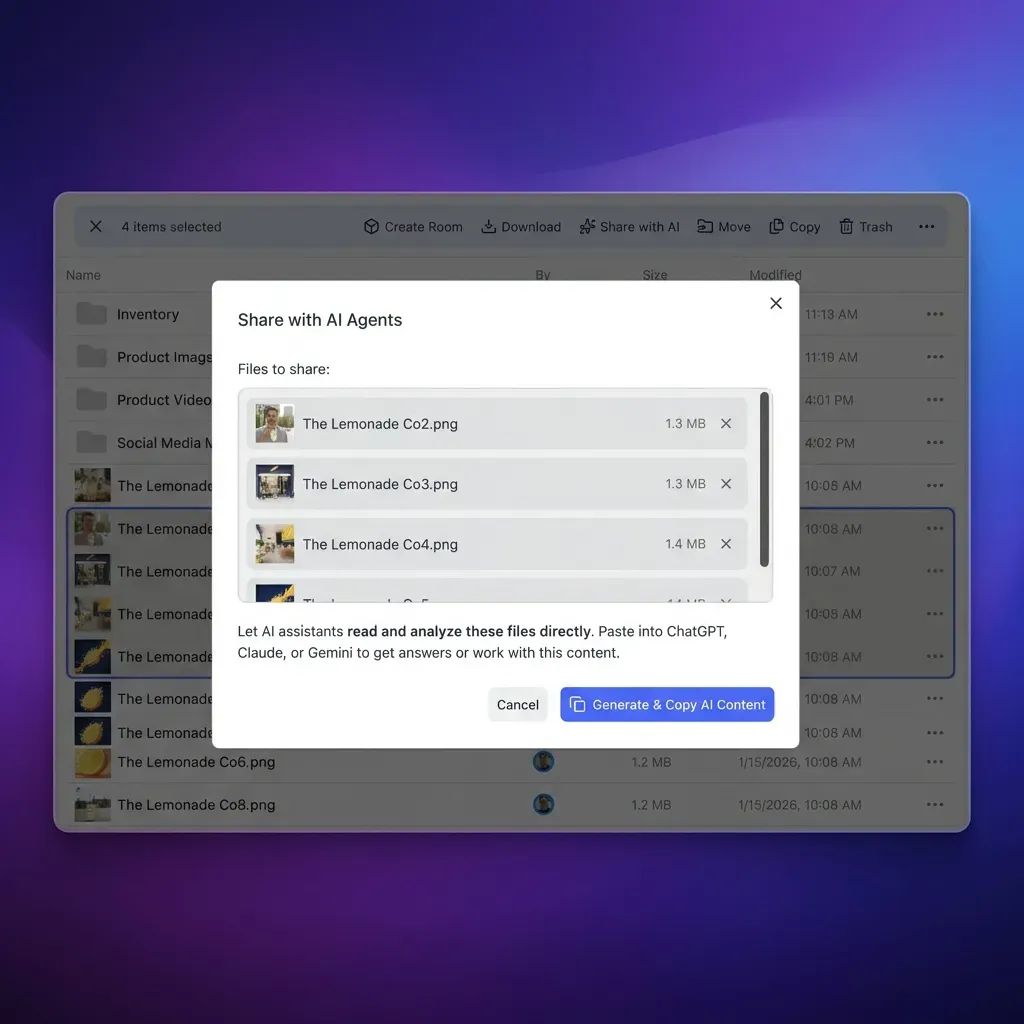
Fastio workspaces auto-index files through Intelligence Mode, so you can search renders by visual content rather than filename. Upload a batch of living room renders and find the right version later by searching "blue accent wall" or "brass fixtures" instead of scrolling through thumbnails. The Fastio MCP server connects directly to OpenClaw, allowing your agent to upload renders, organize them into project folders, and share specific versions through branded portals.
For client handoff, ownership transfer lets you build a complete project workspace with renders, mood boards, and material specs, then transfer the whole package to the client while keeping admin access for future revisions. Fastio offers a 14-day Business Trial, card required; see /pricing/.
Sources
References used to verify factual claims in this guide.
-
64% of architecture and design professionals were experimenting with AI tools in early 2026, while only 20% had fully integrated AI into their workflows AI rendering runs 100 to 500 times faster than traditional rendering methods
-
The virtual interior design AI market reached $2.58 billion in 2026, growing at 30.1% year over year
Frequently Asked Questions
Can AI redesign my room from a photo?
Yes. Most AI rendering providers accept a room photo as input and generate a redesigned version based on your style prompts. Through OpenClaw, you pass a room photo to providers like ComfyUI, fal.ai, or GPT Image 2 along with style instructions. ComfyUI preserves room geometry using depth detection while changing materials and furnishings. Output quality depends on the input photo's resolution and lighting.
What is the best AI interior design tool?
It depends on the task. For one-off room makeovers, standalone apps like RoomGPT and InteriorAI are quick and accessible. For repeatable workflows across multiple rooms or clients, an agent-based approach through OpenClaw gives more flexibility by connecting to ten image providers. You can switch between ComfyUI for detailed pipeline work and GPT Image 2 for fast concept generation without changing tools.
How do I use OpenClaw for interior design?
Set up OpenClaw with at least one image-capable provider by adding the provider's API key. For basic renders, ask the agent to generate room visualizations from text descriptions using GPT Image 2 or Recraft. For photo-based redesign, use providers that support reference images. ComfyUI offers the most control through custom workflow graphs, while fal.ai accepts up to 14 reference images for consistent multi-room projects.
Which OpenClaw image provider gives the best room renders?
ComfyUI with a tuned workflow produces the highest-quality renders because you control every step of the pipeline. GPT Image 2 generates strong results from text prompts alone with minimal setup. fal.ai FLUX is the best choice when you need visual consistency across multiple rooms, thanks to its 14-reference-image capacity. Recraft fills the gap when you need both raster renders and vector layouts from one tool.
Do I need a GPU to run AI rendering through OpenClaw?
Not for most workflows. API-based providers like OpenAI, fal.ai, and Recraft run on remote infrastructure, so your local machine only needs to run OpenClaw itself. ComfyUI in local mode does benefit from a GPU for faster generation. If you want ComfyUI's pipeline control without local hardware, Comfy Cloud mode offloads the computation while using the same workflow files.
Related Resources

Store and share design renders from one workspace
Generous storage with auto-indexing. Upload renders, search by visual content, and hand off project folders to clients through branded portals.