AI vs AGI vs ASI: What Changes for a Team Working With Agents
Today's AI, including the agents teams already run, does specific jobs well. AGI (artificial general intelligence) would match a capable person across most kinds of work. ASI (artificial superintelligence, or simply superintelligence) would exceed the best people in nearly every field. Only the first exists. This guide compares the three, separates AGI from agentic AI, explains the federal "Super Intelligence" term, and covers the controls a team needs for its agents regardless of the label.


AI, AGI and ASI in Plain Words
These three terms describe different levels of capability. Only one of them describes systems you can use today.
AI (artificial intelligence) is the broad field, and in everyday use it means the systems that exist now: chat assistants, coding agents, image generators, document classifiers and the agentic workflows built from them. Each one is trained or configured for particular kinds of work. Researchers call this narrow AI, because a system that writes code well can still fail at a task outside what it was built and tested for.
AGI (artificial general intelligence) describes a system that could learn and perform most intellectual tasks a capable person can, across fields, without being rebuilt for each one. There is no agreed definition and no agreed test, so a claim that a system has or has not reached AGI depends on which definition the speaker uses.
ASI (artificial superintelligence) describes a system that would exceed the best human experts in nearly every field at once, including science, engineering and strategy. ASI is also called superintelligence, and several AI companies now use that word to name their research goals. No such system exists today.
In short: AI is what teams deploy, AGI is a debated milestone, and ASI is a hypothetical stage beyond it. The practical questions a team faces now, such as which agent can open which folder and who reviews what it produces, belong to the first category.
Related guides
- Fastest AI in 2026: Speed Benchmarks Across Top ModelsCerebras now serves Llama 4 Scout at over 2,600 tokens per second, 38 times faster than closed models from OpenAI and...
- Most Powerful AI in 2026: 7 Frontier Models Ranked by CapabilitySix AI labs sit within 79 Elo points of each other on the Chatbot Arena leaderboard as of early 2026. This ranking...
- Best Agentic AI Platforms for Building Autonomous Systems in 2026Picking an agentic AI platform means choosing between orchestration frameworks, managed cloud runtimes, and full-stack...
- How to Build Agentic AI Workflow Automation for Complex TasksAgentic AI workflow automation uses autonomous AI agents to execute multi-step business processes with minimal human...
- Best AI Assistants for Business in 2026: 8 Tools We Actually Tested91% of Fortune 500 companies now run at least one generative AI project in production, yet most teams still struggle to...
- SI vs AI: What the Federal "Super Intelligence" Rename Means for Teams and ContractorsThis guide covers SI in its U.S. federal sense: "Super Intelligence", the term executive branch agencies use in place...
More on this subject: AI Agents: General Guides (172 guides)
AI vs AGI vs ASI: A Side-by-Side Comparison
The table compares the three terms on what exists, what is claimed, and what each would mean for a team that works with agents.
The agent a team runs today belongs in the first row, however well it performs on its tasks. The access questions in that row are the ones a team can act on now, and the last section of this guide covers them.
ASI vs AGI: Where the Line Sits
AGI and ASI are often listed as two stages, and the difference between them comes down to what each is measured against.
- AGI is measured against a capable person. The question is whether one system can handle the range of work a skilled professional can, including tasks it was not specifically trained for.
- ASI is measured against the best people in every field. The question is whether a system would outperform top experts across nearly all domains at once, not in one benchmark or one specialty.
Neither term has a fixed threshold. A system can beat expert scores on a particular exam and still fail at routine tasks outside it, which is why a high benchmark result on its own is not evidence of AGI or ASI. When a vendor or an article uses either word, three questions make the claim concrete: which tasks, measured how, and compared with whom.
Whether ASI would follow AGI, and how quickly, is disputed. This guide makes no prediction about either. It treats both as terms to understand when reading announcements, not as dates to plan around.
AGI vs Agentic AI
These two terms are easy to confuse because both suggest systems that act more independently, but they describe different properties.
Agentic AI describes how a system works. An agentic system takes a goal, plans steps, calls tools such as search, file storage or an API, checks the results and continues until the task is done or it needs a person. Agentic AI exists today: coding agents that open pull requests and workflows that process incoming documents are both examples. For how it differs from content-generating models, see agentic AI vs generative AI and AI agents vs agentic AI.
AGI describes how broad a system's ability is. It concerns whether one system can do most intellectual work a person can, regardless of whether it is connected to any tools.
The two properties are independent:
- A narrow system can be agentic. An agent that only reconciles invoices is narrow, and it still plans, uses tools and acts.
- A general system would not have to be agentic. A system with broad ability that only answers questions in a chat window, with no tools connected, would be general without acting on anything.
For a team, the difference is practical. Agentic AI is a deployment decision you make now: which tasks to hand to an agent, which systems it connects to, and what it is allowed to change. AGI is not a product you can buy or turn on. Types of AI agents covers the kinds of agents in use today.
Which Companies Say They Are Working Toward Superintelligence
As of October 2026, companies that name superintelligence as a goal in their organization names and announcements include:
- Meta formed Meta Superintelligence Labs in June 2025, placing its foundation model, product and FAIR research teams in one organization (CNBC). In an April 8, 2026 announcement of its Muse Spark model, Meta said the lab is building toward what it calls personal superintelligence (Meta).
- Microsoft announced the MAI Superintelligence Team within Microsoft AI on November 6, 2025. It describes its goal as humanist superintelligence: advanced AI capabilities designed to work in service of people (Microsoft AI).
- Safe Superintelligence Inc. (SSI) describes itself as a lab with one goal and one product: a safe superintelligence (SSI).
These are statements of intent. A team name or a mission statement does not mean a superintelligent system exists, and none is available today. Other companies and research groups also discuss superintelligence; this list covers three that have put the word in the name of a lab, team or company.
The Federal "Super Intelligence" Term Means Something Different
Since September 29, 2026, the U.S. federal government has used "Super Intelligence" in a separate sense. Executive Order 14434 directs executive branch agencies to use "Super Intelligence" and "SI" in place of "Artificial Intelligence" and "AI" in official correspondence, public communications, websites, reports, policy documents and other non-statutory documents.
The order defines SI as the technologies and systems covered by the existing statutory definition of artificial intelligence in 15 U.S.C. 9401(3). In a federal document, then, "SI" refers to the systems in the first row of the table above, the AI that exists today. It does not refer to ASI.
The spelling is a quick way to tell the two apart. The federal term is two capitalized words, "Super Intelligence", abbreviated SI. The labs' term is one word, superintelligence, usually abbreviated ASI. For what the order does and does not change, including what federal contractors may see, read SI vs AI.
What Teams Need Regardless of the Label
Whether a system is described as AI, AGI, ASI or SI, a team that lets agents work on its files needs the same four controls. Each one applies to the agents running today.
Scoped permissions. Give each agent the narrowest access its job needs: one workspace rather than the whole company drive, read-only access where it only reads, and folder-level access for outside parties. In a Fastio workspace, agents use the same five role levels as people (Owner, Admin, Member, Guest and View), and an agent is scoped to the workspace it joins, so it does not see files in other workspaces.
An audit trail. Keep a record of what each person and agent opened, changed and shared, so a reviewer can reconstruct what happened after a run. Fastio keeps a detailed activity log of file operations, share events and AI interactions in each workspace, along with version history for every file.
Files and context in one place. An agent can only use the documents it can reach, so when the files a task depends on are spread across inboxes, chat threads and personal drives, its output misses what it cannot see. Keep the source files in the same workspace the agent reads from and the team reviews in. A Fastio workspace holds the files both people and agents work on, and agents connect to it through the Fastio MCP server from Claude, ChatGPT, Codex and other MCP clients.
Human review of agent output. Decide in advance which outputs a person must check: anything sent to a client, anything that leaves the company, and anything that deletes or overwrites files. In Fastio, an agent can build a workspace and then transfer ownership to a person, so a named person is responsible for what is shared from it.
Agentic AI governance covers permissions, oversight triggers and review in more depth.
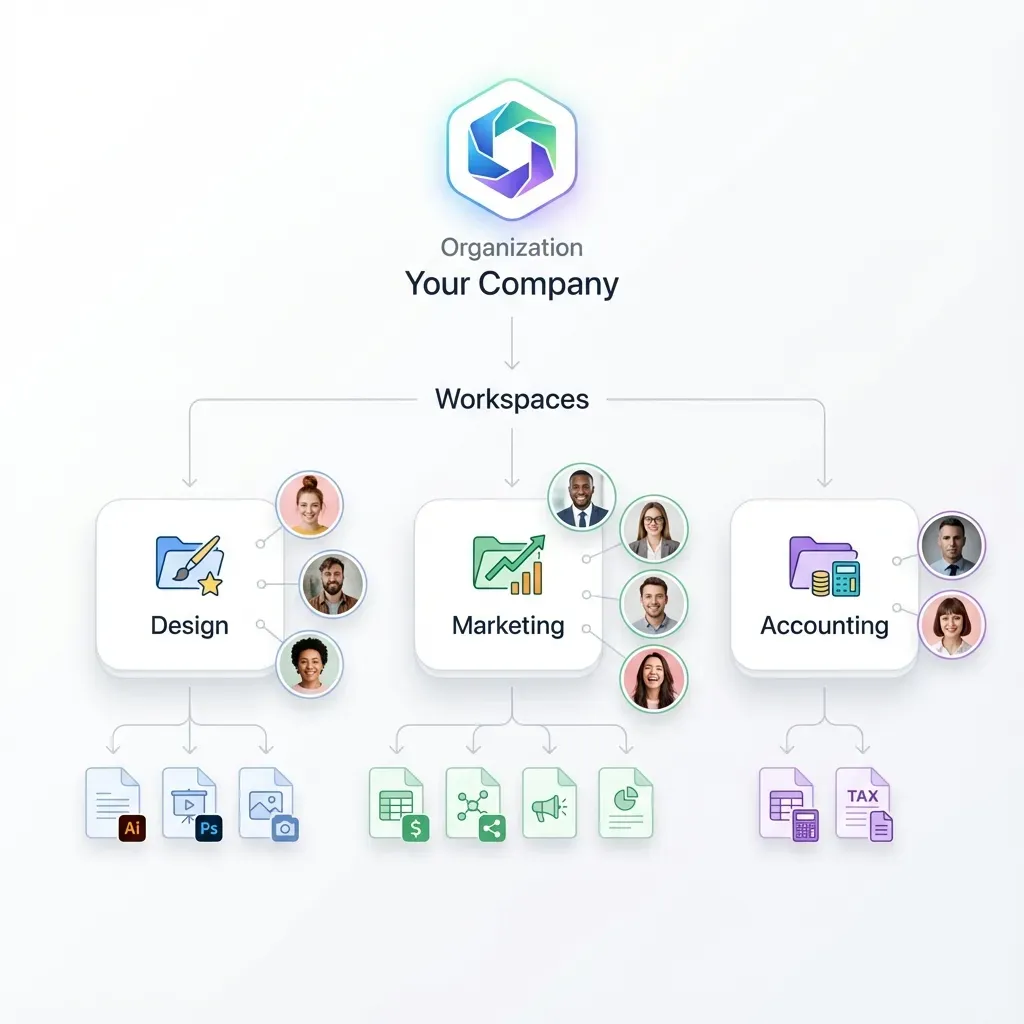


Give agents scoped access to your team's files
Fastio workspaces let people and agents work on the same files, with per-member roles, an activity log, and an MCP server for Claude, ChatGPT and Codex.
Sources
References used to verify factual claims in this guide.
-
Meta formed Meta Superintelligence Labs in June 2025, housing its foundation model, product and FAIR teams
-
Meta said on April 8, 2026 that Meta Superintelligence Labs is building toward personal superintelligence
-
Microsoft AI announced the MAI Superintelligence Team on November 6, 2025
-
Safe Superintelligence Inc. describes its one goal and one product as a safe superintelligence
-
Executive Order 14434 directs executive branch agencies to use Super Intelligence and SI in place of Artificial Intelligence and AI, and defines SI by reference to 15 U.S.C. 9401(3)
Frequently Asked Questions
What is the difference between AI, AGI and ASI?
AI is the broad field, and in everyday use it means the systems that exist today, such as chat assistants, coding agents and agentic workflows, each built for particular kinds of work. AGI (artificial general intelligence) describes a system that could perform most intellectual tasks a capable person can, across fields. ASI (artificial superintelligence) describes a system that would exceed the best human experts in nearly every field. Only the first exists. AGI and ASI have no agreed definitions or tests.
Is ASI the same as superintelligence?
Yes. ASI stands for artificial superintelligence, and most articles and companies shorten it to superintelligence. It is different from the U.S. federal term "Super Intelligence" (SI), which Executive Order 14434 uses for the same technologies the law already calls artificial intelligence.
Does AGI exist yet?
No system available as of October 2026 is generally accepted as AGI. Because there is no agreed definition or test, individual claims vary with the definition the speaker uses. A high score on one benchmark is not evidence of AGI, since a system can beat experts on an exam and still fail at routine tasks outside it.
What is the difference between AGI and agentic AI?
Agentic AI describes how a system works. It takes a goal, plans steps, uses tools and acts, and it exists today. AGI describes how broad a system's ability is. A narrow agent that only reconciles invoices is agentic but not general, and a general system with no tools connected would be general but not agentic. Agentic AI is a deployment decision a team makes now, while AGI is not a product a team can buy.
Which companies are working on superintelligence?
As of October 2026, Meta runs Meta Superintelligence Labs, formed in June 2025. Microsoft announced the MAI Superintelligence Team within Microsoft AI in November 2025. Safe Superintelligence Inc. describes itself as a lab with one goal, a safe superintelligence. These are stated goals. No superintelligent system exists today.
Is the government's SI the same as ASI?
No. Under Executive Order 14434, signed September 29, 2026, executive branch agencies use "Super Intelligence" and "SI" in place of "Artificial Intelligence" and "AI", and the order defines SI as the technologies covered by the existing statutory definition of artificial intelligence. Federal SI therefore refers to today's AI. ASI refers to a hypothetical system beyond human ability.
What controls do teams need for AI agents today?
Four controls apply to the agents teams run today. Scoped permissions limit each agent to the workspace and folders its job needs. An audit trail records what each person and agent opened, changed and shared. Keeping files and context in one place means agents work from the same source documents the team reviews. Human review means a person checks outputs before they reach a client or overwrite files. None of these depends on whether a system is called AI, AGI, ASI or SI.

Give agents scoped access to your team's files
Fastio workspaces let people and agents work on the same files, with per-member roles, an activity log, and an MCP server for Claude, ChatGPT and Codex.