Agentic AI vs Generative AI: Key Differences Explained
Generative AI creates content from prompts. Agentic AI takes goals, breaks them into steps, uses tools, and delivers results with minimal human oversight. This guide explains the practical differences between the two approaches, including the infrastructure requirements that most comparisons overlook, and helps you decide when to use each one.


Quick Comparison: Generative AI vs Agentic AI
Generative AI creates content from prompts. You provide instructions, the model produces text, images, code, or other media, and you decide what to do with the output. Agentic AI takes a goal, plans how to achieve it, calls tools, and works through multiple steps with minimal supervision. Both use large language models at their core, but they operate at different levels of autonomy.
Here is how they compare across six dimensions:
Autonomy
- Generative AI: Reactive. Responds to each prompt individually.
- Agentic AI: Proactive. Pursues goals across multiple steps without waiting for new instructions between each one.
Planning
- Generative AI: None. Produces a single output per request.
- Agentic AI: Breaks goals into subtasks, sequences them, and adjusts the plan when conditions change.
Tool use
- Generative AI: Limited. Can call tools when explicitly configured, but does not decide which tools to use independently.
- Agentic AI: Core capability. Selects and calls APIs, databases, file systems, and external services as needed.
Memory
- Generative AI: Stateless between sessions. Context is limited to the current conversation window.
- Agentic AI: Maintains working memory within a task and can persist information across sessions using external storage.
Human handoff
- Generative AI: Not applicable. Humans review each output individually.
- Agentic AI: Built in. Agents can escalate decisions, request approvals, or transfer completed work to a person.
Infrastructure needs
- Generative AI: API endpoint and prompt. Minimal infrastructure beyond the model itself.
- Agentic AI: Orchestration layer, persistent storage, tool registries, memory systems, and audit logging.
Most agentic systems use a generative model as their reasoning engine. The two are not competing technologies. They operate at different levels of the stack, and understanding where each one fits helps you build the right system for the job.
Related guides
- Agentic AI Design Patterns: Proven Patterns for Building Autonomous SystemsAgentic AI design patterns are reusable architectural templates for building autonomous AI systems that can plan, use...
- Agentic AI Use Cases: 12 Real-World Applications in 2026Agentic AI has moved from experimental pilots to production deployments across financial services, healthcare, and...
- How to Build an Agentic Invoice Processor using Fastio APIAn agentic invoice processor uses Fastio realtime events to detect new files, triggers an LLM to extract data, and...
- ExifTool Tutorial: A Practical Guide to Reading, Writing, and Batch Processing MetadataExifTool is a free, open-source command-line application for reading, writing, and editing metadata in image, audio,...
- How to Build an AI Agent Supervisor Pattern for Complex WorkflowsThe AI agent supervisor pattern provides a centralized management layer for coordinating multiple specialized worker...
- How to Implement the Reflection Pattern for Self-Correcting AgentsThe Reflection pattern lets AI agents review their own work, catch errors, and fix them without human help. By...
More on this subject: Agent Frameworks and Patterns (52 guides)
How Generative AI Works
Generative AI produces original content from a prompt. The content can be text, images, code, audio, or video, depending on the model. You describe what you want, the model generates it, and you decide what to do with the result.
This covers the large language models most teams already use. ChatGPT handles writing and analysis. GitHub Copilot suggests code completions. Midjourney and DALL-E produce images from text descriptions. Each follows the same pattern: one prompt goes in, one output comes back.
What generative AI does well:
- Drafts content faster than a person can type it
- Translates between languages, formats, and technical levels
- Summarizes long documents into key points
- Generates code from natural language descriptions
- Creates images and visual assets from text prompts
Where it stops: generative AI does not take action on your behalf. When ChatGPT writes an email, you still copy it into your email client and click send. When Copilot suggests a function, you still review it, accept it, and run the tests. The model does not know whether you used its output, and it will not follow up if you did not.
This is a design boundary, not a flaw. Generative AI is a tool, not a worker. It amplifies what you can accomplish in a single step, but the sequencing, decision-making, and execution stay with you.
The stateless nature of generative AI also means each interaction starts fresh. Ask ChatGPT to write a report today, then ask it to revise the report tomorrow, and it has no memory of the first conversation unless you paste the context back in. This works well for one-off tasks but breaks down for anything that spans multiple steps or sessions.
What Makes AI Agentic
Agentic AI describes systems that receive a goal and work toward it across multiple steps, using tools and adapting their approach along the way. Instead of "write me an email," the instruction looks more like "reach out to every lead who visited our pricing page this week, personalize each message based on their company size, and schedule follow-ups for anyone who does not respond within 48 hours."
Four capabilities separate agentic AI from generative AI:
Goal decomposition. An agent breaks a high-level objective into concrete subtasks. "Prepare the quarterly report" becomes a sequence: pull data from the analytics API, calculate metrics, generate charts, draft the narrative, format the document, and send it for review. The agent handles dependencies between steps and determines the right order.
Tool use. Agents connect to external systems like APIs, databases, file storage, email services, and CRMs. A generative model might describe how to query a database. An agent runs the query, reads the results, and uses them to decide what to do next.
Persistent memory. Agents maintain context across steps within a task and, in more capable systems, across sessions. An agent handling customer onboarding remembers which documents the customer already uploaded, which steps they completed, and where they dropped off, even if the process spans several days.
Self-correction. When an action fails or produces unexpected results, agents evaluate what went wrong and try a different approach. A sales agent that receives a bounce-back from an email address might search for an updated contact, try a different channel, or flag the lead for manual review.
The reasoning engine underneath is typically a large language model. The difference between generative and agentic AI is not the model itself but the surrounding system: the orchestration layer that manages planning, the tool integrations that connect to external services, and the memory architecture that maintains state. Generative AI is one component of an agentic system, not a separate technology.
The shift toward agentic systems is accelerating. Gartner projects that 40% of enterprise apps will feature task-specific AI agents by end of 2026, up from less than 5% in 2025. Customer service, sales automation, and software development are leading adoption.

The Infrastructure Requirements Most Comparisons Skip
Most articles comparing generative and agentic AI stop at definitions and use cases. What they leave out is the infrastructure question: agentic AI requires a fundamentally different operating environment, and that gap is where most agent projects stall.
Generative AI infrastructure is minimal. You need an API key to a model provider, a way to send prompts and receive responses, and possibly a vector database for retrieval-augmented generation. The model is stateless, so there is no persistent data to manage between calls. A production generative AI application can run with a single API endpoint and very little supporting infrastructure.
Agentic AI infrastructure is an operating environment. When an agent runs a multi-step workflow, it needs somewhere to store intermediate results. When it generates a report, it needs file storage. When it makes decisions over hours or days, it needs persistent memory that survives session boundaries. When it calls external services, it needs a standardized interface that defines what is available and what permissions apply.
Five layers make up the agentic infrastructure stack:
Persistent storage. Agents create files, download data, and produce outputs that must survive beyond a single session. Local filesystems work for prototyping but fail in production, where you need cloud storage with versioning, permissions, and programmatic access. AWS S3 and Google Cloud Storage handle raw object storage. Workspace platforms like Fastio combine file storage with collaboration, AI indexing, and built-in sharing so agents and humans work from the same files.
Tool access. Agents need standardized ways to discover and call external services. The Model Context Protocol (MCP) has emerged as the leading interface for this. An MCP server exposes operations for file management, search, data retrieval, and workflow coordination through a single connection. Fastio's remote MCP server covers workspace, storage, AI search, and sharing, so agents can read, write, search, and share files through one protocol endpoint.
Memory systems. Short-term memory lives in the model's context window. Long-term memory, covering past interactions, learned preferences, and accumulated knowledge, needs a persistent store. Vector databases like Pinecone or Weaviate handle semantic search over past interactions. File-based storage handles documents and structured data. Production agents typically combine both approaches.
Human handoff. Every agent system needs a clean boundary where automated work becomes human work. This means notification systems, human review, and ownership transfer. An agent building a client deliverable needs to package the result and transfer it to the client, not just leave files in a directory nobody can access. Fastio's ownership transfer lets an agent create a workspace, populate it with files, and hand it to a human while retaining admin access for future updates.
Audit and observability. When agents act autonomously, you need to trace what they did, why, and what changed. Audit logs, version history, and provenance tracking are requirements for debugging and for accountability when something goes wrong.
This infrastructure gap explains why Gartner predicted that over 40% of agentic AI projects would be canceled by end of 2027. The models work fine. The platform requirements are what teams underestimate.


Stop losing agent output between sessions
Fastio gives agents persistent workspaces with a consolidated MCP toolset, and ownership transfer for clean human handoff.
Real-World Examples: Generative vs Agentic
The distinction between generative and agentic AI becomes clearest in practice.
Generative AI in production:
Content teams use Claude and GPT-4 to draft blog posts, social media copy, and product descriptions. A marketer writes a brief, the model produces several variations, and the marketer picks the strongest one. Development teams use GitHub Copilot and Claude Code for code suggestions, documentation, and test writing. In both cases, a human stays in the loop for every output.
Agentic AI in production:
Sales automation is one of the clearest examples. An agent monitors CRM data for leads that visited a pricing page, enriches each lead with firmographic data from a third-party API, drafts personalized outreach based on company size and industry, sends emails on a staggered schedule, and creates follow-up tasks for non-responders. No human touches the process until a lead replies.
Customer service is another area gaining ground. Gartner predicts that agentic AI will autonomously resolve 80% of common customer service issues by 2029. Current implementations handle ticket classification, knowledge base search, response drafting, and escalation, routing only the cases the system cannot resolve to human agents.
In software development, coding agents take a bug report, locate the relevant code, write a fix, run the test suite, and open a pull request. The developer reviews the completed PR instead of writing the code from scratch.
Supply chain teams use agents that monitor inventory levels, supplier lead times, and demand forecasts in real time. These systems automatically reorder stock when it hits threshold levels and reroute orders when suppliers report delays.
The combined pattern:
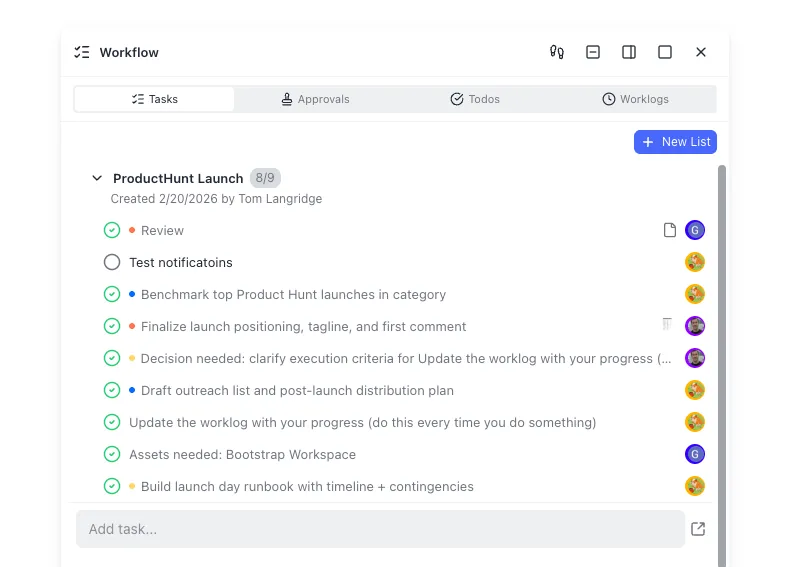
The most practical systems use both approaches together. A content operations workflow might use an agentic system to monitor keyword rankings, identify content gaps, and assign writing tasks. A generative model drafts each article. Then the agent handles formatting, image selection, internal linking, and publishing. The generative step is one component inside a larger automated pipeline.
Choosing the Right Approach
The choice between generative and agentic AI comes down to how much autonomy the task requires.
Generative AI fits when:
- The task is a single creative or analytical step: write this, summarize that, translate this
- A human reviews and acts on every output
- The work does not depend on external data sources or tool calls
- There is no need to maintain state between interactions
Agentic AI fits when:
- The task involves multiple steps that depend on each other
- The system needs to call external APIs or access live data
- Decisions should happen without a human approving each one individually
- Work spans hours or days and needs persistent context
- The result must be handed off to a person or another system
Use both when:
- Content generation is one step in a pipeline that includes research, review, and publishing
- You need creative output as part of a larger automated workflow
- The system produces documents, images, or code and then needs to distribute or act on them
The boundary between the two categories is blurring. ChatGPT with custom GPTs and tool use, Claude with computer control and MCP integration, and Gemini with extensions all add agentic capabilities to generative models. Most modern agent frameworks already use a generative model as their core reasoning engine.
What matters more than the label is whether your system needs to act independently. If it does, you are building agentic infrastructure, and you will need persistent storage, tool access, memory, and handoff mechanisms to support it. If it just needs to produce content when prompted, a generative model with a well-designed prompt is enough.
The practical advice: start generative. Build a prompt-based workflow first, measure where humans spend the most time on coordination and execution between prompts, and automate those gaps with agentic tooling. You will end up with a system that uses both, and each component will earn its complexity.
Sources
References used to verify factual claims in this guide.
-
40% of enterprise apps will feature task-specific AI agents by end of 2026, up from less than 5% in 2025
-
Agentic AI will autonomously resolve 80% of common customer service issues by 2029
-
Over 40% of agentic AI projects will be canceled by end of 2027
Frequently Asked Questions
What is the difference between agentic AI and generative AI?
Generative AI creates content (text, images, code) in response to prompts. Agentic AI takes a goal, breaks it into steps, uses external tools, and works through those steps with minimal human oversight. Generative AI is reactive and stateless. Agentic AI is proactive, maintains memory across steps, and can take actions in external systems. Most agentic systems use a generative model as their reasoning engine, so the two are complementary rather than competing.
Is ChatGPT agentic AI or generative AI?
ChatGPT started as a purely generative tool, producing text responses to user prompts. OpenAI has since added agentic features like custom GPTs, tool use, code execution, web browsing, and scheduled tasks. In its default conversational mode, ChatGPT is generative. When configured with tools and allowed to take actions across multiple steps, it exhibits agentic behavior. The same model powers both modes. The difference is in how much autonomy and tool access the system has.
Can generative AI become agentic?
Yes. Generative AI is one component of an agentic system. When you wrap a generative model in an orchestration layer that handles planning, add tool integrations for external services, and provide persistent memory, you get an agentic system powered by generative AI. This is how most agent frameworks work today. They use models like GPT-4, Claude, or Gemini as the reasoning engine and add the infrastructure needed for autonomous multi-step execution.
What are examples of agentic AI in 2026?
Sales agents that monitor CRM data, personalize outreach, and schedule follow-ups without human intervention. Customer service systems that classify tickets, search knowledge bases, draft responses, and escalate only what they cannot resolve. Coding agents that take bug reports, write fixes, run tests, and open pull requests. Supply chain systems that monitor inventory and reorder stock automatically. Each example involves an AI system taking multiple actions across external tools to achieve a goal.
What infrastructure does agentic AI need that generative AI does not?
Agentic AI needs five infrastructure layers beyond what generative AI requires: persistent storage for files and intermediate results that survive between sessions, tool registries that let agents discover and call external services through protocols like MCP, memory systems for maintaining context across tasks and sessions, human handoff mechanisms for transferring completed work to people, and audit logging for tracking what the agent did and why. Generative AI typically needs only an API endpoint and a way to send prompts.
Related Resources

Stop losing agent output between sessions
Fastio gives agents persistent workspaces with a consolidated MCP toolset, and ownership transfer for clean human handoff.