Best AI Assistants for Business in 2026: 8 Tools We Actually Tested
91% of Fortune 500 companies now run at least one generative AI project in production, yet most teams still struggle to pick the right assistant for their actual workflows. This guide breaks down eight AI assistants by what they do best, what they cost, and where they fall short, so you can match the tool to the job instead of chasing feature lists.


Why Picking the Right AI Assistant Matters More Than Adopting One
91% of Fortune 500 companies now have at least one generative AI project in production, according to Deloitte's 2025 Fortune 500 AI Survey. That number sounds like the hard part is over. It is not. Adoption is nearly universal. Getting value from it is not.
The gap between "we use AI" and "AI saves us time" is almost always a tool-fit problem. A marketing team that defaults to a general-purpose chatbot for content drafts will spend as much time editing outputs as they saved generating them. A sales team that picks a meeting summarizer when their bottleneck is CRM data entry will automate the wrong step.
This list groups eight AI assistants by the business function they serve best. Each entry covers pricing, key capabilities, real limitations, and the specific use case where the tool outperforms the alternatives. Skip to the one that matches your bottleneck.
Related guides
- AI Tools List 2026: A Practical Guide to Every CategoryThe number of active AI tools hit 14,200 in 2026, but the average company uses fewer than five. This directory covers...
- Fastest AI in 2026: Speed Benchmarks Across Top ModelsCerebras now serves Llama 4 Scout at over 2,600 tokens per second, 38 times faster than closed models from OpenAI and...
- Most Powerful AI in 2026: 7 Frontier Models Ranked by CapabilitySix AI labs sit within 79 Elo points of each other on the Chatbot Arena leaderboard as of early 2026. This ranking...
- AI vs AGI vs ASI: What Changes for a Team Working With AgentsToday's AI, including the agents teams already run, does specific jobs well. AGI (artificial general intelligence)...
- SI vs AI: What the Federal "Super Intelligence" Rename Means for Teams and ContractorsThis guide covers SI in its U.S. federal sense: "Super Intelligence", the term executive branch agencies use in place...
- 9 Best AI Assistants for Developers in 2026GitHub Copilot generates 46% of code in files where it's active, yet experienced developers average 2.3 AI tools in...
More on this subject: AI Agents: General Guides (190 guides)
How We Evaluated These Tools
We tested each assistant across five criteria that matter for daily business use:
Workflow depth. Can it do more than answer questions? We looked for assistants that connect to business systems, trigger actions, and handle multi-step tasks without constant prompting.
Integration ecosystem. An assistant that works in isolation creates another silo. We checked native integrations with email, calendars, CRMs, project management tools, and file storage.
Team collaboration. Does it support shared workspaces, admin controls, and usage visibility? Solo tools work for freelancers. Teams need governance.
Output quality. We ran identical tasks, drafting emails, summarizing documents, analyzing data, across all tools and compared the results for accuracy, tone, and usefulness.
Pricing transparency. Credit systems, per-seat fees, usage caps, and hidden overage charges all affect the real cost. We calculated what a 10-person team would actually pay monthly.

1. Microsoft Copilot: Best for Teams Already on Microsoft 365
Microsoft Copilot embeds AI directly into Word, Excel, PowerPoint, Outlook, and Teams. If your company already runs on Microsoft 365, Copilot is the shortest path to AI-assisted work because there is nothing new to install or learn.
What it does well:
- Drafts and rewrites documents in Word using your existing files as context
- Builds formulas and pivot tables in Excel from natural language prompts
- Summarizes email threads and suggests replies in Outlook
- Generates meeting recaps and action items from Teams calls
- Pulls data from your Microsoft Graph (calendar, files, emails, chats) to answer questions
Limitations:
- Locked to Microsoft's ecosystem. If you use Google Workspace or Slack, you get almost no value
- The $21/user/month business tier adds up fast for larger teams. Enterprise runs $30/user/month
- Quality of Excel analysis varies. Complex financial models still need human review
- As of April 2026, organizations with 2,000+ seats lose Copilot access in Office apps unless they pay for the full M365 Copilot license
Pricing: Business starts at $21/user/month. Enterprise is $30/user/month. The new E7 "Frontier Suite" bundles everything for $99/user/month.
Best for: Mid-size to large companies that already pay for Microsoft 365 and want AI embedded in the tools their employees already use daily.


Give Your AI Agents a Workspace That Persists
Built-in RAG, a consolidated MCP toolset, and file sharing your agents and team can use together. Start with a 14-day Business Trial.
2. ChatGPT Business: Best General-Purpose AI for Teams
ChatGPT Business (formerly ChatGPT Team, renamed August 2025) is the most versatile AI assistant on this list. It handles writing, analysis, coding, research, and brainstorming with consistent quality across all of them.
What it does well:
- Strongest general-purpose reasoning across diverse business tasks
- 60+ native integrations including Slack, Notion, Salesforce, and Google Workspace
- Custom GPTs let teams build specialized assistants for recurring workflows
- Canvas mode for collaborative document editing with AI
- SOC 2 Type 2 compliance and SAML SSO on the Business plan
Limitations:
- The 40 agent messages per user per month cap on the Business plan is the most common reason teams upgrade to Enterprise
- Enterprise pricing starts at roughly $60/user/month with a 150-seat minimum, putting it out of reach for small teams
- Data handling policies require careful review. Your prompts train models unless you opt out
- No built-in file versioning or persistent storage. Conversation context resets between sessions
Pricing: Business is $25/user/month (monthly) or $20/user/month (annual). Enterprise starts around $60/user/month with a 150-seat minimum.
Best for: Teams that need one AI assistant that handles everything reasonably well, from drafting investor updates to debugging Python scripts.
3. Claude: Best for Long-Document Analysis and Writing
Anthropic's Claude excels where other assistants hit context limits. With a 200K-token context window (roughly 500 pages) on the standard tier, Claude can ingest entire contracts, research papers, or codebases and reason across them without losing track of details.
What it does well:
- Processes extremely long documents in a single conversation. Competitors truncate or summarize
- Writing quality is consistently more natural and less formulaic than alternatives
- Projects feature lets teams organize files and instructions into reusable workspaces
- Claude Code provides a command-line agent for software development tasks
- Constitutional AI approach makes outputs noticeably more cautious about false claims
Limitations:
- Smaller integration ecosystem than ChatGPT or Copilot. Fewer native connectors to business tools
- Team plan starts at $25/seat/month but the Premium tier jumps to $125/seat/month
- Rate limits on the Pro plan can interrupt intensive workflows
- No built-in calendar, email, or CRM integration without third-party connectors
Pricing: Pro is $20/month. Team Standard is $25/seat/month. Team Premium is $125/seat/month. Enterprise pricing is custom, starting around $60/seat/month with a 70-user minimum.
Best for: Legal teams reviewing contracts, researchers analyzing papers, and content teams that need high-quality writing. Anyone whose work involves long documents.
4. Google Gemini: Best for Google Workspace Users
Google took a different approach than Microsoft: instead of selling Gemini as a separate product, they bundled it into existing Workspace plans. If you pay for Google Workspace Business Standard or higher, you already have Gemini in Gmail, Docs, Sheets, Slides, Meet, and Chat.
What it does well:
- No extra cost on Workspace Business Standard ($14/user/month) and above
- Deep integration with Google Drive, making it easy to reference files in prompts
- Meeting notes and action items generated automatically from Google Meet calls
- Gemini in Sheets handles data analysis with access to your existing spreadsheets
- Multimodal input lets you analyze images, charts, and documents alongside text
Limitations:
- Quality of outputs for complex reasoning still trails ChatGPT and Claude in blind comparisons
- Locked to the Google ecosystem. Less useful if your team splits between Google and other platforms
- The bundled approach means you cannot buy Gemini alone. You need a full Workspace subscription
- Enterprise features (longer context windows, data protection guarantees) only come with Enterprise-tier Workspace
Pricing: Included with Workspace Business Standard ($14/user/month), Plus ($22/user/month), and Enterprise (custom). Consumer AI Pro is $19.99/month.
Best for: Companies already using Google Workspace that want AI capabilities without adding another vendor or per-user fee.
5. Perplexity: Best for Business Research and Competitive Intelligence
Perplexity is not trying to be a general-purpose assistant. It is a research tool that searches the web in real time, synthesizes findings, and cites every source. For teams that spend hours researching competitors, markets, or technical topics, it replaces the tab-switching workflow of Google Search plus manual note-taking.
What it does well:
- Real-time web search with inline citations for every claim
- Follow-up questions refine results without starting over
- Handles multi-step research queries that would take 20+ minutes of manual searching
- Enterprise tiers include SOC 2 Type II and HIPAA compliance
- Spaces feature organizes research by project with shared team access
Limitations:
- Not designed for content creation, coding, or task automation. It researches, it does not execute
- Enterprise Pro starts at $40/seat/month and Enterprise Max jumps to $325/seat/month
- Outputs can over-rely on top search results, mirroring the same SEO-optimized content everyone else finds
- No native integrations with CRMs, project management tools, or email
Pricing: Free tier available. Pro is $20/month. Enterprise Pro is $40/seat/month. Enterprise Max is $325/seat/month.
Best for: Strategy teams, analysts, and anyone who spends significant time on market research, competitive analysis, or due diligence.

6. Lindy: Best for No-Code Business Automation
Lindy sits in a different category than chatbots. It is a no-code platform for building AI agents that automate specific business tasks: triaging your inbox, scheduling meetings, enriching leads, recording calls, and updating your CRM. You describe what you want in plain language, and Lindy builds the automation.
What it does well:
- Build AI agents without writing code. Describe the task and Lindy configures the workflow
- Inbox management triages, prioritizes, and drafts replies in your writing style
- Meeting recording with automatic summaries and action items
- CRM integration updates records after calls and meetings
- Calendar automation checks availability, negotiates times, and sends invitations
Limitations:
- Credit-based pricing makes costs unpredictable. AI-intensive operations consume 5 to 10 credits per action
- The free plan caps at 400 credits per month, which runs out fast with daily email triage
- Complex multi-step automations can break when upstream tools change their APIs
- Limited enterprise governance features compared to Zapier or Microsoft Power Automate
Pricing: Free plan with 400 credits/month. Plus is $49.99/month with 5,000 credits. Business is $299.99/month with 30,000 credits. Additional credits cost $10 per 1,000.
Best for: Small business owners and solo operators who want to automate administrative tasks like email, scheduling, and CRM updates without hiring a developer.
7. Zapier Agents: Best for Cross-App Workflow Automation
Zapier has connected apps for over a decade. Zapier Agents adds AI decision-making on top of that existing integration network. The result is an automation platform that can trigger actions across 7,000+ apps with AI handling the judgment calls that used to require human intervention.
What it does well:
- 7,000+ app integrations, far more than any other tool on this list
- AI agents that process leads, handle support tickets, and execute multi-step workflows
- Copilot builder creates automations from natural language descriptions
- Tables, Interfaces, and Forms let you build lightweight internal tools alongside automations
- AI Guardrails provide safety controls for autonomous agent actions
Limitations:
- Pricing scales with task volume. High-automation teams can face steep monthly bills
- Complex Zaps with many steps become difficult to debug when they fail
- AI agent quality depends heavily on prompt engineering and workflow design
- The platform bundles seven products, which creates a learning curve for new users
Pricing: Free plan with 100 tasks/month. Professional starts at $29.99/month. Team is $103.50/month. Enterprise pricing is custom.
Best for: Operations teams that need to connect a large number of business tools and want AI to handle the routing, filtering, and decision-making between them.
8. Fast.io: Best for AI Agent File Storage and Collaboration
Fast.io takes a different approach from the other tools on this list. Instead of being an AI assistant itself, it is the workspace where AI assistants store their work, share files, and hand off results to humans. Think of it as the collaboration layer between your AI tools and your team.
This matters because most AI assistants have a blind spot: they generate outputs but have no persistent place to put them. ChatGPT conversations disappear. Copilot drafts live inside Office documents. Agent outputs scatter across local filesystems. Fast.io gives AI agents a shared workspace with versioning, permissions, and audit trails.
What it does well:
- Intelligence Mode auto-indexes uploaded files for semantic search and RAG. No separate vector database needed
- MCP server with consolidated tools lets any AI agent read, write, search, and share files through a standardized protocol
- Ownership transfer lets an agent build an entire workspace, then hand control to a human client
- Branded shares (Send, Receive, Exchange) turn agent outputs into professional client deliverables
- Metadata Views extract structured data from documents using natural language. Describe the fields you want and AI builds a queryable spreadsheet from your PDFs, invoices, or contracts
Limitations:
- Not a chatbot or writing assistant. You still need a separate AI for generating content
- Intelligence Mode consumes credits for document ingestion and AI queries
- The platform is newer than competitors like Dropbox or Google Drive, so some enterprise features are still being built
Pricing: Starter at $9.99/month (3 seats, 250 GB), Business at $49.99/month (10 seats, 5 TB), and Enterprise at $199.99/month (30 seats, 25 TB). A 14-day Business Trial requires a credit card; see /pricing/.
Best for: Teams running AI agents that produce files, reports, or deliverables that need to be stored, versioned, searched, and shared with clients or colleagues. Developers building agentic workflows that need persistent storage with built-in RAG.
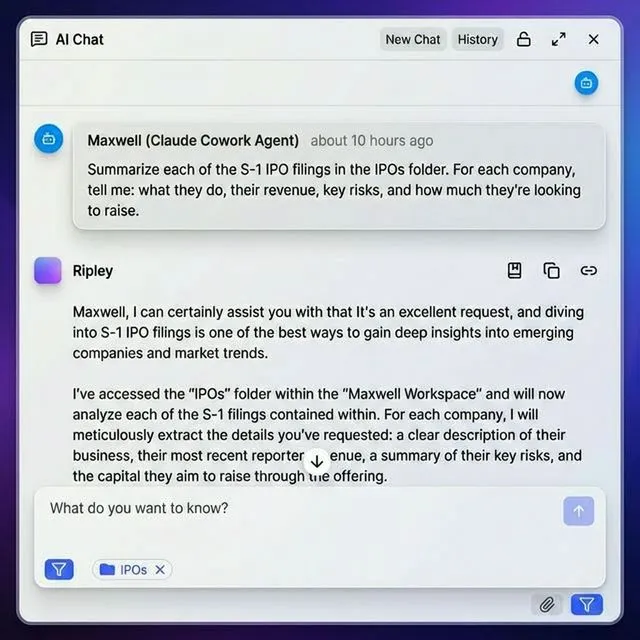
Matching the Tool to Your Business Need
The tools above solve different problems. Picking the wrong category wastes budget and creates frustration.
If your bottleneck is document work (writing, editing, reviewing), start with ChatGPT Business or Claude. ChatGPT is more versatile. Claude handles longer documents better.
If your team lives in one ecosystem, pick the embedded option. Microsoft shops should use Copilot. Google shops should use the Gemini features they already have.
If you need research, Perplexity replaces hours of manual searching. Its citation system makes it trustworthy enough for strategy presentations and client-facing reports.
If you need automation, choose by scale. Lindy works for solo operators automating personal tasks. Zapier Agents handles cross-team workflows connecting dozens of apps.
If your AI agents need a home, Fast.io provides the workspace layer. Most teams will pair it with one of the other assistants on this list, using Fast.io as the place where agent outputs become team assets.
Start with one tool that addresses your most painful workflow. Use it for 30 days before adding another. Stacking AI assistants without mastering any of them is the fastest way to waste your AI budget.
Sources
References used to verify factual claims in this guide.
-
91% of Fortune 500 companies now have at least one generative AI project in production
-
Microsoft Copilot Business starts at $21/user/month; Enterprise is $30/user/month
-
ChatGPT Business is $25/user/month monthly or $20/user/month annual with a 2-seat minimum
-
Claude Team Standard is $25/seat/month; Team Premium is $125/seat/month
-
Google Workspace Business Standard is $14/user/month with Gemini bundled
-
Perplexity Enterprise Pro starts at $40/seat/month
-
Lindy AI Plus plan is $49.99/month with 5,000 credits
Frequently Asked Questions
What is the best AI assistant for business?
It depends on your workflow. Microsoft Copilot is best for teams on Microsoft 365. ChatGPT Business is the strongest general-purpose option. Claude handles long documents better than any competitor. For research, Perplexity outperforms general chatbots. The best choice is the one that fits where your team actually spends time.
How can AI assistants help small businesses?
Small businesses get the most value from AI assistants that automate repetitive tasks. Lindy can manage email triage, meeting scheduling, and CRM updates for under $50/month. ChatGPT Business at $20/user/month handles writing, analysis, and customer communication. Google Gemini comes free with Workspace subscriptions that many small businesses already pay for. Start with the task that eats the most hours each week and automate that first.
What AI tools do businesses use the most?
Microsoft Copilot and ChatGPT lead enterprise adoption by seat count, largely because they integrate with tools companies already use. Google Gemini adoption grew significantly after Google bundled it into Workspace subscriptions at no additional cost. For specific functions, Perplexity dominates business research, Zapier handles cross-app automation, and specialized tools like Lindy cover administrative tasks.
Is there a free AI assistant for business?
Several options offer free tiers. Google Gemini is included at no extra cost with Workspace Business Standard subscriptions. ChatGPT has a free tier with limited access to the latest models. Perplexity offers free research queries with daily caps. Dedicated workspace platforms like Fast.io offer a 14-day Business Trial (credit card required; see [/pricing/](/pricing/)). Free tiers typically cap usage, so teams with heavy daily use will need paid plans.
How much does an AI assistant for business cost?
Costs range from free to over $300/user/month depending on the tool and plan. Google Gemini starts at $14/user/month bundled with Workspace. ChatGPT Business costs $20-25/user/month. Microsoft Copilot starts at $21/user/month. Claude Team is $25/seat/month. Enterprise tiers from all vendors typically start at $40-60/user/month with annual commitments. Budget for the per-user cost multiplied by actual daily users, not your full headcount.
Related Resources

Give Your AI Agents a Workspace That Persists
Built-in RAG, a consolidated MCP toolset, and file sharing your agents and team can use together. Start with a 14-day Business Trial.