Adobe Firefly for Clay GTM Creative Automation
Adobe Firefly draws about 135,000 monthly US searches at keyword difficulty 57, yet most product pages never explain how GTM teams turn enrichment rows into personalized visuals. Clay's personalized demo play already shows table-driven mockups at scale with Claygent. Pair that data layer with Firefly generation and a shared asset workspace, and outbound creatives stop living in random downloads.


What Adobe Firefly is, and why Clay GTM teams care
"Adobe firefly" pulls roughly 135,000 monthly US searches at keyword difficulty 57 and a CPC near two dollars and thirty-one cents according to DataForSEO metrics refreshed for this topic. That demand is real, but the pages that rank for it mostly describe product features. They rarely show how GTM engineers turn a Clay table into personalized demo creatives, where those files live after generation, or how sales reps find the right version before a call.
Adobe Firefly is Adobe's generative AI creative suite for text-to-image and related media generation. Adobe positions it as a way to generate and edit images, video, audio, and designs, including Adobe models and partner models from other providers, inside one Firefly experience. Its text-to-image workflow takes ordinary language prompts and returns visual options, with Adobe stating that Text to Image is designed to be commercially safer because core models train on licensed Adobe Stock imagery and public domain content where copyright has expired.
For marketing and revenue teams, that product story is only half useful. B2B outbound does not need infinite random art. It needs repeatable visuals tied to account context: company name, logo colors, product surface, industry scene, or a mock product UI that looks like the prospect's world. Clay already documents that pattern. In Clay's personalized demo play, Goldcast had reps manually building mockups of online webinar events for prospects, a process that took hours per contact, until the workflow was automated with Clay, Claygent, and AI enrichment to build custom mockups at scale.
That is the practical definition for this guide: Adobe Firefly is the generation engine; Clay is the GTM data and orchestration layer; storage and handoff determine whether a generated PNG becomes a usable sales asset or another orphaned download.
Why product-page Firefly content falls short for GTM
Most Adobe Firefly coverage stops at generation quality, credits, or Creative Cloud integration. GTM operators need answers to different questions:
- Which Clay columns become prompt variables for Firefly text to image?
- How do you keep brand guidelines and approved reference images attached to the agent that writes prompts?
- Where do finished files sit so SDRs, AEs, and marketing ops share one source of truth?
- What happens when legal asks which asset went to which account last quarter?
Claygent Builder helps on the agent side. Clay documents that you can attach tone guides, messaging docs, PDFs, or CSVs as business context for Claygents, and that agents can be tested, versioned, and deployed across tables from one place. Firefly-generated creatives can live outside Clay. Clay stays the enrichment and orchestration layer. The missing third piece is durable asset storage with version history, permissions, and rep-ready shares.

Related guides
- Top 8 OpenClaw Integrations for Creative AgenciesCreative agencies choose OpenClaw integrations to speed up client handoffs and file deliveries. These tools handle...
- Top 7 OpenClaw Skills for Marketing AutomationMarketing automation often just means scheduling posts. OpenClaw skills let AI agents do more: they run campaigns,...
- How to Use a Canva Brand Kit with Clay GTM WorkflowsAbout 85% of companies say they have brand guidelines, yet nearly two-thirds admit those rules are not enforced. A...
- How to Use Canva Magic Design in Clay Outbound Creative PipelinesUS searchers look up "canva magic design" about 3,600 times per month, and the $7.34 CPC points to commercial...
- The Clay Tool: A Comprehensive Guide to No-Code GTM WorkflowsWhile traditional B2B databases yield low match rates, the Clay tool sequences data waterfalls across multiple...
- How to Use Canva Background Remover in Clay GTM Workflows"Canva background remover" draws about 40,500 monthly US searches at keyword difficulty 17 and a CPC near $7, yet most...
More on this subject: Clay and GTM Agents (82 guides)
How Clay tables drive personalized demo mockups
Clay's official personalized demo play is the clearest public blueprint for table-driven creative personalization. The play does not require Firefly by name, but the structure maps cleanly onto Adobe Firefly AI generation for marketing and outbound.
The Clay personalized demo pipeline
Clay walks through a multi-step table that:
- Validates emails and excludes contacts already in the CRM.
- Uses Claygent to research whether the prospect is running webinars or in-person events.
- Builds a personalized demo mockup by pulling profile pictures, company logos, primary brand colors, and website screenshots, then compiling those elements into a final image per contact.
- Finds an alternative marketing leader for a breakup sequence when needed.
- Exports the Clay table into an email tool such as Instantly or Smartlead.
Clay's own summary of the play is direct: profile pictures, company logos, brand colors, and website screenshots are pulled automatically and compiled into a custom mockup image per contact. The finished personalization variables export as a CSV and drop into the sending tool.
That is table-driven creative automation. Each row is a prospect. Each enrichment column is either a fact (domain, logo URL, event name) or a generated artifact (research summary, mockup URL, email body). Claygent handles judgment work such as event detection and copy. HTTP enrichments can call screenshot services or color extractors. The final mockup step is where Adobe Firefly for marketing becomes a natural substitute or companion: instead of only compositing logos onto a static template, you can generate account-specific scenes, UI mock frames, or industry imagery with Firefly text to image, then store the approved file next to the row's metadata.
Claygent Builder as the prompt control plane
Claygent Builder is Clay's hub for building, testing, and deploying Claygents for research, scoring, outbound copywriting, and persona classification. Relevant controls for creative automation include:
- Business context: company description, ICP, and buyer personas that auto-populate so agents stay on-brand.
- Document uploads: tone guides, PDFs, messaging docs, or CSVs attached directly to the agent.
- Web search: optional live research when the mockup should reflect current events or hiring signals.
- Central deploy: update once in Builder; new table runs pick up the latest agent version.
- Free test runs: Clay documents free testing on up to 10 inputs at a time before production credit use.
For a Firefly-oriented Claygent, treat document uploads as brand memory. Upload approved color palettes, sample mockups, forbidden visual themes, and product screenshot rules as PDFs or images. The agent then writes Firefly prompts from enriched columns without inventing brand language from scratch.
What belongs in Clay vs outside Clay
Keep row-level GTM data in Clay: identity, firmographics, scores, prompt text, asset URL, status, and campaign IDs. Keep heavy binary assets outside Clay in object storage or a team workspace. Clay is excellent at orchestration and enrichment. It is not the long-term home for thousands of high-resolution PNGs, review threads, and rep-facing folders. That split is exactly what Clay's document-upload pattern implies: context files support agents, while operational files can live in systems purpose-built for sharing and audit.
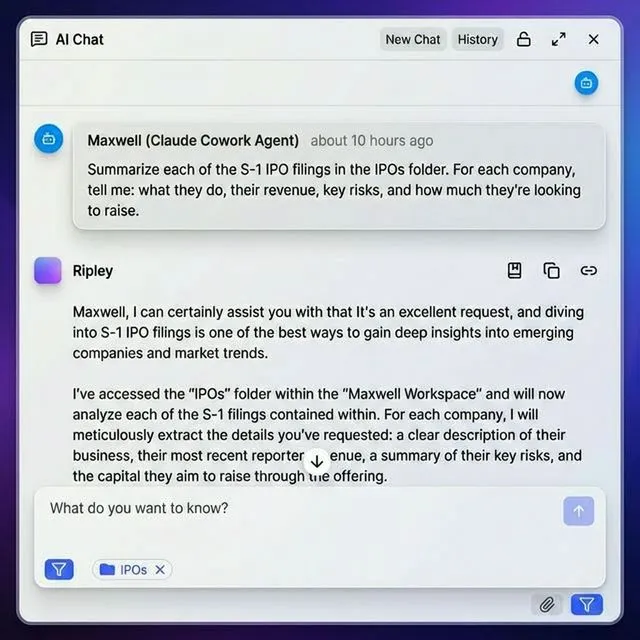


Keep Clay mockups and Firefly exports in one sales-ready workspace
Land generated creatives in a shared Fast.io workspace with version history, branded shares for reps, and MCP access for the agents that upload them. Start with a 14-day free trial.
A Clay plus Firefly plus storage pipeline for outbound creatives
Here is a practical pipeline that closes the content gap between Adobe Firefly product marketing and Clay GTM ops.
Stage 1: Source and qualify in Clay
Start with an account or contact list that already passed ICP filters. Validate emails, suppress customers and open opportunities, and enrich logo URL, industry, tech stack, and recent signals. Use Claygent only where judgment is required, for example "Does this company run public webinars?" or "What visual metaphor matches their product category?"
Stage 2: Build a Firefly prompt column
Create a Claygent (or AI column) that outputs a constrained prompt, not free-form prose. A stable template looks like this:
Product-mockup style image for B2B outbound.
Company: {{company_name}}
Industry: {{industry}}
Visual theme: {{visual_theme}}
Brand colors: {{primary_hex}}, {{secondary_hex}}
Include: clean SaaS dashboard mock, subtle {{industry}} cues,
no fake logos, no unreadable UI text, no celebrity likeness.
Aspect ratio: 16:9. Lighting: soft studio. Style: photoreal product marketing.
Claygent Builder document uploads can hold your negative prompt list and brand rules so every row inherits the same constraints. That is how Adobe Firefly AI output stays usable for B2B outbound creatives instead of drifting into stock-looking chaos.
Stage 3: Generate with Adobe Firefly text to image
Run generation in Firefly Web or a controlled batch process your design ops owns. Adobe's product materials emphasize text prompts that describe subject, action, place, mood, or style, and note that each generation cycle can surface multiple options. For outbound scale, ops should standardize:
- Aspect ratio (email hero vs LinkedIn vs deck slide)
- Content type (photo vs illustration)
- Reference style images for composition when brand fidelity matters
- A human checkpoint for the first N accounts in a new campaign
Firefly is the generator. Do not treat it as the system of record. Download or export approved variants with filenames that include account domain and campaign ID, for example acme-corp_webinar-demo_v3.png.
Stage 4: Land assets in shared storage
Teams often dump exports into a personal Downloads folder, a shared Google Drive campaign folder, or an S3 bucket with opaque keys. Those options work for a pilot. They break when three SDRs need the approved mockup for tomorrow's sequence and marketing needs last week's rejected variants for brand review.
A better pattern is a workspace layout:
/gtm-creatives/inbound/or/gtm-creatives/outbound/{campaign}/source/for raw Firefly exports/gtm-creatives/outbound/{campaign}/approved/for sales-ready files/gtm-creatives/outbound/{campaign}/prompts/for prompt CSVs exported from Clay/brand/reference/for logos, Style references, and legal-approved imagery
Google Drive or Dropbox can host this structure. AWS S3 works if engineering owns access. Fast.io is a strong fit when agents and humans share the same workspace: org-owned storage, per-file version history, granular permissions, branded Send shares for rep packages, Intelligence Mode for semantic search across creatives, and Metadata Views to turn folders of images and PDFs into a queryable grid (account, campaign, status, Firefly prompt hash, approver). Agents can write via the Fast.io API or consolidated MCP tools over Streamable HTTP at /mcp (legacy SSE at /sse); humans review in the UI.
Stage 5: Write the asset URL back to Clay
After upload, store a durable URL or path on the Clay row. That single field ties enrichment, creative, and sequence together. When the sequencer personalizes email body copy, it can also reference the mockup host URL or a tracked share link. If a rep needs the file outside email, they open the workspace folder or share, not a private Slack DM that dies with the thread.
Stage 6: Handoff to sales with guardrails
Export the Clay table for the sequencer as Clay documents. Separately, package approved creatives for humans:
- Folder share or branded Send link per campaign
- Optional expiration for external partners
- Human review step before files move from
source/toapproved/ - Activity log for downloads and permission changes when compliance cares
Fast.io supports branded shares (Send, Receive, Exchange), comments anchored to a page, region or video timestamp, and ownership transfer when an agent or contractor built the workspace and a human GTM lead takes over the org (monthly plans start with a trial of up to 14 days, credit card required; plans such as Starter at $9.99/mo, Business at $49.99/mo, Enterprise at $199.99/mo). Real workspace usage requires a paid organization subscription after the trial.
Where generated Firefly assets should live for sales teams
Sales teams lose personalized creatives in three common places: browser download history, personal Creative Cloud libraries, and unscoped team drives with names like final_final_v7. The storage decision should optimize for findability, version truth, and rep speed.
Option A: Local or Creative Cloud only
Fine for a designer producing a handful of one-off concepts. Poor for large account-level mockup batches. Local disks do not scale across SDRs. Creative Cloud libraries help designers, not always a full outbound pod that lives in Clay, a CRM, and a sequencer.
Option B: Google Drive, Dropbox, or Box
These are familiar and good enough for many teams. Use strict folder templates, naming conventions, and restricted edit rights on approved/. Weak spots appear when you want semantic search across image captions and prompt notes, structured extraction from brand PDFs, or agent-native upload via MCP without custom glue.
Option C: Object storage (S3, GCS)
Strong for engineering-owned pipelines and CDN delivery. Weak for non-technical reps who need preview, comments, and a simple share link without IAM tickets.
Option D: Intelligent workspace (Fast.io)
Position Fast.io as the coordination layer after generation, not as a Firefly replacement and not as a Clay replacement. Upload Firefly outputs into a workspace. Enable Intelligence Mode so files are indexed for hybrid search and citation-backed chat ("show me approved fintech demo mockups from June"). Use Metadata Views when you want columns such as account_domain, campaign, status, aspect_ratio, and approved_by extracted or maintained across PDFs, images, and spreadsheets. Share finished packs with branded sharing instead of emailing zips. When marketing must sign off before outbound, reviewers can leave comments anchored to a region of each mockup.
For agent builders, Fast.io MCP and API access keep the same workspace as the human UI. An orchestration agent can upload the PNG, attach metadata, add a comment asking design to review it, and leave a share URL for Clay to store. That is human-agent collaboration on one file tree, not a parallel shadow process.
Recommended folder contract for Clay campaigns
Use one campaign slug everywhere: Clay table name, sequencer campaign, and workspace path.
gtm-creatives/
  brand/
    logos/
    firefly-style-refs/
  campaigns/
    2026-q3-webinar-mockups/
      clay-export/
      firefly-raw/
      approved/
      rejected/
      shares/
Naming rule for files: {domain}_{use-case}_{variant}.png. Naming rule for Clay columns: firefly_prompt, asset_path, asset_status, asset_version. When status flips to approved, only then does the sequencer or AE deck builder read the URL.
Governance, brand safety, and rep handoff patterns
Creative automation fails quietly when volume rises without controls. Firefly's commercial-safety story around training data does not replace your own brand review, trademark checks, or claim review on the mockup content itself.
Brand and legal controls
- Keep a short allowed/forbidden prompt list in Claygent Builder document uploads.
- Never generate fake customer logos or invented UI that implies a partnership.
- Prefer logo compositing from official brand assets for identity-critical elements; use Firefly for backgrounds, scenes, and illustrative frames.
- Store the exact prompt with the file so audits can reproduce how an image was requested.
- If a prospect asks "where did this image come from?", you need a path from email send -> Clay row -> asset version -> prompt.
Version history that sales can trust
Outbound creatives iterate. Color shifts, copy overlays, and legal redlines create multiple binaries. Per-file version history matters more than a folder full of v2 filenames. Workspaces that keep history (including Fast.io) let you restore a prior approved asset when a bad upload overwrites the live file.
Approvals before scale
Run a two-phase launch. Phase one: a small pilot cohort with dual review from design and a senior AE. Phase two: full table run only after approval criteria are written down (contrast, legibility, no trademark risk, on-brand colors). A shared checklist in Fast.io Collaborative Notes can record that gate.
Rep handoff that does not depend on tribal knowledge
The best handoff is boring:
- Clay row has
asset_status = approvedand a stable URL. - Sequencer personalization pulls text fields and optional image host.
- AE open-pipeline folder in the workspace lists only current approved files.
- Comments stay on the file, not in a private chat history nobody can search.
When contractors or agents build the initial creative factory, ownership transfer on the workspace org lets a human GTM lead take billing and admin control after setup, without re-uploading hundreds of assets.
Metrics worth tracking
- Time from Clay row ready to approved asset available
- Percentage of rows blocked on creative review
- Reply or meeting rate for sequences with personalized mockups vs text-only control
- Asset reuse rate across multi-touch sequences (same visual, new copy)
If creative automation does not move reply or meeting metrics after a fair test, stop scaling generation. Fix messaging or ICP first. Adobe Firefly for marketing is not a substitute for offer clarity.
Implementation checklist and common failure modes
Use this checklist when you wire Adobe Firefly into a Clay GTM creative system.
Build checklist
- Document the campaign thesis in one paragraph (who, visual hook, CTA).
- Create Clay columns for inputs, Claygent research, Firefly prompt, asset URL, and status.
- Configure a Claygent in Claygent Builder with ICP context and document uploads for brand rules.
- Pilot Firefly prompts on a diverse sample of accounts before full-table generation.
- Land files in a shared workspace with
raw/vsapproved/separation. - Write asset URLs back to Clay; never rely on "search the Drive" as process.
- Package a branded share or campaign folder for reps.
- Run a QA sample across the pilot cohort, then scale.
- Log who approved each asset class for the campaign.
- Schedule a mid-campaign prompt review when reply data arrives.
Failure modes and fixes
Prompts too vague. "Modern SaaS dashboard for Acme" produces generic output. Fix with industry, color hexes, composition rules, and negative constraints from Claygent documents.
Every mockup looks the same. Over-constrained templates erase personalization. Vary one visual variable per segment (industry scene, product metaphor) while locking brand chrome.
Clay table has prompts but no files. Generation happened in personal Firefly accounts. Fix with a single ops-owned generation path and mandatory upload step before status can flip to approved.
Reps use outdated creatives. Shares pointed at raw/ or local copies. Fix by only distributing approved/ and revoking old links when a campaign refreshes.
Legal blocks the campaign late. No prompt archive, no asset inventory. Fix with Metadata Views or a structured spreadsheet of account, prompt, file, approver, and date, stored next to the binaries.
Agents overwrite human edits. Concurrent writers without version discipline. Fix with clear folder ownership: agents write to raw/, humans promote to approved/, version history on both.
When not to use this pattern
Skip heavy visual personalization when the motion is pure transactional outreach, when design capacity cannot review samples, or when your product story is still unstable week to week. Clay enrichment and copy personalization still work without Firefly. Add generation when a visual proof (mock event page, mock dashboard, industry scene) is a real differentiator, the way Goldcast-style webinar mockups were in Clay's public play.
For teams ready to keep Clay as the GTM brain, Firefly as the generator, and a durable workspace as the handoff layer, start with one campaign, one prompt template, and one shared folder contract. Expand only after the first sequence shows cleaner handoffs and measurable engagement lift.
Sources
References used to verify factual claims in this guide.
-
Adobe Firefly keyword demand is about 135,000 monthly US searches with keyword difficulty 57 and CPC near two dollars and thirty-one cents.
-
Claygent Builder allows free testing on up to 10 inputs at a time before production credit use. Claygent Builder supports document uploads (tone guides, messaging docs, PDFs, CSVs), business context, free test runs on up to 10 inputs, version history, and centralized deploy across tables.
-
Fast.io organization plans include Starter at $9.99/mo, Business at $49.99/mo, and Enterprise at $199.99/mo, with a 14-day free trial that requires a credit card.
-
Adobe Firefly generates and edits images, video, audio, and designs using Adobe and partner AI models.
-
Firefly Text to Image is designed for commercial use cases with models trained on licensed Adobe Stock images and eligible public domain content.
-
Firefly provides generative creative tools including text-to-image and related image workflows in the Firefly web product.
-
Clay documents a personalized demo play that uses Clay, Claygent, and AI enrichment to build custom mockups at scale, including an example where Goldcast reps previously spent hours manually creating webinar mockups.
-
Claygent is Clay's AI agent product for GTM research and related judgment work on people and companies.
Frequently Asked Questions
Can Adobe Firefly be used for B2B outbound creatives?
Yes. Adobe Firefly's text-to-image and related tools can produce account-specific mockups, scenes, and marketing frames for outbound when prompts are constrained by brand rules and enriched prospect data. Keep identity-critical logos and claims under human control, and store approved files where sales can find them.
How do Clay teams personalize demo mockups at scale?
Clay's personalized demo play enriches each row, uses Claygent for research judgments, pulls logos, colors, profile images, and website screenshots, then compiles a custom mockup per contact before exporting variables to an email sequencer. Claygent Builder can centralize the agent prompt, business context, and document uploads so the same logic deploys across tables.
Where should generated Firefly assets be stored for sales teams?
Store them outside personal download folders: a structured Drive/Dropbox tree, object storage for engineering-led pipelines, or an intelligent workspace such as Fast.io for versioned files, permissions, branded shares, and search. Write the durable URL back to the Clay row so sequences and reps share one source of truth.
What is Adobe Firefly in one sentence for GTM operators?
Adobe Firefly is Adobe's generative AI creative suite for text-to-image and related media generation; GTM teams pair it with Clay when enrichment data drives personalized visual mockups for outbound and demos.
Does Clay store the final creative files for you?
Clay orchestrates data, Claygents, and table exports, and Claygent Builder supports uploading images or PDFs as agent context. Heavy campaign asset libraries usually live in separate storage while Clay keeps the row-level URL, status, and prompt fields.
How should Firefly prompts be written from Clay columns?
Use a fixed template with variables for company, industry, colors, and visual theme, plus negative constraints. Generate the prompt in a Claygent column, review a sample set, then batch-generate. Save the prompt text with the asset for auditability.
What Fast.io features help after assets are generated?
Shared workspaces, per-file version history, granular permissions, branded Send/Receive/Exchange shares, Intelligence Mode search, Metadata Views for structured fields across files, anchored comments for review, MCP/API access for agents, and ownership transfer when builders hand orgs to human GTM leads. Orgs run on paid plans such as Starter, Business, or Enterprise; monthly plans start with a trial of up to 14 days that requires a credit card.
Related Resources

Keep Clay mockups and Firefly exports in one sales-ready workspace
Land generated creatives in a shared Fast.io workspace with version history, branded shares for reps, and MCP access for the agents that upload them. Start with a 14-day free trial.