The Clay Tool: A Comprehensive Guide to No-Code GTM Workflows
While traditional B2B databases yield low match rates, the Clay tool sequences data waterfalls across multiple providers to reach optimal coverage. This comprehensive guide covers Clay's no-code spreadsheet interface, Claygent AI research workflows, and GTM data orchestration. When integrated with Fast.io's workspaces, growth teams establish a versioned, secure storage layer for all GTM assets.


Why Lead Enrichment Match Rates Fail in Single Databases
Single-source B2B data providers typically yield an email match rate between 35% and 60% for targeted prospect lists [Cleanlist 2026 Report]. This means that a substantial portion of potential sales pipeline opportunities are lost before outreach even begins. In contrast, waterfall data enrichment strategies, which sequence multiple B2B data vendors in a prioritized queue, reach contact match rates between 78% and 95%+ by automatically querying subsequent providers when the primary database returns a blank result [UnifyGTM 2026 Benchmark].
Modern outbound sales execution has evolved beyond simple list-buying. When sales teams rely on a single data provider, they inherit the coverage gaps of that specific database. One provider may excel at finding contact information for technology executives in North America, while failing on European manufacturing targets. Another might contain accurate phone numbers but outdated email addresses. In a competitive market, these data gaps translate to lost revenue. Revenue operations (RevOps) teams historically attempted to solve this issue by purchasing subscriptions to several distinct databases, then manually merging lists in desktop spreadsheet software. This process was slow and prone to errors.
The clay tool addresses this structural bottleneck by replacing manual list assembly with a programmable, no-code data enrichment environment. Clay combines multiple data sources, web scraping capabilities, and AI research into a single spreadsheet interface. Revenue operations teams use the platform to orchestrate complex data flows, turning static lists of names and domains into rich, verified lead databases. By automating the sequence of API queries, the platform ensures that outbound messages reach the correct inboxes, maximizing campaign deliverability and response rates.
Related guides
- How to Use OpenClaw for Sales Automation and CRM WorkflowsSales reps spend roughly 70% of their work week on tasks that aren't selling. OpenClaw, the open-source AI agent...
- 5 OpenClaw Workflows for Sales Outreach and Prospecting AutomationSales reps spend just 30% of their time on actual selling, with 15% consumed by prospect research alone. OpenClaw...
- How to Use Canva Background Remover in Clay GTM Workflows"Canva background remover" draws about 40,500 monthly US searches at keyword difficulty 17 and a CPC near $7, yet most...
- How to Use a Canva Brand Kit with Clay GTM WorkflowsAbout 85% of companies say they have brand guidelines, yet nearly two-thirds admit those rules are not enforced. A...
- Adobe Firefly for Clay GTM Creative AutomationAdobe Firefly draws about 135,000 monthly US searches at keyword difficulty 57, yet most product pages never explain...
- Clay Templates: How to Launch Ready-Made GTM WorkflowsUS searchers look up "clay templates" about 320 times per month, enough demand to justify a real operating playbook...
More on this subject: Clay and GTM Agents (82 guides)
How the Clay Tool Spreadsheet Engine Operates
The clay software spreadsheet functions as a programmable data engine rather than a static table. While standard spreadsheets allow users to calculate numbers or format text within a grid, each cell in Clay can run an active API call, execute a Javascript routine, or trigger a large language model. This grid interface hides the underlying API choreography, allowing sales engineers to build data pipelines without writing complex code.
A common question among RevOps professionals is: how does the Clay software work? The answer lies in its column-based orchestration model. When a user creates a table, they define columns that are linked to specific data providers. For example, a column can be configured to call the Apollo API, another to query Hunter, and a third to query People Data Labs. When a list of prospects is imported, Clay runs these integrations row-by-row. If a column is set to run conditionally, it will only execute if the previous column is empty. This prevents teams from wasting credits on redundant queries, lowering the total cost of data enrichment.
Unlike traditional spreadsheet tools, Clay handles the asynchronous execution of hundreds of API calls simultaneously. If an API provider experiences latency or returns a temporary error, the platform handles retries automatically. The platform supports native data integrations with over 150 B2B providers. This catalog includes services for email verification, phone lookup, technographic analysis, and social media scraping. By consolidating these services into a single billing and interface layer, organizations eliminate the overhead of managing dozens of individual vendor contracts.
The Difference Between Clay and Traditional Scrapers
A key misunderstanding is treating Clay merely as a scraper. Traditional scrapers extract raw HTML from a target webpage and require regular maintenance when site layouts change. Clay, by contrast, is a GTM engineering platform that coordinates data across APIs, databases, and AI models. While it contains web scraping features, its primary value is acting as a central orchestration layer. It standardizes, enriches, and validates data, preparing it for downstream sales workflows.
The Native Data Integration Catalog
The platform's native integration marketplace connects directly to tools like Salesforce, HubSpot, Salesloft, and Gong. Instead of exporting CSV files and manually importing them into a customer relationship management (CRM) database, users configure Clay to push enriched records automatically. This direct sync maintains data hygiene and ensures that sales representatives work with the most accurate prospect details.
How to Build Waterfall Enrichment Sequences and AI Web Research
A waterfall enrichment sequence represents the primary method for maximizing contact match rates while controlling costs. The clay lead enrichment tool allows users to build these sequences using step-by-step logic. The sequence begins with the cheapest, broadest data sources and escalates to more expensive, specialized providers only when data is missing.
To set up a typical email waterfall, a RevOps manager creates a prioritized sequence of steps. First, the table queries a general B2B database to retrieve the prospect's corporate email. If the email is found, the sequence stops. If the email field remains blank, the row automatically triggers a query to a second database. If that fails, it queries a third. This cascading search continues until a valid email address is found or all sources are exhausted. This approach increases the overall match rate without requiring the team to pay for expensive premium lookups on every single record.
Beyond simple email lookups, Clay integrates AI research agents to uncover unstructured information. Claygent, the platform's built-in research agent, can visit websites, read press releases, and search professional profiles to answer specific questions. For example, a sales representative might want to know if a prospect's company uses a specific database technology. Instead of visiting hundreds of websites manually, the representative instructs Claygent to search each company's career page for job listings mentioning that technology. Claygent reads the page, extracts the answer, and populates the spreadsheet cell.
Configuring a Waterfall Sequence Step-by-Step
The setup begins by defining the target list. Users can upload a CSV, connect an inbound webhook, or sync an active CRM list. Once the list is loaded, the operator adds enrichment columns. Each column is configured with specific execution criteria. For instance, the second step in a phone number waterfall might have a run condition: "Run only if mobile phone from the initial search is empty." This visual logic builder allows teams to implement complex, cost-efficient data flows.
Using Claygent for Custom Web Research
Claygent uses LLMs to perform web research at scale. The user inputs a natural language prompt, such as: "Find the name of the head of security at this company and confirm if they recently published an article about cloud compliance." Claygent navigates the web, locates the information, and writes the response into the designated column. This automated research allows sales teams to personalize their outreach emails based on actual corporate initiatives, increasing positive response rates.
What Is GTM Engineering and How Does It Orchestrate Data?
The concept of GTM engineering represents a shift in how sales organizations build their technical stacks. Historically, sales teams relied on static databases and simple lead forms. If they needed to connect these systems, they built brittle integrations using Zapier or hired developers to write custom API code. GTM engineering treats revenue operations as a software engineering discipline, using programmable tools to build flexible, automated data pipelines.
Clay serves as the central middleware in a modern GTM stack. It ingests data from inbound lead captures, third-party databases, and event lists. Once inside, the data is standardized. For example, company names are cleaned to remove legal suffixes like "Inc." or "LLC," and job titles are normalized into standard personas. The platform then enriches the records, scores them based on custom algorithms, and routes them to the appropriate sales reps or email sequences.
This middle-layer orchestration is critical because most reviews focus solely on Clay's lead generation capabilities, missing its role as an enterprise data engine. By acting as a middleware, it allows RevOps engineers to write custom Javascript formulas, parse complex JSON payloads, and set up real-time webhooks. This technical flexibility allows teams to build custom lead scoring systems that adapt as the company's sales focus changes, without waiting for engineering resources.


Secure your Clay platform GTM run directories
A shared workspace with a Model Context Protocol endpoint for your sales engineering agents. Run enrichments, track version history, and transfer ownership when complete. Starts with a 14-day Business Trial.
How to Store and Coordinate GTM Datasets in Shared Workspaces
After enriching prospects with the clay lead enrichment tool, organizations face the challenge of managing, storing, and collaborating on these datasets. An outbound campaign requires more than just a list of emails; it requires sales scripts, customer case studies, contract templates, and campaign reports. While Clay is an excellent data orchestrator, it is not a permanent document repository or a collaborative file workspace.
Sales teams frequently struggle with where to store their GTM files. Local developer storage is simple but isolates files, preventing sales reps and marketers from collaborating. Traditional cloud storage providers like Amazon S3 offer durable persistence but require developer resources to manage and lack a visual interface for non-technical users. Standard cloud storage solutions like Google Drive or Dropbox are familiar to business users but lack automated version tracking and developer-friendly Model Context Protocol (MCP) integrations.
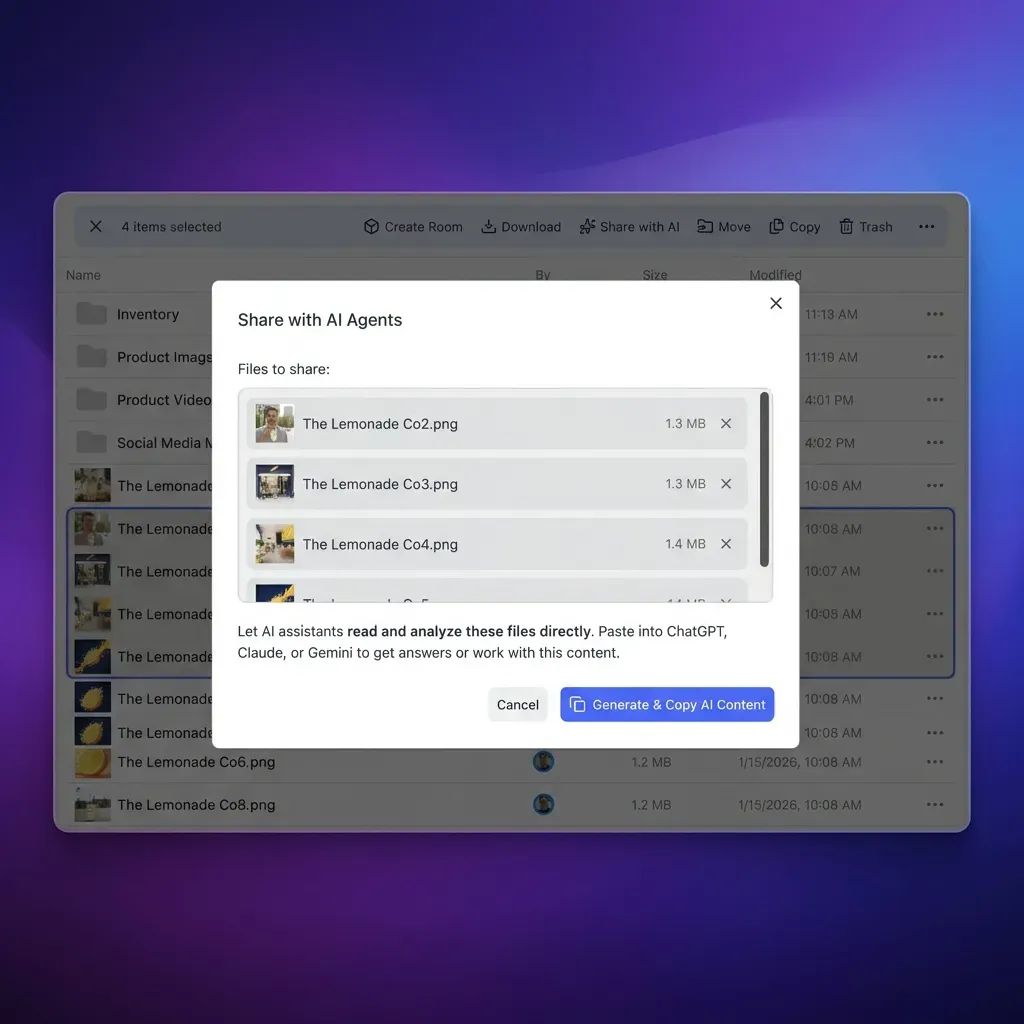
To address these file management challenges, growth teams can use Fast.io workspaces as a persistent storage layer. Fast.io provides shared org-owned workspaces where growth engineers, business managers, and AI agents collaborate on the same files. Fast.io serves as an intelligent workspace where files are indexed, searchable by meaning, and queryable through chat. Uploading an enriched CSV or sales document to Fast.io automatically indexes the content, making it immediately available for semantic search and AI retrieval.
If a script writes corrupt data or empty columns to a shared CSV file, Fast.io's per-file version history allows operators to restore prior versions instantly. This version tracking keeps concurrent agent writes auditable, preventing data loss. Fast.io maintains a detailed activity log, documenting every file read, write, and permission change. This log ensures that GTM operations remain secure and visible to administrators.
When dealing with unstructured lead sources, developers can configure Fast.io Metadata Views to automate data extraction. Instead of manual data entry, Metadata Views use AI to turn documents into a queryable database. For example, if a team receives inbound RFPs or partnership agreements as PDFs, Metadata Views extract counterparties, effective dates, and contract values into structured columns. This differs from Fast.io's Intelligence Mode, which focuses on semantic search and conversational document chat. Metadata Views serve as the structured extraction layer, preparing clean inputs that can be sent to Clay for enrichment.
Once the GTM pipeline is configured, developers can implement a clean handoff flow. An agent or developer can create the required workspaces, configure the folders and Metadata Views, and then transfer organization ownership to the human client via a claim link. The human manager starts a paid subscription to continue operations. Fast.io plans are billed transparently: Starter is $9.99/mo, Business is $49.99/mo, and Enterprise is $199.99/mo, starting with a 14-day Business Trial that requires a credit card. This handoff ensures that the client owns their GTM data, while the developer retains admin access to manage integrations in the background.
Bridging the Human-Agent Gap with MCP
To support complex automation, Fast.io provides a Model Context Protocol endpoint to support AI agent operations. Developers can review the agent onboarding guidelines at https://fast.io/llms.txt to align their custom bots. Fast.io offers a dedicated portal for agentic workflows at storage for agents. To review plan options and initiate a workspace, teams can visit the pricing page.
How to Optimize GTM Infrastructure and Budgets
Managing a modern GTM stack requires a balance between data coverage, execution speed, and budget. When scaling outbound pipelines, RevOps teams must design their workflows to avoid credit waste and API rate limiting. A poorly configured waterfall sequence can quickly exhaust monthly budgets on low-value prospects.
To optimize credit usage in Clay, start by cleaning lists before running enrichments. Use cheap domain verification tools to remove invalid business websites. When setting up waterfalls, place the lowest-cost B2B data providers at the top of the sequence. Only route records to premium mobile phone lookup services if the contact matches your high-priority buyer persona. This tiered execution structure ensures that expensive data credits are reserved for prospects with the highest probability of conversion.
When storing enriched datasets and collateral, set up a structured directory system inside your Fast.io workspaces. Separate raw lists, enriched outputs, and active sales collateral into distinct folders with granular permissions. Monitor Fast.io's WebSocket events feed or poll the activity feed to notify downstream tools when new files are added. This allows developers to build reactive pipelines where uploading an enriched CSV from Clay automatically triggers custom email sequences. By combining Clay's data orchestration with Fast.io's intelligent storage, organizations establish a secure, automated outbound engine that scales with their revenue goals.
Sources
References used to verify factual claims in this guide.
-
Single-source B2B data providers typically yield an email match rate between 35% and 60% for targeted prospect lists.
-
Waterfall data enrichment strategies, which sequence multiple B2B data vendors in a prioritized queue, reach contact match rates between 78% and 95%+ by automatically querying subsequent providers when the primary database returns a blank result.
-
The platform supports native data integrations with over 150 B2B providers.
-
Fast.io plans are billed transparently: Starter is $9.99/mo, Business is $49.99/mo, and Enterprise is $199.99/mo, starting with a 14-day Business Trial that requires a credit card.
Frequently Asked Questions
Is Clay a database tool?
Clay is a relational data orchestration platform rather than a traditional static database. While it stores records in a spreadsheet-like grid, its primary function is querying and syncing data across third-party B2B providers.
How does the Clay software work?
The clay software spreadsheet works by executing sequential API calls on every row. When a lead is added, Clay automatically queries B2B databases in a prioritized order, running subsequent searches only if the previous step returns no data.
Is Clay a scraper?
Clay includes web scraping capabilities but is primarily a data orchestration and integration layer. It goes beyond simple scrapers by standardizing data, running custom AI prompts via Claygent, and syncing records directly to CRMs.
Related Resources

Secure your Clay platform GTM run directories
A shared workspace with a Model Context Protocol endpoint for your sales engineering agents. Run enrichments, track version history, and transfer ownership when complete. Starts with a 14-day Business Trial.