How to Master WhatsApp AI Agent File Management
WhatsApp agents need more than text to be useful. Learn how to set up your bot to receive PDFs, images, and videos, and store them securely to bypass API limits.

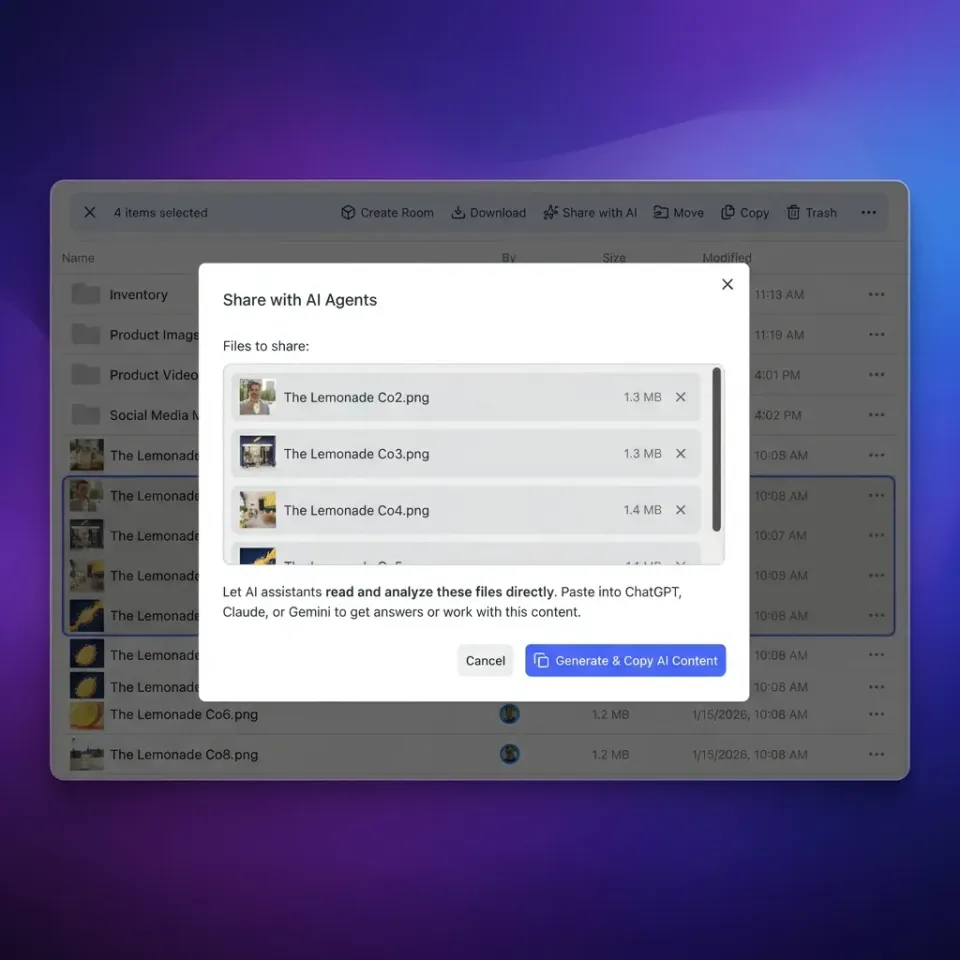
Why WhatsApp Agents Need File Management
WhatsApp is no longer just for text. With over 65% of WhatsApp Business messages including files, the ability for an agent to handle them is a requirement. Customers expect to snap a photo of a damaged product, upload a PDF invoice, or share a voice note, right in the chat. Adding file support lets bots receive invoices, send catalogs, and process support screenshots automatically.
Meta reports billions of messages sent every day. For businesses, that is a lot of data to catch and organize. If your agent can't handle files, it misses half the conversation. Handling files turns a basic bot into a real assistant that can do real work.
Helpful references: Fastio Workspaces, Fastio Collaboration, and Fastio AI.
Related guides
- How to Manage Files with the Gemini APIGoogle's Gemini API offers powerful multimodal capabilities, allowing you to analyze images, audio, and video directly....
- How to Manage Files for Image Generation AgentsImage generation agents create thousands of files in minutes. Learn how to organize prompts, version outputs, and...
- How to Manage Files in Rasa ChatbotsRasa file management includes storing conversation data, training files, model artifacts, and user documents. Rasa...
- How to Manage Files for Resume Parsing AgentsManaging files for resume parsing agents means organizing candidate documents for AI recruitment systems. Learn to...
- How to Set Up AI Agent File Indexing (The Easy Way)Most AI agent file indexing requires complex Python pipelines and vector databases. This guide shows you how to skip...
- Top 5 File Sharing Tools for AI WorkflowsOver 60% of AI workflows involve document or file processing. Multi-agent systems can generate hundreds of artifacts...
More on this subject: Agent File and Document Workflows (325 guides)
Real-World Applications of WhatsApp File Management
File skills change how businesses work. Here are some ways agents use files today.
1. Automated KYC and Onboarding Financial apps use WhatsApp agents to collect IDs securely. Users upload photos of their cards directly in the chat. The agent routes these files to secure storage where an OCR system checks the data, cutting onboarding time.
2. Insurance Claims Processing Speed matters in insurance. Customers involved in accidents can instantly share photos of damage, police reports, and medical records. An agent can organize these into a claim folder, tag them, and notify an adjuster, making the claim faster.
3. E-commerce Returns and Support Stores use agents to handle returns. Instead of logging into a portal, a customer can send a photo of the item. The agent checks the image to confirm the condition and sends a return shipping label as a PDF right in the chat.
4. Educational and Training Bots Schools use WhatsApp to send lessons. Students can receive lecture notes (PDFs), listen to guides (Audio), or watch clips (Video). They can also submit assignments by uploading documents, which the agent stores and forwards to grading systems.
Supported File Types and Storage Limits
The WhatsApp Business API supports specific file types and strict size limits. You need to know these limits to build a working agent.
Supported Formats:
- Documents: PDF, DOC, DOCX, PPT, PPTX, XLS, XLSX (Up to 100MB)
- Images: JPEG, PNG, WEBP (Up to 5MB)
- Video: MP4, 3GP (Up to 16MB)
- Audio: AAC, MP4, MPEG, AMR, OGG (Up to 16MB)
WhatsApp handles the delivery, but it does not provide long-term storage. Media URLs from the API are temporary. Your agent must download and store these files to a service like Fastio right away so you don't lose them.
How to Store Files from WhatsApp Bots
You need permanent storage for any serious automation. When an agent receives a file, it must move it from WhatsApp's temporary hosting to a secure, permanent spot.
The Storage Workflow:
- Receive Webhook: The agent gets a message notification with a media ID.
- Retrieve URL: The agent asks the API for a temporary download URL.
- Download and Store: The agent downloads the data and uploads it to Fastio.
- Index and Process: Once stored, the file is indexed for search and RAG applications once Intelligence is enabled for the workspace.
Fastio offers a 14-day Business Trial requiring a credit card, followed by paid plans starting at $9.99/mo. It works well for bots that need persistent storage without runaway cloud bills.
Handling API Limitations and Errors WhatsApp media links expire quickly, often in a few hours. This creates a race condition for your agent. You need good error handling. Your agent should retry failed downloads and check file integrity. If a download fails, the agent must be able to ask the user to upload again.


Give Your AI Agents Persistent Storage
Store, index, and retrieve files instantly.
Implementing RAG with WhatsApp Files
Retrieval-Augmented Generation (RAG) allows your AI agent to "read" the files it sends and receives. Connecting your agent to storage with indexing lets it answer questions from those documents.
For example, a customer service agent can receive a PDF manual, upload it to a Fastio workspace where, once Intelligence is enabled, it can immediately answer questions about it. This removes the need for a separate vector database, as the storage layer handles the retrieval.
Scenario: The Legal Assistant Bot Imagine a law firm using a WhatsApp bot. A client uploads a contract (PDF) for review. The agent stores the file, and the RAG system indexes the text. The client can then ask, "What is the termination clause?" The agent retrieves the section and gives an answer. This makes the file storage actually useful for the client.

Security and Compliance for Agent Files
Handling user files means you need good security. Files shared on WhatsApp often contain personal data, so encryption and access control are critical.
Best Practices:
- Encryption at Rest: Ensure your storage provider encrypts files on upload.
- Granular Permissions: Use Fastio's access controls so only authorized agents or humans see specific folders.
- Audit Trails: Keep a log of every file access. Fastio's audit logs show a history of agent interactions, which helps with troubleshooting.
Automated Data Expiration and Retention Regulations like privacy requirements often require deleting user data after a set time. Good systems let you set Time-to-Live (TTL) policies on files. For instance, ID docs can auto-delete after a set period so you don't keep data longer than you need.
Sources
References used to verify factual claims in this guide.
-
With over 65% of WhatsApp Business messages including files
-
Fastio offers a 14-day Business Trial requiring a credit card
-
WhatsApp Business API limits documents to 100MB, videos to 16MB, and images to 5MB
-
agent downloads an image from WhatsApp pass file to vision-enabled model like GPT-4o or Claude 3.5 Sonnet to analyze the content
Frequently Asked Questions
How do WhatsApp bots handle files?
WhatsApp bots handle files by receiving a media ID via webhook, retrieving a temporary download URL from the API, and then transferring the file to permanent cloud storage like Fastio for processing.
What is the file size limit for WhatsApp API?
The WhatsApp Business API generally limits documents to 100MB, videos to 16MB, and images to 5MB. Files larger than these limits cannot be sent or received through standard API messages.
Can AI agents analyze images sent on WhatsApp?
Yes, once an agent downloads an image from WhatsApp, it can pass the file to a vision-enabled model (like GPT-4o or Claude 3.5 Sonnet) to analyze the content and generate a text response.
Is WhatsApp file transfer secure?
WhatsApp uses end-to-end encryption for transmission. However, once the file reaches the business's agent, the business is responsible for storing it securely using encrypted storage solutions and proper access controls.
Do I need a database to store WhatsApp files?
You do not need a traditional database for the files themselves. You need object storage (like Fastio) for the actual files and can use metadata or a lightweight database to track file IDs and associations.
Related Resources

Give Your AI Agents Persistent Storage
Store, index, and retrieve files instantly.