How to Manage Files for Image Generation Agents
Image generation agents create thousands of files in minutes. Learn how to organize prompts, version outputs, and automate storage workflows to keep your creative library searchable and organized.

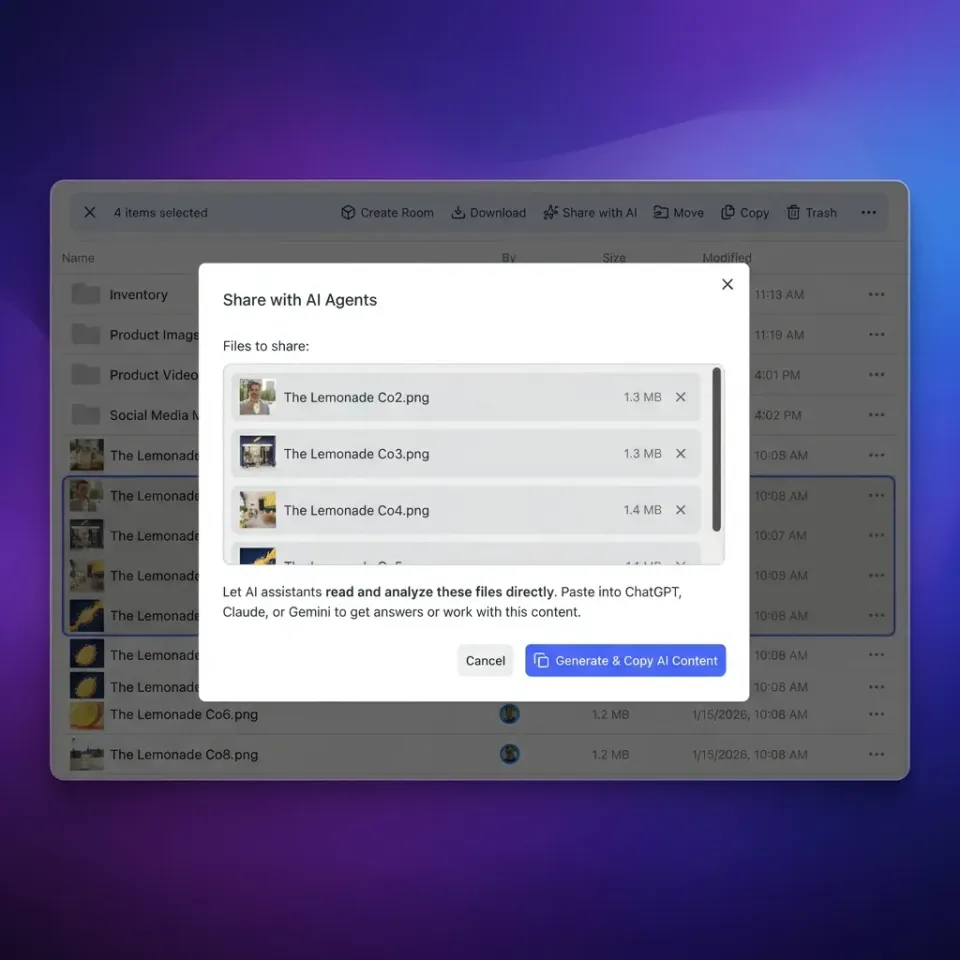
What to check before scaling image generation agent file management
Image generation is not just about creating art; it is a data problem. Unlike human designers who might produce a dozen iterations of a concept, an image generation agent can generate hundreds of variations per hour. Without a solid file management strategy, creative teams quickly drown in a sea of unnamed_001.png files.
The problem involves three data types:
- The Output: The final image file (PNG, JPG, WebP).
- The Recipe: The prompt, negative prompt, seed, and model version.
- The Context: Which project, campaign, or client the image belongs.
Effective image generation agent file management links these three elements permanently. If you lose the prompt (the recipe), you lose the ability to iterate or recreate the style.
Without a clear link between the prompt and the output, teams risk duplicating work. If a client requests a modification to an image generated three weeks ago, but the original prompt parameters (including the specific seed and model version) are lost, the designer essentially has to start from scratch. This lack of reproducibility wastes hours in professional workflows, turning what should be a quick tweak into a long recreation effort.
Helpful references: Fastio Workspaces, Fastio Collaboration, and Fastio AI.
Related guides
- How to Manage Files with the Gemini APIGoogle's Gemini API offers powerful multimodal capabilities, allowing you to analyze images, audio, and video directly....
- How to Manage Files in Rasa ChatbotsRasa file management includes storing conversation data, training files, model artifacts, and user documents. Rasa...
- How to Manage Files for Resume Parsing AgentsManaging files for resume parsing agents means organizing candidate documents for AI recruitment systems. Learn to...
- How to Manage AI Content Generation Agent FilesAI agents generate thousands of files: drafts, metadata, and images. Standard storage can't handle the volume. To keep...
- How to Master WhatsApp AI Agent File ManagementWhatsApp agents need more than text to be useful. Learn how to set up your bot to receive PDFs, images, and videos, and...
- Best AI File Organizers in 2026: 8 Tools That Actually Sort Your FilesMcKinsey estimates that employees spend 1.8 hours every day just searching for and gathering information. AI file...
More on this subject: Agent File and Document Workflows (325 guides)
Best Practices for AI Image Organization
Structuring your file system for AI outputs needs a different approach than traditional photography.
1. Hierarchy by Project, Then Date
Avoid dumping everything into a "Midjourney" folder. Structure your agent's output directory by intent:
Projects / [Client Name] / [Campaign] / [Date] / [Batch ID]
2. Consistent Naming Conventions Make your agent name files with meaning.
- Bad:
image_492.png - Good:
project-x_hero-banner_v4_seed-84920.png
3. Separate "Raw" from "Curated" AI agents generate noise. Create a "Raw" directory for the initial outputs, and a separate "Selects" directory for human-approved assets. This keeps your production library clean while preserving the raw data for future training or reference.
4. Flatten vs. Nested Structures Deep nesting (as shown above) works for humans, but some automated systems prefer flatter structures with rich metadata. If you are building a custom DAM (Digital Asset Management) system on top of your storage, consider a flatter hierarchy where folder names act as primary categories, but all other context is handled via tags or a database. For most teams using standard file explorers, a logical, deep hierarchy remains the most intuitive way to browse and ensures compatibility across different operating systems.

Metadata and Prompt Versioning
The prompt is the source code of your image. Managing it requires version control, just like software development.
Embed Metadata in Files advanced workflows embed the generation parameters directly into the image's EXIF or PNG chunks. Ensure your storage solution preserves this metadata. When files are compressed or converted (e.g., passing through a chat app), this data is often stripped.
Sidecar Files (JSON/YAML) For maximum compatibility, configure your agents to save a matching text file for every image:
castle_v1.pngcastle_v1.json(Contains prompt, seed, model hash, and workflow ID)
This "sidecar" approach makes sure that even if the image is edited or converted, the generation data remains accessible to your agents for future iterations.
Protecting Metadata Integrity Remember that many social media platforms and chat applications (like Slack, Discord, or WhatsApp) aggressively strip metadata to reduce file size. If you share an image via these channels, the recipient often receives a "lobotomized" file with no history. Always share the original file link or a zipped package to ensure the metadata survives the transfer. This is particularly important when handing off assets between the generation agent and the final compositing team.
Automating Workflows with Fastio Agents
Manual organization fails at scale. Fastio provides the infrastructure for AI agents to manage their own files programmatically.
Model Context Protocol (MCP) Fastio offers an MCP server with numerous tools, allowing agents (like Claude or custom Python scripts) to read, write, organize, and search files directly. Your agent can generate an image, save it to a specific project folder, and update a central index file without human intervention.
Intelligence Mode and RAG With Intelligence Mode enabled, Fastio automatically indexes your images and documents. You can ask your agent, "Find the cyberpunk city concepts we generated last week," and it will retrieve them based on semantic understanding, not just filenames.
Zero-Latency Handoff Because Fastio mounts cloud storage as a local drive or API, an agent can "save" a file that is instantly visible to your human design team. There is no "uploading" phase; the file appears in the shared workspace.
The Human-in-the-Loop Approval Chain You can configure a "Review" folder where the agent dumps high-quality candidates. A human creative director can then drag the best images into an "Approved" folder. This simple drag-and-drop move appears in the workspace activity feed, which the agent can watch as its signal to proceed with upscaling, creating variations, or publishing the asset to a web gallery. This creates a smooth collaboration where the AI handles the bulk generation and the human handles the curation.


Give Your AI Agents Persistent Storage
Stop juggling download folders.
Retention and Archival Strategies
Storage costs for AI images can grow quickly. Set up a lifecycle policy for your generative assets.
- Hot Storage: Keep active generation batches on high-performance storage for immediate review and selection.
- Warm Storage: Move "Selects" and "Candidates" here. Delete the "Raw" rejects from the Hot tier.
- Cold Storage: Archive only the final approved assets and their metadata.
Industry estimates suggest that few AI-generated images are ever used in production. Aggressive culling of the "Raw" folders is essential for sustainable file management.
Legal and Copyright Considerations As laws around AI copyright change, maintaining a clear chain of custody is key. Your archival strategy should not just store the final image but also the specific model version, seed, and prompt used to generate it. In the event of a copyright dispute or a need to prove human authorship (via significant modification or selection), having the original raw generation files and their creation timestamps serves as useful evidence of your creative process.
How to Choose the Right Storage
Not all storage is equal for AI workflows.
For teams building automated image pipelines, a storage layer designed for programmatic access stops bottlenecks and API throttling.
Sources
References used to verify factual claims in this guide.
-
Good filename project-x_hero-banner_v4_seed-84920
Frequently Asked Questions
How do I organize Midjourney outputs automatically?
You can use a Discord bot or a browser extension to auto-save Midjourney images to a local folder watched by Fastio. From there, an AI agent can analyze the filename (which often contains the prompt) and move the file to the correct project folder.
What is the best way to store AI prompts?
Store AI prompts as metadata embedded in the image file (PNG Info) or as sidecar JSON files. This keeps the 'recipe' permanently attached to the visual output, allowing you to recreate or iterate on the image later.
Can AI agents access files on my local computer?
Generally, cloud-based agents cannot access your local drive for security reasons. However, Fastio acts as a bridge: you sync your local folder to Fastio, and the agent accesses the files securely via the Fastio API or MCP server.
Does Fastio support vector search for images?
Yes, Fastio's Intelligence Mode indexes your content. While primarily text-based, it can index the descriptions, prompts, and metadata associated with images, allowing you to find assets using natural language queries.
Related Resources
