Top OpenClaw Workflows for AI Text-to-Video Generation
OpenClaw agents can generate video directly from text prompts, but the right workflow depends on what you are building. This guide ranks five text-to-video approaches available in the OpenClaw ecosystem, from the built-in video generation tool with 16 provider backends to full production pipelines like CellCog and ClawVid, with practical guidance on when each one fits.


How Text-to-Video Generation Works in OpenClaw
OpenClaw's text-to-video capability operates at two levels. The first is the built-in video generation tool that ships with OpenClaw and connects to 16 provider backends including Google Veo, OpenAI Sora, Runway, MiniMax, and fal. The second is the ClawHub skill ecosystem, where developers publish specialized video workflows that chain together multiple generation steps into a single agent interaction.
The built-in tool handles straightforward requests. Give your agent a text prompt, and it calls whichever video provider you have configured. For anything more complex (multi-scene sequences with narration, social media pipelines with analytics feedback loops, or long-form productions that coordinate several foundation models), you need a dedicated skill from ClawHub.
Most guides compare video providers like Runway and Sora in isolation, but they skip the agent orchestration layer that makes multi-step generation workflows possible. With advertiser bids on "ai text to video generation" reaching $25.68 per click, the commercial demand is real, and OpenClaw is the orchestration layer that ties individual providers into automated production pipelines.
Each workflow below is evaluated on four criteria: generation quality, speed, workflow complexity (how many manual steps you need), and output flexibility (formats, resolutions, and platform targeting).
Related guides
- How to Automate Video Review Workflows with Manus AIWhile AI-driven automation can slash initial video editing and rough-cut assembly times by up to 80%, creative teams...
- How to Build Scalable Lead Generation Workflows in ClayWaterfall enrichment increases contact find rates by up to 80%, yet many sales teams fail to scale outbound workflows...
- Best OpenClaw Workflows for AI Music Video and Lyric Video CreationOpenClaw 2026.4.5 shipped music_generate and video_generate as built-in tools, but most guides cover them in isolation....
- Best OpenClaw Workflows for AI Product Demo Video and Walkthrough CreationOpenClaw's ecosystem includes a dedicated demo-video skill that records browser walkthroughs through CDP screencast, a...
- Top OpenClaw Workflows for AI Video Dubbing and Lip SyncThe AI video translation market hit $2.68 billion in 2024 and is growing at 28.7% annually, yet most dubbing guides...
- Top OpenClaw Workflows for AI Image-to-Video ConversionOpenClaw's video_generate tool supports 13 providers for image-to-video conversion, each with different strengths. Some...
More on this subject: OpenClaw Workflows and Integrations (69 guides)
How We Evaluated These Workflows
We tested each workflow against practical production needs:
- Generation quality: Does the output look professional without manual cleanup? Can it handle motion coherence across scenes?
- Speed: How long from prompt to finished video? Does the workflow support async generation so your agent can continue other tasks?
- Workflow complexity: Is it one command, or does it require configuring multiple API keys and chaining skills together?
- Output flexibility: What resolutions, aspect ratios, and export formats does it support? Can it target specific platforms like YouTube or TikTok?
We also factored in provider coverage. A workflow that only works with one video model is fragile. Provider fallbacks matter when you are running batch generation and cannot afford failures to stall the pipeline.
The five workflows below range from zero-config (built-in tool, one provider key) to full production pipelines (multi-model orchestration with post-production). Pick the one that matches your actual needs.

Quick Comparison
Top 5 OpenClaw Text-to-Video Workflows
- Built-in video generation tool - 16 provider backends, multiple generation modes, async task handling, automatic provider fallback
- CellCog - Coordinates multiple foundation models to produce long-form videos from a single prompt, with scripting, voice synthesis, lipsync, and music scoring
- Genviral - Dozens of API commands covering the full social video lifecycle from trend research to multi-platform publishing with analytics feedback
- ai-video-gen - End-to-end pipeline chaining image generation, video synthesis, TTS narration, and FFmpeg editing into a single skill
- ClawVid (Composio + Remotion) - Open-source pipeline combining OpenClaw orchestration with Composio integrations, fal.ai generation, and Remotion rendering for faceless video production
Each targets a different production need. The built-in tool is the fastest path to a single clip. CellCog handles long-form content with narration and scoring. Genviral automates social media at scale. ai-video-gen gives you control over each generation stage. ClawVid is the most customizable option for developers willing to wire up the full stack.


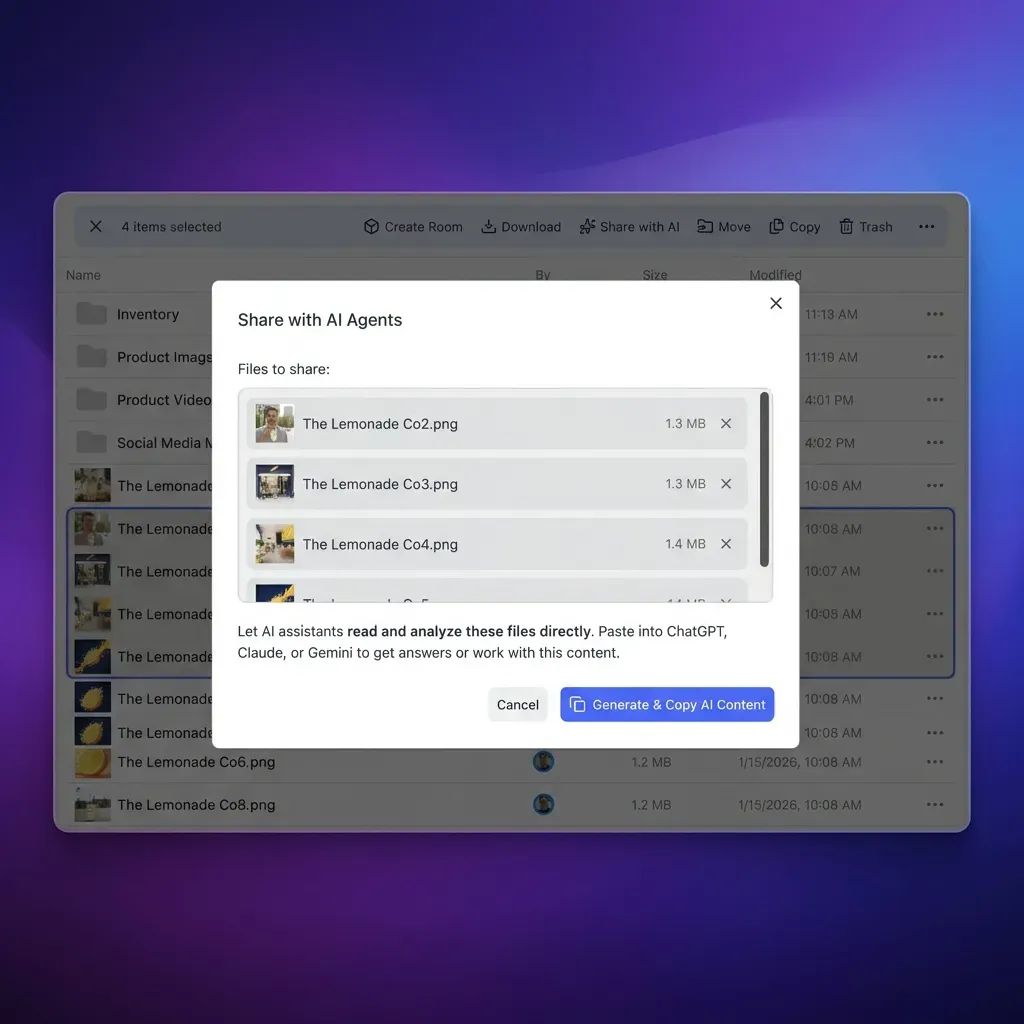
Give your video pipeline persistent storage and team review
Upload generated videos to a shared workspace where collaborators stream and comment. Generous storage, MCP endpoint ready for your OpenClaw agent.
1. Built-in Video Generation Tool
OpenClaw ships with a built-in video generation tool that requires no skill installation. If your agent has at least one video provider API key configured, the tool appears automatically.
The tool supports several generation modes: text-to-video from a prompt alone, image-to-video where reference images guide the visual output, and video-to-video where existing clips are transformed or extended based on your description. Generation runs asynchronously, so your agent submits the request and continues working. When the video is ready, OpenClaw delivers the finished file back to the conversation.
OpenClaw's official documentation lists 16 supported provider backends, including Google Veo, OpenAI Sora, Runway, BytePlus Seedance, MiniMax Hailuo, and Qwen/Alibaba Wan. You can set a primary provider and a fallback chain so that if your first choice fails or times out, the next provider picks up the request. This keeps batch workflows running even when a single provider has capacity issues.
Output controls include aspect ratio (1:1, 16:9, 9:16, adaptive), resolution options up to 4K, configurable duration, and toggles for audio and watermarks.
Best for: Single-clip generation where you need fast results with minimal setup. Works well for product demos, social media clips, and concept visualization.
Limitations: Each call produces one clip. Multi-scene sequences, narration, transitions, and post-production require additional tooling or a dedicated pipeline skill.
2. CellCog Multi-Model Production Pipeline
CellCog takes a fundamentally different approach from single-provider generation. Instead of routing your prompt to one video model, it coordinates multiple foundation models to handle every stage of video production: scriptwriting, scene generation, voice synthesis, lip synchronization, music scoring, and final editing.
The result is long-form video up to 4 minutes from a single text prompt. That puts CellCog in a different category from clip generators. Where the built-in tool produces a 10-second clip, CellCog produces a structured video with narration, synchronized visuals, background music, and scene transitions.
Available on ClawHub as part of the CellCog/VideoCog skill family. Search for it in the ClawHub directory and install it from your OpenClaw settings.
Supported output types:
- Marketing videos and product demos
- Explainer and educational content
- AI spokesperson videos with lip-synced narration
- UGC-style content
- Training materials
The multi-model orchestration handles tasks that would otherwise require manually chaining together separate skills for each production stage. CellCog manages the model coordination internally, so your agent sends one prompt and receives a finished video.
Best for: Long-form content production where you need narration, scene structure, and music scoring. Ideal for teams producing explainers, training videos, or marketing content at a regular cadence.
Limitations: More complex to configure than the built-in tool because it depends on API keys for multiple underlying models. Generation time is longer due to the multi-stage pipeline.
Storing and sharing generated videos: Once CellCog finishes rendering, your agent needs somewhere to put the output. Local disk works for testing, but production workflows need persistent storage that other team members can access. Fastio workspaces give your agent a place to upload finished videos, organize them by project, and share them with clients or teammates. The 14-day Business Trial provides workspace access, and videos uploaded to Fastio get HLS streaming out of the box, so reviewers can watch without downloading.
3. Genviral Social Video Automation
Genviral turns OpenClaw into a social media video factory. Where CellCog focuses on production quality for individual videos, Genviral optimizes for volume and distribution across TikTok, Instagram Reels, and YouTube Shorts.
The skill exposes 42 API commands covering the full content lifecycle:
- Research: Hashtag scraping and trend verification using TikTok data
- Scripting: 30-second scripts generated with hook, body, and CTA structure
- Production: Text-to-speech narration, clip matching from a media library, caption overlays, and transitions
- Publishing: Multi-platform upload with scheduling
- Analytics: Engagement metric collection feeding back into the next content cycle
The feedback loop is what separates Genviral from simpler generation tools. After publishing, the skill collects performance data and uses it to adjust hook formulas and posting strategies for subsequent videos. Over time, this closed-loop architecture means your agent learns which content formats perform best on each platform.
Install the Genviral skill from ClawHub and connect it to your social media accounts. The skill handles OAuth for each platform through the Genviral Partner API.
Best for: Content creators and marketing teams producing high-volume short-form video across multiple platforms. If you need dozens of videos per week with consistent branding and data-driven optimization, this is the workflow to evaluate.
Limitations: Focused on short-form social content. Not suited for longer explainers, product demos, or videos that need custom visual effects. The quality ceiling is lower than CellCog or a custom ClawVid pipeline because it prioritizes speed and volume.
4. ai-video-gen End-to-End Skill
The ai-video-gen skill bridges the gap between the built-in tool and a full production pipeline. It chains image generation, video synthesis, text-to-speech narration, and FFmpeg editing into a single skill, giving you more control over each stage than the built-in tool offers while requiring less setup than CellCog or ClawVid.
Available on ClawHub in the Image and Video Generation category, which hosts over 170 skills. ai-video-gen is one of the most downloaded in the video subcategory.
The skill supports multiple providers at each stage of the pipeline:
- Image generation: DALL-E, Stable Diffusion, Flux
- Video synthesis: LumaAI, Runway, Replicate
- Voice: OpenAI TTS, ElevenLabs
- Editing: FFmpeg for transitions, overlays, and final export
You can run it in budget mode (faster, lower-quality providers) or quality mode (premium providers with higher fidelity). The skill handles provider selection automatically based on your available API keys, or you can override at each stage.
Workflow options:
- Single-scene video from a text prompt
- Multi-scene sequence with transitions
- Image sequence converted to video with narration and music
The FFmpeg integration means your agent can add text overlays, watermarks, intro/outro segments, and custom transitions without leaving the OpenClaw session. This makes ai-video-gen a good middle ground for teams that want production features without building a custom pipeline.
Best for: Teams that want control over each generation stage (image, video, voice, edit) without wiring up a custom pipeline. Good for product walkthroughs, tutorial content, and internal presentations.
Limitations: The multi-provider approach means you may need several API keys configured. Quality depends heavily on which providers you have access to. The skill's FFmpeg integration handles common editing tasks, but complex post-production still requires dedicated video editing tools.
5. ClawVid Pipeline (Composio + Remotion)
ClawVid is an open-source pipeline that combines OpenClaw orchestration with Composio for API integrations, fal.ai for AI generation, and Remotion for programmatic video rendering. It is the most customizable option on this list and the best fit for developers who want full control over every stage of the pipeline.
The architecture breaks down into four layers:
- Orchestration: OpenClaw manages the workflow, handling prompt analysis, scene planning, and task sequencing
- Credentials: Composio provides OAuth access to 860+ SaaS tools without handling raw API keys
- Generation: fal.ai powers text-to-speech (Qwen 3 TTS with voice cloning), image generation, video clip synthesis, background music, and sound effects
- Rendering: Remotion assembles all assets into final video, and FFmpeg adds Whisper-powered word-level subtitles
The workflow proceeds in sequence: your agent analyzes the prompt, generates a workflow.json with timed scenes, creates narration audio first (so scene timing derives from actual audio length), generates visual assets, composes background audio, then renders the final output. Each video is exported in both 16:9 (YouTube) and 9:16 (TikTok/Shorts) formats.
The entire pipeline runs in Docker for isolation, and the output is a fully edited video with synchronized narration, visuals, music, and subtitles, produced without any camera footage or manual editing.
Best for: Developers building custom faceless video pipelines who want full control over the technology stack. The Remotion rendering layer is particularly valuable if you need programmatic control over layout, timing, and visual composition.
Limitations: Requires the most setup of any workflow on this list. You need OpenClaw, Composio, fal.ai, Remotion, FFmpeg, and Docker configured and running. This is a developer tool, not a plug-and-play skill.
Managing pipeline output at scale: A ClawVid pipeline producing daily content generates files fast. Local storage fills up, and collaborators need access to review and approve videos before publishing. Fastio's MCP server lets your agent upload rendered videos directly to a shared workspace, where team members can stream them via HLS and leave comments anchored to timestamps. The agent handles the upload; the human handles the review. That ownership transfer pattern, where the agent builds and hands control to a human through a claim link, keeps the production pipeline moving without bottlenecks.
Sources
References used to verify factual claims in this guide.
-
ClawHub's Image and Video Generation category hosts over 170 skills
-
'ai text to video generation' has $25.68 CPC indicating strong commercial intent
-
OpenClaw's official documentation lists 16 video generation provider backends
-
Genviral skill includes dozens of API commands covering the video production lifecycle
Frequently Asked Questions
Can OpenClaw generate videos from text?
Yes. OpenClaw includes a built-in video generation tool that connects to 16 provider backends including Google Veo, OpenAI Sora, and Runway. You send a text prompt, and the tool handles generation asynchronously, returning the finished video to your conversation when it is ready. For more complex workflows, ClawHub skills like ai-video-gen, CellCog, and Genviral extend the built-in capability with multi-stage pipelines.
What is the best AI text-to-video tool in OpenClaw?
It depends on what you are building. The built-in video generation tool is the fastest path to a single clip with automatic provider fallback. CellCog is the best choice for long-form content up to 4 minutes with narration and music. Genviral is optimized for high-volume social media production with analytics feedback. ai-video-gen gives you control over each pipeline stage. ClawVid offers the most customization for developers willing to set up the full stack.
How do I create videos with OpenClaw agents?
Configure at least one video provider API key (Google Veo, Runway, Sora, or any of the 16 supported backends) in your OpenClaw settings. Then ask your agent to generate a video from a text description. The agent uses the built-in video generation tool, which submits the request asynchronously and delivers the finished video when generation completes. For multi-scene videos with narration, install a ClawHub skill like ai-video-gen or CellCog that chains together multiple generation steps.
How many video generation providers does OpenClaw support?
OpenClaw supports 16 video generation provider backends. These include Google Veo, OpenAI Sora, Runway, BytePlus Seedance, MiniMax Hailuo, Qwen/Alibaba Wan, fal, ComfyUI, DeepInfra, OpenRouter, Together, xAI, and others. You can set a primary provider with fallbacks so generation continues automatically if one provider fails.
How do I store and share AI-generated videos from OpenClaw?
For production workflows, upload generated videos to a shared workspace like Fastio using the MCP server. Your agent can upload files directly via the Fastio MCP endpoint, and team members can stream videos through HLS and leave comments anchored to timestamps. A 14-day Business Trial is available.
What video formats and resolutions does OpenClaw support?
The built-in video generation tool supports aspect ratios including 1:1, 16:9, 9:16, and adaptive. Resolution options range from 480P to 4K depending on the provider. Duration is configurable in seconds, and some providers support audio generation alongside the video. Pipeline skills like ClawVid can export the same video in multiple formats simultaneously, such as 16:9 for YouTube and 9:16 for TikTok.
Related Resources

Give your video pipeline persistent storage and team review
Upload generated videos to a shared workspace where collaborators stream and comment. Generous storage, MCP endpoint ready for your OpenClaw agent.