Top 7 OpenClaw Tools for AI Reel Maker and Short-Form Video Creation
The short-form video market is growing at 30.33% annually, but most teams still produce only a few reels per week. This guide ranks seven OpenClaw tools and skills for automating reel creation across TikTok, Instagram Reels, and YouTube Shorts.


How We Evaluated These Tools
The short-form video market will reach $59.09 billion in 2026, growing at a 30.33% compound annual rate according to Business Research Insights. Meanwhile, 91% of businesses use video as a marketing tool (Wyzowl 2026), yet most teams still ship only a few videos per week because each reel demands scripting, voiceover, editing, captioning, and platform-specific formatting. OpenClaw's tool ecosystem compresses that multi-hour process into prompt-driven automation.
We scored each tool on five criteria: pipeline coverage (how many production stages it handles), provider flexibility (number of AI backends), platform targeting (TikTok, Reels, Shorts formatting), setup complexity, and post-production capabilities. Tools that automate the full pipeline score highest, while single-stage utilities earn points for depth in their specialty.
Here is a quick summary of all seven options:
- video_generate (built-in): 16 providers, generation only, zero setup
- Genviral: full pipeline from ideation to publishing, 42 API commands
- ClawVid: full pipeline with quality presets, TypeScript CLI
- ai-video-gen: text-to-video generation, simple skill install
- video-editor-ai: chat-based post-production, short-form export
- ffmpeg-video-editor: local FFmpeg processing, zero API costs
- eachlabs-video-edit: lip sync, translation, subtitle generation
Related guides
- Best n8n Tools for AI Agents: Top 10 Nodes for 2026n8n changed AI automation with its visual workflow builder. We rank the best nodes and integrations for building...
- Best Tools for CrewAI Agents: Top Picks for 2026CrewAI agents need good tools to be useful. The framework handles coordination, but external integrations let agents...
- Top OpenClaw Tools for AI TikTok and Short-Form Video OptimizationShort-form video ad spending hit $111 billion in 2025 and is projected to reach $145.8 billion by 2028, yet most TikTok...
- Top OpenClaw Tools for AI Color Grading and Video Post-ProductionColorists using AI tools report cutting grading time by 30 to 60 percent, yet most agent-driven video pipelines still...
- Top OpenClaw Tools for AI Photo Animation and Cinemagraph CreationThe AI image generator market reached $484 million in 2026, but most of that growth targets text-to-image creation....
- Best OpenClaw Tools for AI Video Editing AutomationOpenClaw's ecosystem includes both built-in video generation tools and community-developed editing skills that handle...
More on this subject: OpenClaw Tools (101 guides)
How Four Generation Tools Turn Prompts into Video Clips
These four tools handle the first stage of reel creation: turning a text prompt, image, or existing clip into new video footage. Each takes a different approach to provider access and pipeline depth.
A typical workflow starts with video_generate for a quick first draft since it ships with every session. Once you have raw footage worth developing further, Genviral or ClawVid adds the voiceover, captions, and platform formatting that make clips publishable. The tradeoff is setup time: video_generate needs zero configuration, while Genviral requires API keys for each connected service and ClawVid needs Node.js 18+, FFmpeg, and a fal.ai account. Start simple and add pipeline depth as your production volume grows.
1. video_generate (Built-In Tool)
OpenClaw's native video generation tool ships with every agent session. No installation, no skill activation. You type a prompt and the agent calls video_generate automatically.
The tool connects to 16 provider backends: Runway (Gen4.5), Google Veo (3.1), OpenAI Sora, xAI Grok, BytePlus Seedance, fal, MiniMax, DeepInfra, Alibaba, Qwen, ComfyUI, OpenRouter, Together, and Vydra. Three modes cover different starting points. The generate mode creates video from text alone. The imageToVideo mode accepts reference images alongside prompts. The videoToVideo mode transforms existing footage based on new descriptions.
For short-form content, set the aspectRatio parameter to 9:16 for TikTok and Reels or 16:9 for landscape Shorts. Resolution goes up to 4K, and durationSeconds caps clip length. Processing runs asynchronously: the agent gets a task ID while the provider renders in the background. If a provider fails, the tool tries the next configured backend automatically.
Key strengths:
- Zero setup. Available in every OpenClaw session without activation.
- 16 provider backends with automatic fallback chains.
- xAI supports up to 7 reference images for style-consistent series.
Key limitations:
- Generation only. No editing, captioning, or platform formatting.
- Results vary by provider since each model has different capabilities.
Best for: Quick clip generation when you need raw footage and plan to edit separately.
Pricing: Free to use (provider API costs apply per generation).
2. Genviral
Genviral is the most complete single-skill solution for short-form video on OpenClaw. It covers the entire production pipeline through 42 API commands, handling everything from finding trending topics to publishing the finished reel.
The pipeline runs in seven stages. Idea generation analyzes trending TikTok hashtags and YouTube search data. Script writing drafts platform-appropriate scripts with hooks and calls to action. Voiceover generates multilingual narration. The editor combines clips with transitions and text overlays. Thumbnail creation produces preview images sized for each platform. Scheduling publishes at optimal posting times. Analytics tracks engagement afterward so you can iterate on what performs.
Each platform gets specific treatment: trending sounds and hashtags for TikTok, branded stickers for Reels, and auto-captioning formatting for Shorts. The skill runs as modular open-source software, deployable locally or in a managed VM.
Key strengths:
- End-to-end automation from topic research through publishing.
- Platform-aware output with TikTok, Reels, and Shorts formatting.
- Built-in analytics for measuring performance and iterating.
Key limitations:
- Requires API keys for social platforms and text-to-speech services.
- Seven-stage pipeline means more configuration during initial setup.
Best for: Creators and marketing teams who want to automate their entire short-form video operation from ideation to analytics.
Pricing: Open source (API costs for connected services).
3. ClawVid
ClawVid is a TypeScript CLI tool that turns text prompts into rendered short-form videos. Where Genviral emphasizes the publishing pipeline, ClawVid focuses on production quality with voice cloning for consistent narration, word-level subtitle sync, and multi-track audio mixing.
The six-phase pipeline handles TTS generation with voice cloning, timing computation that matches scene durations to actual speech length, image generation via Kling Image v3, video creation via Kling 2.6 Pro, sound design, and background music production via Beatoven. Final rendering uses Remotion, a React-based video composition framework that gives you programmatic control over every frame.
Three quality presets control the tradeoff between render time and output fidelity: max_quality, balanced, and budget. Four built-in templates (horror, motivation, quiz, reddit) provide distinct visual treatments and color palettes. The template system keeps a branded look consistent across dozens of reels without manual styling.
Key strengths:
- Word-level subtitles via Whisper transcription for precise caption timing.
- Character and environment consistency across scenes using fixed-seed image generation.
- Quality presets let you trade render time for production value.
Key limitations:
- Requires Node.js 18+, FFmpeg, and a fal.ai API key.
- Currently in beta with 97 tests passing and edge cases still being hardened.
Best for: Developers building custom video pipelines who want fine-grained control over rendering quality and visual consistency.
Pricing: Open source (fal.ai API costs for AI model calls).
4. ai-video-gen
A ClawHub skill for straightforward text-to-video generation. It wraps AI video creation into a simpler interface than the built-in video_generate tool, targeting users who want a quick skill install rather than configuring multiple provider backends directly.
Key strengths:
- Simple setup through ClawHub skill install.
- Focused interface without provider configuration overhead.
Key limitations:
- Generation only. No editing or platform formatting included.
- Less provider flexibility than the built-in video_generate tool.
Best for: Quick experiments with AI video generation when you want minimal setup.
Pricing: Free skill install (provider API costs apply).
What Post-Production Skills Handle After Generation
Raw AI-generated clips rarely go straight to publishing. These three skills handle the post-production work: adding captions, applying effects, converting formats, and localizing content for international audiences.
The most practical sequence is subtitles first (since they affect pacing and readability), then effects and transitions, then a final format pass for the target platform. For example, you might run video-editor-ai to add captions and background music to a clip generated by video_generate, then use ffmpeg-video-editor to batch-convert the result into 9:16 for TikTok and 1:1 for Instagram feed posts. If you distribute internationally, eachlabs-video-edit slots in at the end to dub and lip-sync before export.
5. video-editor-ai
This ClawHub skill turns your OpenClaw agent into a video editor that works through natural language. Hand it an MP4 file and describe what you want: add background music, insert subtitles, apply a fade transition, trim to 30 seconds for Reels. The skill handles formatting differences between platforms without requiring you to memorize specifications. TikTok gets 9:16 output with trending audio support. Instagram Reels gets 9:16 with branded overlay options. YouTube Shorts supports both aspect ratios.
Key strengths:
- Chat-based editing removes the need for timeline software.
- Direct export targeting TikTok, Reels, and Shorts formats.
- Works with existing footage, not just AI-generated clips.
Key limitations:
- Processes one file at a time rather than batch operations.
- Complex multi-step edits may require detailed prompting.
Best for: Adding polish to raw clips before publishing, especially for creators without video editing experience.
Pricing: Free skill (no external API required for basic operations).
6. ffmpeg-video-editor
This skill translates natural language descriptions into FFmpeg commands. "Trim the first 5 seconds, add a 1-second fade-in, and export at 1080x1920 for TikTok" becomes the correct FFmpeg pipeline without you writing a single flag.
Because everything runs locally through FFmpeg, there are no API costs and no data leaves your machine. That makes it particularly useful for batch processing: convert a folder of raw clips to Reels-ready format, normalize audio levels across a content series, or extract frames for thumbnail generation.
Key strengths:
- Zero API costs. All processing runs locally.
- Supports any format FFmpeg handles.
- Batch processing for high-volume production runs.
Key limitations:
- No AI-powered effects or generation. Strictly format transformations.
- Requires FFmpeg installed on your system.
Best for: Batch format conversion, trimming, and audio normalization when you already have source footage.
Pricing: Completely free with no API keys needed.
7. eachlabs-video-edit
EachLabs specializes in three capabilities most other tools skip: lip synchronization, video translation, and AI-driven subtitle generation. Feed it a video in English, and it dubs the audio into another language while adjusting mouth movements to match the new speech patterns.
For short-form creators targeting international audiences, this removes the biggest barrier to localization. A single reel can reach TikTok users in Brazil, Instagram users in Japan, and YouTube viewers in Germany without re-recording anything.
Key strengths:
- Lip sync produces natural-looking dubbed content.
- Multi-language support opens international distribution from a single source video.
- AI subtitle generation handles timing automatically.
Key limitations:
- Requires an EachLabs API account with separate billing.
- Focused on localization rather than general-purpose editing.
Best for: Creators distributing content across languages and regions.
Pricing: Free skill install (EachLabs API pricing applies per operation).


Store and share your AI-generated reels in one workspace
Your OpenClaw agent writes generated reels through the MCP server, your team reviews them in the browser, and approved content ships from a single workspace. Monthly plans start with a free trial of up to 14 days.
Connecting the Pipeline with Persistent Storage
Most practical workflows chain several of these tools together. Genviral or video_generate creates raw footage, video-editor-ai adds captions and effects, and ffmpeg-video-editor handles final format conversion. The gap that often stalls production is persistent storage: a place where generated assets survive between pipeline stages and where finished reels wait for human review before publishing.
Local file systems work for single-session experiments, but they fall short when agents run across sessions, when teams need to review output before publishing, or when you want audit trails of what was generated and when. Cloud object storage like S3 or Google Cloud Storage handles the durability problem but lacks workspace-level organization and an easy way for non-technical team members to review files.
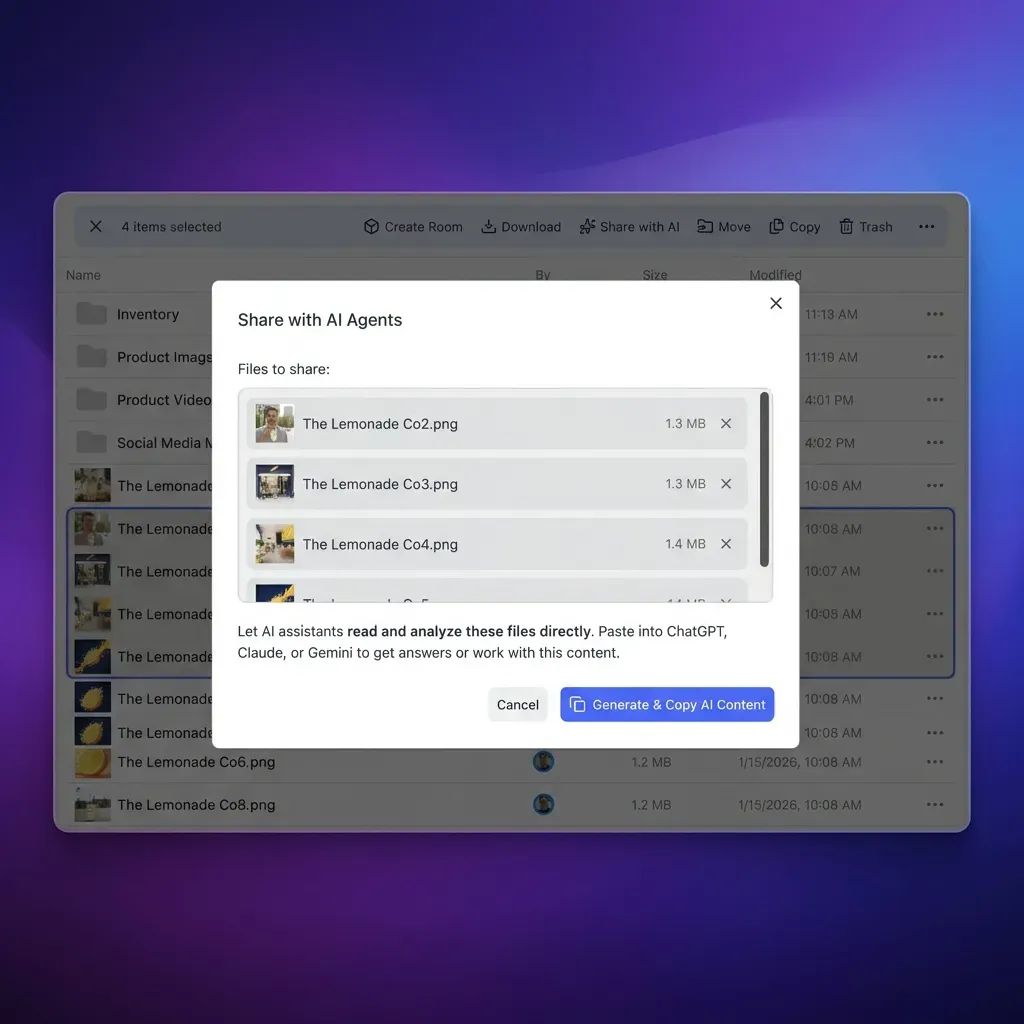
Fast.io fills this gap as a workspace layer built for agent output. An OpenClaw agent writes generated reels to a Fast.io workspace through the MCP server, and team members review them through the web interface. Intelligence Mode auto-indexes uploaded videos for semantic search and AI chat, so you can query your content library without tagging files manually. When content is approved, ownership transfer hands the workspace from agent to human without losing admin access.
Monthly plans start with a trial of up to 14 days, with storage, monthly credits, and workspaces scaled to each paid plan. For a team producing 10 to 20 reels per week, that covers several months of output alongside source assets.
Which Tool Should You Choose?
The right pick depends on how much of the pipeline you want to automate and whether you're starting from text prompts or existing footage.
Start with video_generate if you need raw video clips from text descriptions. It ships with every OpenClaw session, connects to 16 providers, and requires zero setup.
Choose Genviral if you want a complete pipeline covering trending topic research, scripting, voiceover, editing, thumbnails, scheduling, and analytics in one skill. The setup takes longer, but you get full automation from idea to published reel.
Pick ClawVid if you're a developer who wants control over rendering quality, subtitle timing, and visual consistency through a TypeScript CLI with quality presets and templates.
Reach for video-editor-ai when you have footage that needs captions, music, or effects applied through natural language chat. Pair it with ffmpeg-video-editor for batch format conversion at zero API cost.
Add eachlabs-video-edit when you're distributing content internationally and need lip-synced dubbing without re-recording.
For a team producing daily reels, the strongest combination is Genviral or ClawVid for generation, video-editor-ai for post-production polish, and Fast.io for persistent storage and human review. That covers the full cycle from idea through approved, published content.
Sources
References used to verify factual claims in this guide.
-
Short-form video market projected to reach $59.09 billion in 2026 at 30.33% CAGR
-
91% of businesses use video as a marketing tool
-
video_generate supports 16 provider backends
-
Genviral provides 42 API commands covering the entire video production pipeline
Frequently Asked Questions
What is the best AI reel maker?
For OpenClaw users, Genviral covers the most production stages in a single skill. It handles trending topic research, script writing, voiceover generation, video editing, thumbnail creation, scheduling, and analytics. If you need finer control over rendering quality and subtitle timing, ClawVid provides quality presets and word-level caption sync through a TypeScript CLI.
Can OpenClaw create TikTok videos?
Yes. The built-in video_generate tool supports 9:16 aspect ratio output formatted for TikTok. Skills like Genviral and video-editor-ai add trending sounds, hashtags, and TikTok-specific formatting to finished videos before publishing them to the platform.
How do you automate short-form video creation?
Install a pipeline skill like Genviral that covers ideation through publishing, or chain individual tools together. Use video_generate for raw clips, video-editor-ai for captions and effects, and ffmpeg-video-editor for final format conversion. Store outputs in a persistent workspace so your team can review and approve content before it goes live.
What AI tools make Instagram Reels?
On OpenClaw, video_generate creates raw video clips at Reels-native 9:16 resolution. Genviral adds Reels-specific formatting including branded stickers and auto-captioning. ClawVid renders complete Reels from text prompts with word-level subtitles. For editing existing footage into Reels format, the video-editor-ai skill handles post-production through natural language chat.
Related Resources

Store and share your AI-generated reels in one workspace
Your OpenClaw agent writes generated reels through the MCP server, your team reviews them in the browser, and approved content ships from a single workspace. Monthly plans start with a free trial of up to 14 days.