Top OpenClaw Tools for AI Object Removal and Image Inpainting
The video object removal AI market hit $1.27 billion in 2024, but most guides still cover standalone apps that process one image at a time. OpenClaw skills bring inpainting into agentic workflows where detection, mask generation, removal, and batch delivery happen in a single conversation. This guide ranks five OpenClaw tools by model quality, speed, and batch capability so you can pick the right one for your editing pipeline.

Why Agentic Inpainting Beats Standalone Object Removal Apps
The global video object removal AI market reached $1.27 billion in 2024 and is projected to grow at 21.5% CAGR through 2033, according to Growth Market Reports. Yet the tools driving that growth are mostly browser-based editors where you upload one image, paint a mask, wait, and download. Scale a cleanup job to 50 product photos and the manual overhead erases the time savings.
OpenClaw changes the model. Because it runs locally and connects to external APIs through installable skills, you can describe what to remove in plain language, let the agent generate masks, call an inpainting API, and save the output, all without leaving your terminal or chat window. Chain that with a file management skill and you get batch processing: point the agent at a folder of photos, specify "remove the watermark in the bottom-right corner," and walk away.
The five skills below each take a different approach. Some route through a single vendor API. Others aggregate dozens of models behind one interface. The right choice depends on whether you need raw model variety, video support, or tight cost control.
Most existing object removal guides cover Photoshop generative fill, Canva's magic eraser, or web tools like Cleanup.pictures. None of them cover the agentic workflow where OpenClaw chains detection, removal, and delivery into a repeatable pipeline. That gap is what this guide fills.
Related guides
- Best n8n Tools for AI Agents: Top 10 Nodes for 2026n8n changed AI automation with its visual workflow builder. We rank the best nodes and integrations for building...
- Best Tools for CrewAI Agents: Top Picks for 2026CrewAI agents need good tools to be useful. The framework handles coordination, but external integrations let agents...
- 5 Best OpenClaw Tools for AI Watermark Removal and Image CleanupThe keyword "ai watermark remover" draws 14,800 monthly searches in the US, yet most guides cover standalone browser...
- 7 Best OpenClaw Tools for AI Image Outpainting and Canvas ExpansionOpenClaw's skill registry grew from 2,857 skills in January 2026 to over 13,700 by late February, but finding the right...
- 8 OpenClaw Skills for AI Visual Search and Reverse Image LookupGoogle Lens now handles over 20 billion visual searches per month, up 43% from 2024, but most of that capability stays...
- Top OpenClaw Tools for AI Image Quality Checking and ScoringOpenClaw's skill ecosystem spans thousands of community-built tools, but only a handful focus on quantitative image...
More on this subject: OpenClaw Tools (101 guides)
How We Evaluated These OpenClaw Skills
Not every image editing skill on ClawHub is useful for object removal. We filtered the 44,000+ skill registry down to tools that explicitly support inpainting or object erasure, then ranked them on three criteria:
Model quality and variety. Does the skill route through proven inpainting models like Flux Fill Pro, Stable Diffusion Inpainting, or GPT Image 2? More model options means better results across different image types (photos, illustrations, product shots).
Batch and automation capability. Can you point the skill at a folder of images and process them without manual intervention? Object removal is repetitive work. A skill that handles one image at a time saves less time than one that processes a queue.
Speed and cost. Inpainting is compute-heavy. We noted whether each skill charges per request, offers a free tier, or requires a separate API key with its own billing.
The tools below are ordered by breadth of inpainting capability, from the most versatile to the most specialized.
Quick Comparison: Top 5 OpenClaw Inpainting Skills
Each skill fills a different niche. The sections below break down what each one does well and where it falls short.
1. eachlabs-image-edit
The eachlabs-image-edit skill is the broadest option for object removal inside OpenClaw. It connects to EachLabs' Predictions API and routes requests through 200+ AI models, including dedicated inpainting models like Flux Fill Pro and Stable Diffusion Inpainting. Background removal uses Rembg and EachLabs' own BG Remover. Install it from ClawHub with the skill ID eftalyurtseven/eachlabs-image-edit.
The workflow is straightforward: you provide an image and a text prompt describing what to remove, the skill selects an appropriate model, submits a prediction, polls for completion, and returns the output URL. For mask-based inpainting, you supply a mask image where transparent areas mark the regions to regenerate.
Key Strengths:
- Covers inpainting, background removal, upscaling, style transfer, and face manipulation in one skill
- Model variety means you can try Flux Fill Pro for photorealistic fills and switch to Stable Diffusion for stylized content
- API-based architecture means you can script batch jobs by calling the prediction endpoint in a loop
Key Limitations:
- Requires an EachLabs API key (sign up at eachlabs.ai)
- No built-in batch endpoint. Batch processing depends on your agent scripting the API calls sequentially
- Poll-based completion can add latency for large queues
Best For: Teams processing diverse image types who want one skill to cover inpainting, background removal, and upscaling without installing three separate tools.
Pricing: Pay-per-prediction through EachLabs. Rates vary by model.
Skill Page: clawskills.sh/skills/eftalyurtseven-eachlabs-image-edit


Store and share your edited images from one workspace
Persistent workspace with MCP access for your OpenClaw agent. Upload inpainting results, organize by project, and share with clients.
2. ai-image-generation
The ai-image-generation skill aggregates 50+ image models from several providers into a single OpenClaw interface. Instead of committing to one vendor's inpainting engine, you pick the model that fits the image you are editing. Inpainting sits alongside text-to-image generation, image-to-image conversion, upscaling, and text rendering as a supported capability.
The workflow centers on providing a reference image and a prompt describing what to change. The skill routes your request to the selected model, and you get back the edited result. Because each request targets a specific model, you can test different engines on the same image and compare output quality before committing to a batch run.
Key Strengths:
- 50+ models across providers let you match the inpainting engine to the image type (photorealistic, illustrated, product shots)
- Covers generation, inpainting, upscaling, and text rendering in one skill, reducing the number of tools you need installed
- Supports scripting batch operations by calling the skill repeatedly across a list of files
Key Limitations:
- Choosing the right model requires some familiarity with which engines handle inpainting well for specific image types
- Per-model pricing varies across providers, so costs are harder to predict upfront
- Setup involves configuring provider credentials separately from the OpenClaw skill itself
Best For: Users who want to compare multiple inpainting models and pick the best output per image rather than relying on a single engine.
Pricing: Per-prediction, billed through the underlying model provider.
Skill Page: github.com/VoltAgent/awesome-openclaw-skills
3. Recraft
Recraft's OpenClaw skill exposes the full Recraft API inside any OpenClaw conversation. For object removal, the relevant capabilities are background removal, prompt-based editing, and vectorization. You install it by typing /recraft in a conversation, confirming the tool registration, and pasting your Recraft API key.
The background removal feature uses Recraft's V3 model, which handles both raster and vector output. Prompt-based editing lets you describe changes ("remove the lamp from the desk") rather than supplying a mask image, which lowers the barrier for non-technical users. Recraft also supports batch jobs through its API, so agents can queue multiple edits and retrieve results asynchronously.
Recraft also offers MCP (Model Context Protocol) connectivity, meaning you can wire it into custom workflows outside OpenClaw if your pipeline requires it.
Key Strengths:
- Prompt-based editing means no mask creation required for simple removals
- Batch job support through the API for processing image queues
- Outputs both raster and vector formats, useful for design workflows
Key Limitations:
- Single model family (Recraft V3). You cannot switch to Flux or Stable Diffusion if Recraft's output does not match your needs
- Per-request billing adds up for high-volume jobs
Best For: Designers who want prompt-driven editing without mask creation and need both raster and vector output.
Pricing: Free to install. Usage billed per request, with rates varying by operation type.
Install: Type /recraft in any OpenClaw conversation.
4. ObjectRemover
ObjectRemover takes a different approach from the model-aggregator skills above. It is a dedicated object removal service with its own proprietary AI that specializes in erasing elements from both photos and videos. The OpenClaw skill connects to the ObjectRemover API, letting your agent describe what to remove in natural language rather than painting a mask.
The standout feature is video support. While most inpainting skills focus on still images, ObjectRemover handles MP4 and MOV files up to 500 MB. Its "Geometry-Aware AI" tracks objects across frames, so a removed element stays gone without flickering or ghosting. For still images, it supports JPG, PNG, and WebP.
Setup involves installing the skill directory, generating an API key from your ObjectRemover profile, and configuring it with openclaw env set OBJECTREMOVER_API_KEY.
Key Strengths:
- Video object removal with frame-consistent tracking
- Natural language object selection ("remove all watermarks") instead of manual mask painting
- Free browser-based tier for testing before committing to API usage
Key Limitations:
- Proprietary model with no option to switch engines
- Processes one file at a time through the API. Batch processing requires agent-side scripting
- 500 MB file size limit
Best For: Video editors and content creators who need frame-consistent object removal from video clips, not just still images.
Pricing: Free browser tier (no credit card). Paid plans for API access and higher volume.
Skill Page: objectremover.video
Storing and Sharing Edited Images with Fastio
Object removal is the editing step, but the files need to go somewhere after processing. Local folders work for personal projects. S3 or Google Cloud Storage handles volume. But when an agent is doing the editing and a human needs to review and approve the results, you need a workspace that both can access.
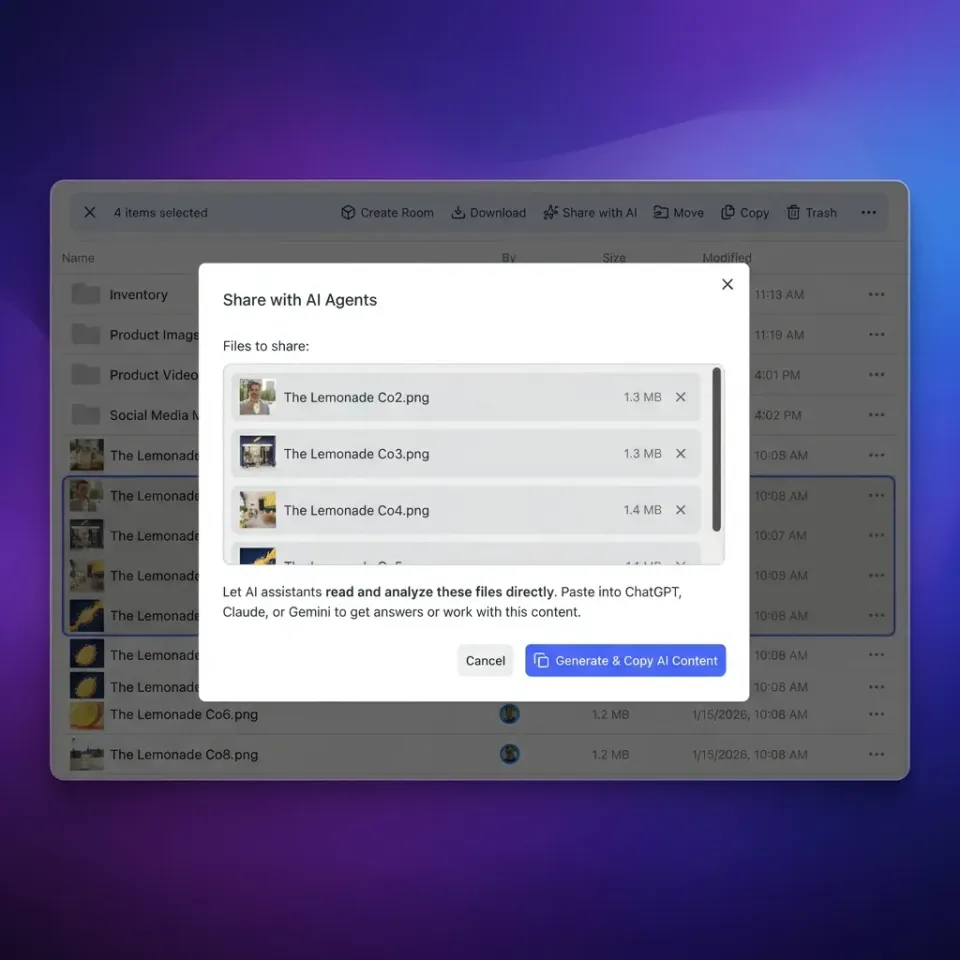
Fastio is built for this handoff. It provides persistent workspaces where agents write files via the MCP server and humans browse the same workspace through the web UI. After your OpenClaw agent finishes an inpainting batch, it can upload the results to a Fastio workspace, organize them into folders, and create a branded share link for your client or team.
The practical setup: connect OpenClaw to the Fastio remote MCP server, connect it to your workspace, and add an upload step after your inpainting skill runs. The MCP server exposes a consolidated toolset for file management, including upload, organize, and share operations. Once Intelligence is enabled for the workspace, it auto-indexes uploaded files, so you can later search edited images by visual content or metadata.
Fastio offers a 14-day Business Trial (credit card required) with paid plans starting at $9.99/mo for Starter (250 GB) and storage reaching 25 TB on the Enterprise plan. For an image editing pipeline, that covers thousands of processed photos. You can sign up at fast.io/storage-for-openclaw.
Which OpenClaw Inpainting Skill Should You Choose?
The right skill depends on your volume, your file types, and how much control you want over model selection.
If you process a mix of product photos, portraits, and illustrations and want one skill to cover everything, start with eachlabs-image-edit. Its 200+ model library means you can match the right inpainting engine to each image type without installing additional skills.
If you are a developer building a custom pipeline and want to call specific models by ID, the ai-image-generation skill with inference.sh gives you that control. It is the most scriptable option.
If you work in design and want to describe edits in plain language without creating masks, Recraft is the lowest-friction choice. Its prompt-based editing and vector output make it practical for brand asset cleanup.
If you need to remove objects from video, ObjectRemover is the only skill on this list with frame-consistent video processing. No other OpenClaw skill handles video inpainting this cleanly.
For any of these workflows, pair your editing skill with a persistent storage layer. Local folders work for solo projects, but team handoffs and client delivery benefit from a shared workspace. The Fastio MCP skill connects directly to OpenClaw and adds upload, version tracking, and share link generation to your pipeline.
Sources
References used to verify factual claims in this guide.
-
The global video object removal AI market reached $1.27 billion in 2024
-
The parent keyword ai object removal has 2,900 monthly searches in the US
-
eachlabs-image-edit supports inpainting via 200+ AI models
-
ClawHub hosts over 44,000 community-built skills
Frequently Asked Questions
What is the best AI tool for removing objects from photos?
For OpenClaw users, eachlabs-image-edit offers the broadest model selection with 200+ AI models including dedicated inpainting engines like Flux Fill Pro. For video object removal, ObjectRemover is the strongest option because it tracks objects across frames. Outside of OpenClaw, tools like Adobe Photoshop Generative Fill and Cleanup.pictures are popular standalone alternatives.
How does AI inpainting work?
AI inpainting uses diffusion models to reconstruct missing or masked regions of an image. You mark the area to remove (either by painting a mask or describing the object in text), and the model generates new pixels based on the surrounding context. Modern inpainting models understand scene structure, so they reconstruct backgrounds with correct perspective, lighting, and texture rather than blurring the area.
Can OpenClaw remove objects from multiple images at once?
Yes, but batch processing depends on the skill and your scripting. Skills like eachlabs-image-edit and ai-image-generation expose APIs that agents can call in a loop, processing a folder of images sequentially. Recraft supports batch jobs through its API. The agent handles the orchestration, iterating over files, submitting predictions, and collecting results. None of the skills listed here have a single "process this folder" button, but the agentic workflow makes batch jobs practical.
Do I need to create masks manually for AI object removal?
Not always. ObjectRemover and Recraft support natural language selection, where you describe what to remove and the AI identifies it. For more precise control, eachlabs-image-edit and ai-image-generation accept mask images where transparent regions mark the areas to regenerate. The choice depends on whether you need pixel-level accuracy or conversational convenience.
What file formats do OpenClaw inpainting skills support?
Most skills support standard image formats including JPG, PNG, and WebP. ObjectRemover Also, supports MP4 and MOV video files up to 500 MB. Output formats vary by model, with some skills returning URLs to download the processed image and others saving directly to your local filesystem.
Related Resources

Store and share your edited images from one workspace
Persistent workspace with MCP access for your OpenClaw agent. Upload inpainting results, organize by project, and share with clients.