Top OpenClaw Tools for AI Image Quality Checking and Scoring
OpenClaw's skill ecosystem spans thousands of community-built tools, but only a handful focus on quantitative image quality assessment. This guide compares the top OpenClaw skills for scoring image composition, detecting AI-generated content, analyzing color profiles, and running multimodal visual checks, with practical advice on storing and querying results at scale.


Why OpenClaw Agents Need Structured Image Scoring
The VoltAgent curated skill registry catalogs over 5,400 OpenClaw skills across dozens of categories. Browse the image-and-video-generation listing, and generation tools outnumber analysis tools by roughly ten to one. Most skills create, edit, or upscale images. Far fewer return structured quality scores.
OpenClaw image quality tools are skills that automatically analyze visual properties of images, including composition, clarity, color balance, and structural integrity, and return quantified scores or targeted improvement suggestions. They differ from general vision model queries because their output is structured and repeatable: the same image produces the same scores on every run.
That distinction matters for production pipelines. An agent generating product photos or social content needs more than a vision model's opinion. It needs thresholds: reject any image where empty space dominates the frame, flag anything with signs of AI generation artifacts, ensure color palettes stay within brand guidelines. Without numeric scores, agents can't filter, rank, or feed corrections back to the generation step.
The vtl-image-analysis skill, contributed via PR #22726 on the OpenClaw repository, is one of the first structured scoring frameworks in the ecosystem. It returns five deterministic compositional coordinates for any input image, no model fine-tuning required. That level of specificity is what separates quality scoring from general visual analysis.

Related guides
- Best n8n Tools for AI Agents: Top 10 Nodes for 2026n8n changed AI automation with its visual workflow builder. We rank the best nodes and integrations for building...
- Best Tools for CrewAI Agents: Top Picks for 2026CrewAI agents need good tools to be useful. The framework handles coordination, but external integrations let agents...
- 5 Best OpenClaw Skills for AI Content Scoring and Quality GradingClawHub hosts over 44,000 skills, but fewer than a dozen specifically address content quality scoring as distinct from...
- 5 Best OpenClaw Tools for AI Watermark Removal and Image CleanupThe keyword "ai watermark remover" draws 14,800 monthly searches in the US, yet most guides cover standalone browser...
- Top OpenClaw Tools for AI Grammar and Style CheckingAI detection tools now identify fully machine-generated text with 89% accuracy, which means agents that write need...
- 7 Best OpenClaw Tools for AI Image Outpainting and Canvas ExpansionOpenClaw's skill registry grew from 2,857 skills in January 2026 to over 13,700 by late February, but finding the right...
More on this subject: OpenClaw Tools (101 guides)
How We Evaluated These Skills
We assessed each tool against four criteria before ranking.
Scoring dimensions counts how many distinct quality aspects the tool quantifies. A skill that returns five compositional scores ranks higher than one that outputs a single pass/fail label.
Automation fit captures whether the tool works in an unattended pipeline. Skills that accept an image path and return structured JSON without per-run configuration score well here.
Output format distinguishes between numeric scores, classification labels, and unstructured text. Numeric scores plug directly into filtering and ranking logic, making them the most composable option for downstream automation.
Pricing notes the cost model. Free and open-source skills rank highest since they scale without budget constraints.
Compositional and Detection Skills
These skills return structured, deterministic output. They measure specific image properties and report results that an agent can filter and threshold against without additional parsing.
1. vtl-image-analysis
The vtl-image-analysis skill applies the Visual Thinking Lens framework to measure compositional structure in images. Contributed by rusparrish via PR #22726 on the OpenClaw repository, it evaluates five deterministic coordinates: placement offset (how far subjects deviate from compositional anchors), void ratio (proportion of unused space), packing density (how tightly visual elements are arranged), curvature torque (variation in curved compositional lines), and radial compliance (how well elements follow radial patterns).
Each metric returns a numeric value, making it straightforward to set thresholds. An agent generating marketing visuals could reject any image with a void ratio above a configured limit or flag compositions where the placement offset exceeds tolerance. The skill also includes a refusal gate: images that are invalid or too low-signal to analyze trigger a hard stop rather than returning fabricated scores. This prevents garbage-in, garbage-out results from polluting your scoring pipeline.
The underlying VTL framework is designed to expose compositional collapse and spatial priors in AI-generated images without accessing model internals or training data. It works as a black-box evaluation layer that sits between generation and distribution.
Key Strengths:
- Five independent compositional metrics with deterministic, repeatable output
- Refusal gate rejects invalid or low-signal input instead of guessing
- Built specifically for evaluating AI-generated images
Key Limitations:
- Focuses on composition only, not technical quality metrics like sharpness or noise
- A security review flagged the safe_eval function in the regeneration module
Best For: Quantifying compositional quality in generated image batches with hard thresholds.
Pricing: Free and open source.
2. image-detection
The image-detection skill analyzes images to classify whether they were AI-generated. Listed in the awesome-openclaw-skills image-and-video-generation category, it works as a detection layer for content authenticity.
For quality pipelines, this serves as a verification check. If your agent pulls images from external sources, image-detection tells you which ones likely came from a generative model. This is useful for content moderation, compliance workflows, or building training sets where you need to control the ratio of synthetic to real images. Run it early in the pipeline as a lightweight gate before more expensive analysis steps.
Key Strengths:
- Direct binary answer to "is this AI-generated?"
- Fits content moderation and compliance pipelines
- Lightweight check that runs before heavier analysis steps
Key Limitations:
- Binary output without a documented confidence score
- Detection accuracy varies with the generation model and image post-processing
Best For: Verifying image authenticity before publishing or distribution.
Pricing: Free.
3. color-palette
The color-palette skill extracts dominant colors from images, returning HEX and RGB values with an optional visual swatch. Color analysis is a key dimension of image assessment that complements structural scoring.
An agent evaluating product photography could use color-palette to verify brand consistency across a batch. If your brand requires specific accent colors and an AI generator drifts off-palette, this skill flags the deviation. Combined with vtl-image-analysis for structural quality, it covers two of the three main visual quality dimensions. The third, technical quality (sharpness, resolution, noise), requires either a dedicated IQA library or a vision model query.
Key Strengths:
- Returns structured color data in both HEX and RGB formats
- Optional swatch output for quick visual verification
- Composable with other scoring skills for multi-dimensional assessment
Key Limitations:
- Extracts colors but doesn't score palette quality (scoring logic is up to you)
- No built-in brand-color matching or harmony benchmark
Best For: Brand consistency checks and color harmony analysis across image batches.
Pricing: Free.
Multimodal Assessment and Enhancement Skills
These approaches trade deterministic scoring for flexibility. Multimodal models answer open-ended visual questions, while enhancement pipelines provide implicit quality signals through the corrections they apply.
4. MiniMax Image Understanding
MiniMax Image Understanding connects OpenClaw to MiniMax's multimodal model through MCP for image descriptions, object identification, and visual data analysis. Unlike the compositional focus of vtl-image-analysis, this skill provides general-purpose visual comprehension: describe what's in an image, identify specific objects, or answer questions about visual content.
For quality scoring, that flexibility is useful when your assessment criteria don't fit predefined metrics. Ask it whether a product photo has proper lighting, whether a generated scene looks realistic, or whether a marketing banner matches a creative brief. The output is natural language, so you'll need to prompt for structured responses or parse the text into scores downstream.
Key Strengths:
- Answers open-ended visual questions beyond predefined metrics
- Works through MCP, fitting into existing OpenClaw tool chains
- Handles scene understanding, object detection, and visual Q&A in one skill
Key Limitations:
- Returns text rather than structured numeric scores
- Quality of analysis depends on the underlying MiniMax model version
Best For: Flexible, question-driven image assessment where predefined metrics are insufficient.
Pricing: Free tier available through MiniMax.
5. eachlabs-image-edit
The eachlabs-image-edit skill connects to EachLabs AI for editing, transforming, upscaling, and enhancing images. While primarily an editing tool, its quality improvement capabilities double as an implicit assessment layer. Run an image through enhancement and measure how much the output changed from the input. Large corrections suggest lower initial quality.
The skill supports background removal, style transfer, resolution upscaling, and general enhancement. For a quality pipeline, the most useful pattern is a before/after comparison. Upload the original, apply enhancement, then compare file sizes, histograms, or perceptual similarity. The delta gives your agent a proxy quality score without needing a dedicated scoring model.
Key Strengths:
- Multiple image processing operations in one skill
- Enhancement magnitude serves as an implicit quality indicator
- Resolution upscaling addresses one of the most common quality gaps in generated images
Key Limitations:
- An editing tool first, quality scorer second (assessment is inferred, not measured)
- Usage-based pricing can add up for high-volume pipelines
Best For: Pipelines that combine quality improvement with assessment in a single pass.
Pricing: Usage-based through EachLabs.
6. OpenClaw imageModel Configuration
OpenClaw's built-in imageModel setting auto-switches to a vision-capable model when images appear in a conversation. Point it at any supported VLM, such as Claude 4.6, Gemini, or a local model through Ollama, and your agent gains visual analysis without installing additional skills.
This is the most flexible approach to image quality scoring. Prompt the VLM directly: "Rate this image on composition, color balance, and clarity from 1 to 10 and explain your reasoning." The model returns whatever assessment you request. The tradeoff is consistency. A VLM prompted for scores will give different answers across runs, making it harder to use for automated filtering than deterministic skills like vtl-image-analysis.
OpenClaw supports over 300 models through OpenRouter, including multimodal options ranked by community usage. Free-tier vision models are available, keeping costs low during experimentation.
Key Strengths:
- No installation required, built into OpenClaw core
- Works with any supported vision-language model
- Fully customizable assessment criteria through natural language prompting
Key Limitations:
- Non-deterministic output varies between runs and model versions
- Score consistency depends on prompt engineering and model choice
- Per-image model costs apply at scale
Best For: Custom quality assessments where flexibility matters more than determinism.
Pricing: Depends on VLM. Free-tier models available through OpenRouter.


Store image scores where your agent can query them
Fast.io gives your OpenClaw agent persistent indexed storage, Metadata Views for structured scoring data, and MCP access to read and write results.
Storing and Querying Image Scores with Fast.io
Scoring images is half the problem. The other half is storing scores alongside their source images and making both queryable. A pipeline that generates quality metrics but scatters them across log files and temporary directories loses most of its value once the agent session ends.
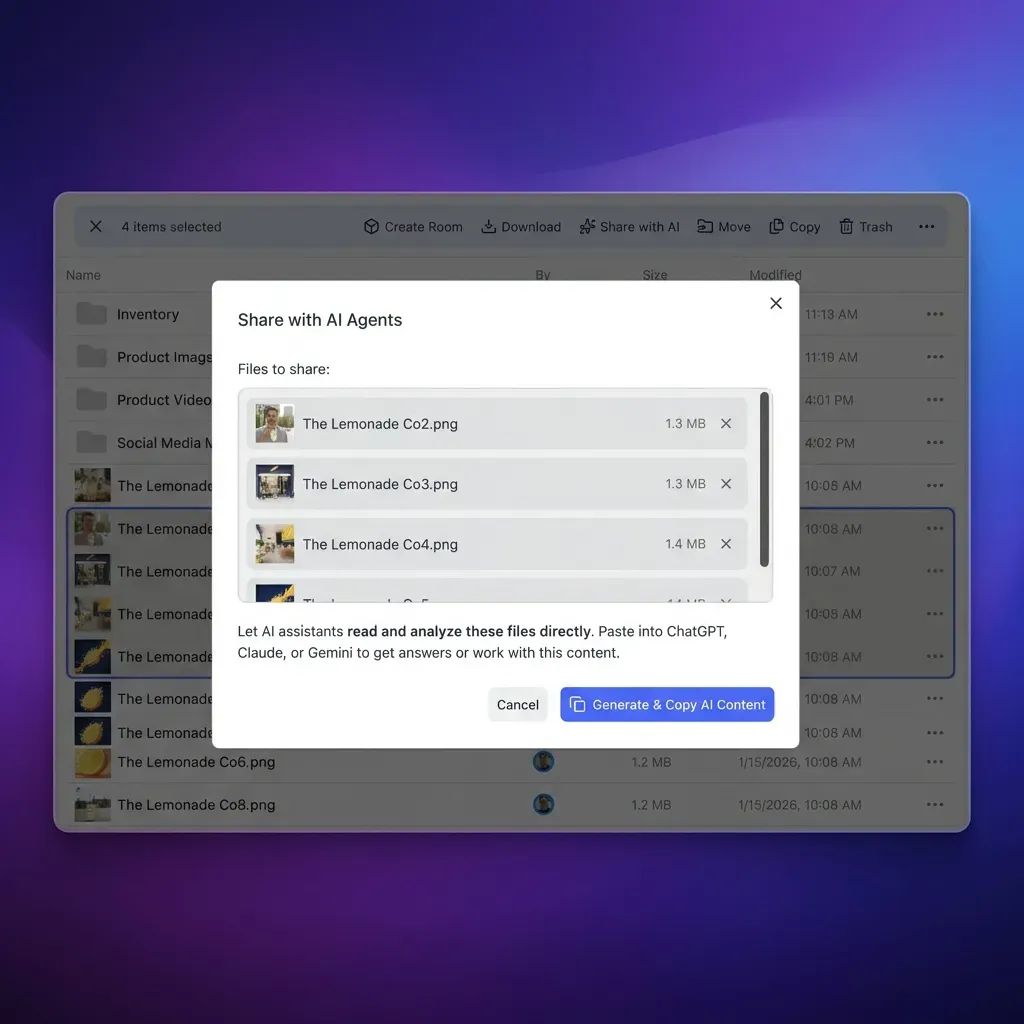
Fast.io fits this pipeline as a persistent workspace where agents write images and scoring metadata through the same API surface. The MCP server exposes workspace, storage, and AI operations through Streamable HTTP at /mcp, so an OpenClaw agent can upload images, attach scoring data, and hand off reviewed batches to a human without switching tools.
Metadata Views turn scoring data into a searchable database. Describe the fields you want (composition score, void ratio, color palette, pass/fail status), and Fast.io builds a typed schema that populates automatically from your uploaded files. The result is a sortable, filterable view of your image scores without building a custom database or writing extraction logic.
Intelligence Mode indexes uploaded images and associated notes for semantic search. Combined with audit trails for tracking which agent scored which image and when, the workspace becomes a coordination layer between generation, scoring, and human review.
Alternatives like Amazon S3 or Google Cloud Storage handle raw file storage but lack built-in indexing, metadata extraction, and an agent-friendly MCP surface. Fast.io offers a 14-day Business Trial (credit card required) to test remote MCP and workspace features, with paid plans starting at $9.99/mo (Starter, 250 GB). See /storage-for-openclaw/ for OpenClaw-specific setup guidance.
Choosing the Right Tool for Your Pipeline
The right skill depends on what you're measuring and how automated the pipeline needs to be.
For compositional quality in generated images, start with vtl-image-analysis. Its five deterministic coordinates give you hard thresholds to automate against. Pair it with color-palette for a two-dimensional quality gate that covers structure and color without vision model costs.
If authenticity verification is the priority, image-detection handles the binary classification of whether an image was AI-generated. This fits content moderation and compliance pipelines where provenance matters more than aesthetics.
For open-ended assessment, combine the imageModel configuration with a strong VLM. You lose determinism but gain the ability to evaluate any visual property through natural language. This approach works best during early experimentation when you're still defining what "quality" means for your specific use case.
MiniMax Image Understanding covers the middle ground between structured metrics and free-form queries. It handles visual Q&A through MCP with a free tier for getting started.
For pipelines producing more than a handful of images, persistent storage is worth setting up early. Losing scoring data between agent sessions means repeating work. A workspace that indexes images and lets you query scores, whether through Fast.io, a custom database, or a file system with naming conventions, saves time as volume grows.
vtl-image-analysis, image-detection, and color-palette are all free to install. Pair them with a persistent Fast.io workspace, and you have a structured quality scoring pipeline ready for production.
Sources
References used to verify factual claims in this guide.
-
over 5,400 OpenClaw skills cataloged in the curated registry
-
vtl-image-analysis measures five deterministic compositional coordinates including placement offset, void ratio, packing density, curvature torque, and radial compliance
-
OpenClaw supports over 300 models through OpenRouter
Frequently Asked Questions
How can OpenClaw check image quality?
OpenClaw checks image quality through installable skills and built-in vision model support. Dedicated skills like vtl-image-analysis return deterministic scores for specific properties such as composition and spatial balance. For broader assessment, the imageModel configuration routes images to any supported vision-language model, which can evaluate visual properties through natural language prompting. The two approaches complement each other: structured skills for automated thresholds, VLMs for open-ended evaluation.
What is the VTL image analysis framework?
The Visual Thinking Lens (VTL) framework evaluates image composition using geometry-based metrics rather than aesthetic judgment. Developed by rusparrish and available as both a standalone Python library and an OpenClaw skill, it measures five coordinates: placement offset, void ratio, packing density, curvature torque, and radial compliance. These metrics expose compositional collapse and spatial priors in AI-generated images without requiring access to model internals or training data.
Can OpenClaw score AI-generated images?
Yes. The vtl-image-analysis skill was built specifically for evaluating AI-generated images and includes metrics that detect common generative model biases like repetitive composition patterns. The image-detection skill classifies whether an image is AI-generated in the first place. For broader quality scoring, any vision-capable model configured through OpenClaw's imageModel setting can evaluate AI-generated images against custom criteria.
What OpenClaw skills analyze photo composition?
The vtl-image-analysis skill is the most targeted option. It returns five compositional metrics (placement offset, void ratio, packing density, curvature torque, radial compliance) as numeric values. For less structured analysis, the MiniMax Image Understanding skill can describe compositional elements and answer specific questions about image layout through its multimodal model. The color-palette skill complements both by analyzing color distribution, which affects perceived composition.
Which vision models work best with OpenClaw for image assessment?
OpenClaw supports vision-language models from multiple providers through its imageModel configuration and OpenRouter integration. Claude 4.6 and Gemini are commonly used for structured visual analysis. OpenRouter provides access to over 300 models, including free-tier options for experimentation. The best choice depends on your use case: larger models produce more nuanced assessments but cost more per image, while smaller models trade depth for speed and cost efficiency.
Related Resources

Store image scores where your agent can query them
Fast.io gives your OpenClaw agent persistent indexed storage, Metadata Views for structured scoring data, and MCP access to read and write results.