10 Raspberry Pi AI Projects for Edge Machine Learning with OpenClaw
The Raspberry Pi AI HAT+ 2 delivers 40 TOPS of INT4 inference for $130, putting local LLM and vision model processing on a single-board computer for the first time. This roundup covers 10 practical AI projects you can build on a Raspberry Pi 5, from real-time object detection at 136 FPS to fully offline voice assistants, with hardware requirements and expected performance for each.


Edge AI Moved to a $130 Add-On Board
The Raspberry Pi AI HAT+ 2 ships with a Hailo-10H neural processor that delivers 40 TOPS of INT4 inference for $130. It is the first consumer-grade accelerator that runs large language models and vision-language models entirely on a single-board computer. Two years ago, running a local LLM required a desktop GPU that cost ten times as much. Now a Raspberry Pi 5 with this add-on board handles object detection, speech recognition, and small language model inference without touching a cloud API.
That shift matters for edge AI projects where latency, privacy, or internet reliability are constraints you cannot negotiate around. A security camera that processes video locally responds in roughly 12 milliseconds instead of waiting for a round trip to a cloud endpoint. A voice assistant that runs Whisper on-device keeps every conversation on hardware you physically control. A construction site helmet detector that works without WiFi does not stop working when the connection drops.
The performance gap between accelerated and unaccelerated inference tells the story . Running YOLOv8 object detection on the Pi 5's CPU alone produces 5 to 8 frames per second. Add a Hailo-8L accelerator and the same model hits 30 FPS. With the optimized YOLOv8 nano model, benchmarks show the accelerated pipeline reaching 136.7 FPS. The neural processing unit handles model execution entirely off the CPU, which stays free for application logic, networking, and orchestration.
This roundup covers 10 practical AI projects you can build on a Raspberry Pi 5, each with specific hardware requirements, inference speeds, and practical notes on what works. OpenClaw agents benefit from these edge builds because local inference eliminates per-token API costs for autonomous tasks that make hundreds of tool calls per session.
Related guides
- Devin AI Local: Running Devin Agents on Your MachineAccording to the official Devin Desktop documentation, the Devin Local agent framework achieves up to 30% greater token...
- How to Use Claude AI Projects to Organize Conversations and KnowledgeClaude Projects carry a 200,000-token knowledge base into every conversation you start inside them, but most users...
- How to Build Edge AI Agents with OpenClaw on Raspberry PiEdge AI with OpenClaw on Raspberry Pi processes sensor data locally through an AI agent that makes decisions and takes...
- How to Build an AWS IoT Greengrass Edge Agent with OpenClaw on Raspberry PiAWS IoT Greengrass handles device provisioning, telemetry pipelines, and fleet management. OpenClaw adds AI reasoning...
- OpenClaw on Raspberry Pi vs Mini PC: Picking the Right Edge Hardware for AI AgentsOpenClaw turns a Raspberry Pi or mini PC into an always-on AI agent gateway, but the two hardware classes make very...
- OpenClaw on Raspberry Pi 6: What to Expect for Edge AI AgentsThe Raspberry Pi Foundation confirmed in May 2026 that the Pi 6 will not ship before 2028 and will not include an...
More on this subject: OpenClaw on Raspberry Pi (192 guides)
What Hardware Do You Need for Each Project Tier
Three tiers of AI hardware cover every project on this list. Pick the tier that matches your performance needs and budget.
Tier 1: CPU Only ($80)
A Raspberry Pi 5 with 8 GB RAM runs lightweight models without any accelerator. Whisper Tiny processes speech in 2 to 3 seconds, Ollama serves quantized 1B to 3B parameter models at 2 to 8 tokens per second, and TensorFlow Lite handles basic image classification. This tier works for learning, prototyping, and applications where real-time speed is not critical.
Tier 2: AI HAT+ with Hailo-8L ($150 total)
The 13 TOPS accelerator handles real-time computer vision at 30 FPS with YOLOv8 and runs MediaPipe pipelines 5.8 times faster than CPU alone. Object detection, pose estimation, and segmentation all work well at this tier. This is the sweet spot for vision projects that need consistent frame rates.
Tier 3: AI HAT+ 2 with Hailo-10H ($210 total)
The 40 TOPS chip with 8 GB of dedicated LPDDR4X memory adds generative AI capabilities. It runs LLMs including Llama 3.2 1B, Qwen 2.5 1.5B, DeepSeek R1 Distill 1.5B, and Qwen 2.5 Coder 1.5B entirely on the NPU. Vision tasks run at roughly the same speed as the Hailo-8L since the extra silicon targets transformer workloads.
All three tiers require a Raspberry Pi 5 running 64-bit Raspberry Pi OS (Trixie). The Raspberry Pi AI software documentation covers driver installation and model compilation for each accelerator. The original AI Kit, which bundled a Hailo-8L on an M.2 HAT+, is no longer in production but works identically to the AI HAT+ if you already own one. A Camera Module 3 is needed for any project that involves live video input.
For OpenClaw agents running on Raspberry Pi, Tier 2 or Tier 3 is recommended. Agents that make frequent inference calls benefit from dedicated silicon that keeps the CPU free for orchestration and network I/O.

10 Raspberry Pi AI Projects Worth Building
Each project below lists the hardware tier you need, the expected performance, and whether a dedicated accelerator is required. Projects are ordered from most accessible to most specialized. Where applicable, links point to original project repositories or the Raspberry Pi AI documentation for setup instructions.
1. Real-Time Object Detection with YOLOv8
The most immediate use of a Raspberry Pi AI accelerator is running YOLO models on a live camera feed. A Seeed Studio tutorial demonstrates YOLOv8n object detection hitting 136.7 FPS on a Pi 5 with a Hailo-8L, fast enough for applications where frame-by-frame analysis matters. At standard video resolution with a Camera Module 3, expect a stable 30 FPS, which matches broadcast frame rates.
Hardware: Pi 5 (8 GB), AI HAT+ or AI Kit, Camera Module 3
Performance: 30 FPS (standard), up to 136.7 FPS (nano model, optimized)
Accelerator required: Yes
Difficulty: Beginner
Start with the hailo-rpi5-examples repository on GitHub, which includes pre-compiled detection pipelines. The examples run out of the box after driver installation and serve as a foundation for custom detection tasks like counting people in a room, monitoring a parking lot, or tracking inventory on a shelf.
2. Boss Detection Alert System (Peeper Pam)
VEEB Projects built Peeper Pam in three days to solve a universal office problem: knowing when someone is approaching your desk. The system uses a Camera Module pointed at the area behind your monitor and an AI Kit running human detection. When a person enters the frame, it sends a signal to a Raspberry Pi Pico W that moves a voltmeter needle on your desk as a silent, analog alert.
Hardware: Pi 5, AI Kit, Camera Module, Raspberry Pi Pico W, voltmeter display
Performance: Real-time human detection
Accelerator required: Yes
Difficulty: Intermediate (hardware and software)
The project is open source at github.com/veebch/peeperpam and demonstrates how to bridge Pi 5 AI inference with Pico W physical output. That "detect and actuate" pattern applies to any scenario where an AI observation needs to trigger something in the physical world: a doorbell that recognizes residents, a birdfeeder that logs species, or a warehouse alert for unauthorized access.
3. Construction Safety Helmet Detection
Shakhizat Nurgaliyev built a safety monitoring system that identifies workers wearing and not wearing helmets on construction sites. The system uses YOLOv8 trained on 5,000 annotated images covering three classes: helmet, person, and head. Running on a Pi 5 with an AI Kit, it processes video at 30 FPS, fast enough for real-time site monitoring without needing an internet connection.
Hardware: Pi 5, AI Kit, Camera Module or IP camera
Performance: 30 FPS inference
Accelerator required: Yes
Difficulty: Intermediate (custom model training)
The dataset and training scripts are published on Hackster.io. You can retrain the model for different safety equipment, like high-visibility vests or hard hats of specific colors, using the same YOLOv8 pipeline with your own annotated images. The project demonstrates the full workflow from data collection through deployment on constrained hardware.
4. Multi-Lane Car Detection and Tracking
Naveen's toll plaza monitoring project uses YOLOv5 to identify and count vehicles across multiple lanes from a single overhead camera. The system tracks individual cars through the frame, handles lane boundaries, and generates per-lane count statistics. It runs on a Pi with an AI Kit and a Camera Module Wide for the broader field of view that toll installations require.
Hardware: Pi 5, AI Kit, Camera Module Wide
Performance: Real-time multi-object tracking
Accelerator required: Yes
Difficulty: Intermediate
The project includes guidance on training custom YOLOv5 models for different vehicle types. The Camera Module Wide is important here because standard camera modules do not cover enough lateral distance for multi-lane views. The same architecture works for parking lot occupancy monitoring, warehouse traffic counting, and any application where you need to track objects moving through defined zones.
5. MediaPipe Hand and Pose Tracking
Mario Bergeron accelerated Google's MediaPipe framework on a Raspberry Pi 5 with an AI Kit, achieving hand detection at 26 to 28 FPS for one hand and 22 to 25 FPS for two hands. That is 5.8 times faster than running the same MediaPipe models through TensorFlow Lite on the Pi 5 CPU alone, crossing the threshold from choppy to usable for interactive applications.
Hardware: Pi 5, AI Kit, Camera Module 3
Performance: 26 to 28 FPS (single hand), 22 to 25 FPS (two hands)
Accelerator required: Yes (for real-time speeds)
Difficulty: Intermediate
MediaPipe supports hand landmarks, face mesh, and 17-point pose estimation. The accelerated pipeline opens up gesture-based interfaces, sign language recognition prototypes, and physical therapy tracking where frame rate directly affects usability. Bergeron's code is published on Hackster.io with detailed benchmarks comparing accelerated and CPU-only performance.
6. Frigate NVR Home Security Camera
Frigate is open-source network video recorder software that added official Hailo accelerator support in version 0.16.0. Running on a Raspberry Pi 5 with a Hailo chip, Frigate processes security camera feeds with approximately 12-millisecond inference latency while keeping CPU usage low enough for 24/7 operation across multiple camera streams.
Hardware: Pi 5 (8 GB), AI HAT+ or AI Kit, network or USB cameras
Performance: Approximately 12 ms inference per frame, low CPU usage
Accelerator required: Yes
Difficulty: Intermediate
Frigate's advantage for always-on deployments is power efficiency. The Hailo NPU draws roughly 3 watts during inference, far less than running detection on the CPU, which matters when the system runs continuously for months. Frigate handles motion zones, object filtering, and event recording, and it integrates directly with Home Assistant for notifications and automation triggers.
7. Fully Offline Voice Assistant
A privacy-first voice assistant runs entirely on the Pi 5 without any cloud dependency. The typical stack combines Whisper Tiny or Small for speech-to-text (processing in 2 to 3 seconds on the Pi 5 CPU), a quantized language model through Ollama for generating responses, and Piper TTS for converting text back to speech in under a second.
Hardware: Pi 5 (8 GB), USB microphone, speaker or Bluetooth earbuds
Performance: 15 to 25 seconds end-to-end latency (without accelerator)
Accelerator required: No (CPU is sufficient for small models), but an AI HAT+ 2 improves LLM response speed
Difficulty: Intermediate to advanced
The TrooperAI project on GitHub demonstrates this full pipeline with LED feedback and gesture control. Every conversation stays on hardware you own, which removes the privacy concerns that come with sending audio to cloud speech APIs. Adding an AI HAT+ 2 cuts the LLM inference portion of the latency by offloading it to the NPU.
8. On-Device LLM Chat with AI HAT+ 2
The AI HAT+ 2 turns a Raspberry Pi 5 into a local chatbot terminal. Its Hailo-10H chip with 8 GB of dedicated RAM runs language models including Llama 3.2 1B, Qwen 2.5 Instruct 1.5B, Qwen 2.5 Coder 1.5B, and DeepSeek R1 Distill 1.5B. The Hailo Model Zoo provides pre-optimized model packages, and LoRA fine-tuning lets you customize a model for specific tasks without retraining from scratch.
Hardware: Pi 5 (8 GB), AI HAT+ 2 ($130)
Performance: On-device LLM inference with 40 TOPS INT4
Accelerator required: Yes (AI HAT+ 2 specifically)
Difficulty: Beginner to intermediate
Raspberry Pi provides an Open WebUI frontend that runs in Docker on the Pi, giving you a browser-based chat interface connected to a fully local model. No API keys, no per-token billing, no internet required. The 1.5B parameter models handle basic reasoning, code generation, and question answering well enough for personal use and experimentation.
9. Smart Home Control with Home Assistant
Home Assistant's local LLM integration connects to Ollama running on a Raspberry Pi 5, enabling natural language voice commands that control lights, thermostats, locks, and other smart home devices without sending a single request to the cloud. The recommended setup uses a quantized 3B to 4B parameter model, which generates responses at 2 to 8 tokens per second on the Pi 5 with 8 GB RAM.
Hardware: Pi 5 (8 GB), microphone (optional for voice), smart home devices
Performance: 2 to 8 tokens per second for response generation
Accelerator required: No (but improves response speed)
Difficulty: Intermediate
Home Assistant formalized this integration path in its 2025.9 release. The setup uses either the Ollama integration directly or the Local LLM Conversation integration pointed at an OpenAI-compatible endpoint. Both paths run entirely on hardware you control, so voice and text commands never leave your network.
10. Multi-Accelerator Benchmark Rig
Jeff Geerling's Monster AI Pi PC pushes the Pi 5's PCIe bus to its limit by connecting eight Hailo-8L accelerators through a PEX 8619 PCIe switch and a Pineboards uPCIty Lite HAT. The combined system delivers 55 TOPS, which exceeds the neural processing performance of many laptop-class processors from AMD, Qualcomm, and Apple.
Hardware: Pi 5, PEX 8619 PCIe switch, Pineboards uPCIty Lite HAT, 8x Hailo-8L modules
Performance: 55 TOPS combined
Accelerator required: Yes (eight of them)
Difficulty: Advanced (custom PCIe wiring)
This is not a practical production setup, and the parts cost well over $500. Its value is as a benchmark reference that demonstrates the Pi 5's PCIe capabilities and the scaling characteristics of Hailo accelerators. If one Hailo-8L gives you 13 TOPS, eight of them deliver roughly linear scaling, which is useful knowledge when planning multi-device deployments.


Persist your Raspberry Pi AI project output across sessions
Workspace storage for detection logs, model weights, and inference results, with MCP server integration for agents. Starts with a 14-day Business Trial.
How to Choose the Right Accelerator
Matching the accelerator to the project saves money and avoids buying hardware you do not need.
For vision-only projects (object detection, pose estimation, segmentation): The AI HAT+ with Hailo-8L at $70 is the right choice. It delivers 13 TOPS, runs YOLOv8 at 30 FPS, and handles every vision project on this list. The Hailo-10H offers roughly the same vision performance since its extra silicon targets transformer and generative workloads, not convolutional networks.
For LLM and generative AI projects: The AI HAT+ 2 with Hailo-10H at $130 is the only option that runs language models on the NPU. Its 40 TOPS of INT4 performance and 8 GB of dedicated RAM handle models up to 1.5B parameters on-chip. If your project involves chat, code generation, or vision-language understanding, this is the board you need.
For prototyping without an accelerator: The Pi 5's ARM Cortex-A76 CPU handles small models through Ollama at 2 to 8 tokens per second and runs Whisper Tiny in 2 to 3 seconds. CPU-only inference works for voice assistants, simple classification, and home automation where sub-second response times are not required.
Power and cooling: The Hailo NPU draws roughly 3 watts under load. A 27W USB-C power supply is mandatory when using any accelerator, and active cooling prevents thermal throttling during sustained inference. Both matter for 24/7 deployments like Frigate or Home Assistant where the system runs for months without a restart.
Storing and Sharing AI Project Output with OpenClaw
Edge AI projects generate output that needs to go somewhere persistent: detection logs, model weights, inference results, captured images, and configuration files. When OpenClaw agents run AI workloads on a Raspberry Pi, they need a storage layer that survives reboots, handles file versioning, and makes results accessible to humans and other agents without manual copying.
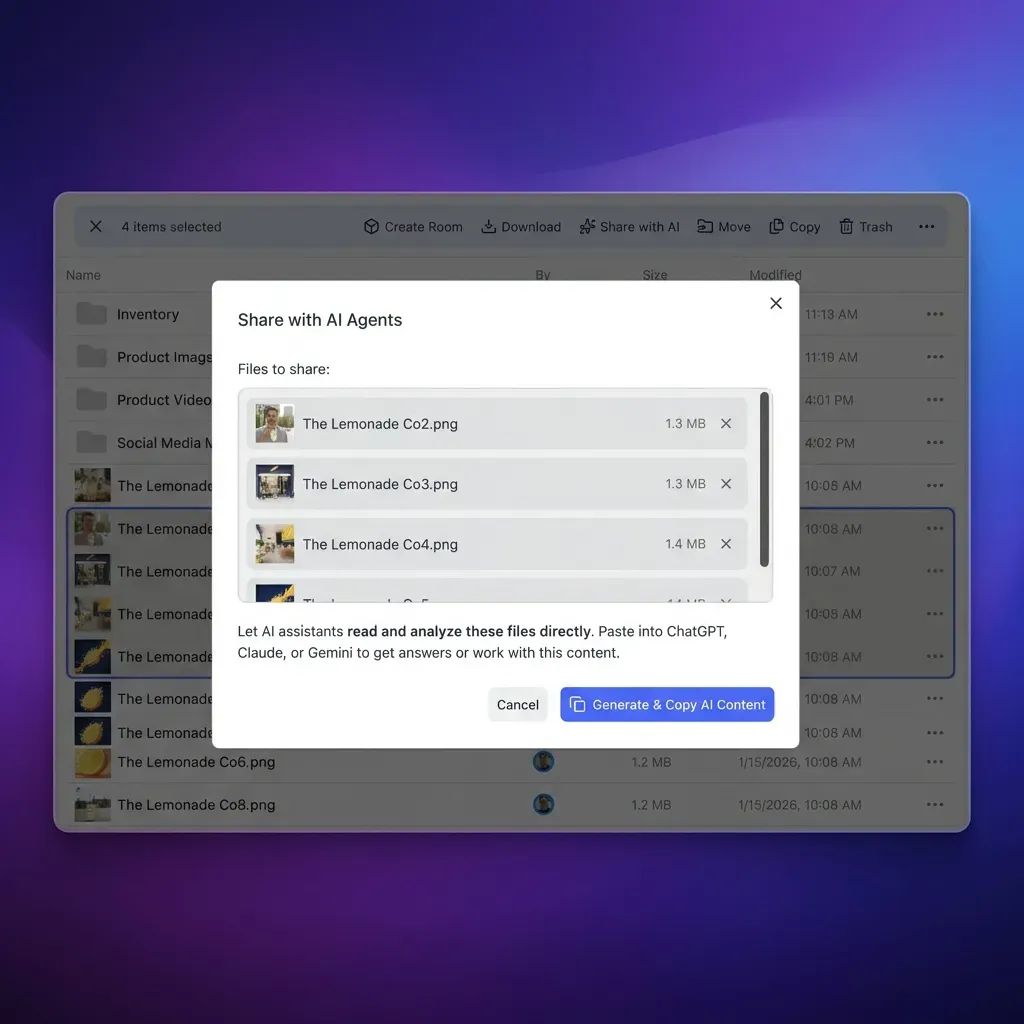
Fast.io provides a workspace that addresses this problem. An agent running object detection can write daily detection logs to a Fast.io workspace, and a second agent or a human reviewer can access those results from any browser. The MCP server exposes a consolidated toolset for reading, writing, searching, and sharing files, so agents interact with storage through the same protocol they use for other integrations.
For Raspberry Pi deployments specifically, this separation matters because the Pi's local storage is limited and not easily shared across devices. A 32 GB SD card fills up quickly with video captures and model artifacts. Syncing results to a persistent workspace keeps the Pi's storage lean and puts the output where it can be searched, discussed, and handed off.
Plans include a 14-day Business Trial (Starter at $9.99/month, Business at $49.99/month), with storage, monthly credits, and seat limits scaled to each tier. That is enough for most edge AI projects to store months of inference output, model weights, and configuration backups. Once Intelligence Mode is enabled for the workspace, uploaded files are indexed and searchable for semantic search and AI-powered Q&A, which makes it easy to query detection logs or search through inference results without writing custom scripts.
Sources
References used to verify factual claims in this guide.
-
AI HAT+ 2 delivers 40 TOPS (INT4) of inferencing performance for $130 AI HAT+ 2 runs Llama 3.2 1B, Qwen 2.5 1.5B, and DeepSeek R1 Distill 1.5B on-device
-
YOLOv8n object detection achieves 136.7 FPS on Pi 5 with Hailo-8L
-
Safety helmet detection runs at 30 FPS using YOLOv8 on Raspberry Pi AI Kit MediaPipe runs 5.8 times faster on AI Kit than TensorFlow Lite on Pi 5 CPU Monster AI Pi PC delivers 55 TOPS with eight Hailo-8L accelerators
-
Ollama serves quantized models at 2 to 8 tokens per second on Raspberry Pi 5
-
Hailo-8L provides 13 TOPS of on-device inference performance
Frequently Asked Questions
What AI projects can you do with Raspberry Pi?
The Raspberry Pi 5 supports computer vision (object detection, pose estimation, face recognition), speech recognition with Whisper, local LLM chat with models up to 1.5B parameters, home automation through Home Assistant, and always-on security monitoring with Frigate. The key variable is whether you add an AI accelerator. CPU-only projects work for prototyping, while the AI HAT+ or AI HAT+ 2 enable real-time inference at 30 FPS or higher.
Can Raspberry Pi run machine learning models?
Yes. The Pi 5 runs inference on pre-trained models using TensorFlow Lite, ONNX Runtime, and Ollama. Without an accelerator, expect 2 to 8 tokens per second for language models and 5 to 8 FPS for object detection. Adding a Hailo AI HAT+ boosts object detection to 30 FPS or higher and moves model execution off the CPU entirely, freeing it for application logic.
Do you need an AI HAT for Raspberry Pi AI projects?
Not for every project. CPU-only inference handles speech recognition with Whisper, basic image classification, and small language models through Ollama. The AI HAT+ becomes necessary when you need real-time video processing at 30 FPS, sustained 24/7 inference for security cameras, or performance above 13 TOPS. The AI HAT+ 2 is specifically required for running LLMs on the NPU rather than the CPU.
What is the best Raspberry Pi for AI?
The Raspberry Pi 5 with 8 GB RAM is the only model that supports the AI HAT+ and AI HAT+ 2 accelerators. The 4 GB variant works for some projects but limits the size of models you can load into system memory. The Pi 4 and older models lack the PCIe interface needed for Hailo accelerators, though they can still run lightweight CPU-based inference.
How fast is object detection on Raspberry Pi with Hailo?
YOLOv8n achieves up to 136.7 FPS on a Pi 5 with a Hailo-8L accelerator in optimized benchmarks. Practical deployments with larger model variants and standard resolution video typically run at 30 FPS, which matches broadcast frame rates. Without an accelerator, the same task runs at 5 to 8 FPS on the CPU, which is too slow for real-time applications.
Can you run a large language model on Raspberry Pi?
The AI HAT+ 2 with Hailo-10H runs models including Llama 3.2 1B, Qwen 2.5 1.5B, and DeepSeek R1 Distill 1.5B entirely on the NPU with 8 GB of dedicated RAM. Without an accelerator, Ollama serves similar models on the CPU at 2 to 8 tokens per second. Both approaches keep data local, but the accelerator provides faster response times for interactive chat.
Related Resources

Persist your Raspberry Pi AI project output across sessions
Workspace storage for detection logs, model weights, and inference results, with MCP server integration for agents. Starts with a 14-day Business Trial.