How to Use OpenClaw for Sales Automation and CRM Workflows
Sales reps spend roughly 70% of their work week on tasks that aren't selling. OpenClaw, the open-source AI agent framework, can automate prospecting, outreach, CRM updates, and follow-up sequences for $20-50 per month, compared to $500+ for commercial AI SDR platforms. This guide covers the full sales funnel, from lead enrichment through close, plus how to store and share the sales assets your agent produces.

How OpenClaw Works as an AI SDR
Sales reps spend just 30% of their work week actually selling, according to Salesforce's State of Sales report. CRM data entry alone accounts for 17% of a typical rep's time, per a Forrester activity study of over 3,000 sales professionals. The rest goes to prospect research, email management, scheduling, and internal meetings.
That imbalance is driving a shift toward AI SDRs. An AI SDR is an autonomous agent that handles the repetitive parts of the sales cycle: researching prospects, writing personalized outreach, monitoring inboxes, logging CRM activity, and managing follow-up sequences. Instead of hiring junior reps to do this work, teams configure an agent that runs around the clock.
OpenClaw, an open-source AI agent framework with over 346,000 GitHub stars, has become one of the most popular foundations for building these agents. It connects language models to messaging channels, CRMs, and browsing tools through a modular skill system. The framework supports memory across sessions, scheduled tasks, and browser automation. That means an OpenClaw agent can navigate LinkedIn, compose emails, and update Salesforce without human intervention between steps.
OpenClaw distinguishes itself from other agent frameworks through its skill marketplace. ClawHub hosts thousands of community-built skills covering CRM connectors, email sequencing, browser automation, and lead enrichment. Most sales integrations already exist as installable packages rather than custom code you need to write from scratch.
The economics tell the story. A self-hosted OpenClaw sales agent typically costs $20-50 per month in VPS hosting plus API usage, compared to $500-2,000 for commercial AI SDR platforms. ClawGTM, a Y Combinator-backed product built on OpenClaw, commercialized this approach: point it at a website URL and it identifies best-fit leads, researches them, and starts conversations on email and LinkedIn. But you don't need a commercial product to get started. The open-source framework gives you full control over every workflow.
Related guides
- Is Clay a CRM? How to Connect Clay to Your Sales WorkflowsClay is not a CRM, but a GTM database layer (Audiences) that integrates with CRM platforms like HubSpot and Salesforce....
- Automating Base44 File Workflows with WebhooksEvent-driven webhooks allow Base44 applications to initiate instant downstream processing whenever users or AI agents...
- How to Automate Email Workflows with OpenClaw AgentsOpenClaw agents can monitor inboxes, classify messages, extract data from attachments, and route actions through...
- How to Automate OpenClaw Workflows with Zapier MCPOpenClaw agents are good at reasoning, but they need a way to act on that reasoning across your existing tools. Zapier...
- How to Integrate OpenClaw with HubSpot for CRM AutomationOpenClaw can connect to HubSpot's CRM through two paths: Composio's managed MCP server with automatic OAuth, or a...
- How to Use OpenClaw with Playwright for Browser AutomationOpenClaw's Playwright integration turns AI agents into browser operators that can navigate pages, fill forms, extract...
More on this subject: OpenClaw Setup and Guides (199 guides)
What Sales Workflows Can OpenClaw Automate?
Most OpenClaw sales guides focus narrowly on LinkedIn outreach. The framework handles far more than that. Here are seven workflows that cover the full sales funnel.
1. Lead Enrichment and Prospect Research
OpenClaw agents can navigate LinkedIn, company websites, and business databases to build prospect profiles. The agent identifies key stakeholders, recent funding rounds, job postings that signal buying intent, and company news that creates conversation openers. This research gets compiled into summary documents for each prospect before outreach begins. When a prospect's company posts a role like "Postgres DBA," the agent infers database scaling challenges and flags it as a potential buying signal.
2. Personalized Cold Outreach
Rather than sending template emails with a merge tag swap, an OpenClaw agent writes emails that reference specific details from its research. The Overton Collective's guide documents three proven email formats: problem-first (targeting known pain points), social proof (referencing similar customer results), and direct pitch. Each message reflects the prospect's actual situation rather than a generic value proposition.
3. Inbox Monitoring and Triage
OpenClaw can scan your sales inbox on a configurable interval, typically every 30 minutes. It categorizes incoming messages by urgency (hot, warm, cold), identifies buying signals, and drafts responses for review. One documented deployment processed 4,000 emails in 48 hours using automated triage, sorting them by intent and flagging the ones that needed immediate human attention.
4. CRM Logging After Sales Calls
This is where the time savings are most concrete. An OpenClaw agent can process sales call recordings, extract key discussion points, and log structured notes to your CRM. Reps save 15-20 minutes per call on manual data entry, which adds up to several hours per week across a team. The agent captures next steps, objections raised, and follow-up commitments that often get lost when reps log notes at the end of the day.
5. Automated Follow-up Sequences
The agent creates contextual follow-up sequences based on prior conversation history. A typical cadence runs Day 3 (bump with additional value), Day 5 (final attempt with a new angle), and Day 7 (breakup message). Each follow-up references the original conversation rather than resending a generic template. This context-awareness is what separates an AI SDR from a basic email sequencer.
6. Meeting Prep Briefings
Before scheduled calls, OpenClaw generates one-page briefing documents with attendee backgrounds, conversation history, suggested talking points, and expected objections. This replaces the 10-15 minutes of manual research reps typically do before each meeting. It also surfaces details that reps might otherwise miss, like a recent acquisition or leadership change at the prospect's company.
7. Pipeline Monitoring and Risk Alerts
An OpenClaw agent can watch your CRM pipeline for signals that deals are stalling. It flags contacts who haven't responded within a set window, detects job changes at prospect companies, and alerts you when engagement metrics drop. This early warning gives reps time to re-engage before deals go cold.
These seven workflows cover the full funnel, from top-of-funnel research to post-call documentation. You don't need all seven running at once. Start with the workflows that address your biggest time sinks, typically CRM logging and inbox monitoring, then expand as you tune the agent's performance.
How to Set Up Your First OpenClaw Sales Agent
The initial setup takes one to two hours if you're comfortable with a terminal. Here's what you need and what each piece costs.
Infrastructure
You need a cloud VPS with at least 2GB of RAM from providers like DigitalOcean, Hetzner, or Linode. Monthly cost: $5-10. Docker is the recommended deployment method, providing a sandboxed environment for your agent.
You also need an API key for the language model that powers your agent. Claude 3.5 Sonnet is a popular choice for balancing cost and capability, running about $15-25 per month in API usage depending on outreach volume. Some teams use open-weight models like Llama 3 for lower-cost filtering tasks and route only complex decisions to a paid API.
Configuration
OpenClaw uses markdown configuration files to define agent behavior. The Overton Collective's complete guide documents three key files:
SOUL.md defines your agent's personality, sales philosophy, email structure, and boundaries. This is where you specify tone, what the agent should never promise, and how it should handle objections. Writing this file is like briefing a new team member on your company's communication style.
USER.md captures your role, target customer profile, typical deal size, timezone, and communication preferences. The agent references this context when writing outreach and prioritizing leads.
HEARTBEAT.md configures scheduled tasks like inbox scanning intervals and daily summary reports. A common setup scans the inbox every 30 minutes and delivers a summary each morning at 8 AM.
These files use natural language rather than strict code. You describe the agent's behavior the way you'd write a briefing document, and the LLM interprets those instructions during execution.
Monthly Cost Breakdown
The total runs $20-50 per month for a fully operational sales agent:
- VPS hosting: $5-10
- LLM API usage: $15-25
- Web search API (Brave): Free tier
- Email: Existing Gmail account
Commercial AI SDR platforms charge $500-2,000 per month for comparable capabilities. The tradeoff is setup time and ongoing maintenance. You handle updates, uptime monitoring, and debugging, work that a managed platform covers for you.
CRM Connections
OpenClaw works alongside CRMs like HubSpot, Salesforce, and Pipedrive through their APIs. You can install pre-built CRM skills from ClawHub or configure a custom integration using the CRM's REST API. The agent can create contacts, log activities, update deal stages, and tag leads based on engagement signals.
Data Ownership
One significant advantage of self-hosting: all your prospect data, email templates, and conversation logs stay on your server. Nothing gets locked into a vendor platform. You control retention, access, and encryption. For teams that handle sensitive account data or operate under strict data governance policies, this matters more than the cost savings.
Starting Small
You don't need to automate everything at once. Most teams start with inbox monitoring and CRM logging, the two workflows with the clearest time savings and lowest risk. Once those run reliably, layer on prospect research and outreach. This incremental approach lets you tune the agent's behavior before trusting it with external communication.

File Storage and Sharing for AI Sales Teams
An AI SDR creates a steady stream of files: prospect research summaries, email drafts, meeting briefings, call transcripts, and proposal documents. Those files need to live somewhere your sales team can access, search, and share them with clients.
The File Management Gap
Most OpenClaw sales guides focus on the agent's outbound capabilities and skip the question of what happens to the files it produces. Prospect profiles pile up in a server directory. Proposals get attached to emails and lose version control. Call transcripts sit in a folder nobody searches.
Local file storage works during prototyping but breaks down once you have a team that needs to find, review, and send sales assets. Cloud storage services like Google Drive or Dropbox solve the access problem but don't offer built-in search across document contents or branded client-facing shares. S3 gives you raw storage but no preview, search, or sharing layer. You end up stitching together multiple tools to cover what a sales workflow actually needs.
An Integrated Approach with Fast.io
Fast.io gives your OpenClaw agent a persistent workspace where sales files are automatically indexed and searchable. When Intelligence Mode is enabled on a workspace, every uploaded document gets indexed for semantic search and AI-powered chat. No separate vector database or RAG pipeline needed. Here's what that looks like in practice:
Prospect research gets organized. The agent uploads profiles and company summaries to a workspace folder. Reps search by company name, industry, or deal stage to find relevant research before calls.
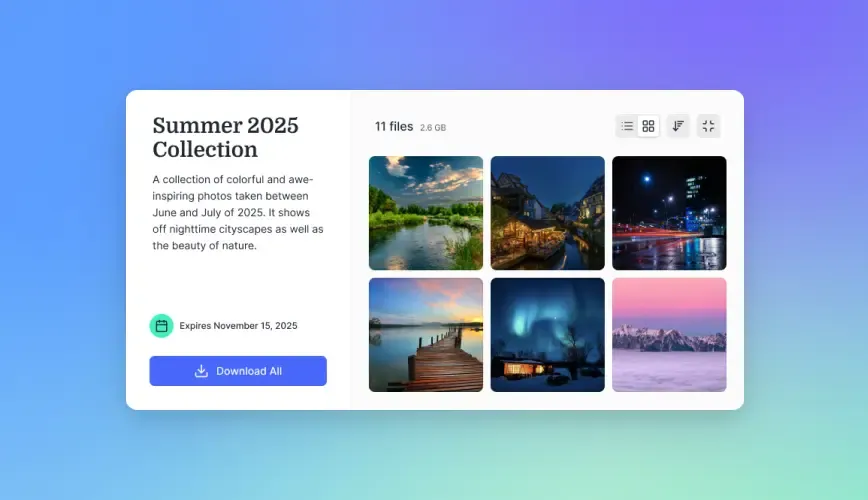
Proposals ship through branded shares. Instead of emailing PDFs, create a branded share with your company's logo and colors. Clients get a professional portal with file preview, download controls, and optional password protection.
Call transcripts become searchable. Upload transcripts to an intelligence-enabled workspace, then ask questions like "What objections did Acme Corp raise about pricing?" and get answers with citations to specific transcript sections.
Agents and humans share the same workspace. Your OpenClaw agent writes files through the Fast.io MCP server, and your sales team accesses the same files through the web interface. No syncing, no export steps.
Fast.io offers a 14-day Business Trial (credit card required; see /pricing/), with paid plans starting at Starter ($9.99/mo). When your agent finishes building a client workspace, ownership transfer lets you hand it to a human account while keeping admin access for the agent.
Extracting Structure from Sales Documents
If your team handles contracts, quotes, or order forms, Metadata Views turns those documents into a queryable database. Describe the fields you want extracted (deal value, closing date, counterparty name) in plain English, and the AI builds a sortable spreadsheet from your document folder. Sales managers get pipeline visibility from their actual documents without re-entering data into a CRM.
For teams evaluating storage options: S3 gives you raw object storage but no preview, search, or sharing. Google Drive offers collaboration but charges per seat and doesn't expose MCP tooling for agent integration. Fast.io sits between them, combining file storage with intelligence and MCP access designed for workflows where agents and humans pass files back and forth.


Store and share the assets your AI SDR creates
Fast.io gives your OpenClaw agent persistent workspace storage, branded client shares, and built-in document search with a 14-day Business Trial.
OpenClaw vs. Commercial SDR Platforms
Building an AI SDR on OpenClaw is not the right choice for every team. Here's how it compares to managed alternatives.
Self-Hosted OpenClaw
- Monthly cost: $20-50
- Setup time: 1-2 hours with terminal experience
- Full control over data, prompts, and agent behavior
- Access to thousands of community skills through ClawHub
- You handle maintenance, monitoring, and debugging
Best for: Technical teams that want full customization and need to own their data.
Commercial AI SDR Platforms
Products like AiSDR, Regie.ai, and the commercially hosted ClawGTM offer managed infrastructure with shorter setup times.
- Monthly cost: $500-2,000
- Setup time: Minutes to an hour
- Managed infrastructure with uptime guarantees
- Built-in analytics and reporting dashboards
- Less customization, vendor lock-in on data and workflows
Best for: Sales teams without engineering resources who need a turnkey solution.
ClawGTM sits between these categories. As a Y Combinator-backed product built on the OpenClaw framework, it offers managed infrastructure with access to the OpenClaw ecosystem. According to its YC launch page, it reads your website, identifies target accounts through ICP filtering, and starts multi-channel outreach on email and LinkedIn.
When to Build vs. Buy
Build on OpenClaw if your team has a developer who can spend a few hours on setup and occasional maintenance. The monthly savings are significant ($450+ compared to commercial tools), and you get complete control over your agent's behavior and data.
Buy a commercial platform if your sales team needs to be running within a day and nobody on the team is comfortable with a terminal. The higher cost covers infrastructure management, support, and ongoing updates.
The Hybrid Approach
Some teams start with OpenClaw for workflows that are low-risk and high-frequency, like inbox monitoring and CRM logging. They use a commercial tool for outbound sequences where deliverability management matters more. As they gain confidence with the self-hosted agent, they migrate more workflows over. This reduces the commercial platform's seat count and cost while building internal capability.
Either way, the file management question remains. Both approaches produce sales assets that need organized storage and client-ready sharing. A workspace platform like Fast.io handles that layer regardless of which agent framework you choose. Connect it through the MCP server for automated file operations, or use the web interface for manual uploads and shares.
Sources
References used to verify factual claims in this guide.
-
Sales reps spend 30% of their work week selling, with 17% going to CRM data entry
-
OpenClaw reached 346,000 GitHub stars
-
Total monthly cost of $20-35 for a self-hosted OpenClaw sales agent
-
One deployment processed 4,000 emails in 48 hours using automated triage
-
ClawGTM launched on Y Combinator for automated lead identification and outreach
Frequently Asked Questions
Can OpenClaw automate sales outreach?
Yes. OpenClaw agents can research prospects, write personalized emails based on company-specific details, and manage multi-step follow-up sequences. The agent connects to your email account and sends messages on configurable schedules, with behavior defined in natural language configuration files. Most teams start with human review of drafts before enabling fully autonomous sending.
How do I connect OpenClaw to my CRM?
OpenClaw works alongside CRMs like HubSpot, Salesforce, and Pipedrive through their APIs. You can install a pre-built CRM skill from ClawHub or configure a custom integration using your CRM's REST API. The agent can create contacts, log activities, update deal stages, and tag leads based on engagement signals.
What is an AI SDR?
An AI SDR (Sales Development Representative) is an autonomous agent that handles prospecting, outreach, and lead qualification tasks traditionally performed by human SDRs. It researches prospects, writes personalized messages, monitors responses, and updates your CRM. Unlike chatbots or auto-responders, an AI SDR makes decisions about who to contact, what to say, and when to follow up based on the context it gathers from research and prior conversations.
How much does OpenClaw cost for sales automation?
A self-hosted OpenClaw sales agent typically costs $20-50 per month. That breaks down to $5-10 for VPS hosting (DigitalOcean, Hetzner, or Linode with 2GB RAM) and $15-25 for LLM API usage. Commercial AI SDR platforms charge $500-2,000 per month for similar capabilities, so the savings are substantial for teams with the technical skills to self-host.
Does OpenClaw work with Gmail and Outlook?
OpenClaw supports Gmail for inbox monitoring and outreach through its email integration. The agent connects to your email account to scan incoming messages, categorize them by urgency, draft responses, and send outreach on configured intervals. Support for other email providers depends on available ClawHub skills and custom API configuration.
Related Resources

Store and share the assets your AI SDR creates
Fast.io gives your OpenClaw agent persistent workspace storage, branded client shares, and built-in document search with a 14-day Business Trial.