Automating Base44 File Workflows with Webhooks
Event-driven webhooks allow Base44 applications to initiate instant downstream processing whenever users or AI agents upload media files. By extracting uploaded file URLs from Base44 webhook payloads and transferring them directly into Fast.io shared workspaces, technical teams eliminate manual document handling while maintaining indexed, queryable file storage.


Why Event-Driven Webhook Automation Matters for Base44 File Workflows
Enterprise teams that transition from polling scheduled API batch jobs to event-driven HTTP webhooks reduce manual document handling overhead by up to 80% [Zapier 2026 Automation Report]. In AI-assisted application platforms like Base44, this efficiency gain is critical when handling incoming attachments, contracts, and media assets across multi-tool data ingestion pipelines.
Base44 applications frequently collect unstructured attachments, including PDFs, spreadsheets, images, and videos up to 100 MB per file [Base44 Documentation], through user forms and AI agent chat interfaces. Relying on periodic database sweeps or manual downloads introduces workflow latency, increases infrastructure polling costs, and creates bottlenecks for downstream processing tools.
Base44 webhooks file automation uses HTTP callbacks to trigger instant file processing upon upload. Instead of forcing external systems to check for new records every few minutes, Base44 generates an event payload immediately after a file upload completes. This payload delivers essential event metadata and target file URLs directly to your API endpoint or integration middleware.
Deploying an event-driven file pipeline transforms incoming files from static storage objects into active triggers. Once an incoming file URL reaches your webhook receiver, your application can automatically extract document metadata, run compliance checks, or mirror the asset into a persistent collaboration environment.
When architecting a persistent storage layer for automated webhooks, developers can choose between local server storage, Amazon S3 buckets, traditional cloud drives like Google Drive, or intelligent workspaces. Fast.io serves as an intelligent storage and coordination layer for incoming Base44 assets, providing shared org-owned Fast.io Workspaces, granular permissions, per-file version history, and indexing once Intelligence is enabled for the workspace for human and AI agent teams working via Fast.io for Agents.
Related guides
- How to Automate Workflows with OpenClaw Webhooks on Raspberry PiA Raspberry Pi running OpenClaw as a systemd service becomes an always-on AI agent that responds to webhook triggers...
- 7 Best OpenClaw Workflows for AI File Format ConversionClawHub lists over 100 document-conversion skills, but most teams still convert files by hand. This guide ranks the...
- Base44 File Storage Setup: Media Libraries and External Cloud PersistenceBase44 file storage setup involves configuring backend media libraries to store, manage, and deliver application...
- Base44 Large File Upload Architecture: Chunked Transfer & Storage StagingBase64 encoding increases file payload sizes by approximately 33%, causing memory spikes and gateway timeouts when...
- Best Storage Solutions for Base44 WorkflowsAccording to the Flexera 2025 State of the Cloud Report, 84% of organizations identify managing cloud spend and...
- Base44 Cloud Import Workflows for Enterprise Files: Implementation GuideBase44 cloud import workflows automate the transfer of documents from cloud storage into Base44 application backends....
More on this subject: AI Coding Assistants (80 guides)
How Base44 Webhook Triggers Process File Uploads
Understanding the execution lifecycle of Base44 webhook triggers is essential for building resilient file processing services. Base44 event-driven triggers operate on an asynchronous HTTP POST architecture, executing callbacks whenever registered system events take place.
When a user or Superagent uploads a document within a Base44 application, the underlying platform stores the object in the app file library and fires registered webhook events. Common triggers for file automation include message.created (dispatched when a chat message containing media arrives) and message.completed (dispatched when an AI agent completes its response generation).
To set up outgoing event notifications, developers configure webhook settings within the Base44 dashboard under Your webhooks by specifying a Target URL. Base44 recommends using your app default base URL structure (such as https://app--your-app-name.base44.app/api/apps/your-app-id/functions/yourFunctionName) or a dedicated external API endpoint.
To prevent unauthorized requests and data tampering, Base44 allows developers to select "Sign requests with an HMAC secret". When enabled, Base44 signs every outgoing HTTP request header with a cryptographic signature, allowing your receiver code to verify request origin before processing incoming file URLs.
Once verified, your receiving service extracts the payload parameters and initiates downstream processing. Rather than downloading large files to ephemeral server disks, developers can pass the file URL directly to external storage platforms. Fast.io supports one-time cloud import through its REST API, allowing teams to bring files into versioned workspaces.
Steps to Trigger File Automation Using Base44 Webhooks
Configuring an end-to-end event-driven file pipeline requires connecting Base44 upload events to an external processing endpoint and storage target. Follow these five steps to establish an automated file ingestion workflow from Base44 to downstream tools and Fast.io workspaces:
Enable Media Uploads in Base44: Configure media upload controls or AI chat attachments in your Base44 app settings. Base44 supports uploaded documents, spreadsheets, PDFs, images, and videos up to 100 MB per file [Base44 Documentation].
Register a Webhook Target URL: Navigate to Your webhooks in the Base44 developer portal and click Add webhook. Provide your public HTTP POST receiver endpoint in the Target URL field.
Bind Webhook Triggers to File Actions: Select event triggers associated with file availability, such as
message.createdfor conversational uploads or custom data model creation events.Extract File URLs and Validate HMAC Signatures: Implement receiver logic to verify the HMAC signature header against your secret key, then parse the incoming JSON payload to retrieve the file URL, MIME type, and original file name.
Import Files into Fast.io Shared Workspaces: Use the cloud import API to make a one-time import into a designated workspace with per-file version history. Enable Intelligence for that workspace before using semantic search.
Developers integrating AI agents into this workflow can configure the remote Fast.io MCP server at https://mcp.fast.io/mcp/tools over Streamable HTTP, sending a scoped API key as a Bearer header. This gives MCP clients access to Fast.io's consolidated toolset according to their scoped-key permissions.
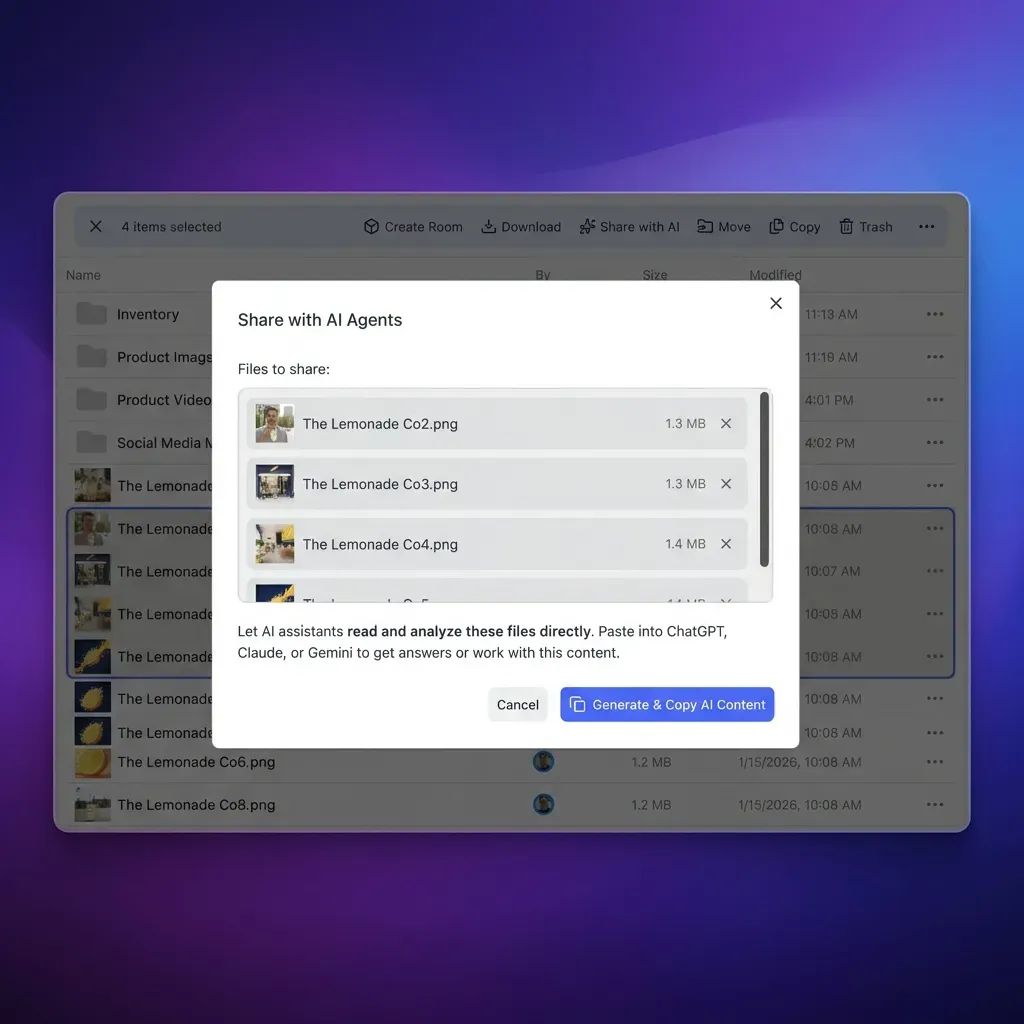


Streamline Base44 file ingestion with persistent Fast.io workspaces
Connect Base44 webhooks to Fast.io workspaces, then use cloud import to store and version files. Enable Intelligence for workspace search. Start a 14-day Business Trial.
What Payload Structures and File URLs Base44 Webhooks Deliver
A frequent challenge when implementing Base44 webhooks file automation is correctly inspecting payload schemas and handling file URL expiration. Base44 transmits event notifications as JSON bodies via HTTP POST requests, embedding file metadata within event context fields.
When a file is uploaded during a message exchange or form interaction, Base44 returns a JSON structure containing event details, sender information, and attached media records. A typical Base44 webhook payload for a file event includes the following properties:
{
  "event": "message.created",
  "timestamp": "2026-07-21T09:00:00Z",
  "data": {
    "message_id": "msg_8849102",
    "sender": "user",
    "attachments": [
      {
        "id": "file_992104",
        "name": "Q3_Financial_Audit.pdf",
        "mime_type": "application/pdf",
        "size_bytes": 10485760,
        "file_url": "https://media.base44.com/uploads/org_12/Q3_Financial_Audit.pdf"
      }
    ]
  }
}
When handling incoming Base44 payloads, your receiver script should iterate over the attachments array, validating that each entry contains a valid file_url and supported mime_type.
Once the file URL is extracted, importing the asset into Fast.io unlocks automated document processing through Metadata Views. Instead of writing custom regular expressions or manual OCR rules, Fast.io Metadata Views use natural language instructions to define a typed schema (including Text, Integer, Decimal, Boolean, URL, JSON, and Date & Time fields).
Fast.io Metadata Views can extract structured data from PDFs, scanned invoices, contracts, and spreadsheets in a workspace. Developers and AI agents can use Fast.io's available interfaces according to their permissions.
Best Practices for Secure File Processing and Workspace Handoff
Building a production-ready file automation pipeline requires reliable error handling, security controls, and clear organizational handoff procedures. When connecting Base44 webhooks to external storage systems, technical teams should implement key design patterns to ensure reliability.
First, handle potential webhook errors and retries gracefully. Receiving a 500 status code from a webhook handler typically indicates an incorrect Target URL format or unhandled parsing exception. Ensure your receiver returns a 200 OK status promptly upon receiving the payload, offloading heavy processing tasks or cloud imports to background workers.
Second, maintain an append-only audit log of ingested event IDs to enforce idempotency. Because network retries may resend duplicate webhook events, checking event IDs prior to executing file transfers prevents redundant file creation and saves storage bandwidth.
Third, establish granular access controls and workspace ownership boundaries. Fast.io enables teams to configure granular permissions and use advisory file locks to coordinate concurrent file processing. AI agents can work with files according to their scoped-key permissions.
Once initial processing is complete, agents can transfer workspace ownership to human team members via claim links while retaining administrative access. Monthly plans start with a Business Trial of up to 14 days (credit card required), allowing engineering teams to evaluate Starter ($9.99/mo), Business ($49.99/mo), and Enterprise ($199.99/mo) plans on Fast.io Pricing.
Sources
References used to verify factual claims in this guide.
-
Enterprise teams that transition from polling scheduled API batch jobs to event-driven HTTP webhooks reduce manual document handling overhead by up to 80%.
-
Base44 applications support uploaded documents, spreadsheets, PDFs, images, and videos up to 100 MB per file.
Frequently Asked Questions
How do Base44 webhooks work with file uploads?
Base44 webhooks listen for events like message.created or form submissions and send an HTTP POST payload containing event metadata and uploaded file URLs to your registered Target URL.
Can Base44 send uploaded files directly to external APIs?
Yes. Base44 webhooks transmit direct file URLs and metadata in JSON payloads, enabling external API endpoints or Fast.io URL import functions to ingest files without manual intervention.
How do I secure Base44 webhook endpoints?
Enable "Sign requests with an HMAC secret" in your Base44 webhook settings and verify incoming cryptographic signature headers in your server code before processing payload data.
What file formats and size limits does Base44 support for uploads?
Base44 supports documents, spreadsheets, PDFs, images, and videos up to 100 MB per file, which are stored in the app file library upon upload.
Related Resources

Streamline Base44 file ingestion with persistent Fast.io workspaces
Connect Base44 webhooks to Fast.io workspaces, then use cloud import to store and version files. Enable Intelligence for workspace search. Start a 14-day Business Trial.