Most Accurate AI in 2026: Which Models Get Facts Right?
Frontier AI hallucination rates now range from 3% to 19%, down from 15-45% in 2024. But accuracy varies sharply by model, task type, and whether you use techniques like extended thinking or retrieval-augmented generation. This guide ranks the most accurate AI models with real benchmark data and explains what drives the differences.


Frontier Hallucination Rates: 3% to 19% and Falling
Frontier AI models now hallucinate between 3.1% and 19.1% of the time, down from 15-45% baselines in 2024, according to a five-model benchmark study by DigitalApplied. That progress is real, but a 5% error rate still means roughly 50 false statements in every 1,000 claims. For a research summary, a legal filing, or a medical explanation, that is too high to trust without verification.
The accuracy gap between models is also wider than most people realize. The Stanford HAI 2026 AI Index found hallucination rates across 26 top models ranging from 22% to 94% on their toughest new benchmark. Model selection matters more than most "AI accuracy" articles admit.
This guide uses published benchmark data to rank the most accurate AI models available today. Rather than vague claims about which chatbot "feels" more reliable, we compared hallucination rates from Vectara's Hallucination Evaluation Framework, factual knowledge scores from SimpleQA, and truthfulness measures from TruthfulQA.
Related guides
- Fastest AI in 2026: Speed Benchmarks Across Top ModelsCerebras now serves Llama 4 Scout at over 2,600 tokens per second, 38 times faster than closed models from OpenAI and...
- Smartest AI in 2026: Which Model Has the Best Reasoning?When Humanity's Last Exam launched in early 2025, top AI models scored single digits on 2,500 expert-level questions....
- Most Powerful AI in 2026: 7 Frontier Models Ranked by CapabilitySix AI labs sit within 79 Elo points of each other on the Chatbot Arena leaderboard as of early 2026. This ranking...
- Best AI Assistants for Business in 2026: 8 Tools We Actually Tested91% of Fortune 500 companies now run at least one generative AI project in production, yet most teams still struggle to...
- AI vs AGI vs ASI: What Changes for a Team Working With AgentsToday's AI, including the agents teams already run, does specific jobs well. AGI (artificial general intelligence)...
- SI vs AI: What the Federal "Super Intelligence" Rename Means for Teams and ContractorsThis guide covers SI in its U.S. federal sense: "Super Intelligence", the term executive branch agencies use in place...
More on this subject: AI Agents: General Guides (190 guides)
How AI Accuracy Gets Measured
No single benchmark captures the full picture of AI accuracy. Each test measures a different dimension of truthfulness, and a model that tops one leaderboard may perform poorly on another.
Hallucination rate measures how often a model fabricates information when given source material. Vectara's Hallucination Evaluation Framework tests this across 12,000 factual queries spanning general knowledge, science, law, medicine, finance, and current events. Lower is better.
SimpleQA tests whether models know what they know. Developed by OpenAI and hosted on Kaggle, it asks straightforward factual questions and measures whether models answer correctly or admit uncertainty. Scores range from roughly 30% to 75% across frontier models as of June 2026.
TruthfulQA measures a model's tendency to produce confident but wrong answers across 817 questions designed to trigger common misconceptions. By mid-2026, frontier models score above 85% on the MC2 metric, which means the benchmark no longer separates the top performers.
The most revealing finding across these benchmarks: models that rank first on one test rarely rank first on all three. Gemini 3.1 Pro leads SimpleQA with 74.8% but posts a higher hallucination rate than Claude. Understanding these tradeoffs is more useful than looking for a single "most accurate" answer.

The 6 Most Accurate AI Models Ranked
Here is how the top AI models compare on factual accuracy as of June 2026, ranked by hallucination rate from the Vectara and DigitalApplied benchmarks:
GPT-5.5 Pro's 4.2% rate requires extended thinking mode. Its standard rate is closer to 8.3%. DeepSeek V4 posts 12.7% standard and 10.4% with reasoning enabled, placing it between Perplexity and Grok on this list.
1. Claude 4.6 (Anthropic)
Claude 4.6 posts the lowest hallucination rate among major AI models at approximately 3-4%, according to both the Talkory five-model study and DigitalApplied's benchmark analysis. Anthropic trained Claude with Constitutional AI, a method that evaluates outputs against a set of principles before returning them. One practical result: Claude is more likely to say "I'm not sure" than to fabricate a confident answer.
Key strengths:
- Lowest measured hallucination rate across standardized benchmarks
- Strong performance on tasks requiring careful reasoning and nuanced judgment
- Consistent refusal to speculate when evidence is insufficient
Limitations:
- SimpleQA score (48.3%) trails Gemini, indicating narrower factual recall
- Extended context windows can increase error rates on very long documents
Best for: High-stakes writing, legal research, medical summaries, and any task where a wrong answer costs more than a declined answer.
2. GPT-5.5 Pro (OpenAI)
OpenAI's GPT-5.5 Pro achieves a 4.2% hallucination rate when extended thinking is enabled, dropping from 8.3% in standard mode. That 50% reduction from a single settings toggle makes it the largest accuracy improvement available without prompt engineering.
Key strengths:
- Extended thinking halves the hallucination rate with no prompt changes needed
- Largest ecosystem of plugins, integrations, and third-party tools
- Strong at multi-step reasoning and code generation
Limitations:
- Standard mode hallucination rate (8.3%) is double Claude's baseline
- SimpleQA score (32.7%) is notably lower than Gemini or Claude
Best for: Complex reasoning tasks where you can afford the extra latency of thinking mode. Software development and API integration work.
3. Gemini 3.1 Pro (Google)
Gemini 3.1 Pro has the most interesting accuracy profile of any 2026 model. It leads SimpleQA with 74.8%, far ahead of every competitor, meaning it has the broadest factual knowledge base. But its hallucination rate sits at approximately 9%, more than double Claude's. In plain terms: Gemini knows more facts but is more likely to state incorrect ones with confidence.
Key strengths:
- Highest SimpleQA score (74.8%) by a wide margin
- Strong multimodal accuracy across text, image, and video inputs
- Deep integration with Google Search for grounded responses
Limitations:
- 9% hallucination rate means roughly 1 in 11 claims may be fabricated
- The gap between knowledge breadth and hallucination rate suggests overconfidence
Best for: Research tasks where breadth of knowledge matters and you plan to verify outputs independently. Multimodal analysis across formats.
4. Perplexity
Perplexity takes a fundamentally different approach to accuracy. Rather than relying purely on model weights, it grounds every response in live search results and provides inline citations. A comparison published in April 2026 measured Perplexity's factual accuracy at 92% on search-grounded queries, compared to ChatGPT's 87%.
Key strengths:
- 92% factual accuracy on search-grounded queries
- Every claim links to a source, making verification fast
- Real-time information access eliminates training-data staleness
Limitations:
- Accuracy depends on search result quality, not just model capability
- Struggles with questions that require synthesis across many disconnected sources
Best for: Fact-checking, current events research, and any task where citation provenance matters more than creative or analytical output.
5. DeepSeek V4
DeepSeek V4 is the strongest open-weight contender for accuracy, posting a 12.7% hallucination rate in standard mode and 10.4% with reasoning enabled. While those numbers trail the closed-source leaders, DeepSeek offers something none of them can: full model weights you can host on your own infrastructure.
Key strengths:
- Open weights allow fine-tuning on domain-specific data for better accuracy
- Reasoning mode drops hallucination rate by 18%
- Self-hosted deployments keep sensitive queries off third-party servers
Limitations:
- 12.7% baseline hallucination rate is 3-4x higher than Claude
- Requires significant compute resources to run at full precision
Best for: Organizations that need data to stay on-premises and are willing to trade some accuracy for full control over the model and its deployment.
6. Grok 4.20 (xAI)
Grok 4.20 rounds out the frontier models with a 12% hallucination rate and a 50.3% SimpleQA score. Its accuracy sits between Gemini and DeepSeek, with stronger factual recall than GPT-5 on SimpleQA but higher hallucination rates than the top three models.
Key strengths:
- Competitive SimpleQA score (50.3%) suggests solid factual knowledge
- Real-time access to social media data through X platform integration
- Improving rapidly across benchmark cycles
Limitations:
- 12% hallucination rate limits suitability for high-stakes applications
- Smaller tool and plugin ecosystem compared to OpenAI or Anthropic
Best for: Social media analysis, trend research, and tasks where real-time data access compensates for a higher baseline error rate.


Ground your AI outputs in verified source documents
Fast.io Intelligence Mode auto-indexes your files for RAG queries with citations.
How RAG Cuts Hallucination Rates by 40-70%
The single most effective way to reduce AI hallucinations is to ground model outputs in verified source documents. Retrieval-augmented generation (RAG) feeds relevant documents to the model alongside the user's question, giving it real facts to reference instead of relying on training data alone.
The numbers are significant. Across multiple 2026 studies, RAG reduces hallucination rates by 30-70% depending on the domain and implementation. Grounded retrieval pushes hallucination rates below 2% in summarization tasks. One study on causal discovery saw average hallucination rates drop from 50% to 13.9% after adding RAG, a 36-point improvement.
This means your choice of infrastructure matters as much as your choice of model. A Claude deployment with proper document grounding will outperform a Claude deployment without it, often by a larger margin than the difference between Claude and GPT.
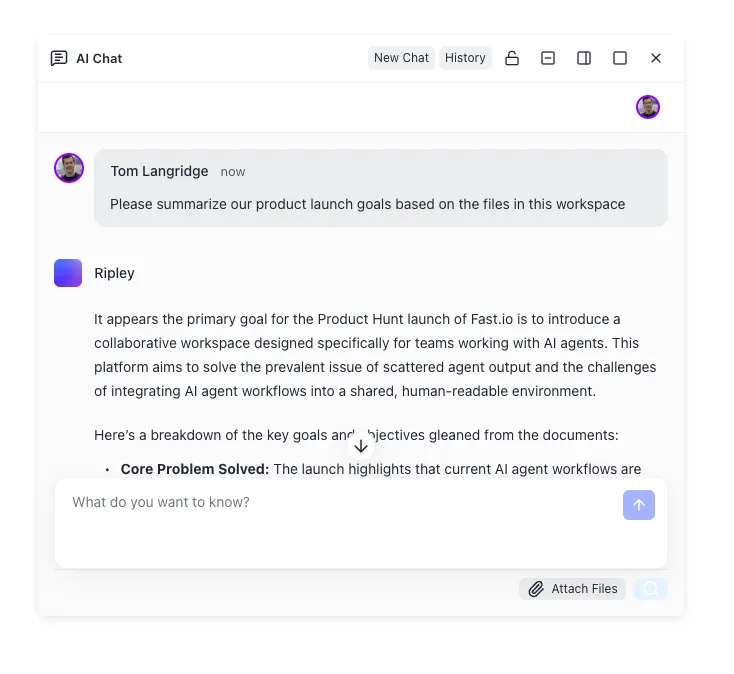
Several approaches work. You can build a custom pipeline with vector databases like Pinecone or Weaviate, use Perplexity's built-in search grounding, or use workspace platforms with built-in indexing. Once Intelligence is enabled for the workspace, Fast.io's Intelligence Mode auto-indexes uploaded files for semantic search and RAG queries with citations. Agents access indexed documents through the Fast.io MCP server, and every answer includes source references back to specific files. Fastio offers a 14-day Business Trial, card required; see pricing.
The practical takeaway: pick one of the top three models from this list, add RAG grounding, and your effective accuracy will exceed what any standalone model achieves.
Picking the Right Model for Factual Work
The "most accurate AI" depends on what you need it to do. Here is a decision framework based on the benchmark data.
Choose Claude when wrong answers are expensive. Legal documents, medical explanations, financial reports, client-facing content. Claude's 3-4% hallucination rate and tendency to decline rather than guess makes it the safest choice for high-stakes output.
Choose Gemini when you need broad factual recall. Research synthesis, competitive analysis, knowledge-base questions. Gemini's 74.8% SimpleQA score means it retrieves more facts than any competitor. Pair it with human verification to catch its higher hallucination rate.
Choose Perplexity when you need citations. Fact-checking workflows, journalism, academic research. Its 92% search-grounded accuracy and automatic source linking saves manual verification time.
Choose GPT-5.5 Pro with thinking mode for complex reasoning. Multi-step analysis, code generation, mathematical proofs. Thinking mode drops hallucination rates to 4.2%, competitive with Claude, at the cost of higher response latency.
Choose DeepSeek when you need on-premises deployment. Regulated industries, government work, data-sensitive applications. Accept the higher error rate in exchange for full infrastructure control.
No model eliminates the need for human review. Even at 3% error rates, a 10,000-word document will contain roughly 15 incorrect claims on average. The most accurate AI workflow in 2026 combines a low-hallucination model, RAG grounding with verified source documents, and a human reviewer who knows the subject matter.
Sources
References used to verify factual claims in this guide.
-
Frontier AI models now hallucinate between 3.1% and 19.1% of the time, down from 15-45% baselines in 2024
-
Hallucination rates across 26 top models range from 22% to 94%
-
Claude 4.6 has the lowest hallucination rate at approximately 3-4%
-
GPT-5.5 Pro drops from 8.3% to 4.2% with extended thinking
-
Gemini 3.1 Pro leads SimpleQA with 74.8%
-
Perplexity factual accuracy at 92% on search-grounded queries versus ChatGPT at 87%
-
RAG reduces hallucination rates by 30-70% across domains
-
Average LLM hallucination rate dropped from 50% to 13.9% after RAG in causal discovery
Frequently Asked Questions
Which AI hallucinates the least?
Claude 4.6 has the lowest measured hallucination rate among major AI models at approximately 3-4%, according to the Talkory 2026 five-model study and DigitalApplied benchmarks. GPT-5.5 Pro reaches 4.2% with extended thinking mode enabled, making it the closest competitor when that feature is turned on.
Is Claude more accurate than ChatGPT?
On hallucination benchmarks, yes. Claude 4.6 posts a 3-4% hallucination rate compared to GPT-5.4's approximately 6%. On SimpleQA factual knowledge tests, Claude scores 48.3% while GPT-5.4 scores 32.7%. GPT-5.5 Pro with extended thinking reaches 4.2%, closing the hallucination gap. The difference depends on whether you use thinking mode and what type of task you run.
How do you measure AI accuracy?
Three main benchmarks test different aspects of AI accuracy. Hallucination rate, measured by frameworks like Vectara's, tracks how often models fabricate information during grounded tasks. SimpleQA measures factual knowledge by asking straightforward questions. TruthfulQA tests whether models produce confident but incorrect answers to trick questions. No single benchmark captures the full picture, which is why the top model differs depending on which test you use.
Which AI is best for factual research?
Perplexity scores 92% factual accuracy on search-grounded queries and provides inline citations with every response, making it the strongest option for research where source verification matters. For research that requires deep reasoning rather than search, Claude 4.6 or GPT-5.5 Pro with thinking mode offer lower hallucination rates.
Does RAG make AI more accurate?
Yes. Retrieval-augmented generation reduces hallucination rates by 30-70% across domains, according to multiple 2026 studies. Grounded retrieval can push hallucination rates below 2% for summarization tasks. RAG works by feeding the model verified source documents alongside the question, so it references real data instead of relying solely on training data.
What is a good hallucination rate for AI?
Frontier models in 2026 range from 3% to 19%. For general content creation, rates below 10% are workable with human review. For high-stakes applications like legal or medical content, target models below 5% and add RAG grounding. No current model achieves a 0% hallucination rate across all task types.
Related Resources

Ground your AI outputs in verified source documents
Fast.io Intelligence Mode auto-indexes your files for RAG queries with citations.