How to Use Claude AI: A Practical Getting-Started Guide
Claude AI crossed 30 million monthly active users by mid-2026, yet most newcomers treat it like a search bar. Projects, Artifacts, file uploads, and Claude Cowork turn Claude into a working productivity tool. This guide walks through each feature with the practical details, like rate limits and model selection, that typical tutorials skip.


What Claude AI Does Beyond Basic Chat
Claude AI crossed 30 million monthly active users by May 2026, up 59% from 18.9 million at the start of the year. That growth tells you people are finding it. What the numbers don't show is how many of those users scroll past the chat box.
Claude is Anthropic's conversational AI assistant, available for free at claude.ai. It handles text generation, code writing, file analysis, web search, and interactive content creation through a feature called Artifacts. You can use it on the web, through desktop apps for Mac and Windows, or on iOS and Android.
What separates Claude from a basic Q&A tool is what happens after your first message. Projects let you organize conversations the way you'd organize folders on your computer. Artifacts let Claude build interactive documents, working code, and apps in a side panel instead of burying them in chat history. Claude Cowork turns the desktop app into an autonomous agent that operates directly on files stored on your machine.
The free tier gives you access to most of this, with some usage limits. Claude works best when you treat it like a specialist you can redirect. Ask it to write a project brief, then tell it to make the tone more casual. Upload a contract and ask it to flag non-standard clauses. Paste code and ask for a review. Each task builds on the same conversation context, so Claude gets more useful the longer you work with it in a single session.
Related guides
- How to Use Devin AI: A Developer's Getting Started TutorialLearn how to use Devin AI as an autonomous software engineer to solve coding tickets from scratch. This developer...
- Getting Started with Clay.com: GTM Platform Pricing and FeaturesOn March 11, 2026, clay.com overhauled its pricing model to introduce a dual-credit system that separates Data Credits...
- Is Claude AI Free? What You Get Without Paying in 2026Claude.ai drew nearly a billion visits in May 2026, and most users start on the free tier. Anthropic's $0 plan includes...
- Claude Context Window: Sizes, Limits, and How to Maximize ItClaude's context window determines how much text fits in a single conversation, and it varies more than most developers...
- Claude Artifacts: How to Create Interactive Apps, Documents, and CodeAnthropic ships Artifacts on every Claude plan, including the free tier, yet most users treat the feature as a code...
- Claude App: How to Download and Use Claude on Every PlatformAnthropic ships Claude across six platforms, but each one gives you different capabilities. This guide covers how to...
More on this subject: Claude and Claude Code (278 guides)
How to Set Up Your Account and Start a Conversation
Getting started takes about two minutes.
- Go to claude.ai and click "Sign up"
- Create an account with your email, or sign in with Google or Apple
- You land in a clean chat interface with a text box at the bottom
No app to install, no API key to configure. If you prefer a native app, download Claude Desktop from claude.ai/download for Mac or Windows. Mobile users can grab the app from the App Store or Google Play.
Choosing a model
Free accounts default to Sonnet 4.6, Anthropic's mid-range model that balances speed and quality. You also get access to Haiku 4.5, a faster model for simpler tasks. The flagship Opus 4.8 requires a paid subscription.
Switch models using the dropdown at the top of any conversation. For most work (writing, analysis, coding), Sonnet handles it well. Switch to Haiku when you want quicker responses on straightforward questions.
Your first conversation
Talk to Claude the way you'd talk to a colleague. "Summarize this PDF" works better than a carefully engineered prompt. Be specific about what you want: instead of "help me with my resume," try "rewrite the experience section of my resume to emphasize project management skills."
Claude keeps context within a conversation, so you can follow up naturally. "Make it shorter" or "add a section about budgeting" works after an initial request, the same way it would with a human editor.
Web vs. desktop vs. mobile
The web app at claude.ai has the full feature set, including Projects, Artifacts, and all model options. The desktop app adds Claude Cowork (on paid plans) and stays accessible from your system tray. The mobile apps handle conversations and file uploads but don't support Cowork. Pick whichever fits your usual workflow. If you plan to try Cowork later, install the desktop app now so it's ready.
Projects, Artifacts, and File Uploads
Three features separate productive Claude users from people who treat it like a search bar.
Projects
Projects organize your Claude conversations by topic. Click "Projects" in the sidebar to create one, give it a name, and optionally add instructions or reference files. Every conversation inside that Project inherits the same context.
This matters when you work on something across multiple sessions. A "Q3 Marketing Plan" project keeps all related conversations grouped together. Upload reference docs that Claude reads before answering, and you won't need to re-explain your brand voice or target metrics every time you start a new chat.
Artifacts
When you ask Claude to build something specific (a React component, a chart, a formatted document), the output appears in a dedicated panel to the right of your conversation. These are Artifacts.
You can edit Artifacts through follow-up messages ("change the color scheme to blue"), download them as files, or publish them with a shareable link. Recipients don't need a Claude account to view published Artifacts, and logged-in users can remix them into their own editable copies.
Artifacts work on the free tier. Try asking Claude to "build an interactive calculator for compound interest" or "create a project timeline as a Mermaid diagram" to see what they can do.
File uploads and web search
Claude accepts up to 20 files per conversation, with a 500MB limit per file. Upload PDFs, spreadsheets, images, code files, or documents and ask questions about them directly.
Web search is built in. When Claude needs current information (stock prices, recent news, product specs), it searches the web and cites sources. You can also ask it to research a topic and return links for further reading.
Extended thinking
Toggle extended thinking when you need Claude to work through complex problems step by step. This is useful for multi-step math, detailed code reviews, or analysis where you want to see reasoning rather than just the final answer. You can adjust the effort level (Low, Medium, High, Max) depending on how much processing time you want Claude to spend.
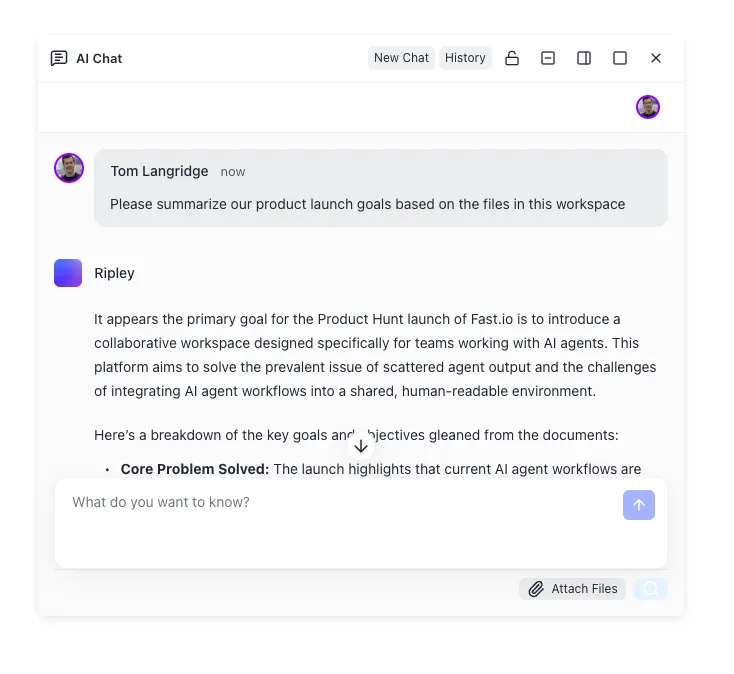


Give your Claude output a permanent home
Upload what Claude builds, search it with AI, and share it with your team.
Claude Cowork: Desktop Agent Mode
Claude Cowork turns the desktop app into something closer to an autonomous assistant than a chatbot. Instead of answering questions in a conversation, Cowork operates directly on files stored on your computer.
What Cowork does
You give Claude access to a specific folder on your machine, describe what you want done, and Cowork plans and executes the task. It can organize files, extract data from receipts, generate reports from notes, create spreadsheets from raw data, and clean up messy directory structures.
The key difference from regular chat: Cowork works autonomously. You approve a plan, then Claude executes each step without waiting for input at every stage. A request like "sort my Downloads folder by file type, rename generic files with descriptive names, and remove duplicates" runs start to finish once you approve it.
Getting started with Cowork
Cowork requires the Claude Desktop app and a Pro subscription ($20/month) or higher. To use it:
- Open Claude Desktop and click the "Cowork" tab in the sidebar
- Select "Work in a folder" and choose your target directory
- Describe your task in plain language
- Review the proposed plan
- Click approve to start execution
Folder access is sandboxed. Claude can only touch files in the directory you select, and you see every planned action before it runs.
Practical uses
Expense tracking: point Cowork at a folder of receipt photos and ask it to extract dates, vendors, amounts, and categories into a spreadsheet.
Research synthesis: drop five papers into a folder and ask for a comparison table of methodologies and findings.
Project cleanup: hand it a messy project directory and ask for a clean structure with renamed files and a README that describes the contents.
Anthropic doubled the 5-hour usage limits for Pro, Max, and Team users through July 5, 2026, which gives new subscribers more room to experiment with Cowork before the promotion ends.
What Free and Paid Plans Include
What the free tier includes
Free accounts get Sonnet 4.6, Haiku 4.5, web search, Projects, Artifacts, extended thinking, and file uploads. Memory is also included: Claude stores details you share across conversations, like your role, preferences, or ongoing projects, so you don't repeat yourself in every new chat.
The main constraint is usage. Expect roughly 15 to 40 messages every five hours, depending on prompt complexity and system demand. Longer prompts and file-heavy conversations count for more against your limit.
The limit resets on a rolling 5-hour window, not at midnight. Hit the cap at 2 PM and you can send messages again around 7 PM.
When to upgrade
Pro at $20 per month unlocks Opus 4.8, Claude Code (a terminal-based coding agent), Claude Cowork, Claude Design, and higher usage limits. If you use Claude daily for work, the free tier's rate limits will likely push you toward Pro within the first week.
Max plans start at $100 per month and provide 5x or 20x the Pro usage. These matter for heavy users running Cowork tasks or long coding sessions throughout the day.
Keeping AI-generated work organized
Claude Projects handle conversation organization inside the app. But the files Claude generates (reports, code, spreadsheets, analysis docs) still need a home outside the chat window.
Local folders work for solo use. Cloud storage like Google Drive or Dropbox handles basic sharing. For workflows where AI-generated content needs to be searchable, indexed, and shared with a team, a purpose-built workspace fills the gap.
Fast.io offers persistent workspaces and a remote MCP server that AI agents connect to directly. Once Intelligence is enabled for the workspace, it auto-indexes uploaded files for AI-powered search and chat, so you can ask questions about your stored documents instead of digging through folder trees. Upload Claude's Cowork output to a shared workspace, and your team accesses the finished product without needing Claude accounts themselves.
For developers building on top of Claude's output, Fast.io exposes a consolidated MCP toolset for workspace, storage, and AI operations. An agent can generate content in Claude, push it to a Fast.io workspace via the MCP endpoint, and transfer ownership to a human reviewer without manual file shuffling.
Sources
References used to verify factual claims in this guide.
-
Claude AI crossed 30 million monthly active users by May 2026, up from 18.9 million at the start of the year
-
Free users can send roughly 15 to 40 messages every five hours Maximum of 20 files per chat session with a 500MB size limit per file
-
Pro plan at $20 per month, Max plans from $100 per month
Frequently Asked Questions
How do I start using Claude AI?
Go to claude.ai and create a free account with your email, Google, or Apple login. You can also download the desktop app for Mac or Windows, or the mobile app for iOS and Android. The free tier includes Sonnet 4.6 and Haiku 4.5 models, web search, Projects, Artifacts, and file uploads.
Is Claude AI free to use?
Yes. The free tier includes two AI models, file uploads (20 files up to 500MB each), Projects, Artifacts, web search, extended thinking, and memory. Usage is limited to roughly 15 to 40 messages per rolling 5-hour window. Pro plans start at $20 per month and add the Opus model, Claude Code, Cowork, and higher message limits.
What can Claude AI do?
Claude handles text generation, code writing, document analysis, web research, and interactive content creation through Artifacts. You can upload files for analysis, organize conversations into Projects with shared context, and use Claude Cowork on desktop for autonomous tasks like file organization and data extraction.
How is Claude different from ChatGPT?
Claude's standout features include Artifacts (interactive outputs in a dedicated side panel), Projects (organized conversation groups with persistent context), and Cowork (a desktop agent that works on local files autonomously). ChatGPT offers different strengths, including image generation. The practical choice depends on which feature set fits your daily workflow.
What are Claude Artifacts?
Artifacts are standalone outputs that appear in a panel beside your conversation. When you ask Claude to build something (a calculator, chart, code snippet, or formatted document), it creates an Artifact you can edit through follow-up prompts, download as a file, or publish with a shareable link. Viewers don't need a Claude account to see published Artifacts.
Does Claude remember previous conversations?
Claude has a Memory feature that stores information you share across conversations, like your name, role, and preferences. You can also import memory from other AI tools. Within a single conversation, Claude maintains full context of everything discussed. Projects add another layer by attaching reference files and custom instructions that apply to every conversation within the Project.
Related Resources

Give your Claude output a permanent home
Upload what Claude builds, search it with AI, and share it with your team.