Best OpenClaw Tools for AI Photo Restoration and Enhancement
OpenClaw photo restoration tools are ClawHub skills that repair, enhance, and upscale damaged or low-quality photos using AI models for colorization, scratch removal, face enhancement, and resolution upscaling. This guide ranks the six best skills for restoration workflows and shows how to chain them into automated pipelines.

What Photo Restoration Skills Actually Do
Photo restoration used to mean hours in Photoshop: cloning out scratches, manually repainting missing areas, guessing at original colors. AI models changed the process by learning to predict what damaged regions should look like, but most tools still require downloading software, uploading files, and manually stitching together multiple steps.
OpenClaw skills wrap those same AI models into conversational commands. You paste an image URL into an OpenClaw chat, tell the agent what you need ("remove the scratches and colorize this 1940s portrait"), and the skill handles the API calls, polling, and file delivery. The parent keyword "ai photo restoration" draws about 1,600 monthly searches at $3.45 CPC, which tells you how many people are looking for exactly this workflow.
Restoration pipelines typically chain several distinct operations. A damaged family photo might need scratch detection and removal first, then face enhancement to sharpen blurred features, followed by colorization to convert black-and-white to natural color, and finally upscaling to bring the result to print resolution. No single AI model handles all four steps well. The advantage of OpenClaw is that an agent can chain multiple skills in sequence, passing output from one step as input to the next, without manual intervention.
Related guides
- Best n8n Tools for AI Agents: Top 10 Nodes for 2026n8n changed AI automation with its visual workflow builder. We rank the best nodes and integrations for building...
- Best Tools for CrewAI Agents: Top Picks for 2026CrewAI agents need good tools to be useful. The framework handles coordination, but external integrations let agents...
- Best OpenClaw Tools for AI Pet Portrait and Custom Animal Photo ArtThe AI pet portrait market hit $240 million in 2025 and generated 4.7 million portraits, yet most standalone apps...
- Best OpenClaw Tools for AI Photo Culling and Shoot SelectionProfessional photographers lose roughly two hours per wedding just reviewing and rating images before editing begins....
- Top OpenClaw Tools for AI Photo Animation and Cinemagraph CreationThe AI image generator market reached $484 million in 2026, but most of that growth targets text-to-image creation....
- 7 Best OpenClaw Tools for AI Photo Collage and Mood Board CompositionDIY and collage-inspired design searches rose 90% year-over-year on Canva, but every popular collage tool remains a...
More on this subject: OpenClaw Tools (101 guides)
How We Evaluated These Skills
We tested each skill against five criteria:
- Restoration quality: How well does the skill repair scratches, tears, fading, and compression artifacts while preserving the original subject?
- Face handling: Does the skill recover facial detail naturally, or does it over-smooth skin and change features?
- Colorization accuracy: For black-and-white inputs, does the skill produce historically plausible colors, or does everything look tinted?
- Pipeline compatibility: Can the skill accept image URLs as input and return URLs as output, making it easy to chain with other skills?
- Cost and setup: API key requirements, per-image pricing, and installation complexity.
Every skill listed here is available on ClawHub, OpenClaw's public skill registry. Install any of them with a single command in an OpenClaw conversation.
Top 6 OpenClaw Skills for Photo Restoration
1. EachLabs Image Edit
EachLabs Image Edit gives you access to over 200 AI models through a single skill, making it the most versatile option for photo restoration. The skill calls the EachLabs Predictions API, which routes your image to whichever model fits the task. For restoration specifically, you can use dedicated models for inpainting (filling in damaged regions), face enhancement, style transfer, and upscaling.
Key strengths:
- Over 200 models covering editing, upscaling, inpainting, face swap, style transfer, and background removal
- Recommended models include Flux 2 Turbo Edit for fast edits and Flux 2 Max Edit for highest-quality results
- Pipeline-friendly: accepts image URLs and returns processed URLs, so you can chain restoration steps without downloading intermediate files
Limitations:
- Requires an EachLabs API key (set via EACHLABS_API_KEY environment variable)
- Model selection can be overwhelming; you need to know which model handles which restoration task
Best for: Complex restoration workflows where you need multiple operations (scratch removal, then face recovery, then upscaling) within one skill.
Install: /install eachlabs-image-edit
2. Recraft
Recraft V3 and V4 power this skill, which covers raster and vector generation, prompt-based editing, background removal, vectorization, and upscaling. For restoration, the prompt-based editing is the key feature: describe what you want fixed ("remove the crease running across the top third of this photo") and Recraft interprets the instruction.
Key strengths:
- Prompt-based editing lets you describe repairs in natural language
- Upscaling preserves detail well, especially on faces and text
- Background removal cleans up damaged or distracting backgrounds without manual masking
Limitations:
- No dedicated colorization model; you can prompt for color changes but results are inconsistent on full black-and-white conversions
- Usage is billed per request with rates varying by operation type
Best for: Targeted repairs where you can describe the damage in words. Works well for creases, stains, and background cleanup.
Install: /recraft
3. fal.ai
The fal.ai skill connects OpenClaw to a large catalog of AI models spanning image generation, video creation, and audio processing. For restoration, the catalog includes upscalers, inpainting tools, and image-to-image enhancement models across the FLUX, SDXL, and Stable Diffusion families. Because the skill handles job submission and result retrieval behind the scenes, you just describe the task and get the processed image back.
Key strengths:
- Broad model catalog with specialized upscalers, inpainting models, and image-to-image enhancers
- Supports multiple model families, so you can pick the best fit for each restoration task
- Handles batch workloads well, making it practical for processing dozens of photos in a single session
Limitations:
- Processing is not instant; larger models and higher resolutions take longer to return results
- Finding the right model for a specific restoration task takes some browsing through the fal.ai catalog
Best for: Batch restoration jobs where you need to process many photos without manually managing each one.
Install: /install fal-ai
4. Nano Banana Pro
Nano Banana Pro wraps Google's Gemini 3 Pro Image model, giving OpenClaw access to one of the strongest general-purpose image editing models available. It supports text-to-image, image-to-image, and multi-image composition with up to 14 reference images. For restoration, the image-to-image editing mode lets you describe repairs and the Gemini model applies them.
Key strengths:
- Gemini 3 Pro Image model produces high-fidelity results, especially on faces and skin texture
- Selectable output resolution: 1K, 2K, or 4K
- Text rendering error rate below 10%, useful for restoring photos that include signage or handwriting
Limitations:
- Requires an API key from APIYI or a compatible Gemini endpoint
- Not a dedicated restoration tool, so specialized tasks like scratch removal depend on how well you phrase the editing prompt
Best for: Portrait restoration where natural skin texture matters. The Gemini model avoids the plastic, over-smoothed look common in cheaper face enhancement models.
Install: /install nano-banana-pro
5. Best Image Generation (EvolinkAI)
Despite the name, this skill handles image-to-image editing alongside generation. It routes prompts to the optimal AI model automatically, which means you describe the restoration task and the skill picks the best available model. Output quality ranges from 1K to 4K resolution.
Key strengths:
- Automatic model routing removes the guesswork of choosing the right AI model for each task
- Supports up to 10 input image URLs per request, useful for batch comparison
- Low cost at roughly $0.12 to $0.20 per image
Limitations:
- Limited control over which model handles your request
- 10MB per-image size limit may exclude high-resolution scans of large prints
Best for: Quick, affordable restoration where you trust the model router to pick the right approach.
Install: /install best-image-generation
6. Image Skill (by Iván)
This skill focuses on image processing fundamentals: format conversion, resizing, compression, color-profile management, and metadata handling. It is not an AI restoration tool, but it fills a critical gap in restoration pipelines. After running an AI-powered repair, you often need to convert the output to a specific format, strip EXIF data, adjust the color profile for print, or compress for web delivery.
Key strengths:
- Format conversion between PNG, JPEG, WebP, TIFF, and more
- Color-profile management for accurate print output
- Metadata stripping and editing for privacy and archival workflows
Limitations:
- No AI-based restoration or enhancement; this is a post-processing tool
- Less useful as a standalone skill for photo restoration
Best for: The final step in a restoration pipeline: converting, compressing, and preparing the restored image for its destination.
Install: /install image-skill


Store and share restored photos from your agent pipeline
Persistent workspaces with remote MCP access. Your OpenClaw restoration pipeline saves, versions, and shares results without manual file management.
Building a Restoration Pipeline with Chained Skills
The real power of OpenClaw for photo restoration is chaining skills into automated pipelines. Instead of manually running each step, you give the agent a sequence of instructions and it handles the handoffs between skills.
A typical restoration pipeline looks like this:
- Damage assessment: The agent examines the input photo and identifies what needs repair (scratches, missing areas, fading, discoloration)
- Inpainting and repair: EachLabs Image Edit or fal.ai runs an inpainting model to fill damaged regions
- Face enhancement: If the photo contains faces, a dedicated face model (via EachLabs or Nano Banana Pro) recovers detail without over-smoothing
- Colorization: For black-and-white photos, a colorization model applies historically plausible colors
- Upscaling: A FLUX or SDXL-based upscaler brings the restored image to print resolution (2x or 4x the original)
- Post-processing: The Image Skill handles format conversion, color-profile tagging, and compression for the final output
Each skill accepts image URLs as input and returns URLs as output, so the agent passes results from one step directly to the next. No intermediate downloads, no manual file management.
The gap that OpenClaw fills here is orchestration. Apps like Remini and MyHeritage handle individual restoration steps well, but they are closed ecosystems. You cannot customize the model for each step, swap in a better upscaler when one becomes available, or add a custom post-processing step. With OpenClaw, each skill is independent and replaceable.
Storing and Sharing Restored Photos
Restoration pipelines generate multiple output files: the original scan, intermediate repair stages, and the final enhanced version. Keeping these organized matters for archival projects where you may want to re-run a step with a better model later.
Local storage works for personal projects, but breaks down when you need to share results with family members or clients, hand off files between agents, or maintain version history. Cloud storage options like Google Drive and Dropbox handle sharing, but lack the agent-level access that makes automated pipelines smooth.
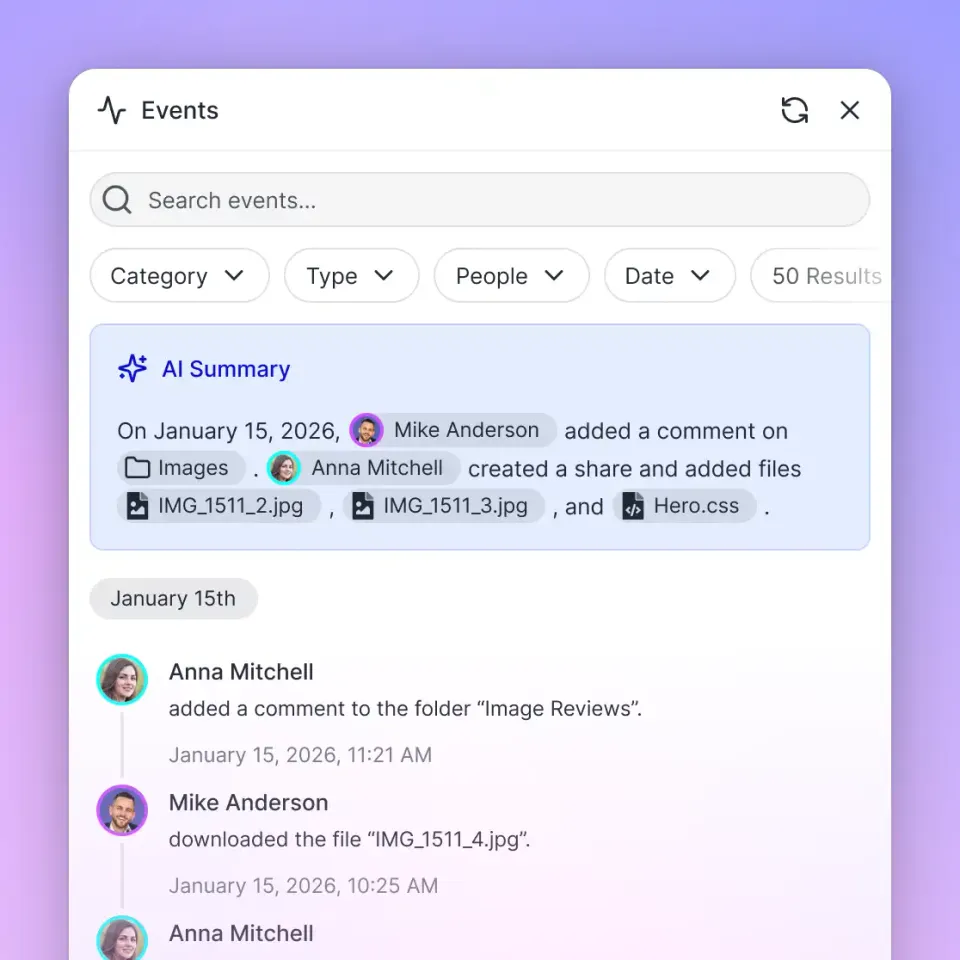
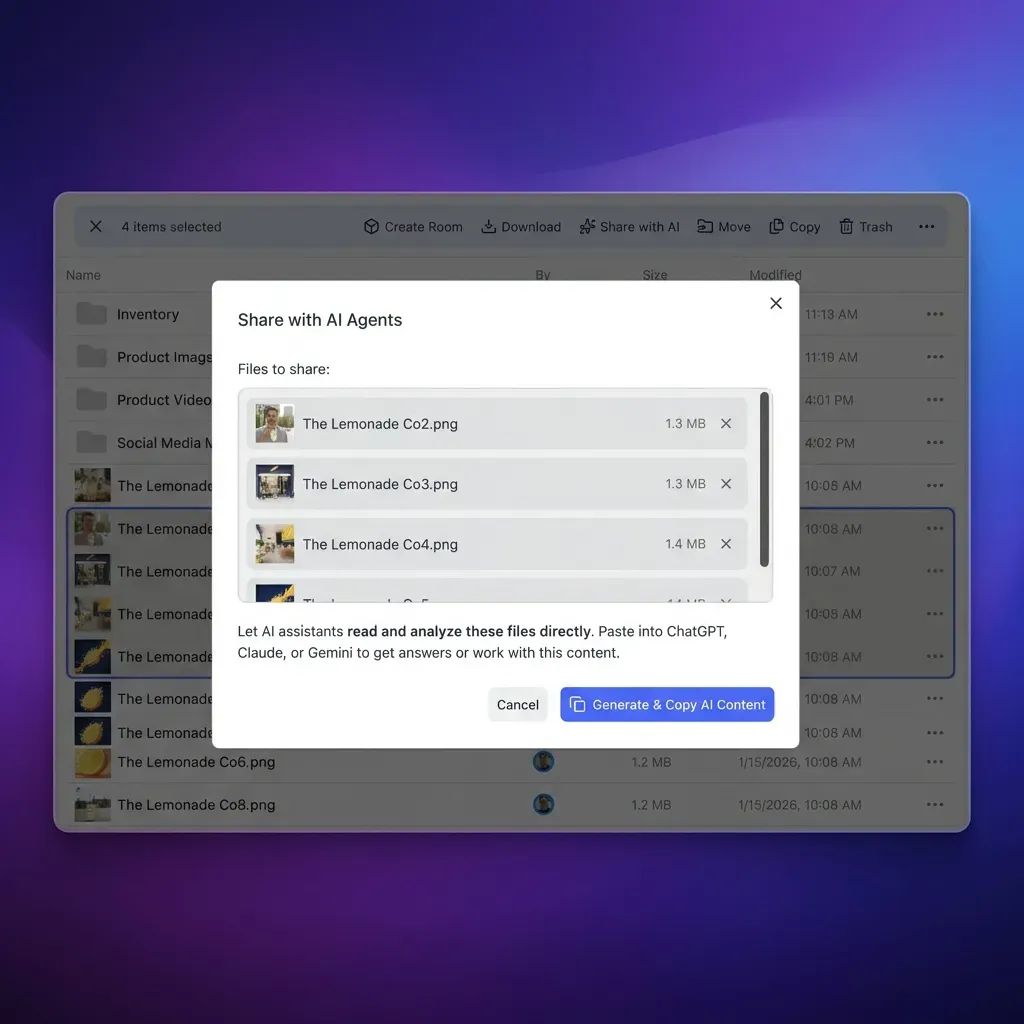
Fastio provides workspaces designed for this kind of workflow. Agents read and write files through the Fastio MCP server, so an OpenClaw restoration pipeline can save each stage of a restoration directly to a shared workspace. Once Intelligence is enabled for a workspace, uploaded images are indexed, making them searchable by content. Branded shares let you send restored photos to clients through a custom portal rather than a generic download link.
Fastio offers a 14-day Business Trial (credit card required; see /pricing/) to evaluate shared workspaces and agent tools. That provides ample capacity for hundreds of restored images and their intermediate files. When the agent finishes a restoration batch, it can transfer workspace ownership to a human team member who reviews and distributes the results.
For teams restoring photos at scale (genealogy services, archive digitization projects, real estate photo cleanup), the combination of OpenClaw's skill-based processing and Fastio's persistent storage removes the manual file shuffling that slows down every other approach.
Choosing the Right Skill for Your Restoration Task
Not every restoration job needs the same toolset. Here is a quick decision guide:
Scratched or torn prints: Start with EachLabs Image Edit using an inpainting model. The large model catalog means you can try several approaches without switching skills.
Faded portraits with blurred faces: Use Nano Banana Pro for its Gemini-powered face recovery. The model preserves natural skin texture better than most alternatives, avoiding the wax-figure look.
Black-and-white to color: This is the hardest restoration task to get right. EachLabs offers dedicated colorization models, and you can chain the result with a face enhancer to clean up any artifacts the colorization introduced.
Batch processing (50+ photos): Use fal.ai for its async queue, which prevents timeouts on large jobs. Pair it with the Image Skill for automated format conversion on the output.
Quick fixes on a budget: Best Image Generation at $0.12 to $0.20 per image handles simple enhancement tasks where you do not need fine-grained model control.
Print-ready output: Always finish with the Image Skill for color-profile tagging (sRGB for web, Adobe RGB for print) and format conversion. Skipping this step is how you end up with washed-out prints.
The general pattern is to start with the most capable skill for your primary restoration task, then add post-processing steps as needed. You can always swap individual skills in the pipeline as better models become available on ClawHub.
Sources
References used to verify factual claims in this guide.
-
Parent keyword 'ai photo restoration' draws 1,600 monthly searches with $3.45 CPC
-
EachLabs Image Edit provides access to 200+ AI models for image processing
-
fal.ai skill connects to over 600 AI models
-
ClawHub hosts over 2,800 published skills
-
Best Image Generation costs roughly $0.12 to $0.20 per image
Frequently Asked Questions
Can OpenClaw restore old photos?
Yes. OpenClaw skills like EachLabs Image Edit and fal.ai connect to AI models that handle scratch removal, inpainting, face enhancement, and colorization. You describe the damage in the chat, and the agent routes the image through the appropriate model. For complex restorations, you can chain multiple skills into a pipeline that handles each repair step automatically.
What is the best OpenClaw skill for photo enhancement?
EachLabs Image Edit is the most versatile single skill, with access to over 200 AI models covering upscaling, inpainting, face enhancement, and style transfer. For portrait-specific work where natural skin texture matters, Nano Banana Pro (powered by Gemini 3 Pro Image) produces some of the most realistic face recoveries available.
How do I upscale photos with OpenClaw?
Install a skill that supports upscaling (EachLabs Image Edit, fal.ai, or Recraft), paste the image URL into your OpenClaw conversation, and ask the agent to upscale it. Most skills support 2x and 4x enlargement. fal.ai offers the Flux Vision Upscaler for high-quality results, while EachLabs lets you choose from multiple upscaling models depending on whether you prioritize speed or detail.
Can OpenClaw colorize black and white photos?
OpenClaw can colorize black-and-white photos through skills like EachLabs Image Edit, which includes dedicated colorization models in its 200+ model library. The results work best on well-preserved originals with clear detail. For heavily damaged photos, run scratch removal and face enhancement before colorization, so the colorization model works with a clean input.
How much does OpenClaw photo restoration cost?
Costs depend on which skills and models you use. Best Image Generation charges roughly $0.12 to $0.20 per image. EachLabs and fal.ai bill per API request with rates varying by model. Recraft also uses per-request billing. The OpenClaw skills themselves are free to install from ClawHub. You only pay for the underlying AI model API calls.
Can I automate photo restoration with OpenClaw?
Yes. OpenClaw agents can chain skills into automated pipelines. You define the sequence (for example, inpaint, then enhance faces, then colorize, then upscale) and the agent handles each step, passing output URLs between skills without manual downloads. This is the main advantage over standalone apps like Remini or MyHeritage, which require manual intervention at each stage.
Related Resources

Store and share restored photos from your agent pipeline
Persistent workspaces with remote MCP access. Your OpenClaw restoration pipeline saves, versions, and shares results without manual file management.