7 Best OpenClaw Tools for AI Photo Collage and Mood Board Composition
DIY and collage-inspired design searches rose 90% year-over-year on Canva, but every popular collage tool remains a standalone app. OpenClaw skills let you chain image generation, style transfer, and layout composition in one agent conversation. Seven tools cover the full pipeline from multi-provider generation to Canva integration.

Why Run Collage and Mood Board Work Through an Agent
DIY and collage-inspired design searches rose 90% year-over-year on Canva, according to the platform's 2026 Design Trends Report. That growth tracks a specific behavior: creators want to assemble compositions from multiple visual elements, not just generate single images from a prompt.
The tooling has not caught up to the demand. Canva, Adobe Firefly Boards, Fotor, and PhotoGrid all work as standalone apps. You open the tool, drag images onto a canvas, adjust the layout, export the file, and close the tab. If those images came from an AI generator, you already used a separate app to make them. Two tools, two interfaces, no connection between them.
OpenClaw skills collapse that gap. Your agent can generate images across multiple providers, apply style references from existing assets, batch outputs for variation, and save everything to a shared workspace without leaving the conversation. The seven tools below cover the full pipeline: generating raw visual elements, refining them with editing and vectorization, and composing final layouts through design-aware skills or direct Canva integration.
Each tool fills a distinct role in a collage or mood board workflow. The first four handle image generation with different strengths (speed, model variety, aesthetic quality). The last three handle composition, editing, and layout. A practical workflow chains tools from both groups.
Related guides
- Best n8n Tools for AI Agents: Top 10 Nodes for 2026n8n changed AI automation with its visual workflow builder. We rank the best nodes and integrations for building...
- Best Tools for CrewAI Agents: Top Picks for 2026CrewAI agents need good tools to be useful. The framework handles coordination, but external integrations let agents...
- Best OpenClaw Tools for AI Pet Portrait and Custom Animal Photo ArtThe AI pet portrait market hit $240 million in 2025 and generated 4.7 million portraits, yet most standalone apps...
- 7 Best OpenClaw Tools for Building a Custom AI Image LibraryNearly half of all stock photos on major platforms are now AI-generated, yet most teams still pay for subscriptions...
- 7 Best OpenClaw Tools for AI Image Outpainting and Canvas ExpansionOpenClaw's skill registry grew from 2,857 skills in January 2026 to over 13,700 by late February, but finding the right...
- 9 Best OpenClaw Tools for AI Art Generation and Creative IllustrationOver 80 million AI images are generated daily, but most creators still toggle between standalone apps and their AI...
More on this subject: OpenClaw Tools (101 guides)
How We Evaluated These OpenClaw Tools
We tested each tool against five criteria specific to collage and mood board workflows:
- Style variety: Can the tool produce different visual styles (photorealistic, illustrated, abstract, textured) from the same conversation? Mood boards need visual diversity, not a single aesthetic.
- Multi-image handling: Does the tool generate or accept multiple images in one request? Collages require batches of elements, not single outputs.
- Editing and refinement: Can the tool modify generated images through background removal, upscaling, or style transfer? Collage elements rarely work straight out of a generator.
- Composition awareness: Does the tool understand layout, visual hierarchy, or design principles? Or does it only output individual images?
- Workflow integration: Does the output feed into a broader pipeline with proper file formats, naming, and storage?
Every tool listed below is either a native OpenClaw capability documented at docs.openclaw.ai or a verified skill from the awesome-openclaw-skills catalog on GitHub. Install skills from your OpenClaw settings panel or from ClawHub.
Quick Comparison
Top 7 OpenClaw Tools for Collage and Mood Board Composition
- OpenClaw image_generate (built-in): Native multi-provider generation with batch output and style reference support
- Fal AI: Fast FLUX and SDXL generation through fal.ai with style reference support
- EachLabs Image Generation: Wide model catalog for maximum style diversity across collage elements
- Image Gen: Multi-model access including Midjourney, FLUX, and SDXL
- Recraft: Generation and post-processing with background removal, vectorization, and batch editing
- Cavas Skill: Design-principled composition in PNG and PDF with visual hierarchy rules
- Canva Connect: Direct Canva API integration for templates, layouts, and asset management
Tools 1 through 4 generate the raw visual elements that fill a collage or mood board. Tools 5 through 7 handle refinement, composition, and final layout. A complete workflow chains tools from both groups.



Keep every generated collage asset in one searchable workspace
Connect your agent to a Fastio workspace with remote MCP access and team sharing. Enable Intelligence to search your mood board library by description.
Image Generators for Collage Elements
Four tools handle the image generation stage of a collage workflow, each with a different strength.
1. OpenClaw image_generate (Built-in)
Every OpenClaw instance ships with a native image generation tool that routes requests across multiple providers, including OpenAI, Google, fal, and xAI. For collage work, the ability to generate several images per request and pass reference images for style-guided output matters most. When you supply existing visuals as style references, the generator matches the tone of your brand assets rather than interpreting each prompt from scratch.
Key strengths:
- Multi-image output per request reduces round trips when building collage element batches
- Reference image support lets you anchor all generations to an existing mood board or brand guide
- Provider failover keeps generation running if one upstream service goes down
Best for: Starting any collage or mood board workflow. Use it as the default generation layer and add specialized skills when you need specific models or features.
2. Fal AI
Fal AI routes requests through fal.ai's inference infrastructure, hosting models like FLUX and SDXL optimized for speed. When you are iterating on mood board concepts and need to see dozens of variations quickly, generation latency becomes the bottleneck. Fal's optimized serving cuts wait times compared to slower endpoints.
Key strengths:
- Fast inference for rapid iteration on collage concepts
- Style reference support matches the visual tone of existing brand assets
- Covers image, video, and audio generation through one service
Limitations:
- Requires a fal.ai API key and account
- Model selection is limited to what fal.ai hosts
Best for: High-volume iteration during the concept phase. Generate dozens of texture, background, and element options quickly, then curate the strongest candidates into a final composition.
3. EachLabs Image Generation
EachLabs gives your agent access to a wide catalog of AI models through a single skill, spanning open-source generators like Flux and SDXL alongside commercial options like GPT Image and Gemini. For collages and mood boards, model diversity is the point. You might want a photorealistic hero image from one model, an illustrated accent from another, and a textured background from a third. EachLabs lets you generate all three from the same conversation without switching skills.
Key strengths:
- Large model catalog lets you match different art styles to different collage elements
- Consistent interface across all models reduces friction when switching between providers
- Includes both open-source and commercial generators
Best for: Mood boards that need visual variety. A brand mood board might combine photography, illustration, and abstract textures, each best served by a different model.
4. Image Gen
Image Gen connects OpenClaw to several generators including Midjourney access through a third-party gateway, plus FLUX and SDXL. The Midjourney access is the differentiator. Midjourney still produces some of the most aesthetically polished output among image generators, and having it available inside an agent conversation means you can generate hero elements with high visual fidelity while filling background textures with faster, cheaper models.
Key strengths:
- Midjourney access for high-aesthetic output without leaving your agent conversation
- Multi-model comparison lets you generate the same prompt across different generators
- Flexible sizing and parameter controls per model
Best for: Collages where visual quality matters more than speed. Use Midjourney for hero elements and FLUX for supporting textures.
Composition and Layout Tools
Three tools move beyond image generation into editing, composition, and layout.
5. Recraft
Recraft brings professional editing capabilities into OpenClaw conversations. It handles both generation and post-processing: create vector and raster artwork, remove backgrounds, vectorize raster images, and upscale resolution. For collage workflows, background removal is the most useful feature. Generate an element with one skill, strip the background with Recraft, and layer the transparent result onto your composition.
Key strengths:
- Background removal and vectorization turn raw generations into clean, composable elements
- Vector output (SVG) produces scalable graphics for mood boards that need to work at both print and screen sizes
- Batch processing handles multiple elements in one run
Limitations:
- Per-request API costs can accumulate during heavy editing passes
- Requires a Recraft API key
Best for: Preparing individual elements for composition. If your collage includes cutout photographs, illustrated icons, and text overlays, Recraft handles the extraction and cleanup that makes layering possible.
6. Cavas Skill
Cavas creates visual output using design philosophy principles rather than raw prompt interpretation. It applies rules about color theory, visual hierarchy, and compositional balance to produce artwork with intentional structure. For mood boards, this adds a layer of design intelligence that pure image generators lack.
Key strengths:
- Applies compositional and design rules to visual output
- Outputs in both PNG (digital) and PDF (print-ready), useful for client-facing mood board presentations
- Focuses on structured design pieces like posters, mood boards, and artwork
Best for: Final mood board assembly where visual balance matters. Use image generators for raw elements, then let Cavas apply design principles to the overall composition.
7. Canva Connect
Canva Connect bridges your agent with Canva's design platform, giving access to Canva's template library, asset management, and layout tools. Instead of generating a mood board layout from scratch, your agent can pull a collage template from Canva, populate it with AI-generated images, and manage the result through Canva's collaborative environment.
Key strengths:
- Access to Canva's template library, which includes collage and mood board layouts
- Asset management lets your agent organize generated elements in Canva folders
- Connects agent-generated content to Canva's collaborative design tools
Best for: Teams already using Canva for design. The agent generates visual elements through other skills and places them into Canva templates, combining AI generation speed with Canva's layout tools.
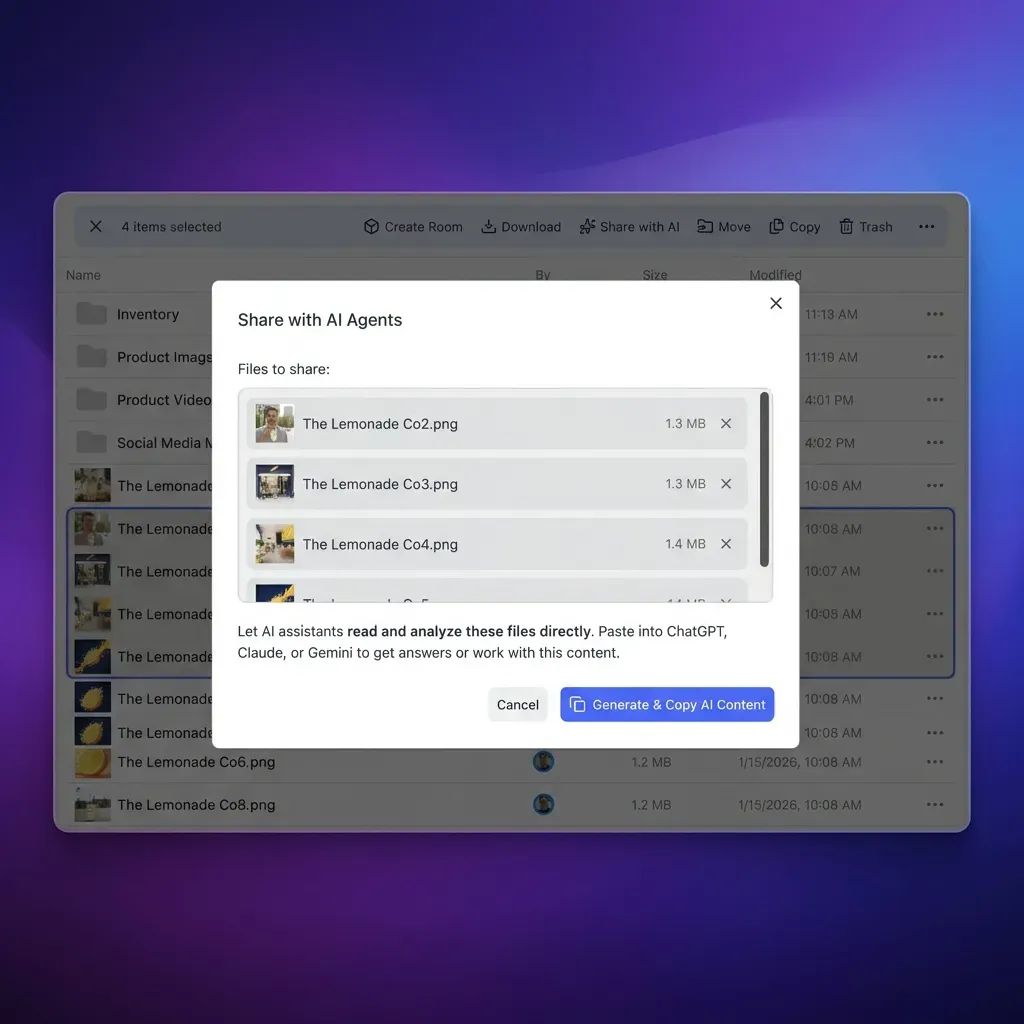
Whichever tools you use, the generated files need persistent storage. Local directories work for solo experiments, but team workflows benefit from a shared space where assets are versioned and searchable. Fast.io provides that with a 14-day Business Trial (credit card required). Your agent saves collage elements directly to a workspace, and once Intelligence is enabled for the workspace, uploaded images are indexed so you can search your generated library by description rather than filename. Other storage options include S3 (flexible but requires infrastructure setup), Google Drive (familiar but limited agent API access), or local directories (simple but not collaborative).
Building a Mood Board Workflow Step by Step
Building a mood board through an agent follows a concrete sequence that chains the tools above into a single pipeline.
Step 1: Define the visual direction. Give your agent a brief: the brand, the color palette, the mood you want to convey, and 2-3 reference images if you have them. The agent uses these as style references in the image_generate tool's images parameter. This anchors all subsequent generation to a consistent visual tone.
Step 2: Generate element batches. Run multiple generation requests across different models. Use EachLabs or Image Gen for style variety: photorealistic textures from GPT Image, illustrated accents from Flux, abstract patterns from SDXL. Set count: 4 on the built-in tool to get multiple options per prompt.
Step 3: Refine and prepare. Pass selected elements through Recraft for background removal and vectorization. This turns raw generations into clean, layerable assets. Upscale any elements that need higher resolution for print mood boards.
Step 4: Compose the layout. Use Cavas for a design-principled layout that applies compositional rules automatically, or use Canva Connect to place elements into a professional template. Cavas works best for original compositions where you want the tool to make layout decisions. Canva Connect works best when you want to start from an existing layout structure.
Step 5: Store and share. Save the finished mood board and all source elements to a shared workspace. With Fast.io workspaces, your team can review the board and request changes while the agent iterates without losing source assets. Ownership transfer lets the agent hand the finished workspace to a client or stakeholder once the board is finalized.
This pipeline replaces what normally requires four separate apps: a text-to-image generator, an image editor, a collage builder, and a file sharing service. The agent handles the app switching while you focus on the creative decisions that need a human eye.
Sources
References used to verify factual claims in this guide.
-
DIY and collage-inspired design searches rose 90% year-over-year on Canva
-
OpenClaw image_generate supports multi-provider routing, multi-image output, and reference image style guidance
-
EachLabs Image Generation skill provides access to 60+ AI models including Flux, GPT Image, Gemini, and Imagen
Frequently Asked Questions
Can AI make a photo collage?
Yes. AI image generators produce individual collage elements like photographs, textures, illustrations, and patterns. Agent frameworks like OpenClaw can orchestrate the full assembly pipeline. The built-in image_generate tool generates up to 4 images per request, skills like Recraft handle background removal to prepare elements for layering, and Cavas or Canva Connect handle the final composition.
What is the best AI mood board generator?
For standalone tools, Adobe Firefly Boards offers AI-powered generation with real-time collaboration, and Canva provides the largest template library. For agent-orchestrated workflows, OpenClaw paired with EachLabs Image Generation (60+ models) covers the generation side, while Canva Connect bridges agent output to Canva's layout tools for the final board.
How do you create a mood board with OpenClaw?
Install image generation skills like EachLabs or Fal AI from ClawHub. Ask your agent to generate visual elements matching your creative brief, using reference images for style consistency. Use Recraft to clean up elements through background removal and vectorization, then compose the final layout with Cavas or Canva Connect. Save all assets to a shared workspace like Fast.io for versioning and team review.
What tools can OpenClaw use for visual composition?
OpenClaw's built-in image_generate tool handles multi-image generation across 11 providers. ClawHub skills extend the pipeline: Fal AI and EachLabs for generation, Recraft for editing and vectorization, Cavas for design-principled composition, and Canva Connect for template-based layouts. Each skill installs from the OpenClaw settings panel.
Do I need separate API keys for each OpenClaw image skill?
Each skill that connects to an external provider (fal.ai, Recraft, Legnext.ai for Midjourney) requires its own API key. The built-in image_generate tool uses the provider keys configured in your OpenClaw settings. Skills that rely on the same underlying provider share the same key. Most providers offer free tiers for testing the workflow before committing to paid plans.
Related Resources

Keep every generated collage asset in one searchable workspace
Connect your agent to a Fastio workspace with remote MCP access and team sharing. Enable Intelligence to search your mood board library by description.