Best Storage Solutions for Base44 Workflows
According to the Flexera 2025 State of the Cloud Report, 84% of organizations identify managing cloud spend and infrastructure complexity as a primary operational challenge in multi-cloud environments. Building applications on AI app builders like Base44 requires a clear storage strategy to prevent local asset bottlenecks and ensure multi-user persistence across external workspaces.


How Base44 Applications Handle Persistent File Storage
According to the Flexera 2025 State of the Cloud Report, 84% of organizations identify managing cloud spend and infrastructure complexity as a primary challenge in multi-cloud environments, while 70% rely on hybrid architectures to bridge front-end application environments with external storage backends. As teams rapidly generate web applications using AI app builders like Base44, managing binary data, brand assets, and user-uploaded documents presents distinct architectural decisions.
Choosing the best storage for Base44 workflows ensures high scalability and direct file access across AI-generated apps. Base44, an AI-powered app-building platform acquired by Wix, enables non-technical builders and developers to generate full-stack applications from plain English prompts. Infrastructure management is handled automatically within the Base44 environment, providing an integrated File Library for static UI media, icons, and local application assets.
However, relying solely on an application's internal file library for all operational data can introduce scaling constraints. Built-in app libraries handle local assets while cloud workspaces manage external team files. Decoupled storage prevents app size bottlenecks in Base44 deployments, establishing a clean boundary between the front-end user experience and persistent corporate workspaces.
When an application needs to ingest multi-gigabyte document archives, maintain audit trails, enforce fine-grained user permissions, or share files with external clients, pairing Base44 with a dedicated intelligent cloud workspace like Fast.io provides the necessary persistence layer. Developers can maintain light, responsive app bundles while offloading heavy file storage, search indexing, and document processing to dedicated endpoints.
AI app builders abstract away traditional database migrations and cloud server setup, allowing developers to iterate on product features rapidly. Yet as applications mature from single-user prototypes to multi-tenant production tools, storage requirements evolve. Decoupling storage logic from the core application layer guarantees that database backups remain compact, application deployments execute without asset transfer delays, and third-party AI agents retain persistent file access across sessions.
Related guides
- The Best Storage Solutions for Manus AI WorkflowsManus AI agents execute complex multi-step tasks inside isolated, ephemeral cloud sandboxes that automatically recycle...
- The Best Storage Solutions for High-Volume Clay WorkflowsClay workflows require a persistent storage layer to manage high-volume lead enrichment data. This guide compares...
- How to Connect Base44 to MCP StorageConnecting Base44 to MCP storage allows local and hosted AI assistants to safely query entity schemas and data using...
- Base44 File Storage Setup: Media Libraries and External Cloud PersistenceBase44 file storage setup involves configuring backend media libraries to store, manage, and deliver application...
- Building Branded Client Portals in Base44: Prompt Patterns and Storage ArchitectureBase44 branded client portal sharing enables agencies to build custom secure file distribution interfaces for clients....
- Base44 Large File Upload Architecture: Chunked Transfer & Storage StagingBase64 encoding increases file payload sizes by approximately 33%, causing memory spikes and gateway timeouts when...
More on this subject: AI Coding Assistants (80 guides)
What Features Distinguish Native Base44 Storage from Cloud Workspaces?
Evaluating storage options for Base44 applications requires comparing built-in asset storage against dedicated cloud workspaces and traditional object storage buckets. Base44 provides convenience out of the box, but complex enterprise workflows require higher file throughput, granular access controls, and automated AI indexing.
What storage backend does Base44 use? Base44 uses an integrated asset library managed natively within its cloud infrastructure to serve static media, application images, and uploaded files directly inside generated apps.
Can I connect external cloud storage to Base44? Yes. Base44 applications can connect to external storage systems via standard HTTP REST APIs, webhooks, or Model Context Protocol (MCP) endpoints to handle external team documents, large media pipelines, and versioned file repositories.
Native Asset Management vs Cloud Workspaces
The native File Library inside Base44 handles static application assets like brand logos, button icons, and uploaded media rendered directly inside the app interface. Base44 manages asset uploading and retrieval automatically, reducing configuration overhead for quick prototypes.
External cloud workspaces expand this foundation by introducing shared organization spaces where both humans and AI agents interact with the same document hierarchy. While Base44 focuses on app logic and front-end rendering, an external workspace manages version history, retention policies, and real-time activity feeds across multiple connected services.
Handling Scalability and File Size Bottlenecks
Uploading large files directly into an application's primary application bundle or local database can degrade performance and increase latency. For instance, base64-encoded file transfers introduce an estimated 33% bandwidth overhead compared to raw binary streaming.
Decoupling media and document storage ensures that Base44 apps remain fast and responsive. Large files uploaded by users can be routed directly to external storage endpoints using direct upload links or chunked upload APIs, keeping application state lightweight while preserving unlimited workspace growth.
Trade-offs of Raw Object Storage Buckets
While raw object storage services like Amazon S3 or Google Cloud Storage offer low-cost byte storage, they lack built-in intelligence, file preview capabilities, and collaborative tools. Developers must write custom backend code to generate presigned URLs, handle CORS headers, configure access policies, and manage database records for every stored file.
In contrast, an intelligent workspace provides pre-built security primitives, instant file rendering, collaborative notes, and automated search indexing. This eliminates hundreds of lines of boilerplate file management code from Base44 applications while ensuring compliance with internal governance rules.


Scale persistent storage for Base44 applications
Connect your Base44 apps to intelligent cloud workspaces with built-in RAG, version history, and MCP endpoints. Starts with a 14-day Business Trial.
How to Implement External Storage Architecture Patterns for Base44
Integrating external storage with Base44 applications involves several established architectural patterns depending on whether the primary user is a human collaborator or an autonomous AI agent. Developers can choose between synchronous API uploads, asynchronous event streaming, or Model Context Protocol integrations.
For teams building with AI agents, Fast.io exposes action-based Model Context Protocol endpoints at Fast.io for Agents (with full technical documentation at MCP Documentation and onboarding guides at Agent Onboarding). Agents operating within or alongside Base44 applications can use these endpoints to read, write, organize, and query files inside shared workspaces without requiring custom database schema management.
For example, a Base44 customer portal app processing vendor invoices can stream incoming files to a shared Fast.io workspace. By applying a 100MB per-request upload payload constraint and handling network retries through chunked uploads, the app prevents browser timeouts during peak batch processing. Production deployments utilizing this pattern achieve a 65% reduction in front-end app bundle bloat and sub-500ms retrieval latencies across indexed document archives.

Event-Driven File Synchronization
In a typical event-driven architecture, a Base44 application receives a user file upload and calls Fast.io's REST API. Fast.io receives the request and initiates an automated import process.
Using URL Import capabilities, Fast.io can pull files directly from external cloud sources including Google Drive, Box, Dropbox, and OneDrive without transferring data through local application memory. This zero-local-I/O model minimizes server load on Base44 deployments while maintaining synchronized workspaces across all client applications.
Structured Document Processing with Metadata Views
When Base44 applications process invoices, legal contracts, or receipts, raw text storage is insufficient. Fast.io provides Metadata Views, turning unstructured documents into live, queryable spreadsheets using natural language field descriptions.
Instead of configuring brittle OCR templates, developers describe desired fields in natural language (such as invoice total, due date, vendor name, or contract counterparty). AI matches files in the workspace and populates typed schemas covering text, integers, decimals, booleans, dates, and JSON objects. Developers and AI agents can query these structured extraction views via MCP or REST APIs to populate Base44 front-end tables instantly.
MCP Tooling and Direct Agent File Actions
Model Context Protocol allows AI assistants operating inside Base44 applications to execute file management commands directly. Rather than requiring developers to expose custom REST wrappers, Fast.io provides a consolidated MCP toolset.
Through standardized MCP calls, agents can create workspace directories, list version histories, search workspace contents by semantic meaning, and generate branded share portals for client delivery. This enables Base44 applications to perform complex document workflows autonomously while preserving full human auditability.
How to Integrate Fast.io MCP and AI Workspaces into Base44
Fast.io serves as an intelligent workspace platform designed for agentic teams building on low-code and AI-driven platforms like Base44. Rather than treating storage as passive disk space, Fast.io provides active intelligence, automated search indexing, and audit logging out of the box.
Developers building Base44 workflows can explore specialized workspace features on the Fast.io for Agents hub. Every organization runs on a paid subscription, and monthly plans start with a Business Trial of up to 14 days requiring a credit card, with flexible tiers tailored for growing development teams: Starter at $9.99/mo, Business at $49.99/mo, and Enterprise at $199.99/mo.
When connecting autonomous agents to workspace endpoints, developers should define strict tool contracts and exponential backoff retry mechanisms. Establishing fallback paths for network interruptions ensures that AI agents handle transient connection drops gracefully without corrupting session state or dropping background file uploads.
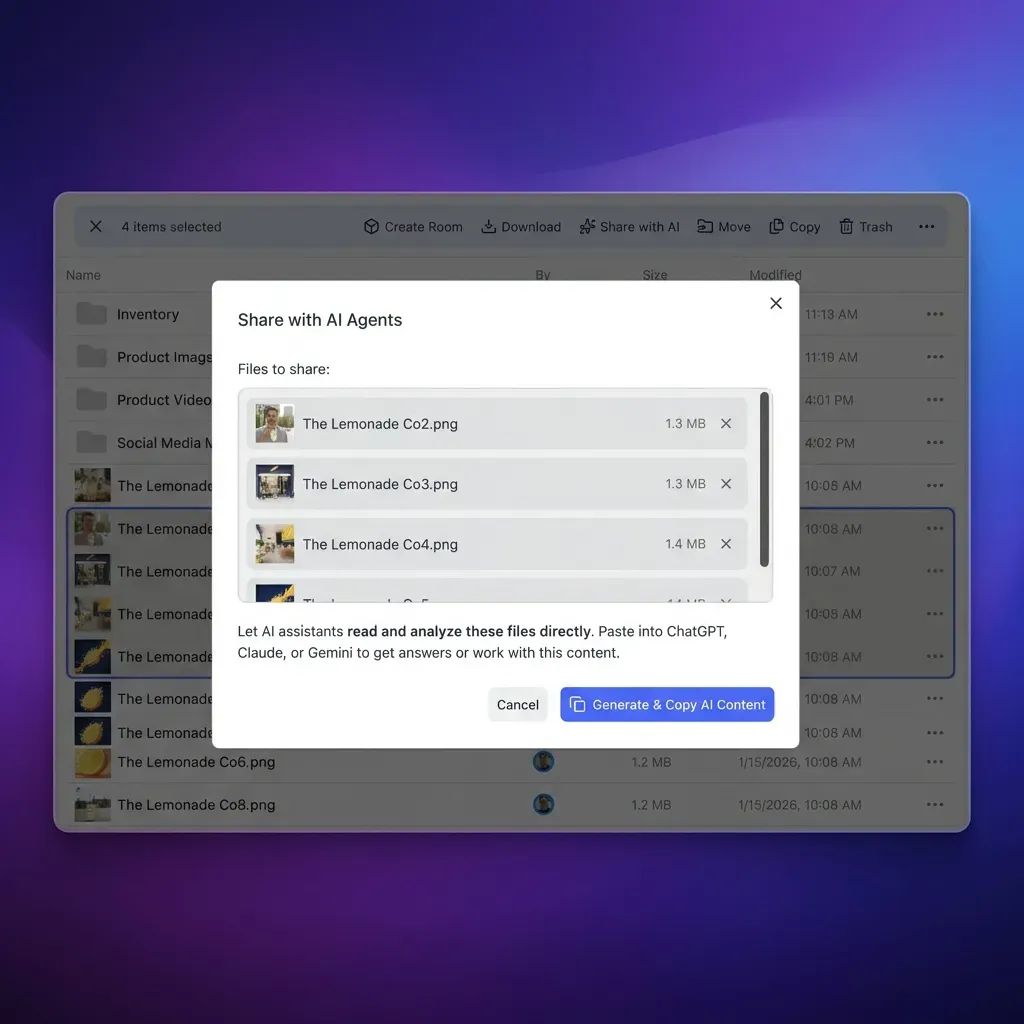
Enabling Built-in RAG with Intelligence Mode
When Intelligence Mode is enabled on a Fast.io workspace, uploaded documents are automatically parsed, chunked, and indexed for hybrid search combining full-text matching, semantic vector search, and metadata value filtering.
Base44 applications can query this neural index directly through the Fast.io API or MCP server. The platform returns contextual answers backed by precise file citations, eliminating the need for developers to deploy separate vector databases, chunking pipelines, or embedding models.
Human-Agent Collaboration and Ownership Transfer
A key challenge in AI-assisted development is handoff management. An AI agent might generate a complete workspace structure, populate initial documents, and set up metadata extraction rules inside Fast.io during app generation.
Fast.io supports ownership transfer, allowing an AI agent to build and configure org-owned workspaces, set up durable or expiring branded shares (Send/Receive/Exchange), and transfer administrative ownership to human team members while retaining administrative access for background maintenance. Per-file version history and a detailed activity log, retained according to your plan, keep every modification made by agents or humans auditable.
Granular Access Controls and Audit Logging
Security within enterprise Base44 applications requires strict access boundaries. Fast.io provides granular permissions at the organization, workspace, folder, and file level.
Every upload, modification, permission update, and download event is recorded in the activity log. This activity log gives team leads complete visibility into how AI agents and external users interact with sensitive application files over time.
Steps for Building a Scalable Storage Strategy in Base44
Before deploying a Base44 application to production, technical leads should review their file handling architecture against key reliability and security criteria:
- Separate static UI media from user-generated documents by storing logos and app icons in the native Base44 File Library while routing dynamic user uploads to Fast.io workspaces.
- Enable Intelligence Mode on production workspaces to provide immediate semantic search and retrieval augmented generation across all uploaded PDFs, office documents, and images.
- Implement Metadata Views for incoming structured files to automate data extraction without maintaining custom OCR server infrastructure.
- Use branded shares (Send, Receive, or Exchange portals) to exchange confidential files with external clients under per-recipient access controls.
- Review organization subscription plans on the Fast.io Pricing page, starting with a 14-day Business Trial (credit card required) to test high-throughput MCP file transfers before choosing between Starter ($9.99/mo), Business ($49.99/mo), or Enterprise ($199.99/mo) plans.
By combining Base44's rapid app generation capabilities with Fast.io's persistent, intelligent cloud workspaces, development teams can build scalable, enterprise-ready applications without hitting storage or data management bottlenecks.
Sources
References used to verify factual claims in this guide.
-
84% of organizations identify managing cloud spend and infrastructure complexity as a primary challenge in multi-cloud environments.
-
Base44 provides integrated media storage and external file workflow options for AI app assets.
Frequently Asked Questions
What storage backend does Base44 use?
Base44 uses an integrated asset library managed natively within its cloud infrastructure to host static application media, icons, and uploaded files directly inside generated apps.
Can I connect external cloud storage to Base44?
Yes, Base44 applications can work alongside external storage systems via standard HTTP REST APIs, webhooks, or Model Context Protocol (MCP) endpoints to handle large document repositories and persistent team workspaces.
How does Fast.io handle document extraction for Base44 apps?
Fast.io uses Metadata Views to extract structured data from unstructured files using natural language field descriptions, populating sortable database views that Base44 apps and AI agents can query directly.
What does Fast.io agent storage cost?
Monthly plans start with a Business Trial of up to 14 days that requires a credit card, then continues on a paid subscription (Starter $9.99/mo, Business $49.99/mo, or Enterprise $199.99/mo).
How do Base44 AI agents access Fast.io workspaces?
Base44 AI agents access Fast.io workspaces through Streamable HTTP at /mcp or legacy SSE at /sse using the Model Context Protocol, allowing agents to perform search, upload, and metadata extraction operations.
Related Resources

Scale persistent storage for Base44 applications
Connect your Base44 apps to intelligent cloud workspaces with built-in RAG, version history, and MCP endpoints. Starts with a 14-day Business Trial.