How to Use RAG for Marketing Content Personalization
RAG marketing content personalization retrieves relevant assets from storage to build custom campaigns on the fly. Marketing teams handle large libraries of brand assets, customer data, and past campaigns. Fastio's Intelligence Mode indexes these files automatically for semantic search and RAG queries. It makes content more relevant and scales without retraining models.


What Is RAG for Marketing Content Personalization?
Retrieval augmented generation (RAG) for marketing content personalization pulls specific assets from a knowledge base to create customized messages for audiences.
Standard LLMs generate generic text based on training data. RAG adds a retrieval step that finds relevant documents, like customer profiles or campaign history, before generation. In marketing, this means emails or ads adapted to user behavior or segment.
For example, a query for "summer sale email for tech buyers" retrieves product specs, past performance data, and buyer personas. The LLM then crafts a version with those details. According to Pinecone, RAG cuts hallucinations by grounding outputs in real data.
It works well for marketing, where content changes by channel, audience, and timing. Teams need fast access to assets without manual tagging.
Helpful references: Fastio Workspaces, Fastio Collaboration, and Fastio AI.

Related guides
- How to Manage Marketing Assets with AI AgentsMarketing teams use AI agents in intelligent workspaces to store, version, and share AI-generated files securely. These...
- How AI Agents Streamline Marketing Automation WorkflowsMarketing teams lose a significant chunk of their week to repetitive tasks like list cleaning, report generation, and...
- How to Set Up an AI Marketing Team Intelligence WorkspaceAI marketing team intelligence workspaces combine semantic search and agent collaboration for files. Marketing teams...
- How to Set Up a Content Marketing Platform for Your TeamA content marketing platform is an integrated workspace where teams create, store, collaborate on, and distribute...
- How to Manage the Full Content Lifecycle from Creation to RetirementGuide to content lifecycle management: Most content teams are good at publishing. Where things fall apart is everything...
- How to Build a Content Production Workflow That ScalesMost content workflow guides stay abstract. This one walks through the actual steps to build a repeatable production...
More on this subject: Creative and Marketing Teams (27 guides)
Why Marketing Teams Need RAG for Personalization
Personalization drives results in marketing. Generic email blasts typically see lower engagement than tailored content. According to industry research, personalized marketing campaigns can achieve higher engagement rates than generic messaging. This lift comes from matching messages to individual preferences, past interactions, and current context.
Marketing teams manage large asset libraries. They include campaign creatives, A/B test results, audience insights, brand guidelines, high-res images, and video clips. Marketing organizations routinely accumulate large volumes of creative assets across multiple campaigns and channels. Manually sifting through these materials for each campaign variant takes hours. This leads to bottlenecks and inconsistent outputs.
RAG solves this problem. It retrieves relevant assets semantically and feeds them into LLMs for generation. That produces personalized content at scale: email subject lines tuned to buyer personas, social posts pulled from high-performing creatives, or landing page copy aligned with product specs.
Generative AI with RAG boosts marketing productivity by automating variant creation while enforcing brand voice. No more copy-pasting from old docs or hunting for the right image.
Fastio simplifies the process. Upload assets to workspaces. Intelligence Mode auto-indexes them for RAG-ready semantic search. Fastio MCP tools let agents query "summer sale creatives for tech buyers" and get cited chunks. LLMs generate, humans iterate in real-time collaboration. Presence indicators show who's reviewing, comments anchor to specific frames or sections.
This integrated approach reduces production time from days to hours, letting teams focus on strategy.
Key Use Cases
- Customer journey emails: Retrieve interaction history to suggest next steps.
- Social ads: Pull performance data for high-engagement creatives.
- Landing pages: Generate segment-specific copy from product docs.


Personalize Marketing Content at Scale
Fastio's Intelligence Mode provides built-in RAG for your asset workspaces with generous storage and included credits on a 14-day Business Trial.
RAG Architecture for Marketing Personalization
RAG follows a straightforward pipeline for marketing storage needs.
- Ingestion: Upload assets to a workspace. Fastio auto-indexes with Intelligence Mode, no separate vector DB.
- Retrieval: Query semantically, e.g., "high-conversion visuals for millennials." Returns top matches with citations.
- Augmentation: Combine query and chunks into LLM prompt.
- Generation: Output personalized content.
For marketing, storage needs to manage multimedia like images and videos, with frequent updates. Most competitors miss this for RAG. Fastio handles streaming previews and indexes it all.
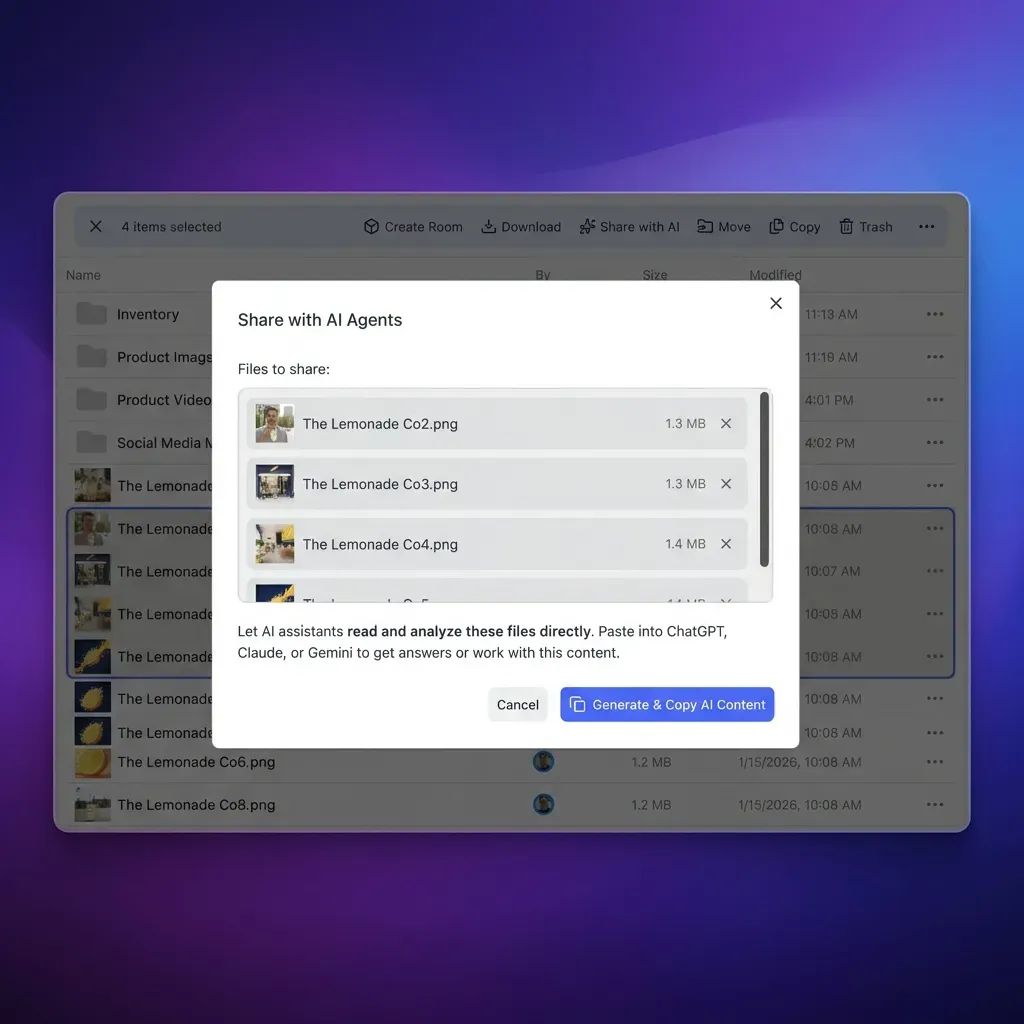
Step-by-Step RAG Workflow for Marketing Content
Start with a Fastio workspace for your campaign assets. This workspace becomes the central repository for all materials your RAG pipeline will access.
Step 1: Organize Assets Upload creatives, data CSVs, and reports to a shared workspace. Group related materials into folders by campaign, product line, or content type. Enable Intelligence Mode to index files automatically for semantic search. The system processes documents, images, and videos to create searchable embeddings.
Step 2: Agent Setup Agents join via MCP (multiple tools). Configure your agent with access to the workspace. Use semantic search queries like "Retrieve Q1 campaign stats for email variant" or "Find high-performing social creatives from last holiday season." The agent receives cited chunks from your indexed assets.
Step 3: Personalize Prompt LLM with retrieved context: "Generate LinkedIn post for SMBs using these stats." The model grounds its output in the retrieved materials, producing content that reflects your actual campaign history and brand voice. Output includes citations showing which assets informed the generation.
Step 4: Review and Deploy Humans collaborate in real-time within the workspace. Team members review generated content, make edits, and provide feedback. Transfer ownership to clients or stakeholders if needed. The WebSocket events feed and activity polling notify your systems when files change, triggering automated re-indexing.
This workflow scales efficiently for A/B testing multiple variants. Agents handle the retrieval and generation while humans focus on strategy and final review.
Code Example with Fastio API
# Semantic query via API
curl -X POST https://api.fast.io/current/search \
  -H "Authorization: Bearer $TOKEN" \
  -d '{"query": "summer sale creatives", "workspace": "campaign-2026"}'
Response includes chunks for augmentation.
Challenges in Marketing RAG and Solutions
Scale hits first. Marketing assets grow fast: videos, graphics, reports. Teams need storage that handles this expansion without manual intervention.
Freshness matters: Old data kills relevance. The WebSocket events feed and activity polling in Fastio track file changes, keeping your RAG pipeline current.
Multi-agent conflicts: When multiple agents work on the same campaign, advisory file locks coordinate writes so agents can wait or read while a file is leased, and version history ensures every update is preserved.
Cost control matters for marketing teams: Fastio plans include seats, and AI credits beyond the monthly allowance are billed by use.
Fastio fills gaps with persistent, collaborative RAG storage designed for marketing workflows. Unlike generic cloud storage, it understands the semantic meaning of your assets.
Best Practices for RAG Marketing Content
Smart chunking improves retrieval quality. For text assets, aim for chunks around 512 tokens. This balances context with precision. For video content, sample representative frames or use scene detection to create meaningful segments.
Rerank results by recency or performance metadata. A campaign from last quarter may outperform older materials, even if the semantic match is similar.
Always test with A/B experiments. Track engagement lift when using RAG-generated content versus generic templates. Measure open rates, click-through rates, and conversion to validate your approach.
Integrate MCP for agentic flows: Retrieve, generate, iterate. Agents can handle the repetitive retrieval and generation tasks while humans focus on strategy and creative direction.
Maintain brand consistency by including brand guidelines in your indexed knowledge base. RAG can reference these documents during generation to ensure tone, voice, and messaging align with your standards.
Evidence and Benchmarks
Teams using RAG for content personalization report clear improvements in efficiency. Marketing teams using RAG workflows often cut content production time compared to manual processes. The ability to automatically retrieve relevant assets eliminates the search and compilation phase that often consumes hours per campaign.
Quality improvements accompany speed gains. RAG-grounded content shows higher accuracy because generation draws from verified internal sources rather than relying solely on model training data. This reduces factual errors and ensures messaging aligns with current product specifications and brand positioning.
RAG handles growing asset libraries well. Unlike approaches requiring complete model retraining, RAG scales by indexing new materials without disrupting existing workflows. Marketing teams can add seasonal campaigns, product launches, and updated brand assets continuously.
RAG costs less than alternatives. Compared to fine-tuning custom models or maintaining separate vector databases, integrated RAG solutions reduce infrastructure overhead. Teams avoid the complexity of managing multiple systems while gaining personalization capabilities.
Implementation Roadmap
Phase 1: Assessment and Setup (Week 1-2) Audit your current asset library. Identify high-value content categories like email templates, social posts, product descriptions, and brand guidelines. Set up your Fastio workspace and enable Intelligence Mode for automatic indexing.
Phase 2: Integration and Testing (Week 3-4) Connect your RAG pipeline through Fastio MCP tools. Test retrieval accuracy with sample queries. Verify that returned assets match intent and include proper citations. Iterate on chunking strategies if needed.
Phase 3: Pilot Campaign (Week 5-6) Run a pilot personalization campaign using RAG-generated content. Compare performance against your baseline generic messaging. Measure engagement metrics, production time, and team satisfaction.
Phase 4: Scale and Optimize (Ongoing) Expand to additional campaign types and channels. Continuously update your indexed assets as new materials become available. Monitor retrieval quality and adjust indexing settings as your library grows.
Sources
Frequently Asked Questions
What is RAG for marketing?
RAG for marketing retrieves campaign assets and data to generate personalized content like emails or ads. It grounds LLMs in your brand library for accurate, relevant outputs.
What is the RAG content personalization workflow?
1. Index assets in storage. 2. Retrieve relevant chunks via semantic query. 3. Augment prompt. 4. Generate tailored content. Fastio automates indexing in workspaces.
How does Fastio enable RAG for marketing?
Intelligence Mode auto-indexes files for RAG queries with citations once enabled on a workspace. MCP tools let agents retrieve assets across shared workspaces.
What storage gaps exist in marketing RAG?
Most solutions ignore marketing needs like multimedia indexing and team collaboration. Fastio provides persistent workspaces with previews and real-time presence.
Can agents personalize marketing content?
Yes, via MCP agents can query indexed assets, generate variants, and enable human review in shared spaces.
How to start RAG personalization with Fastio?
Sign up for the Fastio 14-day Business Trial at /pricing/, create a workspace, enable Intelligence Mode, and upload assets.
What file types work best for marketing RAG?
Text documents, PDFs, CSVs with campaign data, images, and videos all work well. Fastio indexes content and generates searchable embeddings automatically.
How does RAG maintain brand consistency?
By retrieving from your indexed brand guidelines and approved assets, RAG ensures generated content aligns with your established voice and messaging standards.
Related Resources

Personalize Marketing Content at Scale
Fastio's Intelligence Mode provides built-in RAG for your asset workspaces with generous storage and included credits on a 14-day Business Trial.