How to Convert PDF to JPG for Clay GTM Asset Pipelines
US searchers look up "pdf to jpg" about 201,000 times a month, yet most results stop at a one-click download. Clay GTM engineers still need account-named JPGs sized for email and LinkedIn, a shared library sales can trust, and durable links parked next to lead rows. This guide covers lossy-quality tradeoffs, a five-step prep pipeline, and how to hand raster creatives to outbound without treating Clay as a media library.


Why PDF to JPG demand is a GTM pipeline problem
US searchers look up "pdf to jpg" about 201,000 times per month, with keyword difficulty around 60 and CPC near seventy-two cents, according to DataForSEO keyword metrics updated in July 2026. Consumer SERPs treat that query as a free converter race. Clay-powered revenue teams hit a different wall: pitch decks, one-pagers, and case studies arrive as multi-page PDFs, then stall when cold email, LinkedIn posts, CRM thumbnail fields, and personalized demo frames demand a single raster frame instead of a document.
PDF to JPG converts each PDF page into a raster image so GTM teams can drop sales decks and one-pagers into email, LinkedIn, and personalized demo creatives managed alongside Clay lead data. The PDF still owns multi-page reading, fonts, and print fidelity. The JPG owns "show this panel inline without forcing a download." Adobe Acrobat's online PDF to JPG flow and iLovePDF's converter both turn pages into downloadable images. Adobe documents a short path: upload a PDF, pick JPG (or PNG or TIFF), convert, then download. Files process on Adobe servers and are removed unless you sign in to keep them. That finishes a solo export. It does not give you campaign-safe hosting, account naming, or a URL column your Clay table can join forever.
Clay often sits next to the handoff on modern GTM desks, but it is not a pixel converter. Clay University documents Claygent Builder attaching tone guides, messaging docs, PDFs, or CSVs so copywriting agents stay on-brand. The same University track frames list export as the bridge from Clay tables into CRMs, sequencers, Sheets, and other ops tools. The durable pattern is explicit: rasterize PDF pages outside Clay, park approved JPGs in a library the team can version and share, then write stable URLs onto account rows and into Claygent prompts when a visual reference helps. Never claim Clay rewrites pixels natively. Conversion is creative prep. Clay is enrichment and orchestration. Shared storage is where those assets live between sprints.
Related guides
- How to Use GitHub Copilot in GitLab CI/CD PipelinesRunning GitHub Copilot CLI in headless GitLab CI/CD pipelines allows development teams to run automated code reviews...
- How to Build RAG Pipelines with OpenClawOpenClaw RAG pipelines index documents into embeddings for semantic retrieval. This helps agents be more accurate with...
- How to Convert HEIC to JPG for Clay GTM Asset PipelinesUS searchers look up "heic to jpg" about 246,000 times a month, yet converter pages almost always stop at a ZIP...
- How to Convert PDF to PNG for Clay GTM Creative AssetsUS searchers look up "pdf to png" about 74,000 times a month, yet most converters stop at a ZIP download. Clay GTM...
- How to Convert WebP to JPG for Clay GTM Asset PipelinesUS searchers look up "webp to jpg" about 110,000 times a month, yet most converter pages end at a ZIP download. Clay...
- How to Convert HEIC to PNG for Clay GTM Asset PipelinesUS searchers look up "heic to png" about 49,500 times a month, yet most converters stop at a browser download. Clay GTM...
More on this subject: Clay and GTM Agents (82 guides)
JPG vs PDF for outbound and when to keep both
Converter marketing almost never answers the outbound question: should this deck become JPG, or should sales keep the PDF? Most desks need both formats with separate jobs.
Rasterize to JPG when you need any of these:
- Inline email or social creative. ESPs and LinkedIn posts usually render images more reliably than PDF attachments. A page-as-image shows the message without a download step.
- Personalized demo and light ABM frames. Many personalization tools expect a JPG or PNG URL, not a multi-page document blob.
- Photo-heavy one-pagers. Founder portraits, office shots, and product photography compress well as JPG at usable visual quality and smaller payload than a full-color lossless twin.
- Hard size budgets. Email platforms and some ad uploaders punish multi-megabyte attachments. A tuned JPG of a single page often ships cleaner than the full deck PDF.
Leave the PDF intact when you need any of these:
- Full multi-page reading. A 12-slide narrative is still better as a PDF for a human reading the whole story.
- Selectable text and search. Raster JPGs discard searchable text and copy-paste. Legal language, pricing grids, and long case studies often need the PDF.
- Formal leave-behinds. Buyers still expect a PDF one-pager they can save and forward.
- Agent document context. Claygent Builder attaches PDFs and messaging docs so agents can absorb tone and brand rules. That path is about text and context, not about rendering a LinkedIn image.
Practical decision grid for GTM ops
- Cold email hero visual from a one-pager: convert the PDF page to JPG, keep the PDF as an optional attachment or link.
- LinkedIn outreach with a visual teaser: export a cropped JPG of the key page or hero panel (often 1200px wide is enough for feed previews).
- Sales call leave-behind: send the PDF; convert only the cover or summary page if you need a CRM image field.
- Claygent brand voice: attach the messaging PDF in Claygent Builder; do not replace that with a JPG URL alone.
- Multi-page deck for human reading: leave it PDF; convert only the pages that become email, social, or page modules.
Outbound teams that flatten every deck to JPG lose document benefits. Teams that never rasterize force every channel through PDF downloads. The efficient pattern is page selection: convert the frames that become images, archive the source PDF, and name both so Clay rows and sales folders stay in sync.
Should outbound teams convert decks to JPG or keep PDFs?
Convert the pages you need for email, LinkedIn, and visual personalization. Keep the full deck as PDF for reading, downloads, and formal handoffs. Many desks store three related files per account: source PDF, full-page JPG for email modules, and a tighter social crop for LinkedIn. Clay should hold URLs and status fields for those assets, not the binary blobs themselves.
Convert PDF pages to JPG in five pipeline steps
If you only need the short path, use this sequence. It works for one sales one-pager or a folder of account creatives before a Clay campaign load.
- Export and prep the PDF. Collect sales decks, one-pagers, and case studies from shared drives, design tools, email, or a Receive share agencies use for creative drops. Flatten or export the final approved version so you are not converting "Draft_v7_FINAL" with wrong pricing.
- Convert PDF pages to JPG. Use Adobe Acrobat's online PDF to JPG tool, iLovePDF's PDF to JPG converter, desktop Acrobat export, or a conversion API. Adobe's documented flow is select file, choose JPG (or PNG/TIFF), convert, then download. iLovePDF describes converting each PDF page into a JPG or extracting images contained in a PDF. Convert only the pages you need so you do not flood the library with unused appendix slides.
- Name assets by account. Use stable names such as
acct-acme-onepager-p1-v3.jpg, notScan-from-converter-1.jpg. Include account key, asset type, page number, and version so Clay joins and sales folders stay readable. - Store assets in a shared workspace. Local downloads work for a solo designer. Team GTM work needs a shared workspace, Drive shared drive, or object store with folders by account or campaign.
- Link from the Clay table or export view. Add columns for the JPG URL (and optional PDF URL), status, and version notes. Join those URLs to account or contact rows for personalization, Claygent prompts, and CSV export handoffs to sequencers or CRMs.
Online converters for ad hoc work
Browser converters are popular because they require no install. Adobe markets free PDF to JPG conversion with files processed on Adobe servers and deleted unless you sign in to save them. iLovePDF positions PDF to JPG as converting all pages or extracting images, free and online. Both patterns solve click-to-download. Neither replaces a versioned library. Downloads land on one laptop. Clay rows and teammates still need a stable link after the temporary file is gone.
Quality settings that keep page quality usable
"Without losing page quality" is relative. JPG is a lossy format. You cannot magically keep perfect vector text after rasterization. You can keep the result sharp enough for outreach:
- Resolution. Export at roughly 150 to 300 DPI for full-page email modules. Downscale later for social if needed. Low DPI makes type muddy; extreme print DPI creates multi-megabyte files email tools reject.
- Compression quality. Prefer high quality (low compression) for type-heavy one-pagers. Aggressive compression destroys thin type and chart lines. Many teams start around quality 85 to 92 for decks with mixed type and photos.
- Chroma and banding. Heavy compression can smear brand reds or introduce banding in gradients. Spot-check logo colors and full-bleed backgrounds after export.
- Crop. Convert one page at a time when you only need a hero panel. Full-page letter size often looks small in email; a cropped product panel can read better.
- Color. Spot-check brand colors after conversion. Some converters flatten color spaces and shift reds or blues slightly. Prefer sRGB output for web and email.
- Privacy. Avoid uploading confidential pitch PDFs to public converters when legal or customer data is involved. Prefer private tooling for those files.
Desktop and API options
For brand-critical assets, export from the design source when you can. A design-tool export to JPG often preserves intended crop and scale better than rasterizing a print PDF. Desktop Acrobat or Preview still helps when the only source is a locked PDF from legal or product marketing.
When conversion must run from a worker or an enrichment hop, use a conversion API or a small service you control. The endpoint accepts a PDF file or source URL, returns one JPG per page or a ZIP of pages, and logs success or failure per asset. Keep conversion external to Clay and store only URLs and status fields in the table. Log DPI, quality, and page index so a failed sharpness review can re-run without guessing settings.
Quality checklist before Clay ingest
- Page selection: Convert only pages that become outreach or page modules.
- Sharpness: Zoom on body text and small charts. Soft type means re-export at higher quality or resolution.
- File size: Many ESPs choke on multi-megabyte images. Target sizes your tools accept (often under a few hundred KB for email modules after resize).
- Naming: Account key + asset type + page + version.
- Source archive: Keep the original PDF next to the JPG for re-export and legal review.
- Approval: Mark brand-critical creatives as approved before Clay treats the URL as final.


Keep Clay-ready JPG outreach assets in one shared workspace
Store converted sales one-pagers and deck pages in an org-owned Fast.io workspace with version history, Intelligence Mode search, and durable share links your Clay tables can reference. Start with a 14-day Business Trial.
How Clay teams manage converted creatives at scale
Clay shines as the GTM spreadsheet and agent layer. It is a weak place to dump megabytes of raster files. Official Claygent Builder docs describe attaching PDFs and other documents into agent context for tone and messaging. That path helps when an agent must read brand rules or a messaging doc. For visuals that land in email, LinkedIn, or CRM image fields, host the JPG elsewhere and put the URL on the row.
Schema for outreach asset tracking
Prefer a dedicated Clay table for creative inventory when volume grows, or a tight column set on the account table when volume is low:
account_name/crm_id: join keys back to people and company tablessource_pdf_url: original PDF location for audit and re-exportjpg_url: durable link to the approved page imagepdf_url: optional full deck for downloads and leave-behindschannel_fit: email_module, linkedin_teaser, crm_thumbnail, demo_framepage_index: which PDF page produced the JPGexport_dpi/jpg_quality: so ops can reproduce the same settings laterbyte_size_kb: catch oversize modules before ESP upload failspipeline_state: queued, converted, approved, live, retiredrev_tag: integer or semantic tag (v3)signed_off_by/signed_off_at: human approval stampscampaign_code: which sequence or ABM wave owns this creative
Keep firmographic enrichment waterfalls separate from bulk creative conversion. Mixing people-data providers with pixel conversion columns creates noisy tables and expensive accidental re-runs.
Claygent brand docs vs outreach rasters
When the goal is agent judgment (score this account, write a personalized note, classify persona), Claygent Builder can use attached PDFs and messaging docs as business context. Clay's product pages position Claygents for research, workflow orchestration, and content for GTM plays. When the goal is a visual in an email or social post, the page builder and the rep both need a JPG URL, not only a PDF attachment buried in agent settings. Convert first, host the JPG, then either:
- paste
jpg_urlinto account rows for personalization tools, or - attach a brand PDF to Claygent for copy rules while still linking the JPG for creative systems.
Brand context and outreach rasters complement each other. One does not replace the other.
Export and sequencer handoff
Clay University's export lesson frames export as the bridge from Clay workflows into CRMs, sequencers, Sheets, and other systems. CSV export is the universal path for one-time transfers and backups. Real-time integrations fit ongoing sync. For creative assets, export the columns that matter: account identifiers, jpg_url, rev_tag, and approval status. Create a dedicated export view, hide intermediate conversion debug columns, and download a clean sheet. That is how Clay ops hand off creative metadata without emailing ZIPs of JPGs that go stale by the next sprint.
Store versioned JPGs where sales and agents can both reach them
Rasterizing without a library only moves the mess one format later. Someone still has a ZIP on a laptop, the converter has deleted the temporary file, and Clay still has a dead local path.
Designers often start on a laptop folder while reviewing five one-pagers. That breaks as soon as an SDR, a marketer, and a Claygent prompt all need the same module next week.
Shared drives in Google Drive, Dropbox, or OneDrive are the default next stop for many marketing orgs. They solve basic collaboration. Search still leans on filenames, agency permissions get messy, and agent access is rarely first-class.
Object storage such as Amazon S3 is durable and cheap when engineering already runs a public marketing bucket. The tradeoff is operational: bucket policies, CDN wiring, and little review surface for non-engineers who need to approve a crop.
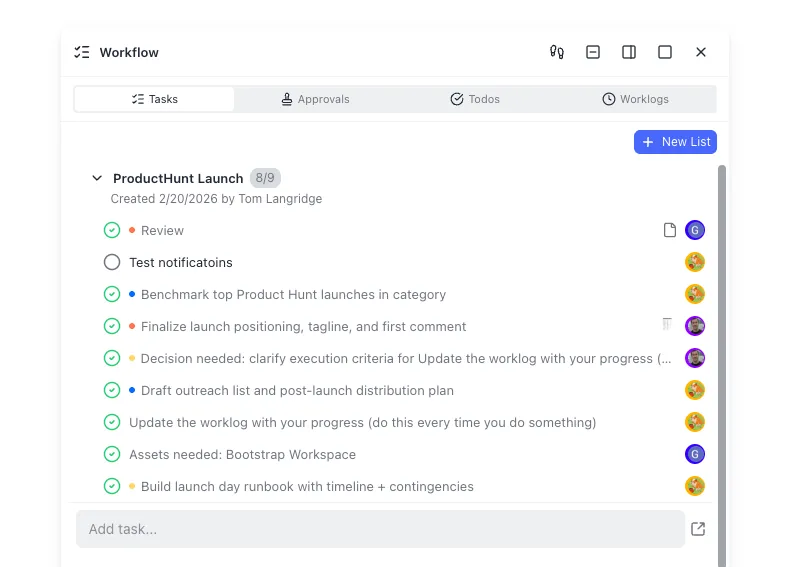
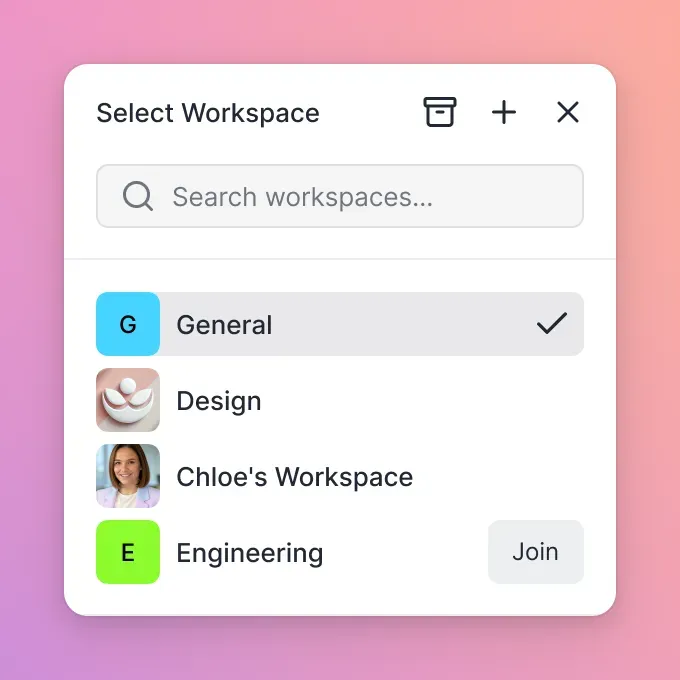
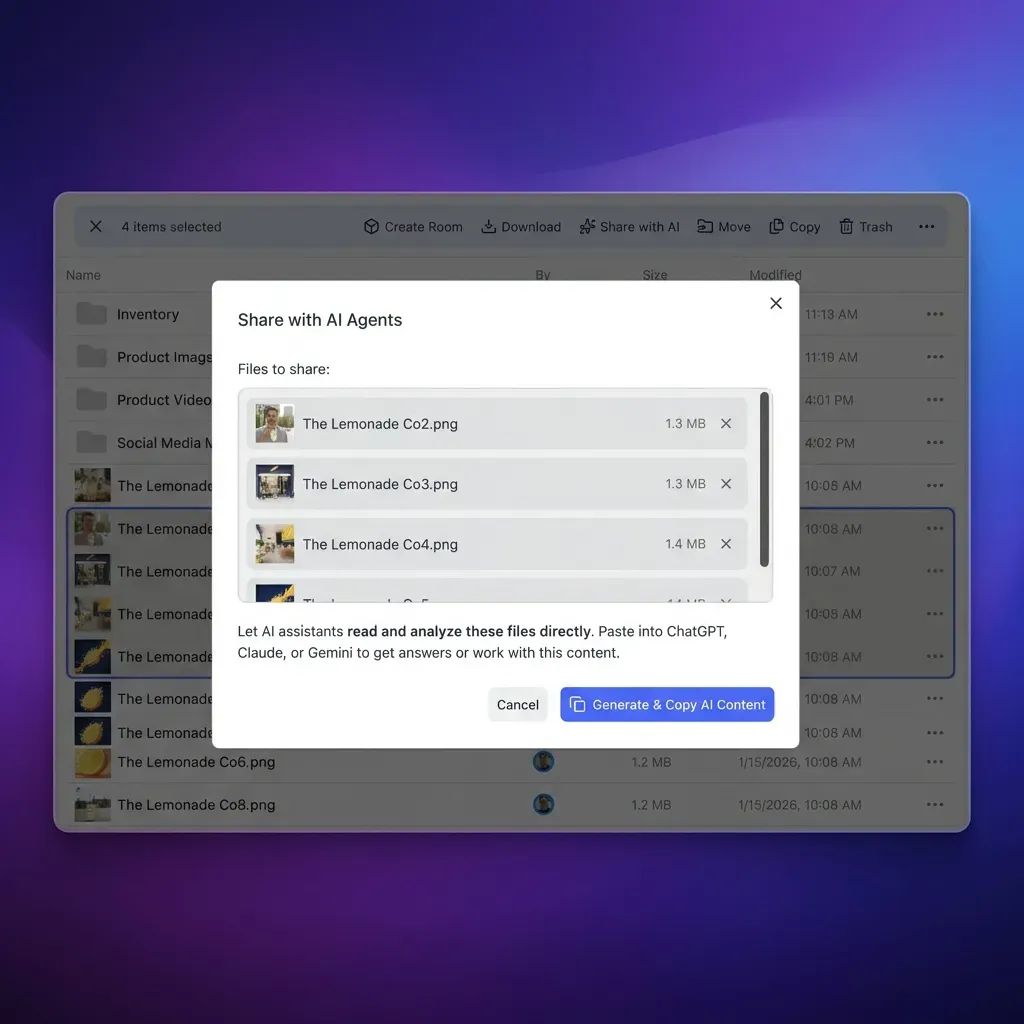
Fast.io fits when the creative library is part of an agentic GTM workspace rather than only a static CDN folder. Create an org-owned workspace such as gtm-outreach-jpgs-2026, upload converted JPGs (and archived source PDFs) with clear folders by account or campaign, and keep per-file version history when design revises a crop or a converter rerun improves sharpness. Enable Intelligence Mode so files are indexed for semantic search and citation-backed chat. Ops can ask for "Acme Q3 one-pager email crop" instead of hunting through date folders.
For structured catalogs, use Metadata Views to extract fields such as account name, asset type, page number, campaign, and approval status into a sortable grid. That is the structured extraction layer. Intelligence Mode remains the search and summarization layer. Agents can create Views, trigger extraction, and query results through Fast.io's consolidated MCP tools over Streamable HTTP at /mcp or legacy SSE at /sse. See the storage for agents overview for MCP access and current tool-surface details.
Permissions stay granular at org, workspace, folder, and file levels. The activity log records who uploaded or replaced assets. Branded shares (Send, Receive, or Exchange) let agencies drop source PDFs or pick up approved JPG packs without full workspace admin rights. Comments anchored to image regions or text selections let marketing review brand-critical creatives before Clay's jpg_url is treated as final.
Agents and humans share the same workspace. An agent can upload converted JPGs through the API or MCP, write Collaborative Notes about review status, and transfer organization ownership to a human ops lead when the workspace is ready for billing control. Creating an account is free, but real work requires an organization on a paid subscription. Monthly plans start with a Business Trial of up to 14 days (credit card required); annual plans have no trial. Plans include Starter at $9.99/mo, Business at $49.99/mo, and Enterprise at $199.99/mo. Details live on the pricing page.
Wire Clay rows to durable JPG URLs and keep versions honest
Once JPGs live in shared storage, Clay should reference URLs, not binaries. Binary cells are hard to audit, hard to reuse across tables, and expensive to re-fetch.
Recommended handoff pattern
- Convert the right PDF pages to JPG (and keep the source PDF).
- Name files by account, asset type, page, and version.
- Upload approved files to Fast.io (or S3/Drive if that is your standard).
- Copy the durable share or file URL into Clay's
jpg_urlcolumn. - Join or lookup that URL onto account tables by CRM ID or account name.
- Use the URL in personalization tools, email modules, LinkedIn creatives, Claygent prompts that need a visual reference, or CRM writebacks that accept image links.
- Export clean views when ops needs a CSV of accounts plus creative URLs for another system.
If upload is automated, a worker can watch conversion success, push files into Fast.io, then POST the final URL back into Clay. Fast.io's realtime activity feed and WebSocket events feed help on the storage side: when a new file lands or a version changes, your worker detects the update so Clay rows update without delay.
Versioning that Clay ops can trust
- Bump
rev_tagon the row when the JPG file is replaced. - Keep the source PDF in an
originals/folder so legal can re-export later. - Never overwrite without history when two campaigns share the same account module. Fast.io's per-file version history (or object-store versioning on S3) is the safety net.
- Record who approved the asset. A JPG that "looks fine" can still show an outdated discount or product name.
- Store
export_dpiandjpg_qualitynext to the URL so a future re-export matches the live creative.
Failure modes unique to lossy outreach images
- Expired converter downloads: Browser tools delete temporary files when you do not save them. Re-host approved JPGs before the link dies.
- Soft type from over-compression: Type-heavy one-pagers need higher quality settings than photo dumps. Mosquito noise around thin glyphs is a signal to re-export, not to "fix it in email."
- Oversized modules: Full-page print-resolution JPGs can exceed email and ad limits. Produce a web-sized derivative (for example 1200px wide at quality ~85) for ESP upload.
- Broken joins: Conversion succeeds, but the account table never sees the URL because join keys do not match.
- Stale Claygent attachments: Messaging PDFs attached to agents can drift from the live brand kit. Review agent document uploads on the same cadence as creative versions.
- Confidential PDFs on public converters: Route customer-sensitive decks through private conversion paths.
- Wrong page shipped: Multi-page decks make it easy to upload the appendix instead of the hero. Always map
page_indexin Clay before markingpipeline_stateas live.
Treat the end state as a small media system of record for GTM: source PDFs archived, JPG modules approved and versioned, Clay holding the URLs and status fields enrichment workflows need, and exports carrying clean creative metadata into the rest of the stack.
Sources
References used to verify factual claims in this guide.
-
US search volume for the keyword "pdf to jpg" is about 201,000 monthly searches with keyword difficulty around 60 and CPC near seventy-two cents.
-
Claygent Builder lets you attach tone guides, messaging docs, PDFs, or CSVs directly into agent prompts for business context. Claygent Builder is Clay's hub for building, testing, and deploying Claygents for judgment-based GTM work such as research, scoring, and outbound copywriting.
-
Clay export bridges Clay workflows to operational tools such as CRMs, sequencers, and Google Sheets, with CSV export as a universal transfer method and dedicated export views for cleaner columns.
-
Adobe Acrobat provides an online PDF to JPG converter that converts uploaded PDFs to JPG, PNG, or TIFF images for download, with files handled on Adobe servers and deleted unless you sign in to save them.
-
iLovePDF provides an online PDF to JPG converter that converts PDF pages to JPG or extracts images from a PDF.
-
Fast.io organization plans include Starter at $9.99/mo, Business at $49.99/mo, and Enterprise at $199.99/mo, each with a 14-day Business Trial that requires a credit card.
Frequently Asked Questions
How do you convert a PDF to JPG without losing page quality?
Use a high-quality export (about 150 to 300 DPI for outreach modules and light compression on type-heavy pages), convert only the pages you need, and spot-check body text and charts at zoom before publishing. JPG is lossy, so perfect vector fidelity is impossible after rasterization, but careful resolution and quality settings (often quality 85 to 92 for mixed type and photos) keep pages sharp enough for email and LinkedIn. Adobe Acrobat's online tool converts PDF pages to JPG, PNG, or TIFF; desktop export or a design-source export often gives more control for brand-critical pages.
Should outbound teams convert decks to JPG or keep PDFs?
Convert pages that must render inline in email, LinkedIn, or personalization modules. Keep the full multi-page deck as PDF for reading, downloads, and formal leave-behinds. Most teams maintain both, with Clay rows storing durable JPG URLs for visual channels and optional PDF URLs for document handoffs.
How do Clay teams manage converted creative assets at scale?
Convert externally, store versioned JPGs in shared storage with account-based names, put durable URLs and status fields on Clay asset or account rows, and use dedicated export views to hand clean account-plus-URL data to CRMs or sequencers. Claygent Builder can attach PDFs for agent brand context, which complements URL-based visual assets rather than replacing them.
How do I convert PDF to JPG?
Upload the PDF to a converter such as Adobe Acrobat online PDF to JPG or iLovePDF, choose JPG output, convert, and download the resulting image or page images. For multi-page files, each page typically becomes its own JPG. Then run a quality check, rename by account, re-host approved files in shared storage, and reference the URLs from Clay rather than relying on temporary converter downloads.
Does Clay convert PDF to JPG natively?
Clay is not positioned as a native PDF-to-JPG converter. Official Claygent Builder docs cover attaching PDFs and other documents for agent context, and Clay University covers exporting lists to operational tools. Convert pixels externally, store versioned JPGs in a workspace or object store, and keep URLs plus status fields in Clay tables.
What is the difference between converting one PDF page and a whole deck?
One-page conversion is ideal for a single email module or social crop. Multi-page conversion produces one JPG per page, which is useful when several slides become separate assets. Avoid dumping unused appendix pages into the GTM library. Convert only the pages that will be referenced from Clay rows or outreach creatives.
Where should GTM teams store converted JPG assets?
Personal folders work for solo tests. Team pipelines need shared storage with permissions and clear structure. Options include Google Drive shared drives, Amazon S3, or Fast.io workspaces with version history, Intelligence Mode search, Metadata Views for asset catalogs, and branded shares for agency handoffs.
What JPG settings work best for cold email modules?
Start around 150 to 200 DPI or a 1000 to 1400px-wide export, quality roughly 85 to 90, sRGB color, and a file size your ESP accepts without throttling. Spot-check thin type and brand colors after export. If the module is mostly photography, you can compress slightly more; if it is mostly type and charts, favor higher quality over smaller bytes.
Related Resources

Keep Clay-ready JPG outreach assets in one shared workspace
Store converted sales one-pagers and deck pages in an org-owned Fast.io workspace with version history, Intelligence Mode search, and durable share links your Clay tables can reference. Start with a 14-day Business Trial.