How to Set Up Agent-Managed Game Streaming on Raspberry Pi with OpenClaw
A Raspberry Pi 5 running Moonlight outperforms Chromecast with Steam Link for 4K game streaming, but the setup breaks when the network hiccups or the Pi reboots unexpectedly. This guide pairs Moonlight (or Steam Link) with an OpenClaw agent that monitors connection health, restarts the streaming client on failure, and logs session data to a shared workspace for troubleshooting.

Why Game Streaming on Raspberry Pi Needs an Agent
A Raspberry Pi 5 with Moonlight delivers cleaner motion, sharper visuals, and lower latency than the Steam Link app running on a Chromecast, according to testing by XDA Developers. The Pi 5's updated video decode engine handles high-bitrate HEVC streams that cheaper streaming devices struggle with, pushing 4K at 60fps with roughly 80 Mbps of headroom.
The problem is not performance. It is reliability. Every guide you find covers the initial setup: install Sunshine on your PC, install Moonlight on your Pi, pair them, and start streaming. What they skip is what happens next. The Pi reboots after a power blip and Moonlight does not restart. The network drops for two seconds and the stream dies silently. Your gaming PC goes to sleep and nobody wakes it. You walk into the room, pick up a controller, and nothing works.
OpenClaw changes this equation. Running as an always-on agent on the same Pi, it watches the streaming client, restarts it on crash, verifies network connectivity to the host PC, and can trigger wake-on-LAN when the host sleeps. The agent costs nothing extra to run since the heavy AI inference happens via cloud API calls, and the Pi's gateway process uses minimal resources alongside Moonlight.
This is the gap in existing documentation: one-time setup versus ongoing reliability. An OpenClaw agent turns a fragile streaming appliance into a self-healing system.
Related guides
- How to Set Up the Hermes Agent Web UI DashboardThe Hermes Agent web dashboard gives you browser-based control over an agent that normally lives in a terminal. This...
- How to Set Up MCP in Claude DesktopClaude Desktop MCP enables the local Claude app to interact with external tools and data sources via the Model Context...
- How to Game on Raspberry Pi 5: Native, Emulation, and Cloud Streaming with OpenClawRaspberry Pi Foundation benchmarks show the Pi 5's VideoCore VII GPU pushing OpenArena to 27 FPS, up from the Pi 4's...
- How to Set Up a Raspberry Pi Webcam Server with an OpenClaw Streaming AgentMost Raspberry Pi webcam guides end at "open a browser and see your stream." This guide goes further, pairing...
- How to Set Up Offline Speech Recognition on Raspberry Pi for OpenClaw Voice AgentsWhisper Tiny transcribes speech in 2-3 seconds on a Raspberry Pi 5, making fully offline voice agents practical on $80...
- How to Set Up Multi-System Emulation on Raspberry Pi with OpenClawRaspberry Pi emulation splits into two domains that most setup guides conflate: retro gaming through packages like...
More on this subject: OpenClaw on Raspberry Pi (192 guides)
How to Choose Between Moonlight and Steam Link
Both Moonlight and Steam Link stream games from a PC to your Raspberry Pi, but they work differently and have distinct trade-offs.
Moonlight uses the GameStream protocol (originally Nvidia's, now open-sourced via Sunshine). It requires either an Nvidia GPU on the host PC or the Sunshine server software, which supports Nvidia, AMD, and Intel GPUs. Moonlight handles HEVC and AV1 decoding, supports 4K resolution at high bitrates, and generally delivers lower latency than Steam Link in head-to-head comparisons.
Steam Link works with any Steam library regardless of GPU vendor. It uses Valve's own streaming protocol and integrates tightly with the Steam overlay, Big Picture mode, and Steam Input for controller configuration. The trade-off is that the Linux client has stagnated since Valve discontinued the hardware device in 2019, and performance on Pi specifically trails behind Moonlight.
For most Raspberry Pi setups, Moonlight with Sunshine is the stronger choice. You get better visual quality, lower latency, and active development. Steam Link makes sense if you exclusively play Steam games and want the Big Picture integration without running Sunshine separately.
Regardless of which client you pick, the OpenClaw agent layer works the same way. It monitors the streaming process, checks network connectivity, and handles restarts. The agent does not care whether the underlying client is Moonlight or Steam Link.
Recommended starting configuration for either client:
- Resolution: 1080p (upgrade to 4K after confirming stability)
- Frame rate: 60fps
- Bitrate: 20 to 30 Mbps on wired Ethernet
- Codec: H.265/HEVC (falls back to H.264 if decode fails)
- Connection: Wired Ethernet on both Pi and host PC
Setting Up the Streaming Host with Sunshine
Sunshine is the open-source host server that makes Moonlight work with any GPU. It runs on your gaming PC and handles screen capture, hardware encoding, and client connections. LizardByte maintains it actively on GitHub with support for Windows, Linux, and macOS.
Install Sunshine from the LizardByte releases page. On Windows, download the installer and run through the wizard. On Linux, grab the .deb or .rpm package for your distribution.
After installation, Sunshine opens a web dashboard at https://localhost:47990. Set a username and password on first launch. This dashboard is where you pair clients and adjust encoding settings.
Host-side settings that matter for Pi streaming:
- Encoder: Use NVENC (Nvidia), AMF (AMD), or Quick Sync (Intel). Hardware encoding is essential for low latency.
- Codec: Enable HEVC. The Pi 5 decodes HEVC efficiently, and it delivers better quality per megabit than H.264.
- Bitrate: Set the maximum to 30 Mbps for 1080p60. The client negotiates down if needed.
- Resolution: Match your monitor's native resolution or set a custom resolution that your TV supports.
For remote streaming outside your LAN, install Tailscale on both the host and the Pi. Both devices get stable IPs on a mesh VPN without port forwarding. This also gives the OpenClaw agent a reliable address to ping when checking host availability.
Steam Link does not need Sunshine. If you choose Steam Link instead, just enable Remote Play in Steam settings on the host PC. The Steam client handles encoding and discovery natively.


Store streaming logs and agent configs in one workspace
Cloud workspaces for your OpenClaw agent's session data, configuration files, and troubleshooting history. Remote MCP server access included.
Installing the Streaming Client on Raspberry Pi
Start with a fresh Raspberry Pi OS (Bookworm, 64-bit) installation on your Pi 5. Update the system first:
sudo apt update && sudo apt upgrade -y
For Moonlight, add the official repository and install:
curl -1sLf 'https://dl.cloudsmith.io/public/moonlight-game-streaming/moonlight-qt/setup.deb.sh' | distro=raspbian codename=$(lsb_release -cs) sudo -E bash
sudo apt install moonlight-qt
Launch Moonlight from the desktop or command line. It will scan the network for Sunshine hosts. Select your PC, enter the PIN shown on the Pi into the Sunshine web dashboard, and pairing completes. Test a stream manually before setting up the agent.
For Steam Link, install from the official repository:
sudo apt install steamlink
Run steamlink from the terminal, sign in with your Steam account, and pair with your PC. Steam Link handles discovery via your local network automatically.
Verifying the stream works before adding automation:
- Launch the client manually
- Connect to your host PC
- Start a game and confirm video and audio work
- Check input latency feels acceptable
- Note any dropped frames or visual artifacts
If the manual test shows issues, fix them before adding the OpenClaw layer. Common problems include Wi-Fi interference (switch to Ethernet), thermal throttling on the Pi (add a heatsink or active cooling), or firewall rules blocking Sunshine's ports (TCP 47984, 47989, 48010 and UDP 47998-48000, 48002, 48010).

Configuring OpenClaw as the Streaming Agent
OpenClaw on Raspberry Pi runs as a lightweight gateway process, typically under systemd, that stays online 24/7 while offloading AI inference to cloud APIs. The gateway draws minimal CPU and memory, leaving plenty of headroom for Moonlight's decode workload on the Pi 5.
Install OpenClaw following the official Raspberry Pi deployment guide. The recommended hardware is a Pi 5 with 4GB or 8GB RAM, though a Pi 4 with 4GB works for lighter streaming loads at 1080p.
Once the OpenClaw gateway is running as a service, you configure it to manage your streaming client. The agent's role in this setup covers several responsibilities:
Process monitoring and restart. The agent watches the Moonlight or Steam Link process. If it crashes or exits unexpectedly, the agent restarts it. This handles the common scenario where a network glitch kills the stream and nobody is around to relaunch the client.
Network health checks. The agent periodically pings the host PC (or checks Sunshine's API endpoint) to verify the gaming PC is reachable. If the host goes offline, the agent can send a wake-on-LAN packet to bring it back, then wait for Sunshine to become available before restarting the stream.
Boot automation. After a Pi reboot, the agent ensures the streaming client launches in the correct display environment. This is trickier than it sounds because graphical applications need a display server running first. The agent handles the dependency chain: wait for the desktop session, then launch the streaming client, then verify the connection.
Session logging. The agent logs connection events, dropped frames, restart counts, and network latency measurements. These logs help you diagnose intermittent issues that are hard to catch in person.
The key advantage over a plain systemd unit for Moonlight is intelligence. A systemd service restarts blindly on crash. An OpenClaw agent checks whether the host is actually reachable before restarting, avoids restart loops when the network is down, and can escalate by notifying you on Telegram or Discord when something needs manual attention.
How to Debug Streaming Issues with Agent Logs
Game streaming issues are intermittent. The stream worked fine yesterday, stutters today, and you cannot reproduce the problem because it only happens when you are not watching. Agent-generated logs solve this by capturing every session start, stop, error, and network measurement automatically.
OpenClaw can write structured logs for each streaming session: when the connection started, the negotiated resolution and bitrate, any frame drops or latency spikes, why the session ended (user quit, crash, network timeout), and how long recovery took. Over a week of data, patterns emerge. Maybe the stream dies every evening when someone else saturates the network. Maybe thermal throttling causes drops after 45 minutes of continuous streaming.
For teams or households sharing a streaming setup, pushing these logs to a shared workspace adds visibility. Fastio workspaces give you a centralized place to store session logs, configuration snapshots, and troubleshooting notes that multiple people can access. Fast.io offers paid plans starting at $9.99/mo and a 14-day Business Trial, card required (see pricing), with remote MCP server access.
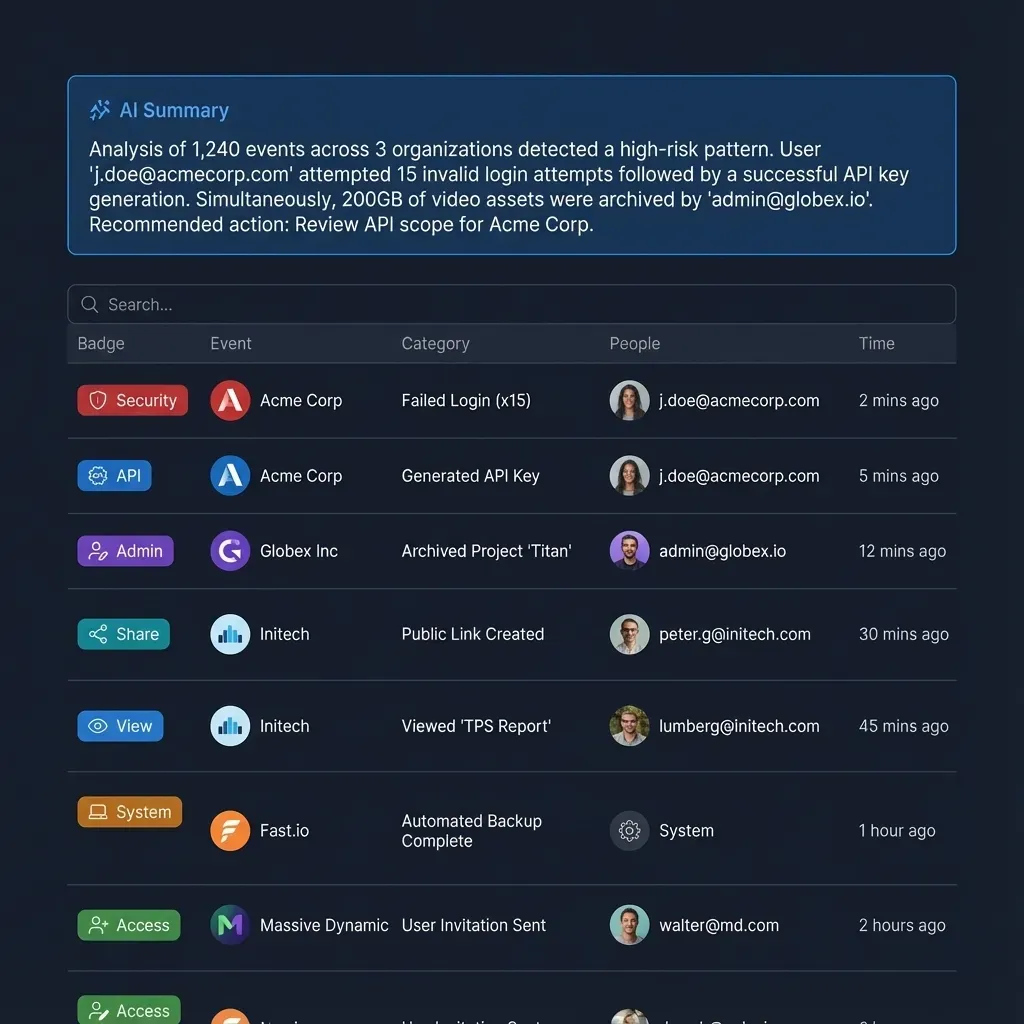
Using Fastio's MCP server, the OpenClaw agent can upload session logs directly to a workspace after each streaming session ends. Intelligence Mode indexes those logs automatically, so you can ask questions like "when did the stream last drop?" or "what was the average latency this week?" and get answers with citations pointing to specific log entries.
This approach turns debugging from "it feels laggy sometimes" into data-driven troubleshooting. You see exactly when problems occur, correlate them with network conditions, and fix root causes instead of guessing.
Common issues the agent helps diagnose:
- Host PC sleeping mid-session (agent logs the disconnect reason and wake-on-LAN attempts)
- Thermal throttling on the Pi (agent can read CPU temperature and correlate with frame drops)
- Network congestion (agent measures latency to host before and during streaming)
- Client crashes after OS updates (agent logs the crash and which system packages changed)
For persistent storage of agent configurations and streaming presets, Fastio workspaces keep everything versioned and accessible from any device. If you need to rebuild your Pi or set up a second streaming endpoint, the configuration lives in the workspace rather than on the SD card alone.
Sources
References used to verify factual claims in this guide.
-
Raspberry Pi 5 with Moonlight delivers cleaner motion, sharper visuals, and lower latency than Steam Link on Chromecast for 4K game streaming
-
Sunshine is a self-hosted game stream host supporting AMD, Intel, and Nvidia GPUs for hardware encoding
-
OpenClaw officially supports Raspberry Pi deployment as an always-on gateway with Pi 5 recommended for 24/7 operation
-
Pi 5 streams 4K at 60fps with approximately 80 Mbps bitrate via HEVC decode
Frequently Asked Questions
Is Raspberry Pi better than Steam Link for game streaming?
The dedicated Steam Link hardware was discontinued in 2019. A Raspberry Pi 5 running Moonlight outperforms the Steam Link software on Chromecast, delivering cleaner 4K streaming with lower latency. The Pi also gives you a full Linux system for running additional services like an OpenClaw agent alongside the streaming client.
How do I set up Moonlight on Raspberry Pi?
Install Raspberry Pi OS Bookworm 64-bit, add the Moonlight repository using the official setup script from cloudsmith.io, then install moonlight-qt via apt. On your gaming PC, install Sunshine as the host server. Launch Moonlight on the Pi, select your PC from the discovered hosts, and enter the pairing PIN into Sunshine's web dashboard.
Can Raspberry Pi 5 stream games at 4K?
Yes. The Pi 5's video decode engine handles 4K at 60fps using HEVC codec at approximately 80 Mbps bitrate over wired Ethernet. For reliable 4K streaming, use a wired connection on both ends and ensure your host GPU supports HEVC encoding. Start at 1080p to verify stability, then increase resolution.
What is the difference between Steam Link and Moonlight?
Steam Link uses Valve's proprietary streaming protocol and works exclusively with Steam games. Moonlight uses the open GameStream protocol via Sunshine and streams your entire desktop or any game regardless of storefront. Moonlight generally delivers lower latency and supports higher quality codecs like HEVC and AV1 on compatible hardware.
Does Moonlight work without an Nvidia GPU?
Yes. While Moonlight originally required Nvidia GameStream, the open-source Sunshine server replaced that dependency. Sunshine supports hardware encoding on Nvidia (NVENC), AMD (AMF), and Intel (Quick Sync) GPUs. Any modern dedicated GPU from the last five years works.
What network speed do I need for game streaming on Raspberry Pi?
For 1080p at 60fps, allocate 20 to 30 Mbps of bandwidth between the Pi and your gaming PC. This is local network bandwidth, not internet speed. Wired Ethernet on both devices is strongly recommended. Wi-Fi works at 5GHz but adds variable latency that causes occasional stuttering.
How does OpenClaw help with game streaming?
OpenClaw runs as an always-on agent alongside your streaming client. It monitors the Moonlight or Steam Link process, restarts it on crash, checks host PC availability, sends wake-on-LAN packets when the host sleeps, handles boot-time launch sequencing, and logs session health data for troubleshooting intermittent issues.
Related Resources

Store streaming logs and agent configs in one workspace
Cloud workspaces for your OpenClaw agent's session data, configuration files, and troubleshooting history. Remote MCP server access included.