Moving a Law Firm off Dropbox: A Practical Migration Blueprint
Moving a law firm off Dropbox is the process of auditing, structuring, and securely transferring client case files to a matter-centric workspace. This guide outlines a structured, six-phase blueprint to execute this transition, preserve file metadata, and establish secure client portals.


Why Moving a Law Firm off Dropbox Is Necessary
A small law firm using Dropbox will eventually hit a wall where attorneys search for a client contract using keywords, only for the search to return hundreds of irrelevant results across unsegregated folders. The core failure of general cloud storage in a legal environment is the lack of matter-centric context, which turns file organization into a manual, error-prone effort that degrades attorney productivity. According to the 2024 ABA Legal Technology Survey, approximately 75% of attorneys use cloud computing for work-related tasks, illustrating why security is top of mind during a migration.
Dropbox was designed for general file synchronization, which works well for individual users or creative agencies. However, legal practices run on clients, matters, and strict document hierarchies. When a firm attempts to adapt a flat cloud syncing tool to manage legal records, it faces several operational bottlenecks. Search speed declines as the document volume grows, and team members frequently encounter version conflicts when multiple users attempt to edit the same file simultaneously. These conflicts lead to duplicate files, such as conflicting copies generated by Dropbox when two paralegals edit a deposition summary at the same time.
Additionally, security permissions in general storage are rarely granular enough for legal compliance. When a new attorney or contract paralegal joins the firm, granting them access to a single folder often exposes other client files if the directory sharing structure is not meticulously managed. To resolve these challenges, firms must move to a structured, matter-centric legal document management environment. While some firms choose to invest in complex on-premises servers or specialized case management systems, modern shared workspaces provide a more flexible alternative. By organizing documents around dedicated client workspaces rather than generic shared folders, firms can establish clear security boundaries while keeping files accessible to the right team members. This transition represents a shift from general-purpose storage to an intelligent, organized legal document environment.
Related guides
- Law Firm IT Consulting: Cloud File Migration and Infrastructure StrategyLaw firm IT consulting modernizes legal technology infrastructure, file systems, and security architecture without...
- Legal Data Migration: How to Move Law Firm Files and Matter Data SafelyExecuting a successful legal data migration requires preserving document metadata, maintaining matter folder...
- Why General Storage Like Dropbox for Law Firms Falls ShortUsing Dropbox for law firms is a common practice among solo and small-firm practitioners, but general storage tools...
- How to Build a Law Firm Client PortalLaw firm client portals give clients secure access to case documents. They replace risky email attachments and personal...
- Modern Law Firm Technology: Building an AI-Ready Document HubLegacy document management was built for local servers and paper files, not for attorneys working across offices with...
- Best Time Matters Alternatives: Migrating Your Law Firm to the CloudMigrating a law firm from a legacy on-premises database like LexisNexis Time Matters to the cloud reduces IT overhead...
More on this subject: Legal Teams (197 guides)
How to Execute the Six Phases of Legal Document Migration
Migrating a law firm's entire file repository is a complex operational task that cannot be completed by simply dragging and dropping folders between windows. Doing so risks corrupting folder paths, dropping permissions, and altering file timestamps that are critical for audit trails. A professional migration requires a phased strategy to ensure zero data loss.
A standard legal document migration follows six distinct phases:
- Audit. Assess the existing document repository. Identify active case files, closed matters, and duplicate documents.
- Map. Define the destination structure. Translate flat Dropbox folders into client-centric and matter-centric workspaces.
- Pilot. Migrate a single, non-critical practice group first. Test the process to identify path length issues or formatting conflicts.
- Communicate. Set a firm transition date. Notify all partners, associates, and administrative staff, and outline new folder rules.
- Transfer. Perform the bulk data migration during low-activity hours, followed by a delta sync to capture any files modified during the transition.
- Decommission. Revoke write access to the old Dropbox folders, archive the legacy account, and declare the new workspace as the sole source of truth.
Applying this sequence prevents the common trap of dual filing, where team members continue saving documents in two different systems, creating version confusion and security gaps.
How to Map and Segregate Legal Matter Archives
The greatest structural gap in general cloud migrations is the failure to segregate active open matters from historical closed archives. In a standard Dropbox setup, closed files often sit alongside active cases in the same directory. This clutter slows search queries and increases the risk of accidental modification of closed case records.
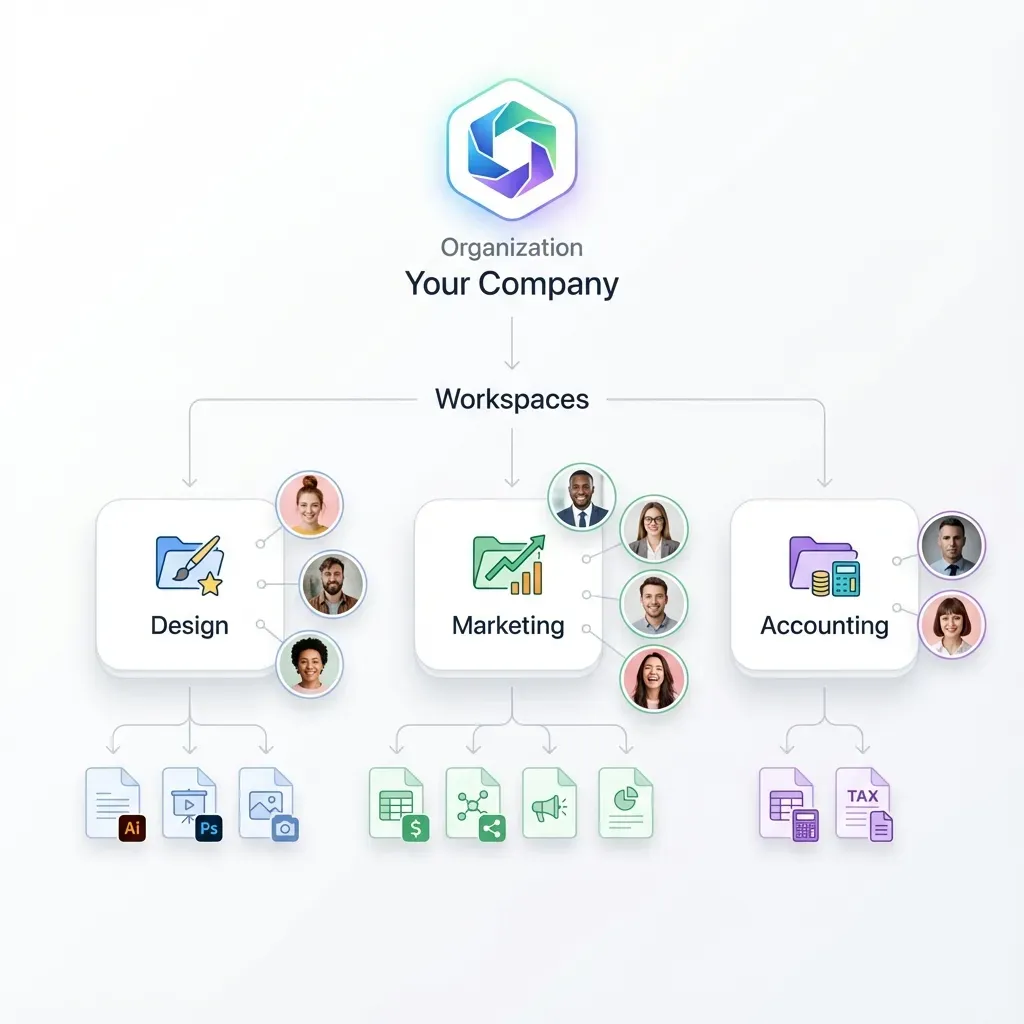
When moving a law firm off Dropbox, the migration team must design a folder schema that mirrors the firm's actual practice. Each client should have a designated, isolated workspace. Within that workspace, separate folders must represent individual matters. This structure makes it simple to apply granular permissions. Partners and associates can be granted full edit access to active matters, while administrative staff or external consultants can be restricted to specific directories.
Preserving file metadata, creation dates, and user access permissions is a critical requirement during this transition. In legal practice, a document's history is as important as its content. If files are simply downloaded and re-uploaded, the system timestamps will reset, overwriting the original author and creation dates with the migration operator's name and the transfer timestamp. This metadata is essential for maintaining a clear chronological record of case documents, and losing it can complicate evidentiary compliance or internal file audits. If an associate needs to prove when a contract draft was first stored, a reset timestamp makes that verification difficult.
To address this, firms should use direct cloud ingestion tools rather than manual file transfers. Fast.io provides a Cloud Import capability that connects directly to Dropbox via OAuth. This tool imports files directly, preserving the original folder structure and document hierarchy without requiring local disk space or manual upload cycles. This direct server-to-server import ensures that the nested directory configurations are mapped accurately to the new workspaces, minimizing the risk of files being misplaced in the wrong client directory.
Why Verifying Data Integrity Through Pilot Migrations Is Critical
Before initiating a firm-wide transition, running a pilot migration with a single practice group is a necessary step. Selecting a group that handles structured, predictable files, such as real estate transactions or immigration filings, allows the migration team to test the transition pipeline under real working conditions. The pilot group should operate in the new workspace for a week to identify any format incompatibilities or network bottlenecks.
During the pilot, the technical lead must validate data integrity. This involves verifying that the number of files in the destination matches the source directory, confirming that nested folder structures are intact, and checking that files with long paths or special characters did not fail during transfer. It is also the ideal time to test search performance. In Fast.io, enabling Intelligence Mode on a workspace automatically indexes files on arrival. This allows pilot users to use the hybrid search feature, which combines exact full-text search with semantic retrieval. Attorneys can search by meaning, such as finding a specific liability clause, or filter search results by metadata values extracted from their active documents.
To further simplify document management, firms can use Metadata Views to extract structured information. Unlike general search, Metadata Views design a typed schema to pull specific fields, such as counterparties, effective dates, or governing jurisdictions, directly from contracts and pleadings. This creates a sortable spreadsheet layer over the files, allowing attorneys to query their workspace like a database. Once the pilot group validates these search and extraction features, the migration team can finalize the rollout schedule for the remaining practice groups.


Moving your law firm off Dropbox?
Migrate your legal files to a secure, matter-centric workspace with granular permissions, intelligent search, and professional client portals. Starts with a 14-day free trial.
How to Secure Client Document Exchange and Portals
A common vulnerability for law firms using Dropbox is the reliance on email attachments or unbranded file links to share sensitive documents with clients. This practice exposes client data to interception and lacks a professional presentation. A successful migration should replace these insecure sharing habits with dedicated, branded portals.
Rather than sending files back and forth via email, firms can establish branded client portals to manage external communication. With Fast.io, teams can create secure client portals that feature the firm's logo, custom colors, and a clean, password-protected interface. Clients can access their documents directly through these portals, searching and viewing files without needing to create a user account. This reduces friction while maintaining the firm's professional brand.
For active document collection, such as collecting client tax records or corporate agreements, firms can use purpose-built Receive shares. These shares act as a secure, one-way upload link. The client uploads files directly into a designated folder in the workspace, bypassing email entirely. This is particularly valuable when handling large files, such as high-resolution scans of business ledgers, trial exhibits, or deposition videos, which often exceed email attachment limits and fail to load in standard cloud storage links. If a client has questions about a shared document, the portal features Ripley AI, which provides citation-backed answers based on the shared files. This allows clients to quickly find information within a long contract or disclosure statement without needing to call the attorney for every question.
How to Establish an Auditable Legal Workspace
The final phase of moving a law firm off Dropbox is establishing long-term security protocols and data governance. Legal teams must ensure that their files are protected against accidental modifications and that user actions are fully auditable. Unlike general cloud storage, an intelligent legal workspace provides the tools necessary to maintain a complete chain of custody.
To ensure compliance with the firm's records policies, the system must log every file modification, share generation, and permission change. Fast.io achieves this with a detailed activity log of actions by people and agents, retained according to your plan, providing a reliable record for audit purposes. Furthermore, the platform's security is built on top of cloud infrastructure partners, including Google Cloud Platform and Cloudflare, which run on industry-leading security standards. Fast.io protects documents with encryption in transit and at rest, coupled with strict workspace isolation and granular permission controls.
For active collaboration, team members can use Collaborative Notes to draft internal case summaries, trial outlines, and meeting minutes in real time. Because every note and document retains its full version history, the firm can restore prior versions at any time and verify exactly who made specific edits. To begin setting up this environment, practice managers can sign up for an account. Monthly plans start with a trial of up to 14 days (credit card required); annual plans have no trial. Paid subscriptions are billed based on usage, with plans including Starter at $9.99/mo | Business at $49.99/mo | Enterprise at $199.99/mo. Once the organization is configured, the migration lead can connect the firm's Dropbox account and begin mapping the legal workspaces.

Sources
References used to verify factual claims in this guide.
-
Approximately 75% of attorneys use cloud computing for work-related tasks.
Frequently Asked Questions
How do I migrate my law firm off Dropbox?
Migrating a law firm off Dropbox requires a structured six-phase process: audit your data, map folders to a client-centric structure, run a pilot migration with one practice group, communicate the transition schedule to your staff, execute the file transfer using direct cloud import tools, and decommission the legacy Dropbox folders to ensure a single source of truth.
What is the best way to move legal files to the cloud?
The best way to move legal files is through direct server-to-server cloud import tools rather than manual download and upload processes. Direct import preserves folder hierarchies and critical file metadata, such as original creation and modification dates, which are essential for keeping chronological legal records intact and searchable.
Why is Dropbox not ideal for law firms?
Dropbox lacks the matter-centric structure, metadata tagging, and granular security controls required for professional legal practices. It leads to search bottlenecks as document volumes grow, suffers from version conflicts during simultaneous editing, and does not provide immutable audit trails or dedicated, branded portals for secure client file exchange.
Related Resources

Moving your law firm off Dropbox?
Migrate your legal files to a secure, matter-centric workspace with granular permissions, intelligent search, and professional client portals. Starts with a 14-day free trial.