How to Connect AI Agents to Make.com with an MCP Server
Make.com offers a cloud-hosted MCP server that turns your automation scenarios into tools AI agents can call directly. This guide covers how to generate an MCP token, connect agents like Claude or ChatGPT to Make, build scenarios that work as agent-callable tools, and handle the outputs that come back.


What the Make MCP Server Does
Make.com's MCP server is a cloud-hosted gateway that exposes your automation scenarios as tools AI agents can discover and execute. Instead of writing custom API integrations, you generate a token, paste a URL into your AI client, and your agent can immediately see which scenarios are available, what inputs they need, and what outputs they produce.
This is different from building a webhook-based integration from scratch. With a traditional approach, you would create a webhook trigger in Make, write the tool definition manually in your agent's config, handle input validation, and parse the response. The MCP server handles all of that through the Model Context Protocol standard.
Make's MCP server supports three transport methods:
- Stateless Streamable HTTP (the default, recommended for most setups)
- Streamable HTTP for clients that need persistent connections
- Server-Sent Events (SSE) for legacy MCP clients
Authentication works through either OAuth (for clients like Claude Desktop that support it natively) or MCP tokens that you generate in your Make account settings. Both approaches give agents access to scenario execution, and paid plans unlock management tools for modifying scenarios, connections, and data stores.
Make is trusted by over 350,000 organizations and connects to more than 3,000 apps. When you expose a scenario as an MCP tool, every app integration in that scenario becomes accessible to your agent. An agent that triggers a scenario connecting Slack, Google Sheets, and Salesforce gets the combined power of all three without needing separate integrations for each.

Related guides
- How to Connect DocuSign to AI Agents with the MCP ServerDocuSign's official MCP server lets AI agents send envelopes, check signing status, query agreements through Navigator,...
- How to Set Up an MCP Server for GitHub ActionsMost GitHub MCP guides stop at repo management. This guide covers the Actions-specific surface: connecting an MCP...
- How to Set Up an MCP Server for LinkedInAn MCP server for LinkedIn lets AI agents read profiles, search jobs, send messages, and publish posts through the...
- How to Set Up an MCP Server for CalendlyCalendly's official MCP server lets AI agents check availability, book meetings, and manage scheduling links through...
- How to Set Up an MCP Server for n8n Workflow AutomationThe Model Context Protocol turns n8n into an AI-accessible automation platform. This guide walks through setting up n8n...
- How to Implement Collaborative MCP Server Management for DevOps TeamsCollaborative MCP management brings DevOps principles to AI agent infrastructure. As teams move from local scripts to...
More on this subject: MCP and Model Context Protocol (238 guides)
How to Set Up Make MCP Access
Getting your AI agent connected to Make takes about five minutes. The process has two paths depending on whether your AI client supports OAuth or needs a direct token URL.
OAuth Path (Claude Desktop, ChatGPT)
For clients that support OAuth natively, the setup is straightforward:
- Open your AI client's settings and find the connectors or integrations section
- Search for "Make" in the available connectors
- Click to add it, and you will see a Make OAuth consent screen
- Select your organization and choose permission scopes
- On Make's free plan, you can select "run your scenarios only," while paid plans offer broader management access
- Approve the connection
Your agent can now discover and run any active, on-demand scenario in your Make account.
MCP Token Path (Cursor, Devin Desktop (formerly Windsurf), Custom Agents)
For clients that need a direct URL, generate an MCP token:
- Log into Make.com and go to your user profile
- Navigate to the API/MCP access section
- Click "Add token" and select "MCP Token" as the type
- Give it a descriptive label (like "Claude Agent - Production")
- Copy the generated token URL
The token URL follows this pattern depending on your Make zone:
https://<MAKE_ZONE>/mcp/u/<MCP_TOKEN>/stateless
Paste this URL into your MCP client's configuration. For Claude Code, add it to your MCP server config:
{
  "mcpServers": {
    "make": {
      "url": "https://us1.make.com/mcp/u/YOUR_TOKEN/stateless"
    }
  }
}
For clients that do not support Streamable HTTP directly, append /sse to the URL for the SSE transport, or use Cloudflare's mcp-remote proxy.
Timeout Considerations
Make's MCP server enforces timeouts on tool calls. Scenario execution has a 25-second timeout via OAuth and 40 seconds via MCP token. If your scenario takes longer to complete, it keeps running in the background for up to 40 minutes. The server returns an executionId you can use to poll for results.
For time-sensitive workflows, keep your MCP-triggered scenarios lightweight. Offload heavy processing to separate scenarios triggered by webhooks or schedules.


Give Your Agents a Workspace for Make Automation Outputs
Fastio provides persistent storage with built-in AI indexing. Agents store Make scenario results, search them by meaning, and share with clients through branded links.
Building Scenarios That Work as MCP Tools
Not every Make scenario automatically shows up as an MCP tool. Your scenario needs specific configuration to be discoverable and callable by AI agents.
Requirements for MCP-Exposed Scenarios
Your scenario must be:
- Active with scheduling set to on demand (click the clock icon on the trigger module and select "on demand")
- Configured with defined inputs and outputs so the agent knows what data to send and what to expect back
Without the on-demand scheduling setting, the MCP server will not expose the scenario to connected clients.
Defining Inputs and Outputs
Click the scenario inputs/outputs icon in the Make toolbar to define what your scenario accepts and returns:
Inputs tell the agent what parameters to provide. For an email search scenario, you might define an input called "search_query" of type text. For a CRM lookup, you might accept a "company_name" string. Be specific with input names and descriptions because the AI agent reads these to understand how to call your tool.
Outputs define the data structure that comes back. Use the "Return Output" module at the end of your scenario to map processed data back to the defined output schema. For structured data, an Array Aggregator module before the Return Output module consolidates multiple items into a single response bundle.
Writing Good Scenario Descriptions
Make strongly recommends adding descriptions to every MCP-exposed scenario. The description is what the AI agent uses to decide which tool fits a request. A scenario described as "Gets unread emails from Gmail and returns sender, subject, and date" gives the agent much better context than one with no description at all.
Keep descriptions factual and specific. State what the scenario does, what inputs it needs, and what format the output takes.
Practical Scenario Patterns
Here are patterns that work well as MCP tools:
- Data retrieval: Pull records from a CRM, database, or spreadsheet based on search criteria
- Content processing: Take raw text input, transform it through multiple modules, return formatted output
- Notification dispatch: Accept a message and recipient, send via Slack, email, or SMS, return delivery confirmation
- File operations: Upload to cloud storage, generate documents, or convert file formats
- Multi-step lookups: Chain API calls across services, aggregate results, return a unified response
Each pattern follows the same structure: defined inputs, processing modules in the middle, Array Aggregator if needed, and a Return Output module at the end.
Where Agent Outputs Go After Make Runs
When an AI agent triggers a Make scenario, the processed data comes back to the agent as structured output. But for many workflows, the real value is what happens next: storing, sharing, and acting on those results.
The Storage Problem
Make excels at moving data between apps, but it is not designed for persistent file storage. If your agent generates a report, transforms a dataset, or collects documents through a Make scenario, that output needs to land somewhere accessible to both the agent and the humans who will use it.
Common approaches include sending files to Google Drive, Dropbox, or S3. These work, but they treat storage as a passive dump. The agent writes a file and moves on. Finding that file later, understanding what it contains, or sharing it with a client requires manual effort.
Using Fastio as the Output Workspace
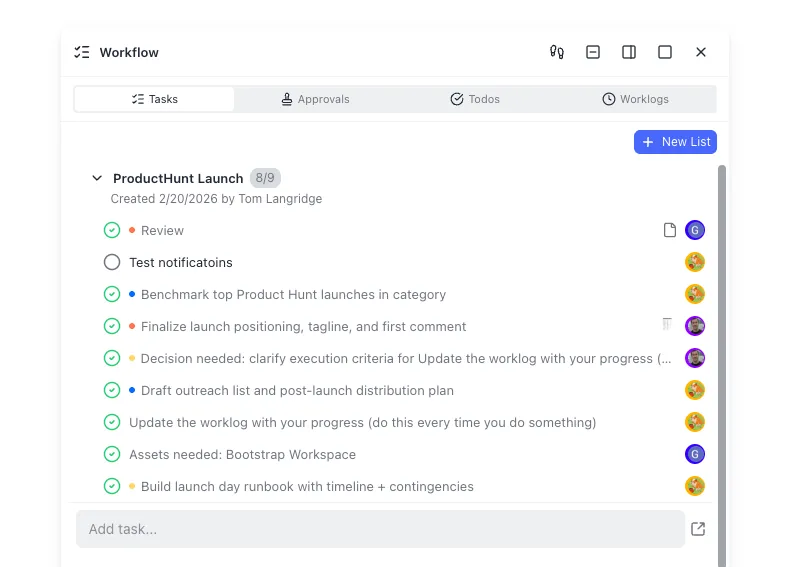
Fastio approaches this differently. It is built as a workspace for agentic teams, where files uploaded by agents are automatically indexed and searchable. When your Make scenario produces output that an agent stores in a Fastio workspace, that content becomes immediately queryable through natural language.
The practical workflow looks like this:
- Your AI agent calls a Make scenario that collects data from multiple sources
- Make processes and formats the data, returning it to the agent
- The agent uploads the result to a Fastio workspace using the Fastio MCP server
- Intelligence Mode indexes the content automatically
- Team members can search, ask questions about, and share the output through the Fastio dashboard or API
Fastio's MCP server exposes tools for workspace management, file upload, AI-powered search, and sharing. An agent can upload a file, enable Intelligence Mode on the workspace, and create a branded share link for a client, all through MCP tool calls without touching a browser.
Fastio offers a 14-day Business Trial to test shared workspaces and AI indexing. For workflows where Make handles the automation and an agent handles the reasoning, Fastio becomes the place where results accumulate and stay accessible.
Multi-Agent Patterns with Make and MCP
Make's scenario-based architecture opens up patterns that go beyond single-agent tool calls. When you combine Make's MCP server with other MCP-connected services, agents can orchestrate complex workflows across multiple platforms.
Agent as Orchestrator
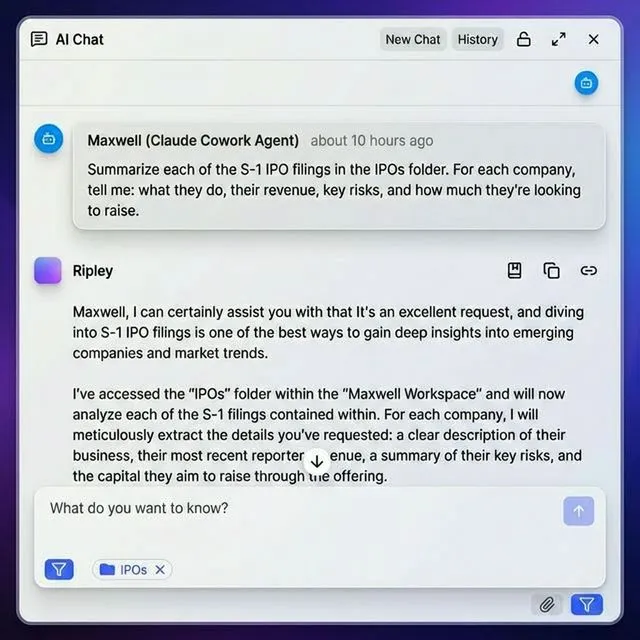
In this pattern, one agent acts as the coordinator. It receives a request, breaks it into steps, and calls different Make scenarios for each step. A research agent might:
- Call a Make scenario that searches a CRM for company data
- Call another scenario that pulls recent news articles about that company
- Call a third scenario that checks internal documents for past interactions
- Synthesize all three results into a briefing document
Each scenario is a discrete, testable unit in Make. The agent decides the order and handles the logic between steps.
Webhook-Triggered Agent Workflows
Make scenarios can also initiate agent work through webhooks. When a new lead enters your CRM, a Make scenario fires a webhook that triggers an agent to research the lead, draft a personalized outreach email, and store the draft in a shared workspace for human review.
This inverts the typical pattern. Instead of the agent calling Make, Make calls the agent. Fastio's WebSocket events feed and activity polling support reactive models, letting agents detect file changes without arbitrary delays.
Handling Concurrent Access
When multiple agents share the same Make account, scenario execution can overlap. Make handles this at the scenario level since each execution runs independently. But if agents write results to the same storage location, you need coordination.
Fastio addresses this with advisory file locks and automatic version history. An agent can acquire a file lock before writing, heartbeat it while working, and release it when done. Another agent attempting to lock the same file gets a 409 and can wait, while every write is versioned regardless so no work is lost if scenarios complete at the same time.
Connecting Make to Other MCP Servers
Your agent is not limited to one MCP server. A typical production setup might connect to:
- Make MCP for triggering automations across 3,000+ app integrations
- Fastio MCP at
https://mcp.fast.io/mcp/toolsfor persistent storage, RAG search, and sharing - Domain-specific MCP servers for services like Calendly, GitHub, or Stripe
The agent sees all connected MCP tools in a unified interface and picks the right tool for each step. Make handles the automation layer, Fastio handles the storage and intelligence layer, and the agent handles the reasoning.
Troubleshooting Common Issues
Setting up MCP connections is generally smooth, but a few issues come up regularly.
Scenario Not Appearing as a Tool
If your agent cannot find a scenario after connecting, check three things:
- The scenario must be active (not paused or in draft)
- Scheduling must be set to on demand (not interval or webhook)
- If using an MCP token, confirm the token has not expired and is associated with the correct organization
After making changes, disconnect and reconnect the MCP server in your client. Most clients cache the tool list and need a refresh to pick up new scenarios.
Timeout Errors on Long Scenarios
If you see timeout errors, your scenario is exceeding the MCP server's response window (25 seconds for OAuth, 40 seconds for MCP tokens). Two approaches to fix this:
- Simplify the scenario: reduce the number of modules, remove unnecessary data transformations, or use parallel execution paths in Make where possible
- Use the executionId pattern: let the scenario timeout, capture the returned executionId, and have the agent poll for the result. This works well for scenarios that need to call slow external APIs
Authentication Failures
OAuth connections can break when tokens expire or when your Make subscription changes. If an agent suddenly cannot authenticate:
- Re-authorize the connection through your AI client's connector settings
- For MCP tokens, generate a new token in your Make profile and update the URL in your client config
- Check that the scopes you selected during setup still match your Make plan. Free plans only support scenario execution, not management tools
Input/Output Mismatches
When an agent sends the wrong data format to a scenario, Make returns an error. This usually happens because the scenario description is too vague or the input definitions are missing type constraints. Add explicit types (text, number, boolean) to your input definitions and keep descriptions specific about expected formats. If a field expects an email address, say so in the description rather than just labeling it "input."
Sources
References used to verify factual claims in this guide.
-
Make is trusted by over 350,000 organizations
-
Make connects to more than 3,000 app integrations
-
Make MCP server scenario execution timeout is 25 seconds via OAuth and 40 seconds via MCP token
Frequently Asked Questions
Can AI agents trigger Make.com automations?
Yes. Make.com's official MCP server lets AI agents like Claude, ChatGPT, and custom MCP clients trigger any active scenario configured with on-demand scheduling. The agent discovers available scenarios, sends the required inputs, and receives structured outputs, all through the Model Context Protocol standard.
How do I connect Claude to Make.com?
Claude Desktop supports Make through its built-in OAuth connector. Open Settings, go to Connectors, search for Make, and authorize the connection by selecting your organization and permission scopes. For Claude Code, generate an MCP token in your Make profile and add the token URL to your MCP server configuration.
Is there an official MCP server for Make?
Yes. Make provides a cloud-hosted MCP server at mcp.make.com that supports Stateless Streamable HTTP, Streamable HTTP, and SSE transports. It requires no local installation. You authenticate through OAuth or an MCP token generated in your Make account settings.
What is the difference between Make's MCP server and a webhook integration?
A webhook integration requires you to manually define tool schemas, build input validation, and parse responses in your agent code. Make's MCP server handles all of this through the standardized Model Context Protocol. The server tells the agent what scenarios are available, what inputs they expect, and what outputs they return, so you skip the custom integration work.
Does the Make MCP server work on the free plan?
Scenario execution tools are available on all Make plans, including the free tier. Management tools for modifying scenarios, connections, webhooks, and data stores require a paid subscription. You can still build and run automation workflows through MCP on the free plan.
How do I store outputs from Make scenarios for long-term use?
Make processes data between apps but does not provide persistent storage. You can route scenario outputs to cloud storage services like Google Drive or S3. For AI-native workflows, Fastio offers workspaces where agent-uploaded files are automatically indexed and searchable through natural language, with a 14-day Business Trial and plans starting at $9.99/month.
Related Resources

Give Your Agents a Workspace for Make Automation Outputs
Fastio provides persistent storage with built-in AI indexing. Agents store Make scenario results, search them by meaning, and share with clients through branded links.