How to Build a Company Brain for Human-Agent Collaboration
Building a centralized company brain is essential for organizations deploying AI agents. As teams adopt autonomous workflows, storing files in isolated, static wikis prevents agents from retrieving critical information or posting updates. This guide outlines how to establish an intelligent, live repository on Fast.io that integrates human documentation and agent outputs into a single, queryable source of truth.


What Is a Company Brain?
According to Capgemini research, 82% of organizations plan to integrate autonomous AI agents within three years, aligning with industry forecasts that over 70% of teams will deploy autonomous AI agents by 2026 [Capgemini Research Institute 2025]. However, the McKinsey Global Institute reports that companies lose up to 20% of productivity simply searching for internal information [McKinsey Global Institute 2012]. The gap between agent capability and fragmented corporate data is where the company brain lives.
A company brain is a centralized, live repository that integrates human-created documents and autonomous agent outputs to serve as the unified source of truth for an entire organization. When teams start deploying autonomous agents, they quickly realize that standard wiki pages and static documentation platforms are not designed for machine interaction. An AI agent cannot browse a folder structure easily, nor can it query a database without structured protocols. If files are fragmented across private drives, personal desktops, and local storage, the agent cannot access the context it needs to perform tasks.
To solve this problem, organizations must move from static documents to an intelligent, queryable repository. This setup allows human employees to read and write documentation while agents interact with the same files through programmatic channels. By building a shared substrate, teams ensure that human knowledge and agent findings remain unified and searchable.
The Cost of Fragmented Data
Information fragmentation is a quiet killer of organizational efficiency. When team members store project notes in personal folders, send documents as email attachments, or leave research buried in chat histories, they create disconnected information pockets. This fragmentation makes it difficult for employees to locate the files they need.
The McKinsey Global Institute study highlighted that knowledge workers spend about 20% of their workweek searching for internal information or tracking down colleagues who can help with specific tasks. When you introduce AI agents into this environment, the problem worsens. An agent operating without a centralized repository spends excessive time and tokens scanning irrelevant folders, which increases operational costs and leads to incomplete or inaccurate outputs.
Why Static Wikis Fail AI Agents
Traditional corporate wikis, intranet pages, and shared drives were built for human visual inspection. They rely on human readers to navigate complex structures, interpret formatting, and jump between links. These platforms do not provide the programmatic entry points that AI agents require.
An agent cannot easily navigate a nested wiki structure because the APIs are often slow or restrictive. Standard cloud storage options also fail to provide clean markdown versions of documents, meaning agents must ingest raw HTML or PDF formatting, wasting context window space on rendering boilerplate. To build a company brain, you need a repository that supports both human co-editing and machine-native tools.
Related guides
- 18 agentic workflows to run against your company brainYour agent starts every session knowing nothing about your company. A company brain fixes that. One Fastio workspace...
- How to Build a Collaborative AI Knowledge Base for TeamsAn AI knowledge base is an intelligent workspace where humans and AI agents collaborate on organizational knowledge....
- How to Set Up an AI Agent Shared WorkspaceA shared workspace gives multiple AI agents a single place to read, write, and organize files without stepping on each...
- The Ultimate Company Brain Setup Checklist for Teams and AgentsLearn how to build a unified knowledge base using this practical company brain setup checklist. Connect team...
- How to Build Persistent Storage for Agentic WorkflowsAgentic workflow storage lets autonomous agents maintain state, share files, and persist progress across long-running...
- How to Build Federated Workspaces for AI AgentsFederated AI agent workspaces enable distributed agents to collaborate without centralizing all data. Learn the...
More on this subject: Agent Memory and Storage (261 guides)
How Do Agents Access Workspace Files?
Before an agent can analyze documents, it must be connected to the organizational workspace. While local file storage, Amazon S3, or raw cloud databases are common starting points, they lack the tools needed for human collaboration. On the other hand, traditional file-sharing services are built for human screens and do not expose protocol-level access for agents.
Fast.io bridges this gap by offering shared workspaces where humans and agents work together on the same files. To set up this access, human administrators grant scoped access through API keys or OAuth using PKCE login. This browser-based login allows agents to authenticate securely without seeing the administrator password.
Once the agent is authenticated, it can interact with the files in the workspace. Because multiple agents and humans may access the same documentation simultaneously, version control is critical. Every file in the workspace maintains a per-file version history. When an agent updates a project brief, the system saves the prior version, allowing teams to audit changes and restore previous files if needed. For external handoffs, administrators can create Send, Receive, or Exchange shares. These branded sharing spaces support custom branding, guest access, and security controls such as passwords. Single-file shares can be set to expire or remain durable, and you can grant and revoke per-recipient access individually. Since shares are versioned, external recipients always view the current version with its history available.
Version History and Audit Trails
In a collaborative workspace where humans and agents edit files concurrently, maintaining a clear audit trail is a necessity. Without version tracking, it is impossible to determine whether a document modification was made by an autonomous script or an employee, making error resolution difficult.
Fast.io tracks version history automatically for every file, creating a history of changes. If an agent writes faulty data or overwrites a project description, an administrator can view the version history and restore the prior file version. This capability ensures that human oversight remains intact even when agents operate autonomously.
Secure Workspace Handoffs
Security must be a primary consideration when granting agents access to company data. Using API keys or OAuth with PKCE login ensures that agents only access the specific folders and workspaces they are authorized to use. Administrators can revoke these keys at any time.
When sharing files externally with clients or partners, the system supports branded shares that keep documents secure. You can share files using Send shares, collect files from external clients using Receive shares, or collaborate bi-directionally using Exchange shares. Because these sharing interfaces support custom branding, they look professional and build trust with clients.
Steps to Structure Ingestion with Metadata Views
A company brain must index files as they arrive to make them queryable. In traditional setups, this requires building complex pipelines that convert documents to text, chunk the content, and upload it to a vector database. Fast.io simplifies this process with Intelligence Mode, which automatically indexes files for semantic search and page-level citation-backed chat on arrival.
For advanced workflows, simple text indexing is not enough. Agents need structured data, such as contract values, renewal dates, or policy numbers, to automate decisions. Traditional optical character recognition (OCR) and custom document templates are fragile and require constant maintenance when formats change.
To address this, Fast.io provides Metadata Views (link to /product/document-data-extraction/). Metadata Views turn unstructured documents into a live, queryable database. Users describe the fields they want extracted in natural language, and the system automatically designs a typed schema. It then matches files in the workspace and populates a spreadsheet with the extracted data.
For example, a legal team can extract counterparty names, governing laws, and renewal dates from contract PDFs. An insurance team can pull policy numbers and coverage limits. The system supports seven field types, including Text, Integer, Decimal, Boolean, URL, JSON, and Date & Time. Because the extraction is incremental, teams can add new columns at any time without reprocessing existing files. Agents can query these schemas, match files, and trigger extraction programmatically.
In addition, humans can import files from Google Drive, Dropbox, Box, and OneDrive via Cloud Import. This OAuth-based import pulls entire folder structures without local input or output, placing the documents directly into the workspace where they are indexed and processed.

Intelligence Mode: Zero-Config RAG
Building a retrieval-augmented generation (RAG) system usually requires a complex stack, including an ingestion service, a document parser, a vector database, and an orchestration layer. This complexity makes maintaining a company brain difficult for smaller organizations.
With Intelligence Mode, this indexing happens on the storage layer. When you upload files to a workspace, the system automatically runs text extraction, chunking, and embedding. Both human workers and connected agents can immediately query the files using hybrid search, which combines full-text search with semantic search. The system returns answers complete with citations to the specific files, pages, and snippets, ensuring accuracy.
Metadata Views for Structured Workflows
Unstructured text search is useful for Q&A, but automated business processes require structured fields. An agent cannot route an invoice for payment unless it knows the total amount and vendor name as typed variables.
Metadata Views solve this problem by converting raw files into structured database columns. By describing what you need in plain English, the system uses Gemini Pro to design the schema and extract the values. The platform uses Gemini Pro to suggest extraction columns with field types and example values from real files, making setup simple. Because agents can query these Metadata Views via the MCP server, they can retrieve structured data directly without writing custom parsing scripts.


Persist agent files and company documents in one place
Deploy a shared workspace with a consolidated Model Context Protocol server for your agents, complete with version history and automatic metadata extraction. Monthly plans start with a Business Trial of up to 14 days (credit card required); annual plans have no trial.
Why Standardize Agent Connections on the Model Context Protocol?
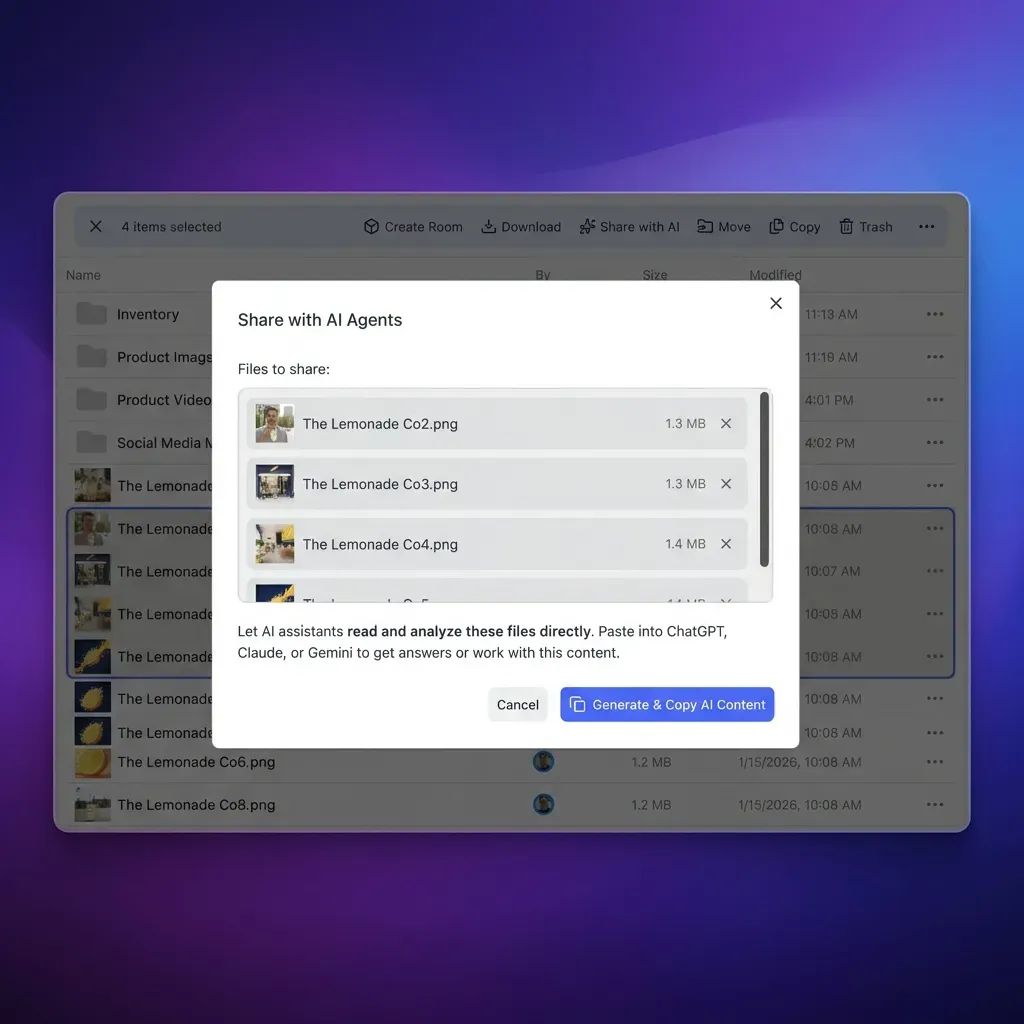
Once files are stored and indexed, agents must query them. Rather than building custom API integrations for every LLM, organizations can standardize on the Model Context Protocol (MCP). Fast.io provides an official MCP server that exposes action-based tools for workspace, storage, AI, and document operations.
The MCP server is accessible via Streamable HTTP. Local agents (such as Claude Code and Cursor) connect at https://mcp.fast.io/mcp/code, Codex connects through the Fastio plugin (or via its custom MCP server at https://mcp.fast.io/mcp/operations), and cloud-native orchestration frameworks (such as OpenClaw, CrewAI, LangGraph, and AutoGen) connect at https://mcp.fast.io/mcp/tools. This protocol allows the agent to run semantic searches, read document text, and edit files directly in the workspace.
For example, the following JSON configuration shows how to register the Fast.io MCP server in a local agent configuration file:
{
  "mcpServers": {
    "fastio": {
      "url": "https://mcp.fast.io/mcp/code"
    }
  }
}
The first time the agent connects, sign in to Fast.io in the browser window that opens. Once connected, the agent can use collaborative notes. Collaborative Notes allow real-time co-editing in every workspace, complete with live cursors. Human employees and AI agents operate as first-class co-editors, allowing the agent to update project briefs, log findings, and draft documentation in real time alongside humans. These notes are also indexed by the system, ensuring they remain grounded for future Q&A sessions.
Model Context Protocol (MCP) Integration
Integrating a company brain with different large language models often leads to API sprawl. You might have to write custom integrations for Claude, GPT, and Gemini separately, leading to high maintenance costs.
Standardizing on the Model Context Protocol (MCP) solves this integration problem. The Fast.io MCP server exposes a consolidated MCP toolset that translates agent requests into workspace actions. Whether your agent runs locally as a terminal companion or in the cloud as part of an autonomous workflow, it can use the same standardized commands to browse folders, search content, and update files. For more details on supported tools, see the Fast.io MCP server documentation.
Notes for Humans and Agents
Documentation is rarely static. It evolves as project requirements change, tasks are completed, and new information is uncovered. Traditional file storage forces agents and humans to edit files offline and upload changes, which creates conflict risks.
Collaborative Notes introduce real-time multiplayer editing to the workspace. When an agent runs a task, it can write its findings directly into a shared note. Human teammates see the agent's cursor moving in real time as it writes, allowing for immediate review. Because these notes are saved and indexed, they serve as live context that other agents can search and reference later.
Guide to Managing Workspace Handoffs and Events
An effective company brain must coordinate handoffs and manage permissions as teams and agents interact. Fast.io provides realtime activity feeds you can poll and a WebSocket events feed to keep downstream systems informed when files change. Rather than maintaining complex integrations, agents and services can listen for events when documents are uploaded or modified.
When a new document is imported, agents can automatically extract metadata fields using Metadata Views, index the contents, or post summaries to Collaborative Notes. Every action is recorded in a detailed activity log of actions by people and agents, retained according to your plan. This log tracks what happened and who did it.
When an agent completes its work, it can transfer ownership of the organization to a human. During ownership transfer, the agent hands over the organization and workspaces via a secure claim link when usage credits run out or the handoff is complete. The agent can keep its admin access while the human assumes ownership of the subscription.
Fastio offers three paid subscription plans: the Starter plan at $9.99 per month, the Business plan at $49.99 per month, and the Enterprise plan at $199.99 per month. The Starter plan includes 250 GB of storage, the Business plan includes 5 TB of storage with 10 seats, and the Enterprise plan provides 25 TB of storage with 30 seats included (up to 200). Monthly plans start with a Business Trial of up to 14 days (credit card required); annual plans have no trial. An agent can sign up, set up the workspaces, and then transfer the organization to a human who initiates the trial and starts the paid subscription.
Realtime Events and Activity Feeds
Tracking file movements and processing steps is essential to keeping a company brain up to date. Rather than relying on custom polling loops, agents can listen to Fast.io's WebSocket events feed or poll the activity feed.
When files arrive in a shared folder, agents can trigger data extraction via Metadata Views and update shared Collaborative Notes. Because every action is recorded in the activity log, administrators can trace exactly how files were accessed, updated, or organized.
Subscriptions and Handoff Flow
Organizations run on paid plans that include seats, storage, and a monthly allowance of AI credits, with extra storage, bandwidth, and AI usage billed as overage. Detailed rates and parameters are available on the pricing page.
To simplify client projects, developers can use the storage for agents handoff flow. An agent signs up for free and configures the workspaces, folder structures, and Metadata Views for a client. Once the project setup is complete, the agent generates a claim link to transfer ownership to the human client. The client clicks the link, creates or joins their organization, starts the 14-day Business Trial (credit card required), and takes over billing. The developer agent can retain its administrator role to continue running automated tasks while the client owns the workspace.
Sources
References used to verify factual claims in this guide.
-
According to Capgemini research, 82% of organizations plan to integrate autonomous AI agents within three years, aligning with industry forecasts that over 70% of teams will deploy autonomous AI agents by 2026.
-
A study by the McKinsey Global Institute found that knowledge workers spend about 20% of their workweek searching for internal information.
-
Fastio offers three paid subscription plans: the Starter plan at $9.99 per month, the Business plan at $49.99 per month, and the Enterprise plan at $199.99 per month. Monthly plans start with a Business Trial of up to 14 days (credit card required); annual plans have no trial. The Starter plan includes 250 GB of storage, the Business plan includes 5 TB of storage with 10 seats, and the Enterprise plan provides 25 TB of storage with 30 seats included (up to 200).
-
The platform uses Gemini Pro to suggest extraction columns.
Frequently Asked Questions
What is a company brain?
A company brain is a centralized, live repository that integrates human-created documents and autonomous agent outputs to serve as the unified source of truth for an entire organization.
How do you build a corporate knowledge base for AI agents?
Building a knowledge base for agents requires moving beyond static wiki tools. You must establish a permanent storage layer with automatic semantic indexing, expose structured data fields through metadata extraction, and provide protocol-level access such as the Model Context Protocol.
How does an AI agent access company files?
Agents access files programmatically through the Fast.io Model Context Protocol server or standard API keys. When authorized, the agent reads and writes files directly within shared workspaces, maintaining a full version history of all modifications.
Related Resources

Persist agent files and company documents in one place
Deploy a shared workspace with a consolidated Model Context Protocol server for your agents, complete with version history and automatic metadata extraction. Monthly plans start with a Business Trial of up to 14 days (credit card required); annual plans have no trial.