How to Host GitHub Pages from Private Repos vs Fast.io for Copilot Builds
Deploying Copilot builds from private repositories to GitHub Pages presents severe security risks since sites are public by default. For internal tools, documentation, and agent outputs, Fast.io provides a private, secure alternative with granular access control and automatic semantic indexing.


Why Private Repositories on GitHub Pages Still Leak Build Outputs
Developers pushing automated build artifacts from GitHub Copilot to GitHub Pages often assume that hosting from a private repository keeps their content secure. The reality is that unless you are paying for GitHub Enterprise Cloud, any site published via GitHub Pages is accessible to anyone on the internet by default, even if the source code itself remains restricted. The source code of your private repository is safe, but the compiled HTML, CSS, JavaScript, and asset files are hosted on a public subdomain under the github.io namespace.
GitHub imposes strict pricing tiers on who can use Pages with private repositories. The official documentation states that GitHub Pages is available in public repositories with GitHub Free and GitHub Free for organizations, and in public and private repositories with GitHub Pro, GitHub Team, GitHub Enterprise Cloud, and GitHub Enterprise Server. If you are on a GitHub Free personal or organization account, you cannot host a GitHub Pages site from a private repository at all. To enable Pages in a private repository, you must upgrade to a paid account tier, which includes GitHub Pro, GitHub Team, or GitHub Enterprise Cloud.
However, simply upgrading to a paid tier like GitHub Pro or GitHub Team does not solve the visibility problem. The site remains fully public to the internet. Access control is exclusive to the high-tier GitHub Enterprise Cloud plan, meaning small teams and individual developers are left with a stark choice: pay for enterprise-grade plans or accept that their internal build outputs are accessible to the public. To publish a GitHub Pages site privately, your organization must use GitHub Enterprise Cloud. Without this specific configuration, any site built from your private code is accessible to anyone with the URL.
Related guides
- Cline GitHub: Repo, Releases, and How to ContributeThe Cline GitHub repository has about 64,700 stars and draws roughly 880 US monthly searches for "cline github," yet...
- Hermes Agent GitHub: Open Source Repo, Architecture, and How to ContributeThe Hermes Agent GitHub repository at NousResearch/hermes-agent is where Nous Research develops its open-source,...
- How to Query the GitHub Copilot API with External Tool ContextQuerying the Copilot API with external context allows developers to pass custom file systems, test outputs, and...
- How to Connect GitHub Copilot to Dropbox Files via MCPConnecting GitHub Copilot to Dropbox via MCP equips VS Code Copilot agent mode with direct semantic search over cloud...
- GitHub Copilot Limits: Plan Quotas, Rate Caps, and Context BoundariesUnderstanding GitHub Copilot limits requires tracking how monthly quotas, chat throttling, and workspace indexing rules...
- GitHub Copilot Personal Access Token Permissions for MCPSetting up a GitHub Model Context Protocol (MCP) server with administrative credentials exposes your entire account...
More on this subject: GitHub Copilot (130 guides)
The Security Risks of Exposing Copilot Build Artifacts
When developers use GitHub Copilot to build prototypes, documentation sites, internal tooling, or dashboard interfaces, they often run automated build pipelines that publish directly to a hosting surface. In a typical workflow, Copilot generates code, a developer commits it, and a GitHub Actions workflow compiles the static files.
If this build output is sent to a public GitHub Pages site, the developer exposes internal details of their application. These build artifacts frequently contain sensitive information, including API endpoints, internal environment configurations, structural documentation of database schemas, and references to proprietary systems. Even if you do not share the generated URL, the URL is predictable. It follows a standard pattern, such as username.github.io/repositoryname.
Security crawlers, search engine indexers, and malicious actors continuously scan the github.io domain for exposed files. Once a build directory is crawled, any hardcoded configuration or exposed API paths become public knowledge. This creates a silent exposure vector where proprietary code patterns generated by Copilot are visible to the public, defeating the purpose of keeping the source code repository private. The risk is compounded when coding assistants build test fixtures or dummy data that contain details resembling real customer records or production environments. A single public build exposure can violate security protocols and expose internal assets to threat actors.
How to Configure GitHub Pages inside a Private Repository
For organizations that choose to use GitHub Pages and possess the necessary paid tiers, configuring the deployment is straightforward. The setup involves preparing the repository, configuring settings, and writing a GitHub Actions workflow.
To set up the repository on GitHub, navigate to the repository settings, select the Pages tab, and choose the source branch or select GitHub Actions as the build source. If you are on a GitHub Enterprise Cloud plan, you will also see a visibility section where you can toggle the site between Public and Private. If you are on GitHub Pro or GitHub Team, this visibility option is disabled, forcing the site to be public.
Below is a standard GitHub Actions workflow file that builds a static site and deploys it to GitHub Pages. Developers place this configuration file at .github/workflows/deploy-pages.yml in their repository.
name: Deploy to GitHub Pages
on:
  push:
    branches:
      - main
permissions:
  contents: read
  pages: write
  id-token: write
concurrency:
  group: "pages"
  cancel-in-progress: false
jobs:
  deploy:
    environment:
      name: github-pages
      url: ${{ steps.deployment.outputs.page_url }}
    runs-on: ubuntu-latest
    steps:
      - name: Checkout repository
        uses: actions/checkout@v4
      - name: Set up Node.js
        uses: actions/setup-node@v4
        with:
          node-version: 20
      - name: Install dependencies
        run: npm ci
      - name: Build static site
        run: npm run build
      - name: Upload artifact
        uses: actions/upload-pages-artifact@v3
        with:
          path: ./dist
      - name: Deploy to GitHub Pages
        id: deployment
        uses: actions/deploy-pages@v4
This workflow runs on every push to the main branch. It checks out the code, installs dependencies, compiles the build output into a /dist directory, uploads that directory as a zip artifact, and deploys it. In a private repository without GitHub Enterprise Cloud, the resulting site URL is immediately live and visible to anyone who accesses the address. This default behavior presents a major challenge for developers using GitHub Copilot to iterate on private tools, since each change is automatically published to a public domain without authorization gates or authentication checks.
Security Audits and Repository Configuration
Before deploying to GitHub Pages, developers must review their repository settings to prevent accidental leaks. In private repositories, the default action is to block public Pages publishing if an organization owner has set restrictive member privileges.
Organization owners can manage pages visibility under Member privileges in their Organization settings, controlling whether members can publish sites publicly, privately, both, or neither. If your team is on a paid plan but cannot access Pages, check with your organization administrator to ensure Pages creation permissions are enabled for your repository.
Why Fast.io is a More Secure Workspace Solution
For developers who need a secure workspace to store, share, and review build artifacts without exposing them to the open web, Fast.io provides a dedicated workspace environment. Unlike static hosting platforms that publish everything publicly by default, Fast.io treats workspaces as private secure vaults. Every file, document, and build artifact uploaded to Fast.io is restricted to organization members unless you explicitly create an access link.
Fast.io organizes shared storage around organizations and workspaces. Creating an account is free; doing real work requires an organization on a paid subscription. Monthly plans start with a trial of up to 14 days (credit card required); annual plans have no trial. Plans are Starter at 9.99/mo, Business at 49.99/mo, and Enterprise at 199.99/mo. Compare plan limits and features on the Fast.io pricing page.
When developers compile static builds, internal documentation, or interactive prototypes using tools like GitHub Copilot, Fast.io acts as a collaborative storage layer. Workspaces can be organized by project or client, with granular permissions scoped at the organization, workspace, folder, or file level. Instead of exposing a public website, developers can share files or folders using branded shares (Send/Receive/Exchange) or durable File Shares. These sharing mechanisms can be configured with password protection, expiration dates, and access controls that do not require recipients to create an account.
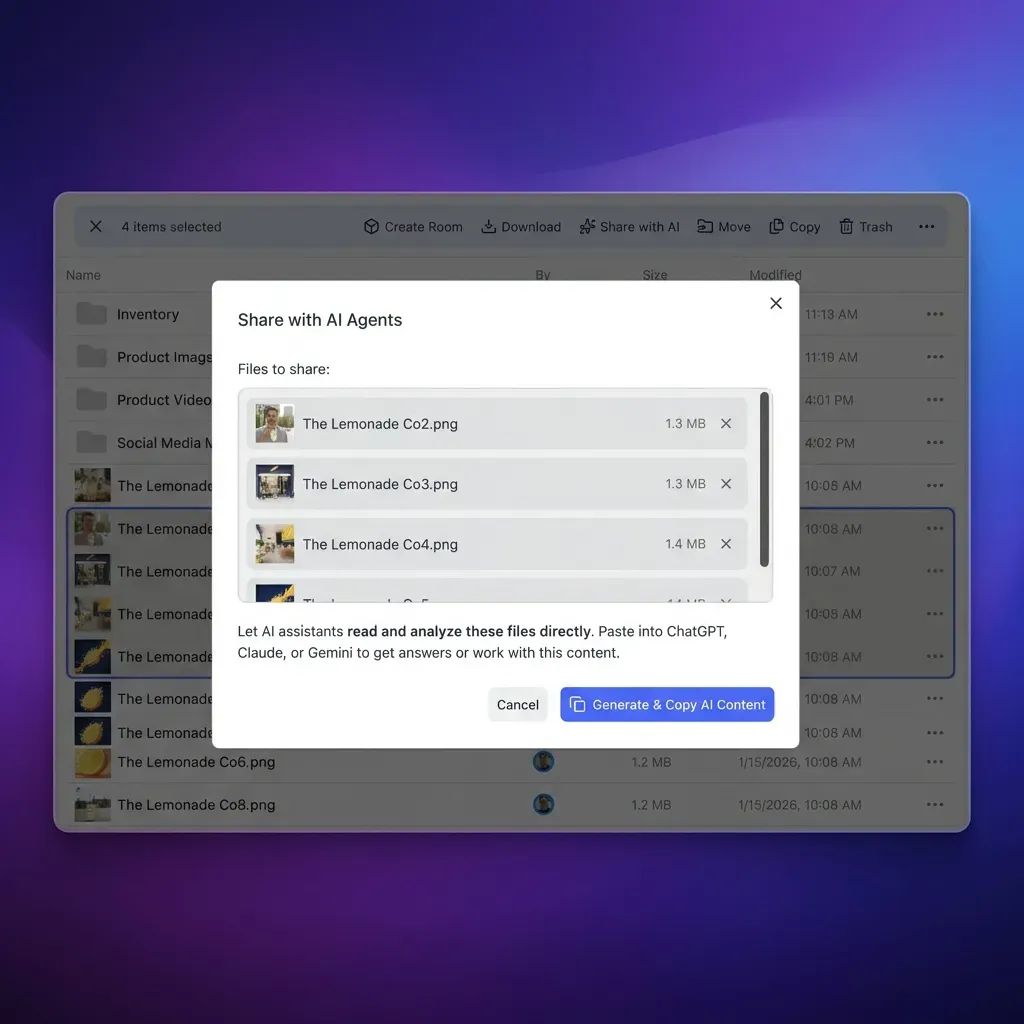
Fast.io also supports developer automation through its Model Context Protocol (MCP) server. Headless agents, terminal assistants, and IDE extensions can connect directly to the Fast.io workspace. With Intelligence Mode enabled, files uploaded to a workspace are indexed automatically, enabling developers and agents to run semantic searches and ask natural-language questions about build documentation, design specifications, or deployment logs. This direct indexing converts static files into a live queryable knowledge base, ensuring that agents can access relevant deployment details without separate vector databases. You can read more about integrating coding agents in our guide to workspace storage for agents.
Leveraging Metadata Views for Structured Build Artifacts
When deploying build outputs, developers often need to track structural metadata about each build, such as compiler version, bundle size, target environment, and commit hash.
Rather than maintaining a separate JSON log or database, developers can configure Metadata Views on their Fast.io build directory. A Metadata View acts as a live, queryable database that extracts structured fields from files in a workspace without manual extraction rules.
For example, a developer can define a schema with columns for the commit hash, the target build environment, and the compile date. When a build report or manifest is uploaded, Fast.io's AI analyzes the file, matches the schema, and populates the spreadsheet view. This structured data can then be sorted, filtered, and queried programmatically. Agents can access these Metadata Views via the MCP server to inspect deployment details or decide their next step based on extraction outcomes. The full capability of this feature is described on the Metadata Views product page.


Protect your Copilot build artifacts from public exposure
Deploy static build directories directly to private workspaces using our Model Context Protocol server. Keep your files versioned, searchable, and secure. Starts with a 14-day free trial.
Steps to Deploy Copilot Build Artifacts to Fast.io Workspaces
Instead of relying on public deployment URL routes, developers can automate file delivery using the Fast.io Model Context Protocol (MCP) server. The MCP server enables local and remote agents to interact with workspaces using standard actions. Developers can run their coding assistants directly against their Fast.io workspace, uploading build assets and documenting changes in real time.
To connect an agent like Cline, Cursor, or a custom terminal tool to your Fast.io workspace, you configure the MCP server settings. Fast.io exposes its MCP server for coding agents at https://mcp.fast.io/mcp/code over Streamable HTTP. Interactive clients sign in using OAuth in the browser without an API key, opening a Review Permissions screen where you choose permissions and workspaces. You can find detailed setup instructions at Fast.io MCP documentation.
Below is an example configuration for Cline or VS Code's cline_mcp_settings.json that connects the agent to your workspace.
{
  "mcpServers": {
    "fastio": {
      "type": "streamableHttp",
      "url": "https://mcp.fast.io/mcp/code"
    }
  }
}
Once the configuration is active, your agent can list, search, and upload files. If you are automating deployments via a pipeline, you can write a deployment script using Node.js that connects to the Fast.io MCP server. Below is a script that reads a build folder and uploads files to a specific Fast.io workspace using the official @modelcontextprotocol/sdk package.
import { Client } from "@modelcontextprotocol/sdk/client/index.js";
import { StreamableHTTPClientTransport } from "@modelcontextprotocol/sdk/client/streamableHttp.js";
import fs from "fs";
import path from "path";
const API_KEY = process.env.FASTIO_API_KEY;
const WORKSPACE_ID = process.env.FASTIO_WORKSPACE_ID;
const BUNDLE_PATH = "./dist/index.js";
if (!API_KEY || !WORKSPACE_ID) {
  console.error("Missing environment variables.");
  process.exit(1);
}
const transport = new StreamableHTTPClientTransport(
  new URL("https://mcp.fast.io/mcp/tools"),
  {
    requestInit: {
      headers: {
        Authorization: `Bearer ${API_KEY}`
      }
    }
  }
);
const client = new Client(
  { name: "copilot-deployer", version: "1.0.0" },
  { capabilities: {} }
);
await client.connect(transport);
const fileBuffer = fs.readFileSync(BUNDLE_PATH);
const base64Content = fileBuffer.toString("base64");
console.log("Uploading build bundle to Fast.io workspace...");
const response = await client.callTool({
  name: "upload_manage",
  arguments: {
    action: "create-session",
    profile_type: "workspace",
    profile_id: WORKSPACE_ID,
    filename: "index.js",
    content_base64: base64Content
  }
});
console.log("Upload result:", response);
await client.close();
This script establishes a Streamable HTTP connection to the Fast.io server, initializes the client, and reads the build output file. It then invokes the upload_manage tool to stage the file directly into the workspace. Because Fast.io supports in-place overwrites, running this script repeatedly updates the file while keeping a complete version history. If another agent or developer accesses the workspace, they can inspect previous versions and track changes without any file conflict. This deployment strategy provides a secure loop where GitHub Copilot builds are uploaded, versioned, and stored without exposing a single byte to the open internet.
Compare Access Controls and Handoff Workflows
When evaluating GitHub Pages against Fast.io for developer builds, the choice depends on visibility requirements and organizational workflows. The primary difference lies in how each platform handles access controls, team collaboration, and the transition of ownership.
Under GitHub Pages, access control is a flat, binary switch. A site is either fully public to the internet or fully restricted to repository readers on a GitHub Enterprise Cloud organization. If you need to share a prototype with a client or external stakeholder who does not have access to your repository, you must either add them to your GitHub organization or make the entire site public. This creates significant overhead and security risks.
In contrast, Fast.io provides a range of granular sharing options. You can create a File Share for a specific file or folder, allowing external viewers to inspect the contents via their browser. These links can be protected with custom passwords, configured to expire after a set time, or restricted to specific email addresses. This ensures that you can share build artifacts securely with stakeholders without giving them access to your underlying source code or adding them to your primary repository.
Fast.io also supports ownership transfer, which is a common requirement when developers build assets for clients. An agent can sign up, create an organization, configure workspaces, and set up metadata views. Once the build is ready, the agent generates a claim link to transfer ownership to the client. The client logs in, adds their billing details, and assumes full control of the workspace while the agent retains administrator privileges to continue updating the files. This smooth handoff workflow prevents the credential sharing and repository access complications common in GitHub-centric deployments.
Sources
References used to verify factual claims in this guide.
-
GitHub Pages is available in public repositories with GitHub Free and GitHub Free for organizations, and in public and private repositories with GitHub Pro, GitHub Team, GitHub Enterprise Cloud, and GitHub Enterprise Server.
-
To publish a GitHub Pages site privately, your organization must use GitHub Enterprise Cloud.
Frequently Asked Questions
Can you have a private repo on GitHub Pages?
Yes, you can configure GitHub Pages for private repositories, but it requires a paid tier such as GitHub Pro, GitHub Team, or GitHub Enterprise. On GitHub Free accounts, Pages is strictly limited to public repositories.
Is GitHub Pages free for private repositories?
No, GitHub Pages hosting from private repositories is not free. It is only available to users with paid subscriptions, which include GitHub Pro, GitHub Team, GitHub Enterprise Cloud, and GitHub Enterprise Server. Accounts on the GitHub Free plan must make their repositories public to use GitHub Pages.
How do I secure a GitHub Pages site in a private repository?
By default, GitHub Pages sites built from private repositories are public and accessible to anyone on the internet. To secure the site so only authorized users can view it, your organization must use the GitHub Enterprise Cloud plan and toggle the site visibility to private in the repository's Pages settings.
Related Resources

Protect your Copilot build artifacts from public exposure
Deploy static build directories directly to private workspaces using our Model Context Protocol server. Keep your files versioned, searchable, and secure. Starts with a 14-day free trial.