Claude Workspace Guide: Projects, Cowork, and Code Environments Compared
Claude now ships three distinct workspace models, each storing context differently: Projects for cloud chat, Cowork for desktop task automation, and Code for developer workflows. Most users only know one of the three, which means they miss features that would save them hours of re-explaining context every session. This guide compares all three side by side and shows how to pair them with persistent file storage for production workflows.


Why Claude Has Three Workspace Models
Claude Code's weekly active users doubled between January 1 and February 12, 2026, according to Anthropic's Series G announcement. That growth exposed a problem: developers, knowledge workers, and teams all need persistent context, but they need it in different shapes.
Anthropic's answer was not one workspace to rule them all. Instead, Claude ships three separate workspace models, each built for a different surface area.
Projects live on claude.ai. They store custom instructions and a knowledge base of uploaded documents, giving Claude persistent context across chat conversations. Every user gets access, including free accounts (up to five projects).
Cowork projects live in the Claude Desktop app. They group instructions, memory, scheduled tasks, and local file access into one workspace. Cowork runs directly on your computer, executing code in an isolated virtual machine and writing output to your file system.
Code environments live in your terminal. Claude Code reads CLAUDE.md files from your repository, accumulates auto-memory across sessions, and operates on your actual codebase with full filesystem access.
The confusion starts because all three use the word "workspace" or "project" to mean different things. A claude.ai Project is a cloud-hosted knowledge container. A Cowork project is a local desktop task workspace. A Code environment is a repository-scoped development context. Knowing which to reach for saves you from fighting the wrong tool.

Related guides
- Best Raspberry Pi Projects for OpenClaw AI AgentsRaspberry Pi OpenClaw projects turn affordable single-board computers into always-on AI agents for home automation,...
- Cline vs. Cursor vs. Claude Code: Best Coding Agents ComparedAn in-depth comparison of Cline, Cursor, and Claude Code coding agents. Choosing the right tool depends on your team's...
- How to Create a Claude Cowork Shared Workspace for TeamsA Claude Cowork Shared Workspace lets teams and AI agents manage files together in one place. The standard Claude app...
- How to Build a Claude MCP Coworking Setup for Your TeamA Claude MCP coworking setup involves connecting shared tools and data sources to Claude via the Model Context...
- How Teams Use Claude at Work: A Guide to Chat, Code, and CoworkAnthropic's Claude now spans four distinct product surfaces for work: Chat for brainstorming, Code for development,...
- How to Build a RAG Pipeline with Claude CoworkAI agents need access to your files to answer questions accurately. A RAG pipeline in Claude Cowork connects Claude to...
More on this subject: Claude and Claude Code (278 guides)
Claude.ai Projects: Cloud-Based Chat Workspaces
Projects on claude.ai are the most accessible workspace type. They work in the browser on any operating system, require no software installation, and are available to free users with a cap of five projects.
Each Project holds two things: custom instructions and a knowledge base. Custom instructions let you set tone, role, formatting rules, or domain-specific guidance that applies to every conversation inside that project. The knowledge base accepts uploaded documents, text files, and code that Claude references when answering questions.
For paid plans (Pro, Max, Team, Enterprise), Projects unlock Retrieval Augmented Generation. When a conversation approaches context limits, RAG mode expands capacity by up to 10x while maintaining response quality. This means you can upload entire documentation sets or codebases and Claude will retrieve the relevant sections rather than trying to hold everything in the context window at once.
Sharing and collaboration is where Projects stand apart from the other two workspace types. Team and Enterprise users can share Projects with specific members or entire organizations. Permission levels include "Can use" (view and chat) and "Can edit" (modify instructions, knowledge, and membership). Multiple team members can contribute documents, create chats, and work together inside a shared project.
Projects work well for:
- Client work requiring a consistent voice across conversations
- Research workflows grounded in your own documents
- Team knowledge bases where multiple people contribute reference material
- Quick prototyping where you need Claude to understand a product or domain
The tradeoff is that Projects cannot execute code, access local files, or run scheduled tasks. They are purely conversational workspaces with persistent knowledge.
Claude Cowork: Desktop Task Automation Workspaces
Cowork shipped in research preview in January 2026 and reached general availability across paid plans in April. It runs in the Claude Desktop app on macOS and Windows, giving Claude direct access to files on your computer.
Each Cowork project bundles four components:
- Instructions that guide Claude's tone, formatting, and behavior for all tasks in that project
- Context from local folders, linked chat projects, or URLs
- Memory that persists within the project scope, so Claude remembers what happened in previous tasks
- Scheduled tasks that run automatically on a cadence you define (daily, weekdays, weekly, or custom)
The execution model is what separates Cowork from chat-based Projects. When you describe a task, Cowork analyzes the request, breaks it into subtasks, runs code in an isolated virtual machine, coordinates parallel workstreams, and delivers finished output to your file system. You can describe an outcome, step away, and come back to a formatted document, organized folder, or research synthesis.
Cowork generates native files: Excel spreadsheets with working formulas, PowerPoint presentations, formatted Word documents. Pro and Max users can assign tasks from mobile while the desktop handles execution. The "Edit with Claude" feature lets you refine drafts in place.
There are a few constraints worth noting. Cowork projects do not support sharing on Team and Enterprise plans, unlike claude.ai Projects. Memory stays scoped to each project and does not transfer between projects. Your computer must be on and Claude Desktop running for scheduled tasks to execute. And Cowork is only available on paid plans.
Cowork is the right choice when you need Claude to produce deliverables that live on your computer: weekly reports, data processing pipelines, file organization, or recurring document generation.
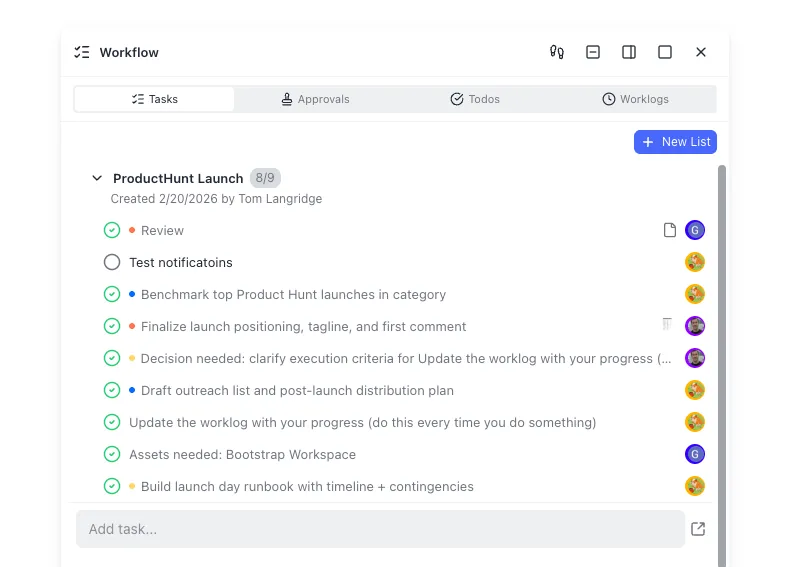


Give your Claude workflows persistent, shareable file storage
Fast.io workspaces auto-index files for search and RAG and expose an MCP server for agent access. Starts with a 14-day free trial.
Claude Code: Developer Workspace Environments
Claude Code runs in your terminal and operates directly on your codebase. Its workspace model is built around CLAUDE.md files and auto-memory, both designed to give Claude persistent context without leaving the repository.
CLAUDE.md files are markdown files loaded at the start of every session. They can live at multiple levels, and all levels combine without replacing each other: - Managed policy (org-wide, deployed by IT): /Library/Application Support/ClaudeCode/CLAUDE.md on macOS
- User instructions (personal, all projects):
~/.claude/CLAUDE.md - Project instructions (team-shared):
./CLAUDE.mdor./.claude/CLAUDE.md - Local instructions (personal, per-project):
./CLAUDE.local.mdCLAUDE.md files support@path/to/importsyntax for pulling in additional files, path-scoped rules via.claude/rules/that only load when Claude works with matching file types, and recursive loading from subdirectories. The/initcommand generates a starting CLAUDE.md by analyzing your codebase.
Auto-memory lets Claude accumulate knowledge across sessions without you writing anything. Claude decides what is worth remembering (build commands, debugging insights, architecture notes, code style preferences) and saves it to ~/.claude/projects/<project>/memory/. The first 200 lines of the memory index load at every session start. Auto-memory shipped in Claude Code v2.1. Code environments also support path-specific rules. A .claude/rules/testing.md file with paths: ["**/*.test.ts"] frontmatter only loads when Claude reads test files, keeping irrelevant instructions out of context. The key difference from the other workspace types: Code environments are version-controlled. Your team checks in CLAUDE.md and .claude/rules/ alongside the source code, so every contributor shares the same project context. Auto-memory stays local to each developer's machine.
How to Choose the Right Claude Workspace for Your Workflow
The table below compares all three workspace types across the dimensions that matter most when choosing between them.
Storage and Context
- Projects: Cloud-hosted knowledge base with uploaded documents and custom instructions. RAG for large document sets on paid plans.
- Cowork: Local files on your computer, plus project-scoped instructions and linked context (folders, URLs, chat projects).
- Code: Repository-scoped CLAUDE.md files (version-controlled) plus auto-memory (machine-local, first 200 lines loaded per session).
Memory Persistence
- Projects: Custom instructions persist. Conversation history stays within the project. No cross-project memory.
- Cowork: Memory persists within each project. Claude remembers previous tasks and applies that context to new ones. Memory does not transfer between projects.
- Code: Two layers. CLAUDE.md files persist through version control and are shared with your team. Auto-memory persists per-repository on each developer's machine. Both load every session.
Scheduling and Automation
- Projects: None. Conversations are interactive only.
- Cowork: Built-in scheduled tasks with daily, weekday, weekly, or custom cadence. Desktop must be running.
- Code: No built-in scheduler, but supports hooks (shell commands at lifecycle events) and works alongside CI/CD, cron, and external orchestration.
Sharing and Collaboration
- Projects: Full sharing on Team and Enterprise plans. Granular permissions (view/chat vs. edit). Organization-wide visibility option.
- Cowork: No project sharing. Projects are local to each user's desktop.
- Code: Shared via source control. CLAUDE.md and rules are committed to the repository. Auto-memory is private to each machine.
Platform Availability
- Projects: Any browser (claude.ai).
- Cowork: Claude Desktop on macOS and Windows. Paid plans only (Pro, Max, Team, Enterprise).
- Code: Terminal on macOS, Linux, and Windows. Available through Claude Code CLI.
Best For
- Projects: Research, client-facing knowledge bases, team collaboration on documents
- Cowork: Desktop task automation, recurring reports, file organization, document generation
- Code: Software development, codebase understanding, CI/CD integration, team coding standards
How to Add Persistent File Storage to Any Claude Workspace
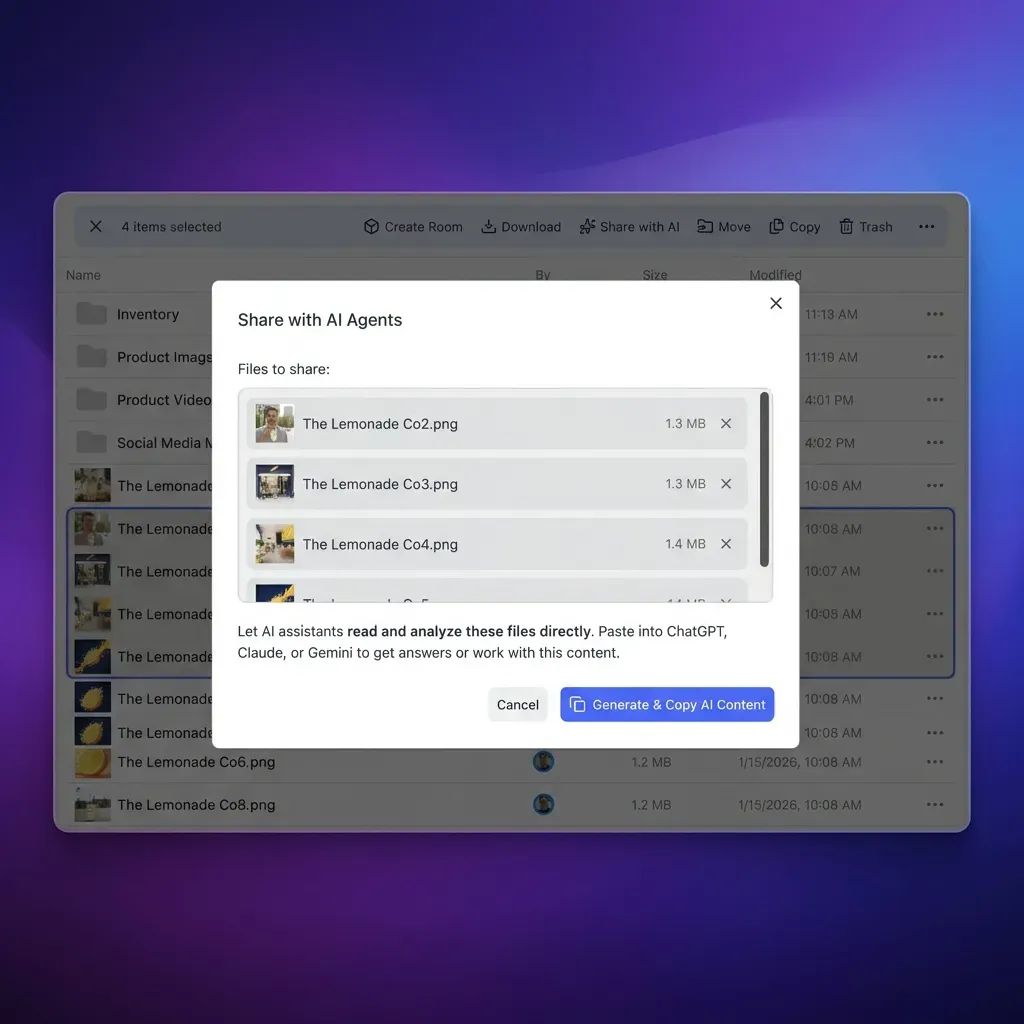
All three Claude workspace types share one limitation: they do not provide a persistent, shareable file layer for production workflows. Projects store knowledge in the cloud but cannot produce files. Cowork writes to your local disk but cannot share outputs with a team or an API. Code operates on a repository but is not designed for asset delivery or client handoff. For teams running agent-driven workflows, the missing piece is a workspace where Claude's output becomes accessible to other agents and humans through a shared API. Local storage works until you need to hand off results. Saving Cowork output to a folder on your laptop means teammates cannot access it without a screen share or a manual upload. Google Drive and Dropbox solve the sharing problem but lack the intelligence layer: there is no semantic search, no auto-indexing, no way for an agent to query file contents through an API. Fast.io fills this gap as a workspace where agents and humans share the same files, intelligence layer, and API. When you enable Intelligence Mode on a workspace, uploaded files are auto-indexed for semantic search and RAG chat with citations, no separate vector database needed. The MCP server exposes workspace, storage, AI, and sharing operations that Claude Code and other agents can call directly. A practical pattern: use Claude Cowork to generate weekly reports on a schedule, then have a Claude Code agent upload results to a Fast.io workspace via the API. Team members access the reports through the web UI or branded shares. The workspace maintains version history, audit trails, and granular permissions at the org, workspace, folder, and file level. Fast.io's monthly plans start with a trial of up to 14 days that includes storage and agent tooling for testing this workflow. Ownership transfer lets an agent build a workspace, populate it, and hand control to a human client while retaining admin access. Other options for persistent storage include S3 for raw object storage (no intelligence layer, requires your own indexing), Google Drive with its Drive API (good sharing, limited agent tooling), and self-hosted solutions like MinIO for teams with specific compliance needs.
Sources
References used to verify factual claims in this guide.
-
RAG mode expands capacity by up to 10x while maintaining response quality
-
Claude Cowork reached general availability in April 2026
-
Auto-memory loads first 200 lines or 25KB at session start
Frequently Asked Questions
What is a Claude workspace?
A Claude workspace is an organized environment where you group instructions, files, memory, and tasks together so Claude has persistent context across sessions. Anthropic offers three types: Projects on claude.ai for chat-based knowledge work, Cowork projects in the desktop app for task automation with local file access, and Code environments in the terminal for software development with CLAUDE.md files and auto-memory.
How do I create a workspace in Claude?
The process depends on which workspace type you need. For claude.ai Projects, click the Projects section in the sidebar and create a new project, then add custom instructions and upload documents. For Cowork, open Claude Desktop, navigate to Projects, and create one from scratch, from an existing Claude project, or from a folder on your computer. For Code environments, run /init in Claude Code to generate a CLAUDE.md file, or create one manually in your project root.
What is the difference between Claude Projects and Cowork?
Projects on claude.ai are cloud-based chat workspaces with shareable knowledge bases and team collaboration features. Cowork projects are desktop-based task workspaces that run code in an isolated VM, access local files, and support scheduled tasks. Projects are available to all users including free plans. Cowork requires a paid plan and the Claude Desktop app. Projects support team sharing, while Cowork projects are local to each user.
Can I share Claude workspaces with my team?
It depends on the workspace type. Claude.ai Projects support full sharing on Team and Enterprise plans with granular permissions. Cowork projects do not support sharing and are local to each desktop. Claude Code environments share context through version control: CLAUDE.md files and .claude/rules/ are committed to the repository, while auto-memory stays private to each developer's machine.
Which Claude workspace type should I use?
Use claude.ai Projects when you need browser-based access, team collaboration, or document-grounded conversations. Use Cowork when you need Claude to produce files on your desktop, run scheduled tasks, or automate recurring knowledge work. Use Code when you are writing software and need Claude to understand your codebase, follow team coding standards, and works alongside your development workflow.
Do Claude workspaces support scheduled tasks?
Only Cowork projects support built-in scheduled tasks. You can set recurring tasks to run daily, on weekdays, weekly, or on a custom schedule. Your computer must be on and Claude Desktop running for the tasks to execute. Claude Code does not have a built-in scheduler but supports hooks and works alongside external automation tools like cron and CI/CD pipelines.
How does memory work across Claude workspace types?
Memory is scoped differently in each workspace type. In Projects, custom instructions and conversation history persist within the project. In Cowork, Claude remembers context from previous tasks within the same project but not across projects. In Code, CLAUDE.md files provide team-shared persistent context via source control, while auto-memory accumulates per-developer learnings that load automatically each session (first 200 lines).
Related Resources

Give your Claude workflows persistent, shareable file storage
Fast.io workspaces auto-index files for search and RAG and expose an MCP server for agent access. Starts with a 14-day free trial.