Claude Teams Plan Guide: Pricing, Cowork, and Administration
Anthropic's Team plan supports 5 to 150 members with SSO, enterprise search across Google Drive, Slack, and Microsoft 365, plus mixed Standard ($20/seat) and Premium ($100/seat) tiers. This guide walks through pricing, admin setup, connector configuration, and seat optimization strategies for teams adopting Claude at work.


Claude Code, Cowork, and What Every Team Seat Includes
Anthropic's share of enterprise AI spending reached 34.4% in May 2026, quadrupling year-over-year according to the Ramp AI Index. Much of that growth came from teams adopting Claude's mid-tier plan, which slots between individual Pro subscriptions and full Enterprise contracts.
The Claude Team plan is built for groups of 5 to 150 people who need shared access to Claude's models, centralized billing, and security controls without the overhead of a full Enterprise deployment. Every seat gets access to all available Claude models, a 200k token context window, and priority access during peak periods.
The full feature set ships with both seat types. Claude Code handles terminal-based coding and automation. Claude Cowork enables collaborative AI sessions where team members work together with Claude in shared contexts, building on each other's projects and artifacts. Claude Design covers visual work. Beyond the core products, teams get connectors for Google Drive, Gmail, Google Calendar, GitHub, Microsoft 365, and Slack, plus enterprise search that pulls answers from across those connected tools.
Admin features separate the Team plan from individual subscriptions: SSO with SAML support, domain verification and capture, centralized billing with organizational spending caps, and the option to prevent model training on your content by default. These controls matter once you move beyond a handful of people paying individually, because they give IT visibility into who uses what and how much it costs. Account creators must use a business email address. Public domains like @gmail.com and @yahoo.com are not allowed for the primary admin, though you can permit them for other team members later.
Related guides
- Manus AI Pricing and Credit Consumption GuideManus AI pricing operates on a credit-based billing system across Free, Pro, and Team tiers, complemented by a...
- Claude Code Teams: Multi-Agent Orchestration GuideClaude Code agent teams split complex coding tasks across multiple independent AI sessions. Each teammate gets its own...
- How to Use Claude Code Plan Mode for Safer Autonomous CodingAI-generated pull requests contain 75% more logic errors than human-written code, and those mistakes compound across...
- How Teams Use Claude at Work: A Guide to Chat, Code, and CoworkAnthropic's Claude now spans four distinct product surfaces for work: Chat for brainstorming, Code for development,...
- How to Set Up Claude Cowork on Windows: Installation and ConfigurationThree GitHub issues filed against Claude Cowork in early 2026 report the same failure: Cowork refuses to start on...
- How to Use Claude Cowork File LocksFile locks in Claude Cowork help prevent conflicts by showing who holds the lock on a document, so other agents and...
More on this subject: Claude and Claude Code (278 guides)
Standard vs Premium Seats: Pricing and Usage Limits
The Team plan sits between Pro ($20/month for individuals) and Enterprise (custom pricing, typically starting around $60/user/month). Understanding where each tier fits helps you avoid overpaying or outgrowing your plan within months.
Standard seats cost $20 per month on annual billing ($25 monthly). They work for team members who use Claude regularly but don't push heavy workloads. Think project managers reviewing documents, marketers drafting content, or analysts running occasional research sessions. Standard gives about 1.25x the usage of an individual Pro subscription, with weekly limits that reset per member rather than pooling across the team.
Premium seats run $100 per month on annual billing ($125 monthly). They're built for power users: engineers running Claude Code for hours each day, researchers doing deep analysis across long documents, and content teams producing high volumes of output. Premium provides about 6.25x the usage of Pro, roughly five times what a Standard seat offers. For heavy Claude Code users, Premium often means the difference between a productive afternoon and waiting for a weekly limit to reset.
Enterprise adds the governance layer that regulated industries require: SCIM provisioning, audit logs, compliance APIs, custom data retention, role-based access controls, HIPAA-ready offerings, and dedicated SLAs. Enterprise pricing works differently. The seat fee covers access only, and all usage is billed separately at API rates.
Quick comparison:
- Pro: $20/month, individual only, no admin controls
- Team Standard: $20/month (annual), 5-150 seats, SSO, enterprise search, 1.25x Pro usage
- Team Premium: $100/month (annual), 5-150 seats, same features, 5x Standard usage
- Enterprise: Custom pricing, 50+ users, SCIM, audit logs, compliance, SLAs
If your team is under 50 people and doesn't need audit logs or compliance APIs, the Team plan covers what you'll actually use. If you're in a regulated industry or need SCIM directory sync, start the Enterprise conversation early.
SSO, Domain Capture, and User Provisioning
SSO setup on the Team plan takes about 30 minutes if you have your identity provider credentials ready. Claude supports SAML 2.0 through six providers: Okta, Microsoft Entra ID, Google Workspace, OneLogin, JumpCloud, and Duo.
Domain verification comes first. Navigate to Organization settings, add your company domain, and create the TXT DNS record that Claude generates. Local propagation usually takes about 10 minutes, though global propagation can take 24 to 48 hours. You need an Owner or Primary Owner role to complete this step.
Connecting your identity provider follows the WorkOS integration flow. Each provider has a dedicated setup guide in the Claude Help Center with provider-specific configuration steps. The general pattern: create an application in your IdP, configure the SAML endpoints Claude provides, map user attributes, and test the connection before rolling out to the full team.
Domain Capture claims your verified domain so new signups from your company email automatically join your workspace instead of creating separate personal accounts. This prevents shadow usage where employees sign up individually and fragment your organization's Claude activity across disconnected accounts. Once enabled, anyone with a matching email domain gets routed to your team workspace on signup.
Provisioning options control how new members get added:
- Invite Only (default): Admins manually send invitations. The most controlled approach, and the right choice if you need to approve each person before they get access.
- Just-in-Time (JIT): Anyone who authenticates through SSO with your domain gets automatically added with a User role. Faster onboarding, but you give up control over who joins.
- SCIM: Full directory sync from your identity provider with automatic role assignment and deprovisioning. Available on Enterprise plans only.
The enforcement toggle lets you require SSO for all logins or leave it optional. Requiring SSO ensures every login goes through your identity provider's security policies, MFA requirements, and conditional access rules. Most teams should enable enforcement once SSO is confirmed working, since it closes the gap where someone could bypass your IdP by logging in with just their email.


Give your Claude team persistent file workspaces
Persistent storage with MCP access for Claude Code, built-in RAG, and branded shares for client delivery. Start with a 14-day Business Trial.
Enterprise Search and the Ask Your Org Project
Enterprise search gives your team a single place to query across every connected tool without leaving Claude. When an admin enables it, Claude creates a dedicated "Ask Your Org" project with system prompts maintained by Anthropic for organizational knowledge retrieval.
Admin setup takes five steps:
- Open the "Ask Your Org" option in the sidebar
- Select "Set up for your org"
- Choose which connectors to enable (Documents and Chat are recommended, Email is optional)
- Add any additional tools from your organization's connector directory
- Customize the project name (formatted as "Ask [Your Company Name]") and add a description
Once configured, the project appears as a starred item for every team member. Each person authenticates with their own credentials for the connected services, which means search results are permission-aware. A team member only sees content they already have access to in the original system.
Supported connectors include Google Drive, Gmail, Google Calendar, GitHub, Microsoft 365 (including SharePoint), and Slack. When someone asks a question in the Ask Your Org project, Claude searches across all connected sources and builds a response with source citations. This works particularly well for questions that span multiple tools. Something like "What was the decision on the Q3 pricing change?" might pull from a Slack thread, a Google Doc, and an email chain to assemble a complete answer.
Connector management is layered. Owners enable each connector at the organization level first. Individual members then authenticate with their own accounts for each service they want to search. You can also restrict which connectors are available if certain integrations shouldn't be used organization-wide.
Search activity counts toward each member's standard usage limits. If someone is running enterprise search queries dozens of times a day alongside regular Claude usage, that's a good signal they might benefit from a Premium seat.
Building a Cost-Effective Seat Mix
The ability to mix Standard and Premium seats within a single Team plan is one of the less obvious advantages over plans that force a single tier for everyone. Match seat type to actual usage rather than job title.
Premium seat candidates are people who would otherwise wait for weekly usage resets:
- Engineers running Claude Code throughout the day for pair programming and code generation
- Researchers conducting multi-hour deep analysis sessions across long documents
- Content teams producing large volumes of output with extended iterative refinement
Standard seat candidates use Claude regularly but in shorter bursts:
- Project managers reviewing summaries and asking follow-up questions
- Executives using the Ask Your Org project for quick company knowledge lookups
- Team members who interact with Claude a few times per day rather than continuously
A practical example: A 10-person team might start with 7 Standard and 3 Premium seats. The three engineers who pair-program with Claude Code all day get Premium. Everyone else starts on Standard. That mix costs $340 per month on annual billing ($140 for Standard plus $200 for Premium) compared to $1,000 per month if everyone had Premium seats.
Reassignment is straightforward. If someone's usage pattern changes, you can upgrade or downgrade their seat type in Organization settings without purchasing a new seat. This flexibility matters during project sprints when someone temporarily needs higher limits, or when a new hire turns out to be a heavier user than expected.
Spending caps add another layer of cost control. Admins can set organizational and individual spending limits so Premium seats don't generate surprise bills. Usage beyond included limits is available through additional credits, but the caps keep monthly costs predictable.
Track usage for the first month before committing to a final seat mix. If your entire team consistently hits Standard limits, moving everyone to Premium is often cheaper than buying additional usage credits on top of Standard seats.
Persisting and Sharing What Your Team Creates
Claude conversations produce outputs that need to live somewhere: code files, research summaries, design specs, analysis reports. The Team plan keeps those within Claude's interface, but most workflows eventually need the output in a shared location where non-Claude-users can access it too.
Local storage works for individual developers pulling code directly into their repos. Google Drive or SharePoint handles document sharing for teams already embedded in those ecosystems. S3 covers programmatic storage for engineering teams building pipelines. Each option works, but none is specifically designed for the pattern where AI-generated output moves between agents, team members, and external stakeholders with version control and access management.
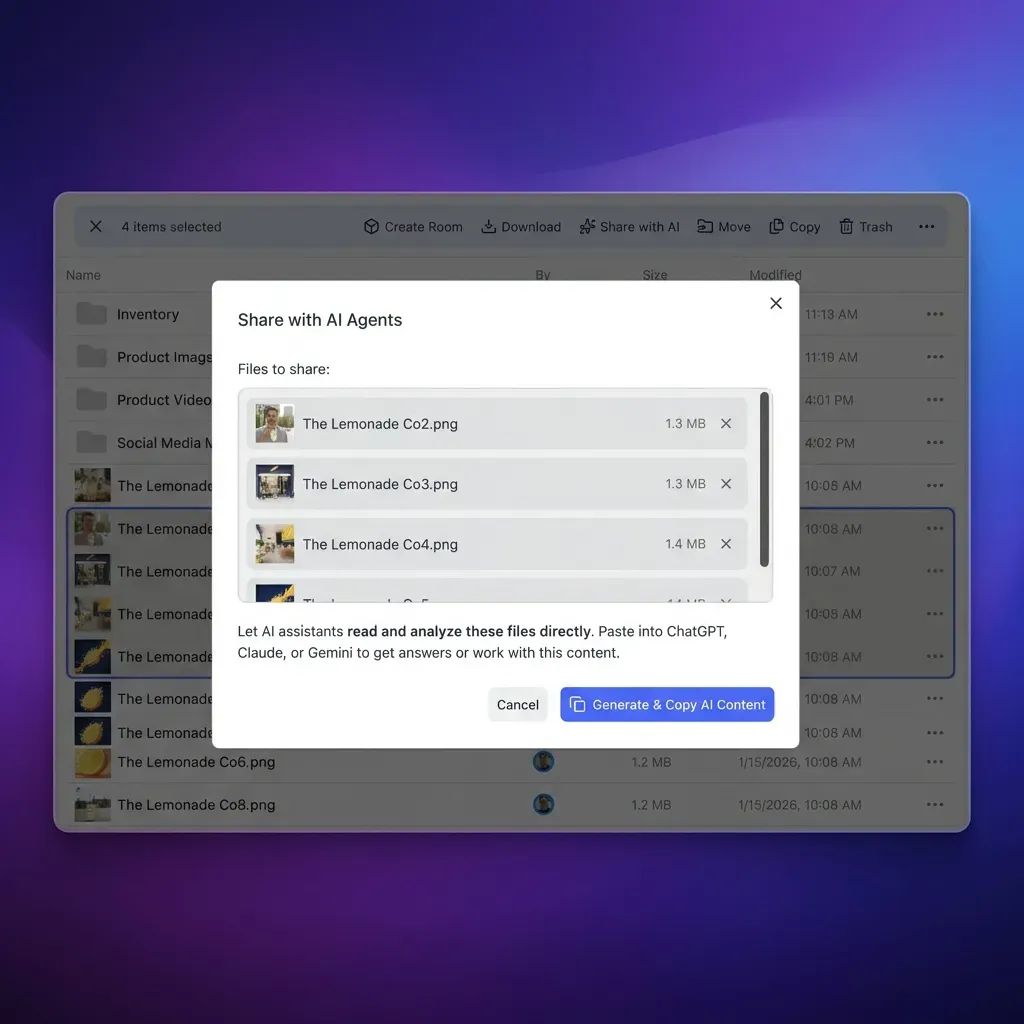
Fast.io provides workspaces built for agentic teams. An engineer's Claude Code session can write output directly to a Fast.io workspace through the MCP server, where files are automatically indexed for semantic search via Intelligence Mode. Another team member can then ask questions about that output through AI chat without downloading anything. The workspace becomes a shared layer between what Claude produces and what the team uses.
For teams that deliver Claude-generated work to clients, Fast.io's branded shares handle the last mile. An agent builds a deliverable, uploads it to a workspace, and the team reviews it before sharing through a branded portal with Send, Receive, or Exchange workflows. The ownership transfer model lets an agent create the workspace structure and hand control to a human when the work is ready.
Fast.io offers Starter, Business, and Enterprise plans starting at $9.99/mo with a 14-day Business Trial requiring a credit card (see pricing). For a Claude Team evaluating where to store and share AI output, that provides ample capacity to test the full workflow before committing budget.
Sources
References used to verify factual claims in this guide.
-
Anthropic's share of enterprise AI spending reached 34.4% in May 2026, quadrupling year-over-year
-
Claude Team plan Standard seats at $20/month annual, Premium at $100/month annual, for 5-150 members with SSO, enterprise search, and admin controls
-
SSO supports Okta, Entra ID, Google Workspace, OneLogin, JumpCloud, and Duo via SAML 2.0
-
Enterprise search creates a permission-aware Ask Your Org project with connectors for Google Drive, Gmail, GitHub, Microsoft 365, and Slack
Frequently Asked Questions
How much does Claude Teams cost?
Standard seats are $20 per month on annual billing ($25 monthly). Premium seats are $100 per month on annual billing ($125 monthly). Premium provides about five times the usage capacity of Standard. Both seat types include the same features, and you can mix them within a single plan. The minimum is 5 seats.
What is included in the Claude Team plan?
Every seat includes access to all Claude models, a 200k context window, Claude Code, Claude Cowork, Claude Design, priority access during peak usage, and connectors for Google Drive, Gmail, Google Calendar, GitHub, Microsoft 365, and Slack. Admin features include SSO with SAML support, domain capture, centralized billing, enterprise search, organizational spending caps, and default opt-out from model training on your content.
How many people can use Claude Teams?
The Team plan supports 5 to 150 members. You need a minimum of 5 seats to create a team. Organizations larger than 150 should contact Anthropic about the Enterprise plan, which adds SCIM provisioning, audit logs, compliance controls, and custom contractual terms.
Does Claude Teams include SSO?
Yes. The Team plan supports SAML 2.0 SSO through Okta, Microsoft Entra ID, Google Workspace, OneLogin, JumpCloud, and Duo. Admins can require SSO for all logins or leave it optional alongside email login. Domain Capture is also available, which automatically routes new signups from your verified company domain into your team workspace.
Can I mix Standard and Premium seats on the same Team plan?
Yes. You can assign any combination of Standard and Premium seats within your plan. Seat types can be changed in Organization settings without purchasing new seats. Most teams assign Premium to heavy Claude Code users and keep everyone else on Standard, then adjust based on the first month of usage data.
What is the difference between Claude Team and Enterprise?
Team covers groups of 5 to 150 with SSO, enterprise search, and admin controls on a per-seat monthly subscription. Enterprise adds SCIM directory sync, audit logs, compliance APIs, custom data retention, role-based access controls, HIPAA-ready options, dedicated SLAs, and custom contractual terms. Enterprise pricing is custom, and the billing model separates the seat fee (access) from usage (billed at API rates).
How do I set up enterprise search on the Team plan?
An Owner or Primary Owner opens the Ask Your Org option in the sidebar, selects Set up for your org, chooses connectors for Documents and Chat (Email is optional), customizes the project name, and completes setup. Every team member then sees the project as a starred item and authenticates with their own credentials for each connected service. Search results respect each member's existing permissions in the original systems.
Related Resources

Give your Claude team persistent file workspaces
Persistent storage with MCP access for Claude Code, built-in RAG, and branded shares for client delivery. Start with a 14-day Business Trial.