How to Use Claude Deep Research for Cited, Multi-Source Reports
Anthropic ships two distinct research tools under the Claude brand, and most guides only cover one. Claude.ai Research runs agentic multi-search sessions from the chat interface, pulling from public web and connected Google Workspace data. Claude Code's /deep-research command takes a different approach: it spawns parallel subagents that independently search, cross-check claims against each other, and synthesize a cited report with unverified claims filtered out.


Two Research Tools, One Name, Different Mechanics
A June 2026 Reddit thread in r/ClaudeCode put it bluntly: "deep research in Claude Code is not the same as in the desktop/web app." The post drew hundreds of upvotes because most users assumed both features worked the same way. They do not, and picking the wrong one wastes time on the wrong kind of output.
Claude.ai Research is a chat-layer feature available on Max, Team, and Enterprise plans. When you toggle it on, Claude conducts multiple searches that build on each other, pulling from the public web and any connected Google Workspace accounts (Gmail, Google Calendar, Google Docs). The output is a conversational answer with inline citations. It runs in the same interface where you already talk to Claude, so there is no setup beyond flipping the toggle.
Claude Code's /deep-research is a bundled workflow, not a chat feature. When you type /deep-research <question>, Claude Code writes a JavaScript orchestration script, spawns parallel subagents that each search independently, cross-checks their findings against each other, and votes on each claim. Claims that do not survive the cross-check get filtered out of the final report. The output is a structured, cited document that lands in your terminal session.
The distinction matters because each tool optimizes for a different failure mode. Claude.ai Research optimizes for breadth and speed across your personal data. Claude Code's /deep-research optimizes for accuracy through adversarial verification. Choosing between them depends on whether you need quick answers backed by your own documents or a thoroughly vetted report you plan to share with a team.
Related guides
- Top OpenClaw Skills for Consultants: Automate Research & ReportsConsultants spend too much time on manual research. OpenClaw skills handle the repetitive tasks so you can focus on...
- Hermes 3: Complete Guide to Nous Research's Open-Source LLMHermes 3 is a family of open-source large language models from Nous Research, fine-tuned on Meta's Llama 3.1 in 8B,...
- How to Setup Claude Coworking Workspaces for Research TeamsResearch teams often struggle with fragmented literature and disorganized data silos. Claude Coworking acts as a...
- Claude Cloud Storage: Connecting Multi-Cloud Repositories via MCPClaude cloud storage connects cloud file systems with Anthropic Claude models using Model Context Protocol (MCP)...
- Claude Multi-Agent Coworking: Architecture and PatternsClaude multi-agent coworking is an architectural pattern where several specialized Claude agents share a single...
- 7 Essential Claude MCP Plugins to Expand Your AI's CapabilitiesClaude MCP plugins (or servers) act as extensions that allow your AI to interface with real-world data and tools. By...
More on this subject: Claude and Claude Code (278 guides)
How Claude.ai Research Works Step by Step
Claude.ai Research is available on the web interface, the desktop app, and the mobile app. Here is the setup and usage flow:
- Open claude.ai or the Claude desktop app
- Click the "+" button at the lower left of the chat interface
- Select "Research" from the menu
- A blue indicator appears at the bottom of the window confirming Research is active
- Type your question and send it
Claude then operates agenically. It decides what to search first, reviews the results, identifies gaps or follow-up angles, and runs additional searches that build on what it already found. You do not need to prompt it to keep searching. The system explores different facets of your question automatically and works through open questions methodically.
The output arrives as a thorough answer with inline citations you can click to verify. Research sessions count against your standard rate limits and may consume quota faster than typical conversations because Claude retrieves and processes multiple sources per query.
Connected data sources make this powerful for personal and team research. When you connect Google Workspace, Claude can search your Gmail inbox, Google Calendar events, and Google Docs alongside the public web. A product manager preparing for a quarterly review can ask Claude to research competitive positioning and have it cross-reference public market data with internal strategy documents and meeting notes from the past quarter, all in one query.
Availability: Research is currently available on Max, Team, and Enterprise plans. It requires web search to be enabled in your account settings. If Claude does not activate Research automatically on a query that warrants it, you can prompt it explicitly with "Claude, please use the research tool."

How Claude Code /deep-research Works
The /deep-research command in Claude Code takes a fundamentally different approach. Instead of one agent running sequential searches, it orchestrates multiple independent agents working in parallel.
Here is how a typical run unfolds:
- Open Claude Code in your terminal, VS Code, or the desktop app
- Type
/deep-researchfollowed by your question - Claude Code asks you to approve the workflow
- The system writes an orchestration script and spawns parallel subagents
- Each subagent searches the web from a different angle independently
- Agents cross-check their findings against each other
- The system votes on each claim, keeping only those that survive verification
- A cited report with filtered claims lands in your session
The key difference from Claude.ai Research is the adversarial verification step. Because each subagent searches independently, they surface different sources. When multiple independent agents find the same claim from different sources, that claim gets high confidence. When only one agent finds a claim and others contradict it, the claim gets flagged or filtered out entirely.
You can monitor the run in real time by typing /workflows and selecting the active run. The progress view shows each phase with agent counts, token usage, and elapsed time. You can drill into any phase to see what individual agents found, pause the run, or stop specific agents.
/deep-research requires the WebSearch tool to be available and works on all paid plans (Pro, Max, Team, Enterprise). On Pro plans, you may need to enable Dynamic Workflows in /config first. The workflow runs in the background, so your terminal session stays responsive while agents work.
/deep-research What changed in the Node.js permission model between v20 and v22?
The run takes several minutes depending on the complexity of your question. For best results, frame specific, bounded questions rather than vague prompts. "What are the tradeoffs between SQLite WAL mode and rollback journal for write-heavy workloads under 100 concurrent connections?" will produce better output than "Tell me about SQLite."
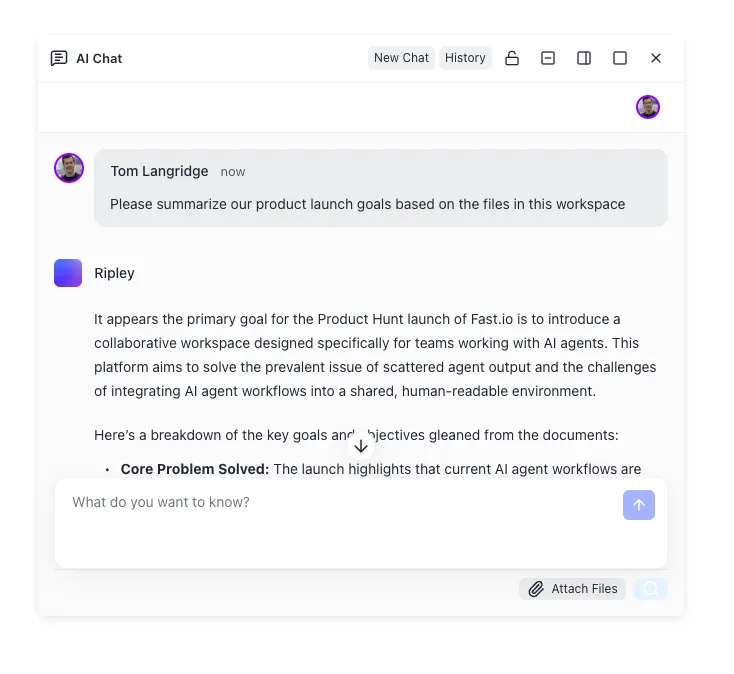


Keep your research findings where your whole team can find them
Upload Claude research reports to a Fast.io workspace and they are auto-indexed for semantic search and RAG chat, with an MCP endpoint ready for your agents. Starts with a 14-day free trial.
When to Use Which: A Decision Framework
Picking the right tool saves you from re-running research that came back in the wrong format or at the wrong depth. Here is a practical framework:
Use Claude.ai Research when:
- You need answers that pull from your personal data (Gmail, Google Docs, Google Calendar)
- The question is exploratory and you want to iterate conversationally
- Speed matters more than adversarial verification
- You are on mobile or want to start research from the web interface
- The output is for your own decision-making, not a shared deliverable
Use Claude Code /deep-research when:
- Accuracy is critical and the output will be shared or published
- You want claims cross-checked across multiple independent sources
- The question is complex enough to benefit from parallel investigation
- You need a structured report rather than a conversational answer
- You are already working in Claude Code and want research inline with your development workflow
Use neither when:
- The question has a simple, factual answer (just ask Claude directly)
- You need real-time data like stock prices or live scores
- The topic requires access to paywalled or authenticated sources neither tool can reach
One pattern that works well for teams: use Claude.ai Research for initial exploration and hypothesis formation, then run /deep-research on the specific claims you plan to act on. The first pass identifies what matters. The second pass verifies it holds up under scrutiny.
Persisting Research Output in a Shared Workspace
Both research tools produce valuable output that disappears when the session ends. Claude.ai Research lives in your chat history. Claude Code /deep-research reports live in your terminal session. Neither format works well for team collaboration or long-term reference.
This is where a persistent workspace becomes useful. Research reports, source documents, and verified claims need a home where teammates (human or AI) can find them later.
Local file storage works for solo developers but breaks down when multiple people or agents need access to the same research. Cloud drives like Google Drive or Dropbox can store the files but do not index them for semantic search, so finding specific claims across dozens of research reports means manual searching.
Fast.io workspaces solve this by combining persistent storage with built-in intelligence. Upload a research report to a workspace and Intelligence Mode auto-indexes it for semantic search and RAG-powered chat. Your team can ask questions about the research in natural language and get answers with citations pointing back to the original report.
For teams running regular research workflows, the Fast.io MCP server lets Claude Code agents write research output directly to a shared workspace. An agent finishes a /deep-research run, uploads the report via MCP, and the workspace indexes it automatically. The next person who needs that research finds it through semantic search or chat rather than digging through Slack threads or shared drives.
Monthly plans start with a trial of up to 14 days, with workspaces, monthly credits, and storage scaled to each plan, so you can test this workflow before committing.
Practical Tips for Better Research Results
After running hundreds of research queries across both tools, a few patterns consistently produce better output.
Frame questions with constraints. "What are the security implications of WebAssembly in server-side runtimes, focusing on sandbox escape vectors documented in CVEs since 2024?" outperforms "Is WebAssembly secure?" The constraints give agents clear boundaries for their searches and reduce the chance of getting generic overview content.
Specify the output format you need. If you want a comparison table, say so. If you want a chronological timeline, say so. Both tools respond well to explicit format requests, and you waste fewer cycles reformatting the output afterward.
Check the citations. Both tools produce citations, but not all citations are equally strong. Blog posts citing other blog posts are weaker than primary sources like official documentation, peer-reviewed papers, or vendor announcements. Skim the cited URLs before treating the research as verified.
Layer your research. Run a broad query first to identify the key subtopics, then run focused queries on each subtopic. This produces deeper coverage than a single comprehensive query because each focused run can dedicate its full context window to one area.
Watch for recency gaps. Both tools search the public web, which means recent developments (last few days) may not be indexed yet. For time-sensitive research, supplement with direct checks of official sources and announcement channels.
For Claude Code, monitor token usage. The /workflows view shows token consumption per agent in real time. If a run is consuming more tokens than expected, you can pause or stop it without losing completed work. Start with a narrow question to gauge the cost before running a broad research sweep.
Sources
References used to verify factual claims in this guide.
-
Claude.ai Research is available on Max, Team, and Enterprise plans and requires web search to be enabled Claude.ai Research conducts multiple searches that build on each other while determining what to investigate next
-
Claude.ai Research integrates with Google Workspace including Gmail, Google Calendar, and Google Docs
-
/deep-research fans out web searches, cross-checks sources, votes on claims, and returns a cited report with filtered claims /deep-research is a bundled workflow available on all paid plans with up to 16 concurrent agents
-
Claude Code /deep-research requires the WebSearch tool to be available
Frequently Asked Questions
How do I use Claude deep research?
There are two ways. On claude.ai (web, desktop, or mobile), click the '+' button and select 'Research' to enable multi-search mode for your next query. In Claude Code, type '/deep-research' followed by your question to launch a multi-agent workflow that cross-checks sources and produces a cited report.
What is the /deep-research command in Claude Code?
It is a bundled workflow that fans out web searches across several angles using parallel subagents. Each agent searches independently, then the system cross-checks findings and votes on claims. The output is a synthesized report with citations, where claims that did not survive cross-checking are filtered out. It requires the WebSearch tool and runs in the background while your session stays responsive.
How does Claude research compare to ChatGPT deep research?
Claude.ai Research and ChatGPT's deep research both conduct multi-step web searches and produce cited answers. Claude's key differentiator is Google Workspace integration, which lets it search your Gmail, Google Docs, and Calendar alongside the public web. Claude Code's /deep-research adds adversarial verification through parallel independent agents that cross-check each other's findings. ChatGPT's deep research runs as a single sequential process.
Is Claude deep research available on the free plan?
Claude.ai Research is not available on the free plan. It requires a Max, Team, or Enterprise subscription. Claude Code's /deep-research workflow is available on all paid Claude Code plans, including Pro. On Pro, you may need to enable Dynamic Workflows in the /config menu first.
Can Claude deep research access my Google Drive and Gmail?
Claude.ai Research can access Gmail, Google Calendar, and Google Docs when you connect your Google Workspace account. Claude Code's /deep-research searches the public web only and does not access personal data sources.
How long does a Claude deep research query take?
Claude.ai Research typically returns results within a few minutes depending on query complexity. Claude Code's /deep-research takes longer because it runs multiple parallel agents and cross-checks their findings. Expect 3 to 10 minutes for most queries. You can monitor progress in real time with the /workflows command.
Related Resources

Keep your research findings where your whole team can find them
Upload Claude research reports to a Fast.io workspace and they are auto-indexed for semantic search and RAG chat, with an MCP endpoint ready for your agents. Starts with a 14-day free trial.