How to Build a Biotech Data Room for Due Diligence
A biotech data room is a secure virtual workspace where life sciences companies share proprietary research, clinical trial data, patent portfolios, and regulatory filings with potential investors, acquirers, or licensing partners. This guide covers what to include, how to organize it by clinical stage, and how to manage access throughout the deal process.


Why Biotech Companies Need Specialized Data Rooms
Biotech due diligence is different from a typical startup fundraise. Investors are not just reviewing financials and contracts. They need to evaluate clinical trial protocols, regulatory submissions, patent claims, manufacturing processes, and scientific advisory relationships. A standard data room template built for SaaS startups won't cut it.
Biopharma M&A activity reached roughly $240 billion in signed deals during 2025, a sharp recovery from 2024's quieter market. Licensing deals, Series B rounds, and pharma partnerships all require a data room. The average biotech licensing or acquisition process involves sharing between 500 and 2,000 proprietary documents, many of which contain trade secrets and patient-level data that demand careful access controls.
The companies that close deals faster tend to share one trait: their data rooms are already built before the process starts. A well-organized virtual data room is one of the clearest signals of maturity in a biotech company, because it shows you understand your own story, risks, and obligations. VCs, pharma business development teams, and regulatory partners all notice the difference between a clean, navigable room and a folder dump of 200 unlabeled PDFs.
What makes biotech data rooms unique comes down to three things:
- Regulatory depth: FDA correspondence, IND applications, clinical hold letters, and post-market commitments create document categories that don't exist in other industries
- Stage-dependent structure: A preclinical company's room looks nothing like a Phase III company's room, and both look different from a commercial-stage company's room
- Sensitivity layers: Patient data, trade secrets, and pre-submission regulatory strategies each require different access tiers within the same room
Helpful references: Fastio Workspaces, Fastio Collaboration, and Fastio AI.
Related guides
- Best Virtual Data Room Providers for Every Deal TypeChoosing a virtual data room provider depends on what kind of deal you are running. This guide breaks down the top VDR...
- Best iDeals Virtual Data Room Alternatives for 2026iDeals is one of the most popular virtual data rooms for M&A and due diligence, but it is not the only option. This...
- Best Data Room Software for Secure Document SharingData room software provides secure, permission-controlled workspaces for sharing confidential documents during M&A,...
- What Is a Data Room? A Plain-English Guide for 2026A data room is a secure space where confidential documents are stored and shared with authorized parties during...
- How to Build an Agentic Virtual Data Room for Due DiligenceAgentic virtual data rooms use AI agents for automated due diligence, handling document review and secure sharing. Skip...
- How to Use a Data Room Q&A Feature for Due DiligenceA data room Q&A feature is a structured communication module inside a virtual data room that lets deal participants ask...
More on this subject: Data Rooms and Due Diligence (53 guides)
What to check before scaling biotech data room
The backbone of any biotech data room is its folder structure. Investors and partners expect to find documents organized into predictable categories. Skipping a category or burying important files in the wrong folder slows down diligence and raises questions about operational discipline.
Corporate Overview
Start with the basics. Certificate of incorporation, bylaws, board minutes, cap table, stockholder agreements, and organizational chart. Include bios for the management team and scientific advisory board. Investors want to know who is making decisions and whether the team has the experience to navigate FDA processes.
Intellectual Property
Patent filings are often the most scrutinized section. Include granted patents, pending applications, provisional filings, and freedom-to-operate analyses. Add any IP assignment agreements from founders, employees, or collaborating institutions. If you have licensed IP from a university, the license agreement and any milestone obligations belong here.
Preclinical Data
For companies with active preclinical programs, include study reports for pharmacology, toxicology, and pharmacokinetic studies. Add assay validation data, animal model selection rationale, and any GLP-compliant study reports. Investors want to see the bridge between your target hypothesis and clinical readiness.
Clinical Program
This is where biotech data rooms diverge most from generic templates. Organize by trial phase and indication:
- Phase I: Protocol, IRB/ethics committee approvals, informed consent forms, dose escalation data, safety reports, DSMB meeting minutes
- Phase II: Efficacy endpoints, interim analyses, patient demographics, adverse event summaries, biomarker data
- Phase III: Pivotal trial design, statistical analysis plans, enrollment data, primary and secondary endpoint results, regulatory interaction records
Include Clinical Study Reports (CSRs) for completed trials. Version-control every protocol amendment so reviewers can trace how the trial design evolved.
CMC and Manufacturing
Chemistry, Manufacturing, and Controls documentation is a frequent blind spot in biotech data rooms, and a frequent focus area for acquirers. Include drug substance and drug product specifications, batch records for GMP manufacturing runs, stability data, supply chain agreements, and CDMO contracts. If you are using a contract manufacturer, include quality agreements and audit reports.
Regulatory
FDA correspondence is critical. Include IND applications, FDA meeting minutes (Type A, B, and C meetings), clinical hold correspondence if applicable, and any Breakthrough Therapy, Fast Track, or Orphan Drug designations. For international programs, add EMA scientific advice letters, PMDA consultation records, and any national regulatory submissions.
Financial Information
Financial statements, tax records, current burn rate, runway projections, and revenue forecasts for commercial-stage products. Include grant funding details (NIH, BARDA, DARPA) and any milestone-based payments tied to clinical or regulatory achievements.
Legal and Compliance
Material contracts, collaboration agreements, licensing deals, employment agreements for key personnel, and any pending or threatened litigation. Add strict security requirements documentation if you handle patient data directly.
Organizing Documents by Clinical Stage
A Phase I startup and a Phase III company approaching an NDA filing need fundamentally different data room structures. The document checklist below adapts based on where your lead program stands.
Discovery and Preclinical Stage
At this stage, the data room is lean. Focus on:
- Target validation data and mechanism of action evidence
- Lead compound characterization (selectivity, potency, ADME properties)
- Animal model efficacy and toxicology studies
- Patent applications covering composition of matter and methods of use
- Scientific advisory board roster and consulting agreements
- Grant funding documentation
Investors at this stage care most about the science and the IP position. Keep the room tight and let the data speak.
Phase I and Phase II (Clinical Proof of Concept)
The data room expands once you enter the clinic. Add:
- IND application and FDA acknowledgment letters
- Clinical protocols with all amendments, version-controlled
- IRB/ethics committee approvals for each clinical site
- Safety data, including SAE reports and DSMB recommendations
- Preliminary efficacy signals and biomarker correlations
- CMC documentation, including analytical methods and release specifications
- CDMO agreements and quality audit reports
- Competitive landscape analysis with clinical differentiation
At this stage, pharma partners and crossover investors want to understand your regulatory strategy and manufacturing readiness alongside the clinical signal.
Phase III and Registration
Late-stage data rooms are the most complex. Everything from earlier stages carries forward, plus:
- Pivotal trial protocols, statistical analysis plans, and randomization procedures
- Complete Clinical Study Reports for all completed trials
- Regulatory meeting minutes and FDA guidance letters
- Pre-NDA/BLA meeting packages
- Commercial manufacturing scale-up data and validation batches
- Launch readiness documentation (market access, pricing strategy, distribution agreements)
- Post-marketing commitments and REMS plans if applicable
Acquirers evaluating a Phase III asset will spend weeks in your data room. The more complete and navigable it is, the fewer follow-up requests you will field.


Build Your Biotech Data Room Today
Organize clinical data, regulatory filings, and IP documentation in secure workspaces with granular permissions, audit trails, and built-in document intelligence. Start 14-day trial.
Access Controls and Security for Life Sciences Data
Biotech data rooms contain some of the most sensitive commercial information in any industry. Trade secrets, unpublished clinical results, and pre-submission regulatory strategies all live alongside patient-level data that carries its own legal obligations.
Tiered Access by Diligence Stage
Not every reviewer needs access to everything. Structure permissions in tiers:
- Tier 1 (Initial screening): Corporate overview, IP summary, pipeline overview, published clinical results. This is what you share during early conversations before a term sheet or LOI.
- Tier 2 (Active diligence): Full clinical data packages, CMC documentation, regulatory correspondence, detailed financial models. Grant access after signing a confidentiality agreement and demonstrating serious intent.
- Tier 3 (Deep diligence): Raw data files, patient-level datasets (de-identified), manufacturing batch records, pending patent applications, and trade secret documentation. Reserve this for final-stage buyers or partners under executed NDAs.
This staged approach protects your most sensitive information while still giving early-stage reviewers enough to make informed decisions about pursuing a deal.
Audit Trails and Activity Monitoring
Knowing who accessed what and when is not optional in biotech. If a deal falls through and your unpublished Phase II data leaks to a competitor, you need a clear record of who had access. Look for platforms that provide granular audit logs covering document views, downloads, print attempts, and session duration.
Fastio tracks every file operation, membership change, and AI interaction in a detailed activity log. When you share clinical data through a branded portal, you can see exactly which documents each reviewer accessed and for how long, which is useful both for security and for gauging investor interest based on engagement patterns.
Watermarking and Download Controls
For highly sensitive documents like unpublished clinical results or trade secret manufacturing processes, consider restricting downloads entirely and using view-only access with dynamic watermarks. This adds friction for legitimate reviewers, so use it selectively on your most sensitive materials rather than blanket-applying it to the entire room.
Platforms like Intralinks and Datasite offer forensic watermarking. Fastio supports download controls and branded shares with guest access, letting you share specific document sets with external parties without granting full workspace access.

Setting Up a Biotech Data Room on Fastio
Several platforms serve the biotech data room market. Dedicated VDR providers like Intralinks, Datasite, and Firmex have deep feature sets built for M&A processes. ShareVault focuses specifically on life sciences. For earlier-stage companies or licensing deals where cost matters, general-purpose workspace platforms can work well.
Fastio fits biotech teams that need secure document sharing with built-in intelligence, without paying enterprise VDR pricing before they have revenue.
Workspace Structure
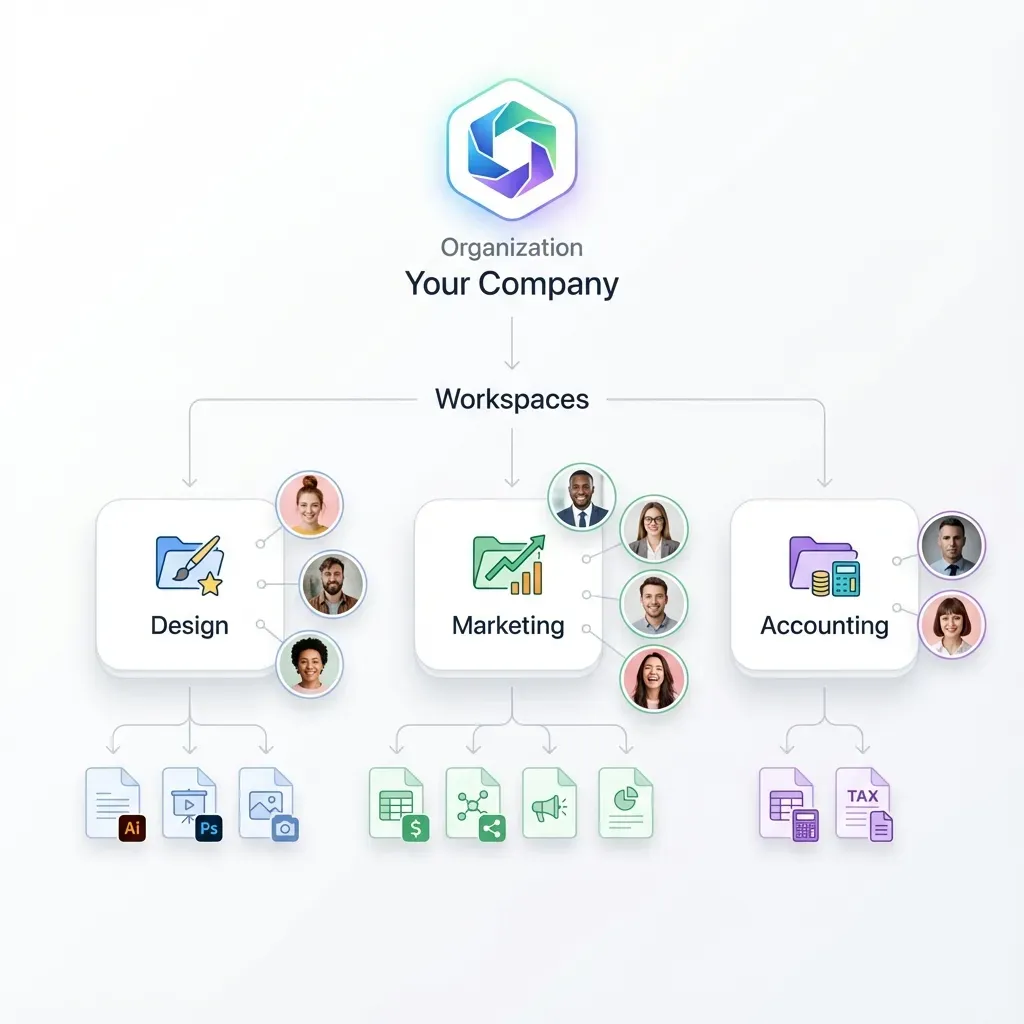
Create a workspace per deal or per program. For a company with multiple pipeline assets, you might have:
- Company Data Room workspace with corporate, financial, and legal documents that apply across all programs
- Program A Data Room workspace with clinical, regulatory, and CMC documents for your lead asset
- Program B Data Room workspace for your second pipeline candidate
This separation lets you share program-specific rooms with different partners without exposing your entire portfolio. Each workspace has its own permissions, audit trail, and intelligence index.
Shares for External Access
When it is time to share with an investor or pharma partner, create a branded share from the relevant workspace folders. Fastio supports Send, Receive, and Exchange share types:
- Send shares for outbound diligence: package documents for investor review with download controls and expiration dates
- Receive shares for collecting documents from partners, CROs, or regulatory consultants
- Exchange shares for bidirectional document flow during active negotiations
Each share can be branded with your company logo and colors, and guests access the portal without creating an account. Auto-expiring access links add a time boundary to sensitive document sharing.
Intelligence Mode for Document Q&A
One advantage workspace platforms have over traditional VDRs is built-in document intelligence. Enable Intelligence Mode on your biotech workspace and Fastio automatically indexes every uploaded file for semantic search and AI-powered Q&A.
This is particularly useful during internal data room preparation. Ask questions like "What were the primary endpoints in our Phase IIb trial?" or "Summarize the FDA's feedback from our Type B meeting" and get answers with citations to specific documents and pages. It saves hours of manual searching through regulatory correspondence and clinical study reports.
Pharma partners reviewing your data room through a portal can also use the AI chat to ask questions about shared documents, turning a static document repository into an interactive diligence experience.

Common Mistakes in Biotech Data Rooms
After reviewing dozens of biotech data rooms across fundraising, licensing, and M&A processes, certain mistakes come up repeatedly.
Missing version control on protocols. Clinical trial protocols evolve through amendments. If you only include the latest version, reviewers cannot trace how the trial design changed in response to safety signals or regulatory feedback. Include all versions with clear naming: Protocol_v1.0_2024-03-15.pdf, Protocol_v2.0_Amendment1_2024-09-22.pdf.
Dumping raw data without context. A folder of CSVs from your Phase I trial is useless without the statistical analysis plan, data dictionary, and a summary of key findings. Always pair raw data with the interpretive documents that make it meaningful.
Forgetting CMC documentation. Many biotech teams focus heavily on clinical data and neglect manufacturing documentation. Acquirers care deeply about whether your manufacturing process is scalable, validated, and transferable. Missing CMC documents can stall deals.
Oversharing too early. Sharing your complete patent prosecution file before a signed NDA puts valuable IP at risk. Use tiered access to control what early-stage reviewers can see. Start with granted patents and published applications, and reserve pending claims and prosecution strategy for later-stage diligence.
Static, stale rooms. The best biotech data rooms are maintained continuously. When a new study finishes, a patent issues, or an FDA meeting concludes, update the room promptly. Investors and partners quietly expect this level of operational discipline. A room that was last updated six months ago raises questions about what else might be falling behind.
No index or guide document. Add a data room index as the first document in your top-level folder. This single PDF should list every folder, what it contains, and what stage of access is required to view restricted materials. It saves reviewers time and reduces the volume of "where can I find X?" requests from your deal team.
Sources
References used to verify factual claims in this guide.
-
Biopharma M&A activity reached roughly $240 billion in signed deals during 2025
-
Average biotech licensing deal requires sharing 500-2,000 proprietary documents
Frequently Asked Questions
What should be in a biotech data room?
A biotech data room should include corporate documents, intellectual property filings, preclinical study reports, clinical trial data organized by phase, CMC and manufacturing documentation, regulatory correspondence (including FDA meeting minutes and IND filings), financial information, and legal agreements. The specific contents depend on your clinical stage. A preclinical company focuses on IP and animal data, while a Phase III company needs complete Clinical Study Reports, statistical analysis plans, and pre-NDA meeting packages.
How do biotech companies organize due diligence documents?
Most biotech companies organize data room documents into eight core folders: Corporate Overview, Intellectual Property, Preclinical Data, Clinical Program, CMC/Manufacturing, Regulatory, Financials, and Legal. Within the Clinical Program folder, documents are further organized by trial phase and indication. Access is typically tiered so that early-stage reviewers see summaries and published data, while deep diligence reviewers get access to raw datasets and pending patent applications.
Do biotech startups need a virtual data room?
Yes, even preclinical biotech startups benefit from setting up a data room early. Seed and Series A investors expect organized access to your IP filings, scientific data, and corporate documents. Building the room before you need it means you can respond to investor interest quickly instead of scrambling to collect documents under time pressure. Early-stage rooms are smaller, but the organizational discipline you demonstrate matters to investors evaluating your operational maturity.
How is a biotech data room different from a standard virtual data room?
Biotech data rooms require document categories that don't exist in other industries, including clinical trial data organized by phase, CMC manufacturing documentation, FDA regulatory correspondence, and patent prosecution files. They also need more granular access controls because different document types carry different sensitivity levels. Patient data, trade secrets, and pre-submission regulatory strategies each need distinct permission tiers within the same room.
What security features matter most for a biotech data room?
Granular access controls (folder and file-level permissions), comprehensive audit trails tracking every document view and download, tiered access that limits what early-stage reviewers can see, download restrictions for the most sensitive materials, and auto-expiring access links for time-limited sharing. Watermarking adds another layer for documents containing trade secrets or unpublished clinical data.
When should a biotech company start building its data room?
Start building your data room as soon as you have IP filings and preclinical data worth protecting. Many companies wait until they are actively fundraising or fielding acquisition interest, then spend weeks collecting and organizing documents under deadline pressure. Companies that maintain a living data room, updated as studies complete and patents issue, can respond to inbound interest within days instead of weeks.
Related Resources

Build Your Biotech Data Room Today
Organize clinical data, regulatory filings, and IP documentation in secure workspaces with granular permissions, audit trails, and built-in document intelligence. Start 14-day trial.