Best Virtual Data Room Providers for Every Deal Type
Choosing a virtual data room provider depends on what kind of deal you are running. This guide breaks down the top VDR providers by use case, from large-cap M&A to startup fundraising, with honest pricing comparisons and feature analysis so you can pick the right one without overpaying.


What Virtual Data Room Providers Actually Do
A virtual data room provider is a SaaS company that offers secure online repositories for storing and sharing confidential documents during due diligence, M&A, fundraising, and other high-stakes transactions. The global VDR market hit $3.4 billion in 2025 and is projected to reach over $4 billion by 2026, driven by increasing M&A activity and regulatory complexity.
VDRs solve a specific problem that general cloud storage cannot: controlled disclosure to parties you do not fully trust. When a company goes through an acquisition, the average deal involves tens of thousands of pages of due diligence documents. Buyers, sellers, lawyers, and advisors all need access to different subsets of those documents, with different permission levels, under strict audit requirements.
The core capabilities that separate VDRs from tools like Dropbox or Google Drive include granular view-only permissions (down to individual files), dynamic watermarking that traces every viewed page back to a specific user, structured Q&A workflows tied to documents, fence view that masks everything outside the reader's cursor, and tamper-proof audit trails that log every action for legal defensibility.
Not every deal needs every feature. A $50 million private equity acquisition has different requirements than a seed-stage startup sharing financials with angel investors. The providers below are organized by what they do best, so you can match your deal type to the right tool.
Helpful references: Fastio Workspaces, Fastio Collaboration, and Fastio AI.
Related guides
- Best Data Room Software for Secure Document SharingData room software provides secure, permission-controlled workspaces for sharing confidential documents during M&A,...
- What Is a Data Room? A Plain-English Guide for 2026A data room is a secure space where confidential documents are stored and shared with authorized parties during...
- Best iDeals Virtual Data Room Alternatives for 2026iDeals is one of the most popular virtual data rooms for M&A and due diligence, but it is not the only option. This...
- How to Choose a White Label Data Room for Client-Facing DealsA white label data room lets advisory firms, investment banks, and service providers rebrand a virtual data room with...
- How to Build a Biotech Data Room for Due DiligenceA biotech data room is a secure virtual workspace where life sciences companies share proprietary research, clinical...
- How to Set Up a Private Placement Data RoomA private placement data room is a secure virtual workspace where issuers share private placement memorandums,...
More on this subject: Data Rooms and Due Diligence (53 guides)
Top VDR Providers by Use Case
Rather than ranking providers on a single scale, here is how the market breaks down by the type of transaction you are running.
Enterprise M&A and Investment Banking
1. Datasite (formerly Merrill Datasite)
The default choice for large-cap M&A and investment banking mandates. Datasite's AI document classification sorts uploaded files automatically, and its AI redaction detects over 100 types of personally identifiable information. The analytics dashboard shows bidder engagement patterns that help sell-side advisors gauge buyer seriousness.
Best for: Deals where institutional credibility matters more than cost. Goldman Sachs, Blackstone, and Johnson & Johnson are reported users.
Pricing: Per-page model, roughly $0.60/page. Expect $25,000 to $100,000+ per year for active deal rooms. The per-page model can create cost surprises on document-heavy transactions.
2. Intralinks (SS&C)
Trusted by 99% of the Fortune 1000 according to SS&C's own reporting, Intralinks offers 16 user roles with granular access tiers. The "View As" feature lets administrators preview exactly what each party sees. Strong capital markets and IPO workflow tools make it the go-to for public offerings alongside M&A.
Best for: Enterprise M&A, capital markets, and IPOs in highly regulated industries. Has processed over $35 trillion in transactions.
Pricing: Quote-based. Typically $25,000 to $100,000+ per year.
Mid-Market M&A and Private Equity
3. iDeals
A consistent G2 Leader for five consecutive years, iDeals offers eight granular permission levels and 24/7 support in more than 10 languages. privacy requirements is built in, and the platform scales well for firms managing multiple concurrent deals.
Best for: Mid-market M&A, legal due diligence, and real estate transactions. Over 175,000 companies and 1 million users.
Pricing: Flat-rate model (quote-based for specific tiers). Transparent compared to per-page alternatives.
4. FirmRoom
Flat-rate pricing for unlimited users and storage makes budgeting straightforward. The interface is clean, with drag-and-drop upload and automatic document indexing. Full-text search works across all uploaded files.
Best for: PE deals and mid-market M&A where teams want predictable costs. Pfizer, Baird, and J.P. Morgan are listed clients.
Pricing: Annual flat-rate billing with no per-user or per-page charges; see the vendor's pricing page.
5. DealRoom
Goes beyond document storage into full M&A project management. Pipeline tracking, diligence request lists, and integration planning are built in. Corporate development teams running multiple acquisitions simultaneously get the most value here.
Best for: Corporate development teams managing deal pipelines, not just individual transactions.
Pricing: Flat rate with unlimited users and storage; see the vendor's pricing page.
Investor Data Rooms and Startup Fundraising
Fundraising data rooms have different requirements than M&A rooms. Founders need page-level analytics to see which investors actually read the pitch deck, branded rooms that look professional, and pricing that does not blow up a pre-seed budget.
6. CapLinked
Clean interface with workspace management designed for fund distribution. Document tracking shows exactly who viewed what and for how long. The pricing is accessible for startups.
Best for: Startups, SMBs, and private equity fund management.
Pricing: Team plans are available on the vendor's pricing page. Enterprise pricing is custom.
7. Digify
Combines data encryption, access control, DRM, dynamic watermarking, and file tracking in one platform. The document analytics are detailed enough to tell you which pages of your pitch deck investors spent the most time on.
Best for: Early-stage fundraising and smaller transactions where document tracking matters.
Pricing: Tiered subscription plans are available on the vendor's pricing page.
8. Fastio
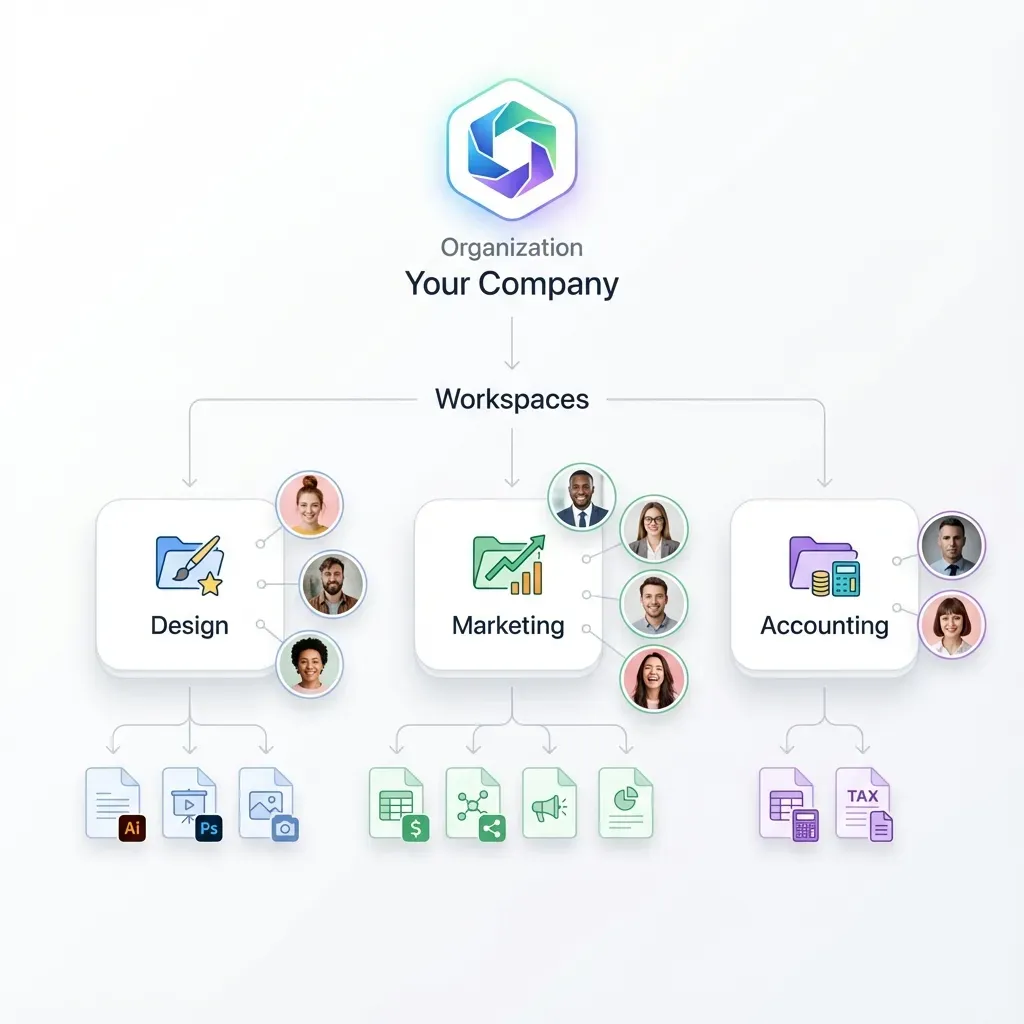
Originally built as a workspace platform for agentic teams, Fastio works well as a lightweight investor data room. Workspaces support granular permissions at the organization, workspace, folder, and file level. Branded shares let you create Send, Receive, and Exchange workflows with guest access. Audit trails log every file operation, membership change, and download. With Intelligence Mode enabled, uploaded documents are automatically indexed for semantic search and citation-backed chat, so investors or advisors can ask questions about your documents directly.
Best for: Startups and small teams that want a data room with built-in AI search and document intelligence, without paying enterprise VDR prices.
Pricing: 14-day Business Trial requiring a credit card. Plans start at $9.99/mo (Starter, 250 GB, 3 seats) and scale to Business ($49.99/mo) and Enterprise ($199.99/mo) with usage-based credits.
Limitations: No dedicated Q&A workflow, no fence view, no dynamic watermarking. If your deal requires those specific features, a purpose-built VDR is the better choice.



Set Up a Modern Data Room with Fastio
Fastio gives you secure workspaces with granular permissions, audit trails, and AI-powered document search. Explore plans at /pricing/. Built for virtual data room providers workflows.
IPO Readiness and Budget Options
IPO and Capital Markets
9. DFIN Venue (Donnelley Financial Solutions)
Integrates directly with DFIN's ActiveDisclosure platform for SEC filings. If your company is preparing for an IPO, Venue connects the data room to the filing workflow so documents move from due diligence to regulatory submission without manual re-uploads.
Best for: IPO processes and capital raises where SEC filing speed matters.
Pricing: Quote-based. Typically bundled with other DFIN compliance products.
10. Ansarada
Stands out with its AI-powered Readiness Scorecard that evaluates whether your document set is complete before you go live. Bidder engagement scoring predicts which parties are most likely to close. The deal workflow tool guides teams through each stage.
Best for: Sellers preparing for structured M&A or capital raises who want to quantify their readiness before opening the room.
Pricing: Storage-based tiers (such as 2 GB and 4 GB packages; see vendor pricing). Gets expensive for document-heavy deals.
Budget-Friendly Options
11. SecureDocs
The fast setup in the market: eight minutes from signup to a live data room, according to SecureDocs. Built-in e-signatures, two-factor authentication, and customizable NDAs. No AI features and no advanced analytics, which is deliberate. SecureDocs does one thing and keeps it simple.
Best for: SMBs and straightforward transactions where setup speed and low cost matter most.
Pricing: Flat-rate plans for unlimited users and documents, available annually or for a three-month commitment; see the vendor's pricing page.
How to Choose: Pricing Models Compared
VDR pricing is where most buyers get surprised. The sticker price rarely tells the full story.
Per-page pricing (Datasite, legacy Intralinks) charges roughly $0.35 to $0.70 per page. On a deal with 50,000 pages of due diligence documents, that is $17,500 to $35,000 in page fees alone, before you add user licenses, support tiers, or overage charges. This model penalizes you for thoroughness.
Flat-rate monthly pricing (offered by SecureDocs, FirmRoom, and DealRoom) gives you unlimited users and documents for a predictable monthly cost. This is the most popular model in the mid-market and the easiest to budget.
Per-user pricing typically starts around $40 per user per month. This works fine when you control the user count, but M&A deals often involve dozens of external advisors, lawyers, and bidder teams. Costs can escalate quickly.
Storage-based pricing (Ansarada) ties cost to the volume of data stored. Even for 2 GB of storage, this is premium pricing that only makes sense if Ansarada's readiness scoring and engagement analytics deliver enough value to justify the cost.
Flat plans with metered overage (Fastio) include seats and storage, and bill extra storage, bandwidth and AI credits beyond the monthly allowance by use. Starter includes 250 GB with 100,000 monthly credits, which is suitable for smaller deals.
What to Watch For in Contracts
- Overage fees: Per-page and per-user plans often have overage charges that double the expected cost.
- Minimum commitments: Some providers require 12-month contracts even for single-deal use.
- Support tiers: Basic support may be included, but 24/7 priority support can add $5,000 to $20,000 annually.
- Archive fees: After a deal closes, keeping the room open for reference may cost extra.
- User types: Some providers charge differently for internal users vs. external reviewers.

What to Look for in a VDR Provider
The feature checklist depends on your deal type, but certain capabilities are non-negotiable for any transaction involving confidential documents.
Granular permissions should go beyond "view" and "edit." Look for download restrictions, print controls, and the ability to set permissions at the individual file level, not just the folder level. The best providers offer view-only access where the document cannot be downloaded or printed at all.
Audit trails need to be tamper-proof and exportable. Every login, file view, download, upload, and permission change should be logged with timestamps and user attribution. This is not optional for regulated transactions. It is the foundation of legal defensibility if a dispute arises after the deal closes.
Q&A workflow matters for sell-side M&A. Buyers submit questions tied to specific documents, and the sell-side routes questions to subject matter experts. Answers can be private (visible only to the asking party) or published to all bidders. This replaces the email chains that create compliance nightmares.
Dynamic watermarking embeds the viewer's name, email, IP address, and timestamp into every page they view or download. If a document leaks, you can trace it to the exact person who shared it.
Search should cover the full text of uploaded documents, not just file names. Some newer providers add AI-powered semantic search that finds relevant documents based on meaning, not just keyword matches. Once Intelligence is enabled for the workspace, Fastio auto-indexes uploaded files for semantic search and lets users ask natural-language questions with citations pointing to specific pages.
Compliance certifications like enterprise security standards, security requirements, and privacy requirements are standard among established VDR providers. If you are in healthcare or financial services, check for strict security requirements or government security requirements compliance specifically. Not every provider has every certification, so match the provider's certifications to your industry requirements.
Sources
References used to verify factual claims in this guide.
-
Global VDR market hit $3.4 billion in 2025
-
Datasite AI redaction detects over 100 types of PII
-
CapLinked per-page overage charges start around $0.40 per page
-
DealRoom flat rate includes unlimited users and unlimited data
Frequently Asked Questions
What is the best virtual data room provider?
It depends on your deal type. Datasite and Intralinks lead for enterprise M&A and IPOs. iDeals and FirmRoom offer strong mid-market options with transparent pricing. SecureDocs is a strong budget option with flat-rate pricing. For startups that want built-in document intelligence, Fastio offers a 14-day Business Trial with AI-powered search and generous storage.
How much do virtual data room providers charge?
Pricing varies widely. Budget flat-rate options (like SecureDocs) offer unlimited users, while mid-market flat-rate providers (FirmRoom, DealRoom) charge predictable monthly rates. Enterprise providers like Datasite and Intralinks typically run $25,000 to $100,000+ per year. Fastio offers a 14-day Business Trial before Starter at $9.99/mo that works for smaller transactions. Watch for hidden costs in per-page and per-user models.
What should I look for in a data room provider?
Start with granular file-level permissions, tamper-proof audit trails, and full-text search. For M&A, add Q&A workflows and dynamic watermarking to the requirements. Check compliance certifications (enterprise security standards, security requirements, privacy requirements) against your industry needs. Then compare pricing models: flat-rate is the most predictable, per-page penalizes large document sets, and per-user can escalate with external reviewers.
Are virtual data rooms better than Dropbox for due diligence?
Yes, for any transaction involving confidential documents shared with external parties. Dropbox is built for collaboration with trusted teammates. VDRs are built for controlled disclosure to parties you may not fully trust. The key differences are view-only permissions without download, dynamic watermarking, fence view, structured Q&A, and legally defensible audit trails. Dropbox has none of these.
Can I try a virtual data room before committing to a contract?
Fastio offers a 14-day Business Trial requiring a credit card, followed by paid plans starting at $9.99/mo. You get granular permissions, audit trails, and AI-powered document search once Intelligence is enabled. For larger rounds requiring dynamic watermarking and dedicated Q&A workflows, enterprise VDRs charge significantly higher rates.
Related Resources

Set Up a Modern Data Room with Fastio
Fastio gives you secure workspaces with granular permissions, audit trails, and AI-powered document search. Explore plans at /pricing/. Built for virtual data room providers workflows.