Best iDeals Virtual Data Room Alternatives for 2026
iDeals is one of the most popular virtual data rooms for M&A and due diligence, but it is not the only option. This guide compares five alternatives on pricing, security, AI document search, and permission models so you can pick the right VDR for your deal workflow.


Why Teams Look for iDeals Alternatives
iDeals has built a strong reputation in the VDR market. The platform serves over one million users across more than 175,000 projects, and it has held a G2 Leader position for five consecutive years. For straightforward M&A transactions, it works well.
So why do teams switch? The reasons tend to fall into a few categories.
Pricing friction. iDeals plans require custom quotes, but the entry tier includes only 5 to 10 GB of storage. Storage overage fees can add $100 to $300 per GB per month, and one-time setup and training fees range from $1,000 to $5,000. For firms running multiple concurrent deals, costs escalate quickly.
Permission gaps. iDeals offers eight levels of access control, from "None" to "Upload." But users report that managing permissions for external organizations is unintuitive, and there is no page-level permission model. If you need to share specific pages of a document without exposing the full file, you will need to split the document manually.
Analytics limitations. While iDeals tracks document access, several reviewers note that you cannot click through from audit logs to the specific files or pages viewed. For deal teams that need to understand exactly what a buyer examined, this creates a gap.
AI capabilities. iDeals has added AI-powered Q&A and automated indexing, but the features are relatively new compared to platforms that built AI into their core architecture from the start.
The average VDR switching cost is two to four weeks of migration and retraining. That is a real cost, but it is a one-time cost. If your current platform charges thousands in overage fees per quarter, the math on switching starts to work within a few months.
Related guides
- Best Virtual Data Room Providers for Every Deal TypeChoosing a virtual data room provider depends on what kind of deal you are running. This guide breaks down the top VDR...
- Intralinks Data Room: Features, Pricing, and Alternatives for 2026Intralinks is one of the oldest virtual data room platforms, now owned by SS&C Technologies. It has facilitated over...
- How to Build an Agentic Virtual Data Room for Due DiligenceAgentic virtual data rooms use AI agents for automated due diligence, handling document review and secure sharing. Skip...
- How to Build a Biotech Data Room for Due DiligenceA biotech data room is a secure virtual workspace where life sciences companies share proprietary research, clinical...
- Best Data Room Software for Secure Document SharingData room software provides secure, permission-controlled workspaces for sharing confidential documents during M&A,...
- What Is a Data Room? A Plain-English Guide for 2026A data room is a secure space where confidential documents are stored and shared with authorized parties during...
More on this subject: Data Rooms and Due Diligence (53 guides)
Side-by-Side Comparison of Top Alternatives
Before diving into each platform, here is a quick reference table comparing the five strongest iDeals alternatives across the dimensions that matter most for deal teams.
Pricing Model
- Intralinks: Per-user or per-page. Enterprise-tier pricing, not published transparently.
- Firmex: Quote-based. Per-project or annual subscription. Generally more affordable than Intralinks or Datasite.
- Ansarada: Storage-tiered, starting with 250 MB. Free preparation phase before deal goes live.
- Datasite: Per-page, averaging $0.60/page. Custom quotes for enterprise.
- Fastio: Plans from $9.99/mo, with a 14-day trial on monthly plans (credit card required), with storage and monthly credits included.
AI Features
- Intralinks: AI-powered redaction and automated indexing.
- Firmex: Basic full-text search, no AI document analysis.
- Ansarada: AI deal prediction, AI bulk redaction, readiness scoring.
- Datasite: AI document classification, intelligent redaction, AI analytics.
- Fastio: Intelligence Mode with semantic search, RAG chat with citations, metadata extraction, auto-summarization.
Permission Model
- Intralinks: Role-based with IRM (Information Rights Management). Granular but complex to configure.
- Firmex: Group and individual permissions. Straightforward but less granular than enterprise options.
- Ansarada: Role-based with document-level controls.
- Datasite: Role-based with "View As" simulation. Can preview how different users see the room.
- Fastio: Granular permissions at org, workspace, share, folder, and file level. Branded shares with download controls and guest access.
Security Certifications
- Intralinks: First VDR with ISO 27701 certification.
- Firmex: AES encryption.
- Ansarada: In-region data centers.
- Fastio: 2FA, scoped API access, audit trails, granular permissions.
Best For
- Intralinks: Enterprise M&A with complex multi-party workflows.
- Firmex: Mid-market firms wanting good value and fast setup.
- Ansarada: Teams that value deal analytics and clean UI.
- Datasite: Large-cap transactions with heavy document volumes.
- Fastio: Teams wanting AI-first document intelligence, ongoing collaboration, or a free evaluation environment.
Intralinks: Enterprise M&A Workhorse
Intralinks, owned by SS&C Technologies, is the legacy heavyweight in the VDR market. If you are working on billion-dollar cross-border transactions, there is a good chance you have already encountered it.
Where Intralinks excels. The platform was purpose-built for complex M&A workflows. Its Q&A management system handles structured question-and-answer exchanges between buyers and sellers, with routing rules that direct questions to the right subject matter experts. Real-time dashboards show participant engagement, and IRM (Information Rights Management) lets you control documents even after download.
Intralinks was the first VDR to achieve ISO 27701 certification, which covers privacy information management. For deals in regulated industries or across jurisdictions with strict data protection requirements, this certification carries weight.
Where Intralinks falls short. Pricing is the biggest complaint. At roughly $7,500 per 10,000 pages, costs add up fast for large deal teams. The platform is also complex to administer. Setting up a new room with proper permissions and workflows can take days, and the learning curve discourages ad-hoc use.
For firms that run a handful of large transactions per year, the cost may be justified. For teams that need a data room for smaller deals, fundraising rounds, or ongoing document management alongside transactions, Intralinks is often overkill.
Migration note. Moving from iDeals to Intralinks means trading one established platform for another, but the permission model is different enough that you will need to rebuild your access structure. Plan for the full two-to-four-week migration window.


Try AI-Powered Document Sharing for Your Next Deal
Fastio gives you generous storage, built-in semantic search, and granular permissions. Set up a secure workspace in minutes with and no sales call. Built for ideals virtual data room alternative workflows.
Firmex, Ansarada, and Datasite Compared
These three platforms each target a different segment of the VDR market. Your choice depends on deal size, budget, and how much you value AI features versus simplicity.
Firmex: Mid-Market Value Play
Firmex positions itself as the practical choice for firms that do not need enterprise complexity. It offers both per-project pricing (pay for a single deal) and annual subscriptions (better for firms running multiple transactions per year). Setup is fast, with drag-and-drop uploads, automatic indexing, and a clean folder structure.
The platform supports geographic data residency, which matters for cross-border deals with jurisdiction constraints. Customer support runs 24/7, and reviewers consistently rate it well.
The tradeoffs: Firmex's mobile experience is weaker than its desktop interface. Settings customization is not intuitive. And while Firmex handles permissions at the group and individual level, it lacks the advanced analytics that Ansarada and Datasite offer. If you need to understand which pages a buyer spent the most time on, you will need a different tool.
Firmex fits best for mid-market M&A, legal due diligence, and firms in industries like mining or energy that need straightforward document sharing with proper audit trails.
Ansarada: AI-Powered Deal Intelligence
Ansarada stands out for two things: its user interface and its AI features. It consistently wins G2 awards for design, and the platform's AI readiness scoring predicts deal outcomes based on participant behavior patterns.
The free preparation phase is a unique advantage. You can set up your data room, organize documents, and configure permissions without paying anything. Billing starts only when the deal goes live and you invite external participants. For teams that spend weeks preparing rooms before launch, this saves real money.
Ansarada's AI bulk redaction handles large document volumes, and real-time analytics show which participants are most engaged. This gives sellers insight into buyer intent before formal offers arrive.
The catch is pricing. Ansarada's storage tiers start with just 250 MB. For context, a single financial model spreadsheet can be 50 MB, and a set of construction drawings can easily hit 1 GB. By the time you load a full M&A document set, costs escalate significantly. The AI features are good, but the storage economics punish large document volumes.
Datasite: The Enterprise Benchmark
Datasite (formerly Merrill DataSite) is the platform that large investment banks default to. Its per-page pricing model (averaging $0.60 per page) reflects an era when data rooms were literal rooms full of binders, and the pricing has not fundamentally changed.
What you get for the premium: AI-powered document classification that automatically sorts uploaded files into logical categories. Intelligent redaction that identifies and masks sensitive information across thousands of pages. A "Sandbox" mode for testing configurations before going live. And the "View As" feature, which lets administrators see exactly what each user role can access.
Datasite covers the full transaction lifecycle from preparation through post-merger integration, with 24/7 support in over 20 languages. For a 10 GB implementation, annual costs can reach $720,000. This is not a platform for small deals.
If your firm is running billion-dollar transactions and needs a VDR that investment bankers and law firms already know how to use, Datasite reduces friction. For everyone else, the per-page model makes it prohibitively expensive.
Fastio: A Different Approach to Secure Document Sharing
Fastio is not a traditional virtual data room. It is a workspace platform built for collaboration between humans and AI agents. But the features that make it work for agent teams also solve several pain points that drive people away from iDeals and its competitors.
Plans instead of per-page pricing. Each plan includes seats, storage and monthly AI credits, and credits cover AI work such as document ingestion and chat. Plans start at $9.99/mo (Starter plan) after a 14-day trial on monthly plans that requires a credit card. Compare that to Ansarada's 250 MB starting tier or iDeals' 5-10 GB entry plan.
For teams evaluating data rooms, the trial means you can upload real documents, test permissions, and run AI queries before committing budget. No sales call required.
Built-in AI document intelligence. Most traditional VDRs have bolted AI features onto existing architectures. Fastio built Intelligence Mode into the platform core. When you enable it on a workspace, every uploaded file is automatically indexed for semantic search, citation-backed chat, and metadata extraction.
Ask "Which contracts have change-of-control provisions?" and the system returns answers with citations pointing to specific files and pages. This is not keyword matching. It is semantic understanding that catches variations in legal language. Traditional VDRs offer full-text search, which misses documents that use different phrasing for the same concept.
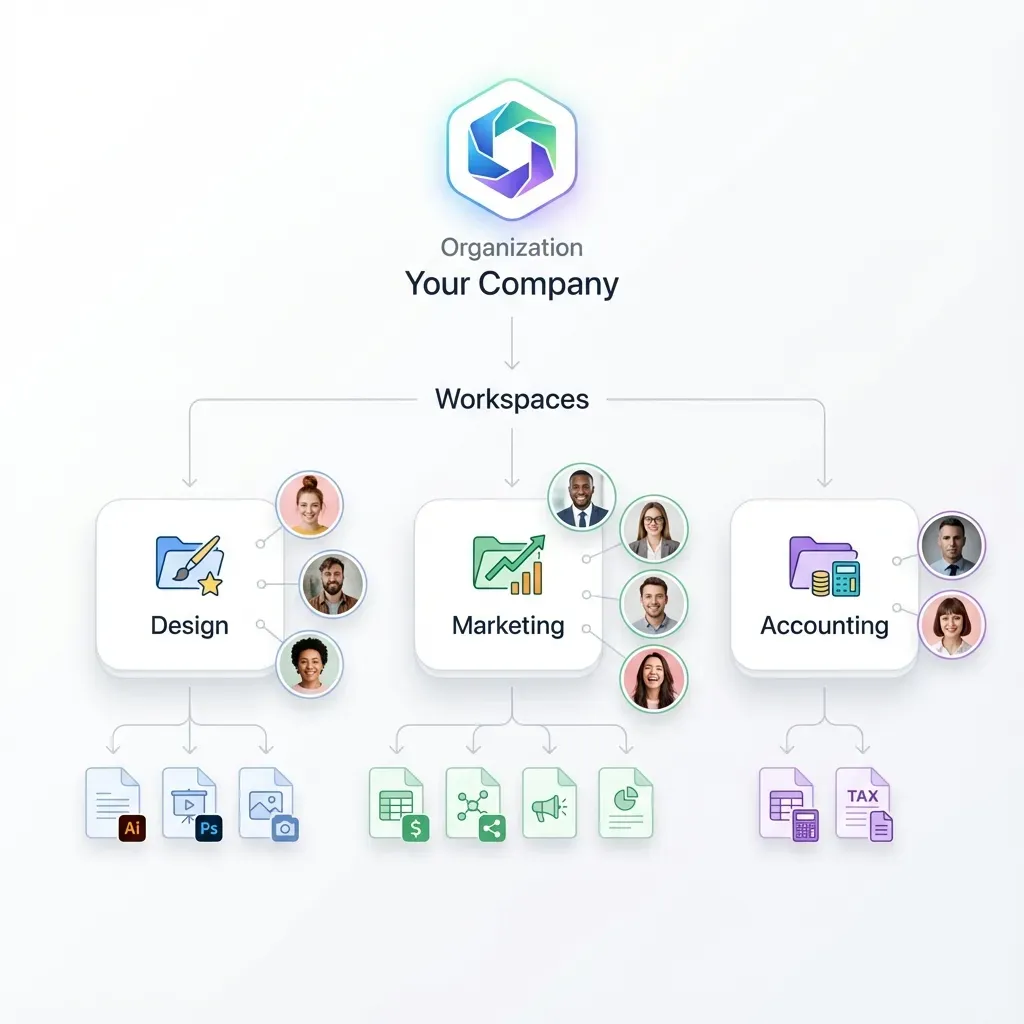
Granular permissions with branded shares. Fastio controls access at the organization, workspace, share, folder, and file level. Purpose-built Send, Receive, and Exchange shares handle the three core VDR workflows: distributing documents to buyers, collecting documents from targets, and facilitating two-way exchanges.
Shares support branding, download controls, guest access, and expiration. Room Storage Mode gives each share independent storage with its own access controls, similar to how a traditional VDR isolates each deal room.
Audit trails that cover AI activity. Unlike platforms where AI features operate outside the audit log, Fastio tracks file operations, membership changes, comments, AI queries, billing events, and permission changes in a single event stream. When a regulator asks what happened with a document, you have a complete picture.
Where Fastio is not the right fit. Fastio is built for workspaces that stay open, not for one-time transactions. It lacks the structured Q&A workflows investment bankers use to route and track buyer questions during an M&A process, and it does not try to replicate the deal-stage tooling in Firmex, Intralinks, Ansarada, or Datasite. If you are running a formal regulated transaction end to end, use one of those.

How to Choose the Right Alternative
The right iDeals alternative depends on three factors: deal complexity, budget, and how you plan to use the platform after the transaction closes.
For enterprise M&A with complex multi-party workflows, Intralinks remains the standard. The cost is high, but the structured Q&A, IRM controls, and ISO 27701 certification justify it for billion-dollar transactions where the VDR cost is a rounding error on total deal fees.
For mid-market transactions where value matters, Firmex hits the sweet spot. Setup is fast and pricing is reasonable. It does the job without the complexity or cost of enterprise platforms.
For teams that want AI-driven deal insights, Ansarada offers the most sophisticated analytics among traditional VDRs. The free preparation phase helps with cost management. Just watch the storage-tier pricing once the deal goes live.
For large-cap deals at established banks, Datasite is the default. Bankers and lawyers know it, which reduces training time. The per-page pricing hurts, but institutional buyers often do not see the bill directly.
For teams that need AI document intelligence and ongoing collaboration, Fastio offers capabilities that traditional VDRs lack. The 14-day trial makes it easy to evaluate before committing. It works well for firms that need a data room for a transaction today and a collaboration workspace tomorrow, rather than paying for two separate platforms.
Migration Planning
Whichever platform you choose, budget two to four weeks for migration. The steps are roughly the same:
- Export your current document structure and permissions matrix from iDeals.
- Map iDeals permission levels to the new platform's access model.
- Upload documents in batches, preserving folder structure.
- Recreate user groups and invite participants.
- Run a parallel period where both rooms are active.
- Verify audit trail continuity and then decommission the old room.
The most common migration failure is losing permission granularity during the transition. Document your current iDeals permission structure before you start, including any custom roles or time-limited access rules.
Sources
References used to verify factual claims in this guide.
-
iDeals serves over 1 million users across 175,000+ projects
-
iDeals G2 Leader for 5 consecutive years
-
Intralinks first VDR with ISO 27701 certification
-
Datasite per-page pricing averages $0.60/page
-
Global VDR market valued at approximately $3.4-3.6 billion in 2025
Frequently Asked Questions
What is a good alternative to iDeals data room?
The best alternative depends on your priorities. Firmex offers strong value for mid-market deals. Ansarada provides AI-powered deal analytics and a free preparation phase. Fastio offers built-in AI document intelligence with a 14-day trial for teams that want to evaluate before committing. Intralinks and Datasite serve enterprise-scale transactions.
Is iDeals the best virtual data room?
iDeals is a strong option with over one million users and G2 Leader status for five consecutive years. It works well for straightforward M&A due diligence. However, its storage-limited entry tier, overage fees, and less developed AI features lead some teams to explore alternatives. The best VDR depends on your deal size, compliance requirements, and whether you need AI document analysis.
How much does iDeals data room cost?
iDeals requires custom quotes for its entry tier, which includes 5 to 10 GB of storage. Premier and Enterprise plans cost more and include additional features. Hidden costs include setup and training fees ($1,000 to $5,000 one-time) and storage overage charges ($100 to $300 per GB per month). Total cost depends heavily on your document volume and number of concurrent projects.
Can I migrate from iDeals to another data room?
Yes. The typical migration takes two to four weeks and includes exporting your document structure, mapping permissions to the new platform, uploading files, and recreating user groups. Most VDR providers offer migration assistance. The main risk is losing permission granularity during the transition, so document your current iDeals permission setup before starting.
What is the difference between per-page and usage-based VDR pricing?
Per-page pricing (used by Datasite) charges a fixed rate per uploaded page, which penalizes large document volumes. Plan pricing with usage-based overage (used by Fastio) charges a monthly fee for a plan that includes seats and storage; extra storage and bandwidth, and AI credits beyond the monthly allowance, are billed by use. Per-seat pricing (used by Intralinks) scales with team size. Each model favors different use patterns. Per-page works for small document sets, per-seat for small teams, and plan pricing with usage-based overage for teams that want a predictable base cost.
Related Resources

Try AI-Powered Document Sharing for Your Next Deal
Fastio gives you generous storage, built-in semantic search, and granular permissions. Set up a secure workspace in minutes with and no sales call. Built for ideals virtual data room alternative workflows.