Best OpenClaw Tools for AI Model Ranking and Benchmarking
PinchBench's top model scores 93.5% while WildClawBench's leader barely clears 62%, proving that no single benchmark captures real agent performance. This guide covers five OpenClaw routing skills that automate model selection at runtime and three benchmark platforms that generate the ranking data those routers depend on.


Why One Benchmark Isn't Enough for OpenClaw
PinchBench's top-performing model, Claude Opus 4.8-fast, hits a 93.5% success rate across 147 agent tasks. WildClawBench's leader, Claude Opus 4.7, tops out at 62.2% on its 60 in-the-wild challenges. Same model family, same ecosystem, a 31-point gap in measured performance. The difference comes down to what each benchmark actually tests: PinchBench focuses on structured productivity and coding tasks with automated grading, while WildClawBench drops agents into messy, multi-step scenarios requiring 10 to 60 tool calls per task.
This gap matters because OpenClaw users need to select models for real workflows, not theoretical capability. A model that aces productivity benchmarks might struggle with open-ended research and creative synthesis. The tools in this guide split into two categories: routing skills that automate model selection inside your agent workflows, and benchmark platforms that give you the data to make those decisions yourself.
Static comparison articles go stale within weeks as new models launch and prices shift. The OpenClaw-native routing skills covered here solve that problem by pulling live rankings and making selection decisions at runtime, not at configuration time.
Related guides
- Best n8n Tools for AI Agents: Top 10 Nodes for 2026n8n changed AI automation with its visual workflow builder. We rank the best nodes and integrations for building...
- Best Tools for CrewAI Agents: Top Picks for 2026CrewAI agents need good tools to be useful. The framework handles coordination, but external integrations let agents...
- 7 Best OpenClaw Tools for AI 3D Model GenerationOpenClaw's skill registry includes several tools that search, download, and generate 3D models in printable formats....
- Top OpenClaw Tools for Graphic DesignersGraphic designers use top OpenClaw tools to handle routine tasks like resizing files and generating palettes. These...
- Best OpenClaw Tools for Indie HackersGuide to openclaw tools indie hackers: OpenClaw tools give solo developers an automated team to handle code and...
- Best OpenClaw Tools for Legal Teams: Top 7 IntegrationsLegal teams use autonomous agents to handle repetitive tasks, and early adopters report significant efficiency gains....
More on this subject: OpenClaw Tools (101 guides)
How We Evaluated These Tools
Every tool in this list was verified against its official source: the awesome-openclaw-skills directory for routing skills, and the project repositories for benchmark platforms. We evaluated each tool on five criteria:
- OpenClaw integration: Does it work as a native skill or require external setup?
- Data freshness: How current are the rankings or routing decisions?
- Cost awareness: Does the tool factor in token pricing, not just performance?
- Transparency: Can you inspect the methodology and raw data?
- Maintenance: Is the project actively updated as of June 2026?
Tools that required proprietary access with no free tier were excluded. Every entry has a public repository or documentation page you can review before installing.
Model Routing Skills for OpenClaw
These skills run inside your OpenClaw instance and automate the "which model should handle this?" decision. Instead of hardcoding a single provider, they classify each prompt and route it to the best available option.
1. llmcouncil-router
Routes prompts to the best-performing LLM using peer-reviewed council rankings from LLM Council. The API accepts your query and returns the top model based on thousands of deliberation outcomes, along with a relevance score and confidence level. Model IDs match the OpenRouter catalog directly, so you can chain the response into your provider call with no mapping needed.
Best for: Teams that want evidence-backed routing without maintaining their own evaluation pipeline.
Install: Available on ClawHub as a skill.
Free API keys are available at llmcouncil.ai/developers.
2. ClawRouter
An agent-native LLM router supporting 41+ models with sub-millisecond routing latency. ClawRouter classifies each request into cost tiers and selects the cheapest model capable of handling it. The project reports roughly 78% average cost reduction while maintaining output quality on benchmarked tasks. It supports USDC payments on Base and Solana via the x402 protocol.
Best for: Cost-sensitive deployments where you want maximum savings with automatic quality guardrails.
Source: github.com/BlockRunAI/ClawRouter
3. arya-model-router
A simpler three-tier router: cheap, default, and pro. It classifies incoming tasks by complexity and delegates expensive reasoning to pro-tier models while sending routine queries to budget options. Sub-agents handle heavy tasks, keeping the primary agent's token spend low.
Best for: Solo developers who want basic cost optimization without complex configuration.
Install: Available on ClawHub as a skill.
4. moa (Mixture of Agents)
Takes a different approach entirely. Instead of routing to one model, moa sends your prompt to three frontier models simultaneously, lets them work through their responses, then synthesizes the strongest reasoning into a single answer. The tradeoff is straightforward: you pay for three model calls to get one better result.
Best for: High-stakes decisions where accuracy matters more than cost, like legal document review or financial analysis.
Install: Available on ClawHub as a skill.
5. which-llm
A deterministic decision-ranking API that scores models against your specific query parameters. It integrates HTTP 402 USDC payments and outcome credits, meaning you can pay per successful routing decision. The deterministic approach means identical queries always route to the same model, which helps with debugging and reproducibility.
Best for: Workflows that need consistent, repeatable model selection across runs.



Keep your model benchmark data organized and searchable
Upload PinchBench results and comparison reports to a shared Fastio workspace. Enable Intelligence for semantic search across your evaluation history with remote MCP access.
OpenClaw Benchmark Platforms
Routing skills need ranking data to work. These platforms generate that data by testing models against OpenClaw-specific tasks rather than generic language understanding.
6. PinchBench
The most widely cited OpenClaw benchmark, built by kilo.ai and open-sourced on GitHub. PinchBench runs 147 tasks across eight categories: productivity, research, writing, coding, analysis, email, memory, and skill integration. Each task is graded through automated checks, LLM judge evaluation, or a hybrid of both.
As of June 2026, PinchBench has evaluated 49 models across 569 runs. The current leaderboard:
- Claude Opus 4.8-fast: 93.5%
- Qwen 3.7-max: 92.5%
- Claude Opus 4.8: 90.5%
- Nemotron-3-ultra-550b (Nvidia): 89.9%
- Mimo v2.5 (Xiaomi): 89.7%
What separates PinchBench from generic coding benchmarks: it tests tool usage accuracy, multi-step reasoning under ambiguity, and practical outcomes rather than isolated language tasks. You can run it locally with ./scripts/run.sh --model [provider/model-name] against your own OpenClaw instance.
Source: pinchbench.com and github.com/pinchbench/skill
7. WildClawBench
Built by researchers at InternLM, WildClawBench takes a harder approach. It drops agents into a live OpenClaw environment with 60 tasks spanning six categories: Productivity Flow, Code Intelligence, Social Interaction, Search and Retrieval, Creative Synthesis, and Safety Alignment. Each task runs in an isolated Docker container with grading scripts hidden until after execution, preventing data leakage.
The benchmark provides dual leaderboards. The model leaderboard ranks LLMs by overall success rate. The use comparison tests the same 60 tasks across four agent scaffolds (OpenClaw, Claude Code, Codex CLI, Hermes Agent), isolating model capability from infrastructure effects.
Current model leaderboard (June 2026):
- Claude Opus 4.7: 62.2%
- GPT-5.5: 58.2%
- Claude Opus 4.6: 51.6%
- GPT-5.4: 50.3%
The lower scores compared to PinchBench reflect the difficulty: WildClawBench tasks require 10 to 60+ tool calls, multi-modal processing, and workflows that run 10 to 20 minutes each.
Source: github.com/InternLM/WildClawBench
8. Price Per Token Community Rankings
Not a benchmark in the traditional sense, but arguably the most useful signal for model selection. Price Per Token aggregates community votes from developers based on real-world experience with agentic coding workflows, including tool use, multi-step planning, and long-context reliability.
June 2026 rankings by community vote:
- Kimi K2.5 (Moonshotai): 7,813 votes at $0.40/$1.90 per million tokens
- Claude Opus 4.5 (Anthropic): 3,618 votes at $5.00/$25.00
- GLM 4.7 (Z-ai): 328 votes at $0.40/$1.75
- Claude Opus 4.6 (Anthropic): 285 votes at $5.00/$25.00
- DeepSeek V3: 104 votes at $0.014/$0.028
The cost data alongside votes makes this useful for quick price-performance comparisons. Kimi K2.5 leading by votes at $0.40 input pricing versus Claude Opus at $5.00 tells a clear story about where the community sees the best value right now.
Storing and Sharing Benchmark Results
Running benchmarks generates data you need to keep: score histories, configuration snapshots, cost logs, and comparison reports. Most teams scatter this across local directories and Slack threads, which makes it hard to track model performance over time or share findings with collaborators.
Local storage works for solo experiments but breaks when multiple team members run evaluations against different model versions. S3 or Google Cloud Storage handles the scale problem, though you lose the ability to search inside documents without building a separate index.
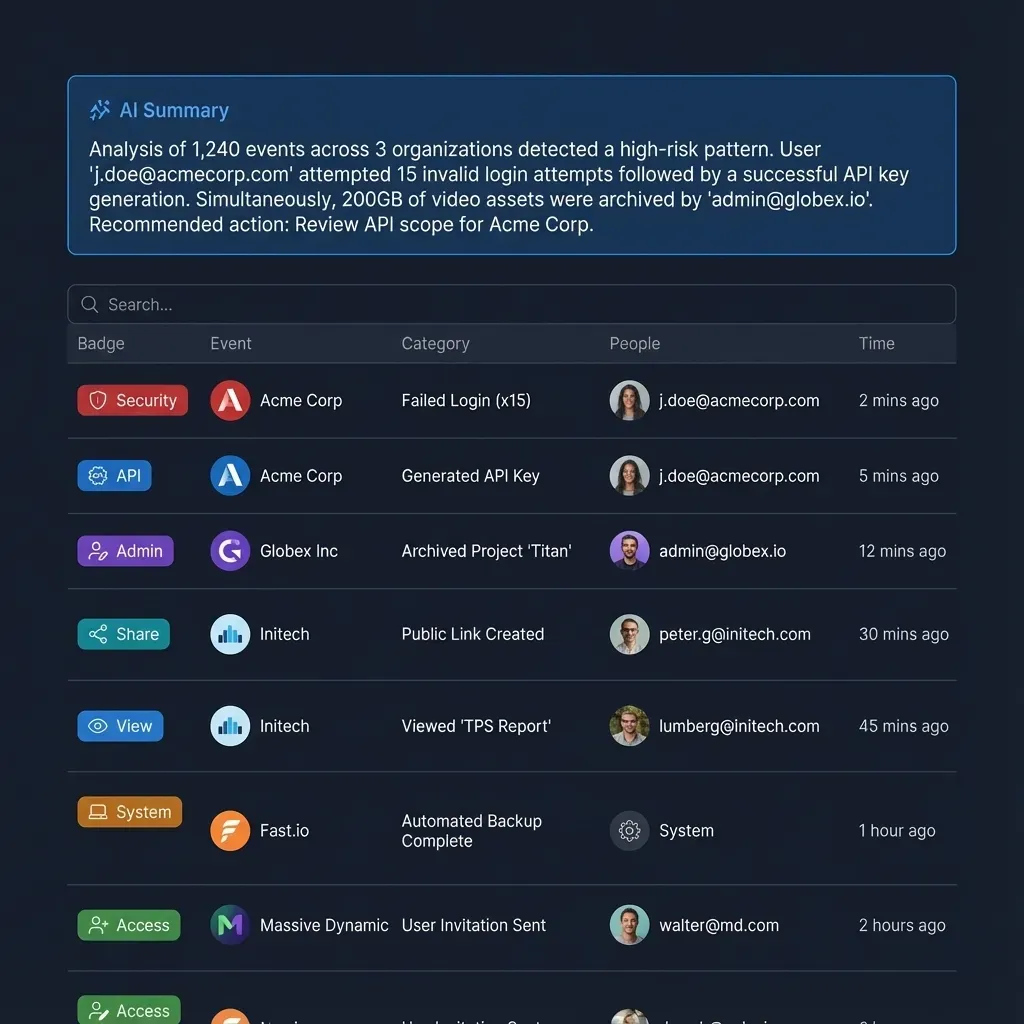
Fastio fits well for teams already running OpenClaw agents. Upload benchmark results to a shared workspace. Once Intelligence is enabled for the workspace, files are indexed for semantic search, so you can ask questions like "which model scored highest on coding tasks last month?" and get cited answers from your own evaluation data. The remote MCP server lets your agents write results directly to the workspace after each benchmark run, and a detailed activity log tracks every change. Fastio offers a 14-day Business Trial (credit card required; see /pricing/) to evaluate shared workspaces and agent tools.
Pairing workspace storage with PinchBench's automated runs creates a feedback loop: benchmark results feed into the workspace, routing skills query the latest data, and your agents always use the best available model.
Picking the Right Combination
Start with a benchmark, then add a router. Running PinchBench locally against your actual agent tasks gives you baseline data. If your workloads involve open-ended research or creative tasks, add WildClawBench to catch failure modes that structured benchmarks miss.
For routing, the choice depends on budget sensitivity. Teams spending over $200 per month on model calls benefit most from ClawRouter or llmcouncil-router, where even a 50% reduction pays for the setup time. Solo developers running 10 to 20 tasks per day can get by with arya-model-router's three-tier approach.
MiniMax M2.5 deserves a callout for cost-conscious teams. At $0.15 per million input tokens (compared to $5.00 for Claude Opus), it scores 80.2% on SWE-Bench Verified and handles multi-turn tool calling at 76.8% accuracy. For routine agent tasks that don't require frontier-level reasoning, it cuts costs by 95% compared to premium models.
The moa skill makes sense only for high-value, low-volume decisions. Running three frontier models per query burns tokens fast, but for tasks where a wrong answer costs more than a few dollars in compute, the accuracy improvement justifies the spend.
One practical setup: use ClawRouter as your default router, override it with moa for critical tasks, and run PinchBench monthly to verify that your routing rules still match current model performance. Check the Price Per Token leaderboard weekly for pricing shifts that might change your routing tiers.
Sources
References used to verify factual claims in this guide.
-
Claude Opus 4.8-fast scores 93.5% on PinchBench across 147 tasks, with 49 models evaluated across 569 runs
-
Claude Opus 4.7 leads WildClawBench at 62.2% success rate across 60 in-the-wild tasks
-
Kimi K2.5 leads Price Per Token community rankings with 7,813 votes at $0.40/$1.90 per million tokens
-
MiniMax M2.5 scores 80.2% on SWE-Bench Verified at approximately $0.15 per million input tokens
-
ClawRouter supports 41+ models with sub-millisecond routing and reports 78% average cost reduction
Frequently Asked Questions
What is the best AI model for OpenClaw?
It depends on your budget and task type. Claude Opus 4.8-fast leads PinchBench at 93.5% success rate but costs $5.00 per million input tokens. Kimi K2.5 tops the Price Per Token community rankings with 7,813 votes at $0.40 per million input tokens. For cost-sensitive workflows, MiniMax M2.5 scores 80.2% on SWE-Bench Verified at just $0.15 per million input tokens. Most teams get the best results by using a routing skill like llmcouncil-router or ClawRouter to select the right model per task automatically.
How do you benchmark LLMs in OpenClaw?
PinchBench is the most common approach. Clone the repository, configure your model provider, and run the benchmark script against your OpenClaw instance. It tests 147 tasks across eight categories and grades results with automated checks plus an LLM judge. For harder, more realistic evaluation, WildClawBench runs 60 in-the-wild tasks inside isolated Docker containers with hidden grading scripts.
What is PinchBench for OpenClaw?
PinchBench is an open-source benchmarking system built by kilo.ai that evaluates how well LLM models perform as the decision-making component of OpenClaw agents. It tests practical capabilities like tool usage accuracy, multi-step reasoning, and real-world task completion across productivity, coding, research, and email workflows. The leaderboard at pinchbench.com tracks 49+ models with regularly updated scores.
How does OpenClaw model routing work?
Model routing skills classify each incoming prompt by complexity, topic, or required capability, then send it to the most appropriate LLM. llmcouncil-router uses peer-reviewed council deliberations to pick models. ClawRouter uses cost-tier classification with sub-millisecond latency. arya-model-router uses a simple cheap/default/pro split. All of them replace the default single-model configuration with dynamic selection, reducing costs without sacrificing quality on tasks that need premium reasoning.
Is MiniMax M2.5 good enough for OpenClaw agent workflows?
For many workflows, yes. MiniMax M2.5 scores 80.2% on SWE-Bench Verified and 76.8% on multi-turn tool calling at roughly $0.15 per million input tokens. Developers report comparable success rates to premium models on routine coding and productivity tasks. The main limitation is complex reasoning: for multi-step research or creative synthesis that needs frontier-level capability, you will see worse results compared to Claude Opus or GPT-5.5.
Related Resources

Keep your model benchmark data organized and searchable
Upload PinchBench results and comparison reports to a shared Fastio workspace. Enable Intelligence for semantic search across your evaluation history with remote MCP access.