Best OpenClaw Tools for Legal Teams: Top 7 Integrations
Legal teams use autonomous agents to handle repetitive tasks, and early adopters report significant efficiency gains. This guide ranks the best OpenClaw tools for contract review, legal research, and secure file management to help your firm stay competitive.

Why Legal Teams Are Switching to OpenClaw
Client demands for efficiency and the pressure of billable hour targets are changing the legal industry. OpenClaw, an open-source autonomous agent platform, leads this shift. Unlike traditional legal software that requires constant manual input, OpenClaw agents execute tasks, from drafting clauses to organizing case files, without constant human supervision.
The 2024 ABA Legal Technology Survey Report notes that 30% of law firms have adopted AI tools. This figure nearly tripled from the previous year. Firms integrating automation see time savings in document review and research.
OpenClaw works well for legal teams because it runs locally or in private clouds. This offers data sovereignty that public AI models cannot match. For law firms handling sensitive client data, this "bring your own infrastructure" approach is an advantage. Legal professionals can build a custom workforce of digital assistants that adhere to strict privacy standards by deploying specific "skills" or tools within the OpenClaw ecosystem.
The ecosystem can be fragmented. With hundreds of available skills, finding tools that are secure and compliant is a challenge. We tested and ranked the top 7 OpenClaw tools specifically for legal workflows.
Helpful references: Fastio Workspaces, Fastio Collaboration, and Fastio AI.

Related guides
- Trending GitHub Copilot Tools & Ecosystem IntegrationsA look at trending GitHub Copilot tools, custom instructions, and Model Context Protocol setups. We explain how...
- The Complete Guide to Clay Integrations: CRMs, Enrichment, and Outreach ToolsWhile a single-source B2B database typically yields email match rates between 30% and 50%, chaining multiple providers...
- 7 Best OpenClaw Tools for AI Travel Itinerary Planning and Booking AutomationOpenClaw's skill registry includes over 110 transportation skills and 29 dedicated travel tools, but most agents cobble...
- Best OpenClaw Tools for AI Spreadsheet Analysis AutomationManual reporting still eats hours every week, even when the analysis itself takes minutes. OpenClaw skills for...
- Best OpenClaw Tools for AI Video Editing AutomationOpenClaw's ecosystem includes both built-in video generation tools and community-developed editing skills that handle...
- 7 OpenClaw Tools That Automate Employee Onboarding ContentGartner projects that 40% of enterprise applications will embed task-specific AI agents by the end of 2026, up from...
More on this subject: OpenClaw Tools (101 guides)
1. Fastio for OpenClaw
Best For: Secure file storage and RAG (Retrieval-Augmented Generation).
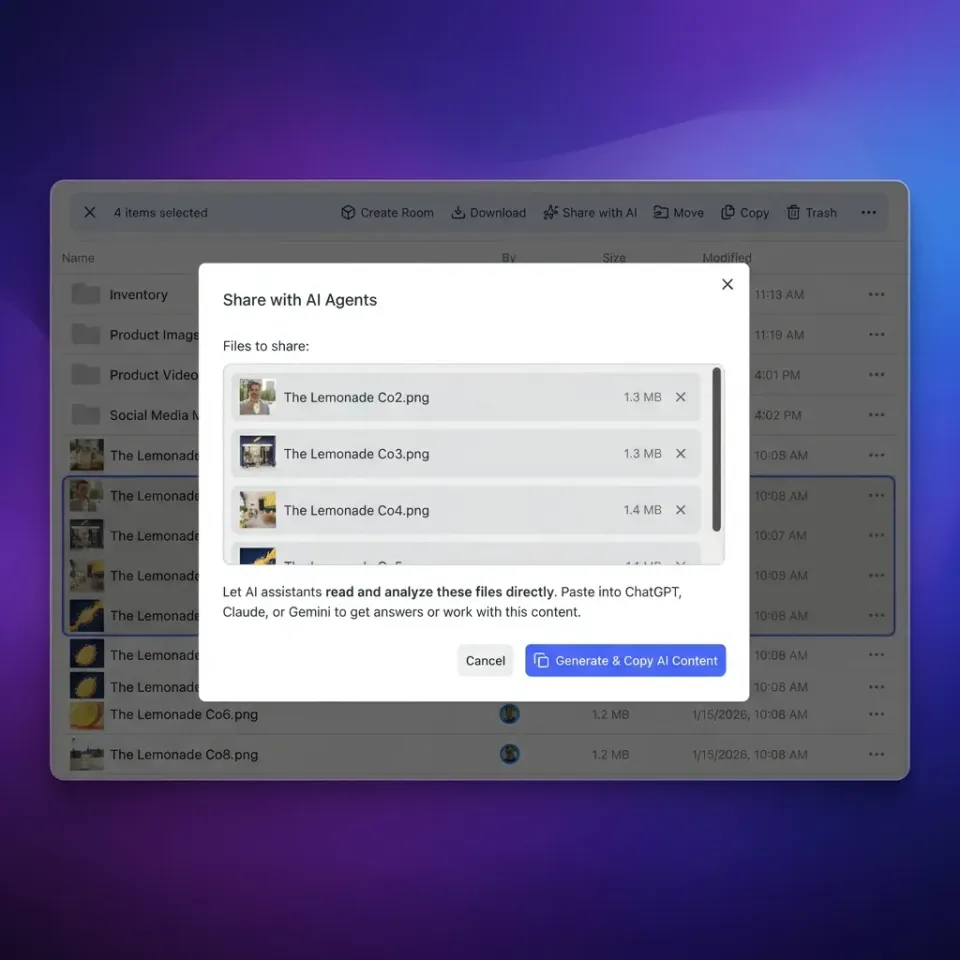
Fastio is the workspace where OpenClaw agents live and work. For legal teams, the challenge isn't just storing millions of documents, it's making them accessible to AI without compromising security. Fastio solves this by providing a file system that indexes uploaded contracts, briefs, and memos for semantic search once Intelligence is enabled for the workspace.
When you connect to the Fastio remote MCP server (https://mcp.fast.io/mcp/tools), your OpenClaw agents get access to your firm's knowledge base. They can read PDF contracts, acquire advisory file locks to coordinate drafting across agents, and write summaries back to specific client folders, with full version history and audit logs to track every change.
How It Works: The integration exposes a standard filesystem interface to your agents but adds a "smart layer." When an agent needs to find "all contracts with Force Majeure clauses," it doesn't need to open multiple files. It queries the Fastio vector index, which returns the specific paragraphs and file paths relevant to the query.
Real-World Scenario: A partner needs a summary of all lease agreements expiring in Q3. Instead of assigning a junior associate to open multiple PDFs, the partner tasks an OpenClaw agent: "Read all leases in the 'Client X' folder and list the expiration dates." The agent uses Fastio to retrieve the text, extracts the dates, and saves a CSV report back to the folder in minutes.
Key Features:
- Built-in RAG: Files are vector-indexed once Intelligence is enabled for the workspace. Agents can ask "What is the indemnity clause in the Smith contract?" and get a citation-backed answer.
- Consolidated MCP Toolset: A consolidated library of Model Context Protocol tools available via streamable HTTP - covering storage, sharing, contextual comments, and audit logs.
- Granular Permissions: Precise control over which agents can access sensitive case files.
Pros:
- 14-day Business Trial (credit card required) to evaluate shared workspaces and agent tools.
- Zero-config integration with OpenClaw via remote MCP.
- Supports "url import" to pull evidence from cloud drives without local I/O.
Cons:
- Requires an active internet connection for the API (though data remains private).
- Advanced features like detailed audit trails are part of the paid tier.
Pricing: Paid plans start at $9.99/month; 14-day Business Trial (credit card required).
MCP Server: mcp.fast.io/docs


Equip Your Legal Agents with Intelligent Storage
Give your OpenClaw agents a secure, searchable workspace. Fastio offers shared cloud storage with built-in RAG and semantic search once Intelligence is enabled.
2. Brave Search (for Legal Research)
Best For: Automated case law research and background checks.
Legal research takes time. The Brave Search skill automates initial legwork with web search and content extraction via the Brave Search API, headless, no browser required. You can task it with "Find recent 9th Circuit rulings on copyright in AI training data" and it will retrieve relevant pages, converting them to readable markdown.
Because Brave Search doesn't personalize results based on your search history, every query returns an unfiltered view, useful when you need objective research rather than results shaped by your prior activity.
Verification Features: The skill provides URLs for every result. Attorneys can verify every source before using it in a brief.
Pros:
- Saves hours of billable time on initial background research.
- Unfiltered results surface pages that don't rank highly on Google.
- Lightweight, no browser runtime required.
Cons:
- Does not have access to paywalled legal databases (Westlaw, LexisNexis).
- Risk of hallucinations requires strict verification of all cited content.
Pricing: Free skill.
ClawHub Page: clawhub.ai/steipete/brave-search
3. Playwright (for Document Archiving & Court Monitoring)
Best For: Archiving digital evidence and monitoring court dockets.
The Playwright skill gives OpenClaw agents full browser automation via the Playwright MCP integration. For legal teams, the critical use case is preservation: capturing screenshots of time-sensitive web content (social media posts, public filings, company announcements) before it can be altered or deleted, then saving those captures to a Fastio Evidence folder with timestamps.
Docket monitoring is another strong use: instruct an agent to check a court's public portal on a schedule, detect any new filings, and notify the team immediately, without a paralegal manually refreshing a browser tab.
Key Features:
- Screenshots and PDFs: Capture and archive web pages as verifiable evidence.
- JavaScript-rendered pages: Access content that standard scrapers miss.
- Trace recordings: Full audit trail of every browser action the agent took.
Pros:
- Creates a timestamped, reproducible record of digital evidence.
- Handles modern web apps that break simpler scrapers.
- Trace files provide a defensible log of how evidence was captured.
Cons:
- Requires a Chromium runtime; heavier than API-based research tools.
- Advanced trace analysis has a learning curve.
Pricing: Free skill.
ClawHub Page: clawhub.ai/ivangdavila/playwright
4. AgentMail (for Client Communication)
Best For: Client communication and inbox management.
Lawyers are buried in email. AgentMail is an API-first email platform built for AI agents, it lets OpenClaw agents manage dedicated email addresses programmatically, without OAuth complexity or mixing automated messages into an attorney's personal inbox.
For routine client updates ("Your filing was submitted"), status notifications, and document delivery, an agent using AgentMail can handle the entire send-and-receive loop. Real-time webhooks notify the agent when a client replies, enabling immediate follow-up actions.
Privacy & Privilege: Because AgentMail operates on dedicated agent-owned addresses rather than attorney inboxes, it creates a clear separation between automated communications and privileged attorney-client correspondence.
Pros:
- Ensures no routine client communication goes unanswered.
- Webhook allowlisting prevents prompt injection attacks from untrusted senders.
- Handles attachments for document delivery.
Cons:
- Requires webhook configuration for full automation.
- Sending automated emails to clients without review carries risk; establish review checkpoints.
Pricing: See ClawHub listing for current details.
ClawHub Page: clawhub.ai/adboio/agentmail
5. Gog (Google Workspace CLI)
Best For: Calendar management, docketing, and Google Drive document access.
Missing a court deadline is malpractice. Gog is a Google Workspace CLI skill covering Gmail, Calendar, Drive, Contacts, Sheets, and Docs. For firms on Google Workspace, it gives OpenClaw agents the ability to read case files from Drive, update deadline tracking spreadsheets, and create calendar events for court dates, all from natural language instructions.
The confirmation prompts built into Gog (required before sending mail or creating calendar events) are deliberately cautious, which is the right default for legal workflows where a misfired email to opposing counsel could be consequential.
Key Features:
- Calendar Events: Create and manage court dates, deposition prep meetings, and filing deadlines.
- Google Sheets: Read and update deadline tracking and matter management spreadsheets.
- Google Drive: Search and retrieve templates, briefs, and client documents.
Pros:
- Works natively with the Google Workspace environment many firms already use.
- Confirmation prompts before send/create actions provide a safety layer.
- JSON output enables chaining with other skills in multi-step workflows.
Cons:
- Requires OAuth setup against your Google Workspace account.
- Limited value for firms standardized on Microsoft 365, consider API Gateway instead.
Pricing: Free skill.
ClawHub Page: clawhub.ai/steipete/gog
6. SQL Toolkit (for Legacy Case Management)
Best For: Integrating with legacy SQL-based case management systems.
Many firms rely on older, SQL-based practice management platforms. The SQL Toolkit gives OpenClaw agents the ability to query, design, migrate, and optimize databases across SQLite, PostgreSQL, and MySQL, translating natural language questions into precise SQL queries.
An agent can query the database to find "all open cases with a statute of limitations expiring in the next 90 days" and generate a report without requiring IT involvement for each ad-hoc request. The read-only deployment pattern keeps the underlying case data safe.
Safety Protocols: SQL Toolkit supports read-only query patterns for general agents. Write access should be restricted to specific, authenticated workflows.
Pros:
- Extends the life of legacy software without replacing core infrastructure.
- Enables natural language querying of structured case data.
- Migration scripts with rollback patterns reduce risk when upgrading schemas.
Cons:
- Requires technical setup by IT staff for database connections.
- Direct database access poses security risks if not properly firewalled.
Pricing: Free skill (MIT-0 license).
ClawHub Page: clawhub.ai/gitgoodordietrying/sql-toolkit
7. Slack (for Internal Knowledge Sharing)
Best For: Internal firm communication and quick knowledge queries.
The Slack skill puts OpenClaw directly into your firm's chat platform. Attorneys can ask the agent questions like "Do we have a template for a California NDA?" or "Summarize the Jones deposition transcript," and get immediate, cited answers pulled from the Fastio knowledge base.
It acts as an always-on internal helpdesk, surfacing knowledge that is often trapped in individual inboxes or local drives. Approval workflows, document request notifications, and deadline reminders can all be routed through Slack, where attorneys are already working.
Key Features:
- Send and Read Messages: Full channel and DM message management.
- React to Messages: Lightweight acknowledgment signals for request triage.
- Pin Items: Surface important announcements or checklists in matter channels.
Pros:
- Reduces interruptions between colleagues for routine knowledge queries.
- Makes institutional knowledge instantly accessible to the whole team.
- Easy adoption for staff already using Slack daily.
Cons:
- Can become noisy if notification rules aren't configured carefully.
- Privacy controls must be set to prevent unauthorized internal access to matter data.
Pricing: Free skill (standard Slack subscription rates apply for the workspace).
ClawHub Page: clawhub.ai/steipete/slack
Comparison of Top OpenClaw Legal Tools
Choosing the right mix of tools depends on your firm's specific bottlenecks. Here is a quick comparison:
Building an Agent Strategy for Your Firm
Adopting OpenClaw tools is a change management process. Here is a roadmap for legal teams:
- Identify the Easy Wins: Don't start with complex litigation strategy. Start with routine, non-billable tasks like file organization (Fastio) or initial background research (Brave Search).
- Audit Your Data: Before starting agents, ensure your document repository is clean. Remove duplicate files and ensure that sensitive HR or partner-compensation data is strictly segregated from the general knowledge base.
- Run a Pilot Program: Select a single practice group (e.g., Real Estate or IP) to test the tools for a set pilot period. Gather feedback on accuracy and time savings.
- Establish "Human-in-the-Loop" Protocols: Define clear rules for when an agent's work must be reviewed. For example, "All agent-drafted emails to clients must be reviewed by an associate."
- Train Your Team: Teach your attorneys how to "prompt" or instruct the agents. The quality of the output depends on the clarity of the instruction.
Ethical Considerations for Legal AI
The use of autonomous agents in law raises specific ethical duties. Under the Model Rules of Professional Conduct (specifically Rule 1.1 on Competence), lawyers have a duty to understand the benefits and risks of relevant technology.
Hallucinations: Generative AI can invent facts. Attorneys must verify every citation. Tools like Brave Search that provide source URLs are essential for compliance.
Confidentiality: Data submitted to public models may be used for training. Using OpenClaw with local models or private-cloud providers (like Fastio's private RAG) ensures that client confidences are preserved (Rule 1.6).
Unauthorized Practice of Law: Agents cannot practice law. They are tools for lawyers. All final advice delivered to a client must be the product of a human attorney's judgment.
Selecting the Right Tools for Your Practice Group
Implementing autonomous agents requires a strategic approach. Start by identifying the most repetitive, low-value tasks that consume high-value attorney time. For most firms, this is document organization and initial research.
Security First: Ensure any tool you select allows for local or private cloud execution. OpenClaw's architecture supports this, but you must verify that specific skills do not send data to third-party APIs for training.
Integration: Look for tools that play well together. Brave Search that saves pages to Fastio, which are then indexed for the Slack bot to answer questions, creates an efficient system.
Human in the Loop: Never deploy a tool that acts without supervision. The best OpenClaw configurations include "checkpoints" where a human must approve a draft or a research summary before it is finalized.
Sources
References used to verify factual claims in this guide.
-
The 2024 ABA Legal Technology Survey Report notes that 30% of law firms have adopted AI tools.
-
Up to 74% of hourly billable tasks in law firms can be automated by AI.
Frequently Asked Questions
Is OpenClaw secure for confidential legal documents?
Yes, OpenClaw is designed for security. It can run entirely on your local infrastructure or private cloud, meaning sensitive client data never leaves your control. However, you must vet individual skills and integrations to ensure they adhere to your firm's data privacy standards.
How does Fastio improve OpenClaw for lawyers?
Fastio provides the memory and storage layer for OpenClaw. It allows agents to search, read, and manage millions of legal files using semantic search (RAG) without needing complex database setup. This turns your document repository into an active knowledge base.
Can OpenClaw replace paralegals?
No, OpenClaw tools are designed to augment paralegals, not replace them. Agents handle the tedious data gathering and initial sorting, allowing legal professionals to focus on analysis and strategy. This partnership increases overall firm capacity and job satisfaction.
Do I need a developer to install these tools?
Some technical knowledge is helpful, but tools like ClawHub make installation much easier with simple command-line instructions. Integrations like Fastio are zero-config, meaning they work immediately after installation. Complex SQL connections may require IT support.
What is the cost of using OpenClaw tools?
OpenClaw itself is open-source and free. Most skills are also free, though you may pay for the underlying compute (like LLM API costs) or paid infrastructure plans like Fastio Starter or Business for advanced storage features.
Related Resources

Equip Your Legal Agents with Intelligent Storage
Give your OpenClaw agents a secure, searchable workspace. Fastio offers shared cloud storage with built-in RAG and semantic search once Intelligence is enabled.