6 Best OpenClaw Skills for AI Soundscape and Ambient Audio Generation
Cinematic and ambient audio holds the largest genre share of the AI music generation software market in 2026, yet most guides cover standalone generators and miss agent-orchestrated workflows. This guide ranks six OpenClaw skills and built-in tools for soundscape creation, from free open-source models to premium APIs, with the provider details and cost structures you need to pick the right one.


Why Agent-Driven Soundscape Generation Is Different
Cinematic and ambient audio holds the largest genre share of the $1.18 billion AI music generation software market in 2026, according to Meticulous Research. The segment dominates because atmospheric soundscapes improve video, podcast, and game content without overpowering narration or dialogue. But most tools built for this market are standalone web apps where you type a prompt, wait, and download an MP3.
OpenClaw changes the equation. Because it runs as an autonomous agent, you can script batch generation workflows: produce 20 ambient tracks from a mood list, tag each with BPM and key metadata, and push the finished files to a shared workspace for your team to review. No manual prompt-and-download loop. No copy-pasting between browser tabs.
This guide covers six tools available inside OpenClaw for ambient audio work. Three are community skills you install from ClawHub. Two are built-in capabilities that ship with OpenClaw itself. One is the storage and organization layer that ties generated output together.
How we evaluated each tool:
- Output quality for ambient, atmospheric, and lo-fi styles
- Cost per track (free tier availability matters for experimentation)
- Parameter control: BPM, key, duration, instrumental mode
- Batch generation support for volume workflows
- Provider flexibility and model selection

Related guides
- How to Use Claude Code Skills in ClineAccording to GitHub's Octoverse 2024 report, the number of developers building with generative AI on the platform...
- How to Install and Manage Cline Agent SkillsAI coding agents boost code volume by 180%, but shipped code rises by only 30%, showing a critical gap in development...
- Best OpenClaw Skills for AI Paraphrasing and RewritingOpenClaw paraphrasing skills are installable agent capabilities that transform, rephrase, and rewrite text for...
- Top OpenClaw Skills for Consultants: Automate Research & ReportsConsultants spend too much time on manual research. OpenClaw skills handle the repetitive tasks so you can focus on...
- Best OpenClaw Skills for AI Long-Form Writing and BloggingOpenClaw skills turn your AI agent into a capable blog writing partner. This guide covers the 7 best ClawHub skills for...
- Best OpenClaw Skills for AI Essay Writing and Academic AssistanceA 2025 HEPI survey found 92% of undergraduates now use AI in their academic work, but most rely on generic chatbots...
More on this subject: OpenClaw Skills (109 guides)
Quick Comparison of OpenClaw Soundscape Tools
Every tool on this list works inside the OpenClaw agent loop. You can chain them in a single session: generate an ambient track with ACE Music, store it in a Fast.io workspace, and share a branded download link with a client, all without leaving the agent context.
Built-in music_generate Tool and Its Provider Ecosystem
The music_generate tool ships with OpenClaw and becomes available as soon as you configure at least one music provider. It supports five providers out of the box, each with different strengths for ambient and soundscape work.
1. Google Lyria 3 (via Google or OpenRouter)
Google's Lyria 3 model produces polished instrumental tracks with strong stereo imaging. The default model through Google is lyria-3-clip-preview; through OpenRouter you get google/lyria-3-pro-preview. Both handle ambient prompts well. The OpenClaw docs list "warm ambient synth loop with soft tape texture" as an example prompt, and Lyria renders that kind of atmospheric request with layered pads and subtle texture.
Strengths:
- Clean, production-ready output for cinematic and atmospheric styles
- Up to 10 image inputs through Google's provider for visual-to-audio workflows
- Edit capability lets you refine existing tracks
Limitations:
- Pricing follows Google's or OpenRouter's rate cards
- Vocal generation is weaker than MiniMax for tracks that need sung elements
Best for: High-quality cinematic soundscapes where output polish matters more than cost.
2. MiniMax
MiniMax handles vocal generation better than Lyria and costs less per track. For ambient work, set the instrumental flag to true and use descriptive prompts focused on texture and mood. The provider supports lyrics input, duration control, and direct MP3 output.
Strengths:
- Lower cost per generation than Google providers
- Native MP3 output without format conversion
- Supports both minimax API-key auth and minimax-portal OAuth
Limitations:
- Instrumental ambient quality is slightly less refined than Lyria 3
- Fewer image input options (no multi-image reference)
Best for: Volume ambient production where you need dozens of tracks at reasonable cost.
3. fal Provider (ACE-Step and Stable Audio Models)
The built-in fal provider defaults to fal-ai/minimax-music/v2.6 but also exposes fal-ai/ace-step/prompt-to-audio and fal-ai/stable-audio-25/text-to-audio. The ACE-Step endpoint is notable for ambient work because it generates from pure text prompts without requiring lyrics or vocal parameters, which makes it natural for atmospheric content. Stable Audio specializes in sound design textures that sit between music and sound effects.
Strengths:
- Three distinct models through one provider
- ACE-Step handles abstract atmospheric prompts well
- Stable Audio fills the gap between music and sound effects
Limitations:
- Credits consumed per generation vary by model
- Quality depends heavily on prompt specificity
Best for: Sound designers who need both ambient music and textural sound effects from the same workflow.

Best Community Skills for Ambient Audio on ClawHub
ClawHub hosts several community-built skills that extend OpenClaw's audio capabilities beyond the built-in tool. Three stand out for soundscape work.
4. ACE Music
ACE Music generates audio using the ACE-Step 1.5 model through a free hosted API. The skill accepts BPM, musical key, duration in seconds, language, and a batch count for producing multiple variations. Setting the instrumental flag suppresses vocals entirely, which is what you want for ambient loops and atmospheric textures.
The ACE-Step 1.5 model is open source and generates a full track in under 2 seconds on an A100 GPU, or under 10 seconds on a consumer RTX 3090. The hosted API removes the need to run inference locally.
The skill is available on ClawHub and can be added through the OpenClaw skills marketplace.
Strengths:
- Completely free with no per-track charges
- Fine-grained parameter control (BPM, key, duration, batch size)
- Fast generation through the hosted API
Limitations:
- Output quality trails premium providers on complex arrangements
- Hosted API availability depends on ACE Music's infrastructure
Best for: Rapid prototyping and high-volume ambient loop generation where zero cost matters.
5. Cynaps3 Plugin
Cynaps3 is a full music production platform packaged as an OpenClaw plugin with 26 agent tools. It connects to both Suno and Sonauto as generation backends. The agent auto-selects the provider based on available API keys, or you can specify a preference.
What separates Cynaps3 from standalone generation skills is its library management layer. Generated tracks get organized into projects with mood, genre, energy, and BPM metadata. You can search your library by attributes, rate tracks on a 1-10 scale, assemble albums with energy curves for mood arcing, and run bulk operations across your collection.
The documentation highlights ambient track creation with solfeggio frequencies as a use case: the agent generates a calming ambient track, saves it to a Meditation project, and has it ready without manual intervention. Suno produces 2 variations per generation. Sonauto outputs a single track at 100 credits per song and supports MP3, FLAC, WAV, OGG, and M4A formats.
Cynaps3 is available as an open-source plugin on GitHub and installs through the OpenClaw plugin system.
Strengths:
- 26 tools covering generation, library management, and album assembly
- Dual-provider flexibility (Suno + Sonauto)
- Built-in metadata tagging and project organization
- 150+ artist style references across 15 categories
Limitations:
- Requires Supabase credentials for library features
- Generation costs depend on Suno/Sonauto credit pricing
Best for: Teams producing ongoing ambient content who need library organization, not just one-off generation.
6. ElevenLabs Music
ElevenLabs Music generates tracks up to 10 minutes long from text prompts using the Eleven Music API. That duration ceiling matters for ambient work. A 30-second loop is fine for a UI notification sound, but meditation apps, podcast backgrounds, and game environments need tracks that run several minutes without obvious repetition.
The skill supports instrumental mode, which strips vocals for pure ambient output. You control duration in seconds (3 to 600), specify an output path, and get MP3 files ready for distribution.
The skill is listed on ClawHub and can be added to your OpenClaw setup through the marketplace.
Strengths:
- 10-minute maximum duration for long-form ambient content
- High output quality from ElevenLabs' production-grade API
- Multiple language support for tracks that need spoken or sung elements
Limitations:
- Requires a paid ElevenLabs subscription (Creator tier minimum)
- Higher cost per track than free alternatives
Best for: Production-quality ambient tracks where duration and fidelity justify the subscription cost.


Store and share your generated soundscapes in one workspace
Storage for your ambient audio library. Push files from OpenClaw via MCP, tag with Metadata Views, and share branded download pages. 14-day Business Trial.
How to Store and Share Generated Soundscapes
Generating ambient audio is half the problem. The other half is organizing, reviewing, and distributing it. When an OpenClaw agent produces 20 ambient tracks in a batch run, those files need to land somewhere accessible to the rest of your team.
Local filesystems work for solo experiments, but fall apart when multiple people need to listen, approve, or download tracks. S3 buckets handle storage but lack built-in preview, search, or access control granular enough for creative review workflows. Google Drive and Dropbox work for simple sharing but offer no semantic search over file contents or AI-powered metadata extraction.
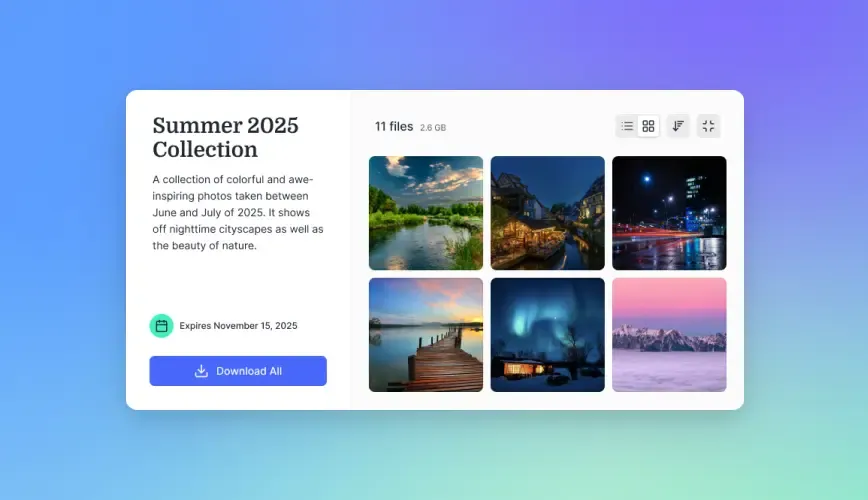
Fast.io fills this gap as a workspace layer purpose-built for agentic teams. Your OpenClaw agent can push generated audio to a Fast.io workspace via the remote MCP server, which exposes a consolidated toolset for workspace, storage, and AI operations. Once Intelligence is enabled on the workspace, files are indexed and searchable by mood, style, or content description.
For ambient audio specifically, Metadata Views let you define custom fields (BPM, key, mood, duration, generation prompt) and extract them across your entire library. The result is a sortable, filterable spreadsheet of your generated soundscapes without manual tagging.
Branded Shares let you send curated track collections to clients through a custom-branded download page. Plans include storage, monthly credits, and multiple workspaces, and monthly plans start with a Business Trial of up to 14 days requiring a credit card (see pricing).
Which Skill Should You Choose
Your choice depends on three factors: budget, volume, and output quality requirements.
Start free, validate the workflow. Install ACE Music and generate a batch of ambient loops at zero cost. If the quality meets your needs for background audio, game soundscapes, or lo-fi ambient content, you may never need a paid option. The ACE-Step 1.5 model handles atmospheric textures surprisingly well for a free tool.
Scale with Cynaps3 for ongoing production. If you are building an ambient music library over time, Cynaps3's project management and metadata tools save hours of manual organization. The dual-provider system (Suno + Sonauto) gives you backup if one service is down or produces unsatisfying results for a particular style.
Use ElevenLabs Music for client-facing work. When tracks need to be longer than two minutes and production quality needs to match commercial standards, the paid ElevenLabs subscription pays for itself. The 10-minute duration ceiling covers most ambient use cases.
Use the built-in music_generate tool for provider flexibility. If you already have API keys for Google, MiniMax, or OpenRouter, the built-in tool lets you compare output across providers without installing anything. Switch between Lyria 3 for cinematic polish and MiniMax for cost-effective volume.
Store everything in one place. Whichever generation tool you pick, pushing output to a shared Fast.io workspace keeps your team aligned. Agents generate and upload. Humans preview, listen, and organize. The workspace handles versioning, access control, and distribution through branded shares.
Sources
References used to verify factual claims in this guide.
- 1 Meticulous Research, AI Music Generation & Composition Software Market Global Forecast 2026-2036 Accessed
Cinematic and ambient audio holds the largest genre share of the $1.18 billion AI music generation software market in 2026
-
ACE-Step 1.5 generates a full track in under 2 seconds on an A100 GPU
-
OpenClaw music_generate supports five providers including ComfyUI, fal, Google Lyria 3, MiniMax, and OpenRouter
-
Cynaps3 plugin provides 26 agent tools with dual-provider generation via Suno and Sonauto
Frequently Asked Questions
Can AI generate ambient music?
AI models like Google Lyria 3, ACE-Step 1.5, and MiniMax can generate ambient music from text prompts. You describe the mood, texture, and instrumentation you want, and the model produces an audio file. OpenClaw wraps these models into agent tools, so you can script batch generation, chain prompts, and push output to shared storage without manual intervention.
What is the best free AI soundscape generator?
ACE Music is the strongest free option available as an OpenClaw skill. It uses the ACE-Step 1.5 model through a free hosted API with no per-track charges. You control BPM, musical key, and duration, and the instrumental mode strips vocals for pure ambient output. For users not on OpenClaw, the ACE-Step 1.5 model is also open source and can run locally on consumer GPUs.
How do you create a soundscape with AI?
Write a descriptive prompt that specifies mood, texture, tempo, and instrumentation. For example, "gentle rain with warm analog synth pads, 70 BPM, C minor" produces a more focused result than "relaxing music." In OpenClaw, use the music_generate tool or install a ClawHub skill like ACE Music, set the instrumental flag to true, and specify your desired duration. The agent generates the audio file and can push it to a workspace for review.
Can OpenClaw generate music?
OpenClaw ships a built-in music_generate tool that supports five providers out of the box, including Google Lyria 3, MiniMax, fal (with ACE-Step and Stable Audio models), ComfyUI, and OpenRouter. Beyond the built-in tool, ClawHub hosts community skills like ACE Music, ElevenLabs Music, and the Cynaps3 plugin that add specialized generation and library management capabilities.
How long can AI-generated ambient tracks be?
Duration depends on the tool. ElevenLabs Music supports tracks up to 10 minutes. ACE Music duration is configurable through the skill's parameters. The built-in music_generate tool's duration limits vary by provider. For longer ambient pieces, you can generate multiple segments and concatenate them, or use a tool like Cynaps3 that supports album assembly with energy curve planning.
Related Resources

Store and share your generated soundscapes in one workspace
Storage for your ambient audio library. Push files from OpenClaw via MCP, tag with Metadata Views, and share branded download pages. 14-day Business Trial.