Best OpenClaw Skills for AI Paraphrasing and Rewriting
OpenClaw paraphrasing skills are installable agent capabilities that transform, rephrase, and rewrite text for different audiences, tones, or purposes without losing meaning. This guide ranks the best community-built skills on ClawHub for rewriting workflows, explains how each one works, and shows how to connect them to persistent file storage on Fastio.


Why Paraphrasing Skills Beat Standalone Rewriters
Standalone paraphrasing tools work in isolation. You paste text into a browser tab, get a rewritten version back, and copy it somewhere else. That workflow breaks the moment you need to process more than one document, apply a consistent voice across a project, or hand results to another agent.
OpenClaw skills change the equation. Because they run inside an agent that already has access to your filesystem, project context, and memory, a paraphrasing skill can reference your style guide while rewriting, check previous edits for consistency, and save output directly to the right folder. The skill becomes part of a larger pipeline rather than a dead-end tool.
ClawHub, the public skill registry for OpenClaw, hosts over 4,000 community-built skills. A growing subset focuses specifically on text transformation: rewriting AI-generated drafts, adjusting tone for different audiences, repurposing long-form content into shorter formats, and auditing text for patterns that AI detectors flag. The skills below represent the strongest options available today.
Related guides
- How to Use Claude Code Skills in ClineAccording to GitHub's Octoverse 2024 report, the number of developers building with generative AI on the platform...
- How to Install and Manage Cline Agent SkillsAI coding agents boost code volume by 180%, but shipped code rises by only 30%, showing a critical gap in development...
- Best OpenClaw Skills for AI Long-Form Writing and BloggingOpenClaw skills turn your AI agent into a capable blog writing partner. This guide covers the 7 best ClawHub skills for...
- Top OpenClaw Skills for Consultants: Automate Research & ReportsConsultants spend too much time on manual research. OpenClaw skills handle the repetitive tasks so you can focus on...
- Best OpenClaw Skills for AI Essay Writing and Academic AssistanceA 2025 HEPI survey found 92% of undergraduates now use AI in their academic work, but most rely on generic chatbots...
- Best OpenClaw Skills for AI SEO Keyword Research and Content PlanningOpenClaw SEO skills automate keyword discovery, search volume analysis, and content brief generation using your local...
More on this subject: OpenClaw Skills (109 guides)
How We Evaluated These Skills
Each skill was evaluated on four criteria:
- Detection depth: How many patterns, vocabulary terms, and structural signals does the skill check? A larger detection surface catches more problems.
- Rewriting quality: Does the skill produce output that reads naturally, or does it just swap synonyms? The best skills restructure sentences and vary rhythm.
- Installation simplicity: Can you install with a single command, or does it require manual setup and configuration?
- Workflow integration: Does the skill work well inside multi-step agent pipelines, or does it only handle one-shot rewrites?
We tested each skill against a 2,000-word AI-generated draft and measured before/after scores using independent AI detection tools.
Top OpenClaw Skills for Paraphrasing and Rewriting
1. Humanizer by Brandon Wise
The most downloaded rewriting skill on ClawHub. Humanizer scans text for 29 AI writing patterns across five categories (content, language, style, communication, and filler) using 500+ vocabulary terms organized in three tiers. Tier 1 words always flag. Tier 2 words flag when they cluster together. Tier 3 words flag at high density.
Beyond vocabulary, Humanizer runs statistical analysis on burstiness (sentence length variation), type-token ratio (vocabulary diversity), and readability metrics. The final score combines pattern detection at 70% weight with uniformity analysis at 30%, producing a 0-100 scale: green (0-25, human), yellow (26-50, light AI), orange (51-75, moderate), and red (76-100, heavily AI).
ClawHub slug: brandonwise/ai-humanizer
Best for: Scoring existing drafts and getting a clear pass/fail signal before publication.
2. avoid-ai-writing by Conor Bronsdon
Where Humanizer focuses on scoring, avoid-ai-writing focuses on surgical rewriting. It operates in two modes: rewrite mode (default) identifies AI patterns, produces a cleaned version, summarizes what changed, and runs a second-pass audit to catch patterns that survived the first edit. Detect mode flags patterns without touching the text.
The skill identifies 42 distinct patterns across content, language, structure, communication, and meta categories. It tracks 109 flagged vocabulary terms across three tiers, plus 10 multi-word phrases that signal AI-generated text when they cluster. The output groups issues by severity: P0 (clear problems), P1 (likely problems), and P2 (potentially intentional patterns).
ClawHub slug: avoid-ai-writing
Best for: Deep rewrites where you want a two-pass process with a detailed changelog of every edit.
3. voice-matched-content
Most rewriting skills remove AI patterns without replacing them with anything specific. voice-matched-content takes a different approach: it learns your writing voice from 3-5 sample pieces, building a profile across 47 markers including sentence rhythm, vocabulary habits, punctuation patterns, and humor style. Then it rewrites content to match that profile.
The skill analyzes first-line energy levels, transition phrase fingerprints, baseline energy (calm authority vs. electric enthusiasm vs. quiet confidence), and authority zones, which are topics where you write with genuine confidence. This prevents the agent from writing with false expertise on subjects you are still learning about.
ClawHub slug: voice-matched-content
Best for: Writers who need consistent voice across dozens of articles and want rewrites that sound specifically like them, not just "less like AI."
4. content-recycler (qf-content-repurpose)
This skill takes a single piece of content and adapts it for different platforms and formats. Feed it an article and it generates a Twitter/X thread, LinkedIn post, newsletter excerpt, podcast summary, YouTube description, and pull-quote graphics. Each output follows platform-specific conventions for length, tone, and engagement patterns.
The skill preserves core messaging while adjusting framing for each audience. It handles cross-language adaptation (English to Chinese platforms and back) and can generate a full content calendar from one source piece.
ClawHub slug: qf-content-repurpose
Best for: Content teams repurposing long-form pieces across social channels without manually rewriting each version.
5. blog-writer
A full-stack writing skill that combines keyword research awareness with long-form SEO content generation. blog-writer produces opinionated, conversational drafts that match a configured writing style. It handles keyword density control, internal linking suggestions, and section structure.
The skill works best when paired with a paraphrasing skill like Humanizer or avoid-ai-writing. Use blog-writer to generate the initial draft, then run it through a detection and rewriting pass.
ClawHub slug: blog-writer
Best for: First-draft generation when you plan to refine and humanize the output in a second step.
6. academic-writing-refiner
Built specifically for computer science research papers targeting top-tier venues like NeurIPS, ICLR, ICML, and AAAI. This skill refines academic prose: tightening arguments, improving clarity, fixing passive voice overuse, and adjusting formality levels. It understands LaTeX formatting and preserves citations and mathematical notation during rewrites.
ClawHub slug: academic-writing-refiner
Best for: Researchers polishing paper drafts who need rewrites that respect academic conventions and LaTeX structure.
7. aeo-content-free
Answer Engine Optimization (AEO) is the practice of writing content that AI assistants like ChatGPT, Perplexity, and Google AI Overviews are likely to cite in their answers. This skill creates or refreshes content specifically for that purpose: clear definitions, structured Q&A formats, and direct answers that LLMs can extract cleanly.
The skill rewrites existing content to improve its chances of being selected as a source by AI search engines. It is less about removing AI patterns and more about restructuring content so machines can parse and cite it accurately.
ClawHub slug: aeo-content-free
Best for: SEO teams optimizing existing articles for AI-powered search engines rather than traditional Google rankings.

Installing and Combining Skills
Every skill above follows the same installation pattern through ClawHub, the public skill registry. Search for the skill by its slug, install it to your project, and the version locks automatically. For global access across projects, add the skill to your user-level OpenClaw configuration.
The real power shows up when you chain skills together. A practical content pipeline looks like this:
- blog-writer generates a 2,000-word draft from a keyword brief
- voice-matched-content rewrites the draft to match your brand voice profile
- avoid-ai-writing runs a detection pass and flags surviving AI patterns
- Humanizer scores the final output on a 0-100 scale for a pass/fail gate
Each skill reads the output of the previous step from the filesystem. OpenClaw's memory system (MEMORY.md) persists context between runs, so voice profiles and style preferences carry forward across sessions.
Before installing any community skill, read the SKILL.md file first. ClawHub hosts thousands of skills, and not all have been vetted for quality or safety. Treat third-party skills the same way you would treat third-party npm packages: review what they do before giving them access to your workspace.


Give your rewriting pipeline persistent storage
Shared cloud workspace where OpenClaw agents save, version, and share rewritten content. Connect via the remote MCP server and start your 14-day Business Trial.
Storing and Sharing Rewritten Content with Fastio
Rewriting is one step in a longer workflow. After an OpenClaw agent transforms your content, the output needs to go somewhere accessible to editors, clients, or downstream agents.
Local filesystems work for solo projects, but they break down when you need version history, team access, or handoff to a non-technical reviewer. S3 gives you storage but not collaboration. Google Drive works for humans but is awkward for agents to interact with programmatically.
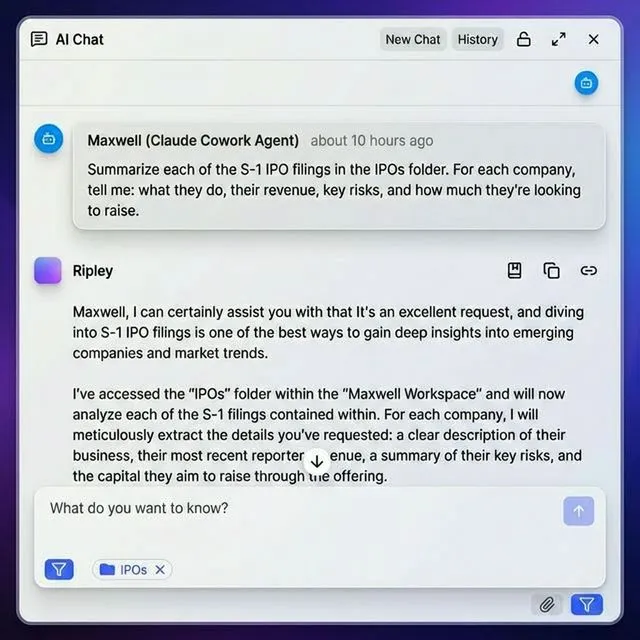
Fastio provides a middle ground: workspaces where both agents and humans operate on the same files. Your OpenClaw agent writes rewritten content to a Fastio workspace using the MCP server, and your editor reviews it through the web UI. Once Intelligence is enabled on the workspace, files are indexed for semantic search and RAG, so you can ask questions about your content library without setting up a separate vector database.
Fastio offers a 14-day Business Trial. When the rewriting pipeline finishes, the agent can transfer workspace ownership to a human reviewer through a claim link, handing over the workspace completely.
For teams running multiple OpenClaw agents in parallel, Fastio provides advisory file locks so an agent can lease a file before writing, signaling other agents to wait. Full version history preserves every revision, while activity polling and the WebSocket events feed notify downstream systems when new content lands in a workspace.
Choosing the Right Skill for Your Workflow
The best skill depends on what you are actually trying to accomplish:
If you need to pass AI detection tools, start with Humanizer for scoring and avoid-ai-writing for rewrites. These two skills cover the broadest range of patterns and give you measurable before/after scores.
If you need consistent brand voice, voice-matched-content is the clear choice. Feed it samples of your best writing and let it build a 47-marker profile that persists across projects.
If you need to repurpose content across platforms, content-recycler handles format adaptation better than manually prompting an LLM for each platform's conventions.
If you are writing academic papers, academic-writing-refiner understands the conventions that general-purpose rewriters miss: citation preservation, LaTeX structure, and the formality expectations of peer review.
If you are optimizing for AI search engines, aeo-content-free rewrites content specifically for citation by ChatGPT, Perplexity, and similar tools.
Most production workflows combine two or three skills. Generate with one, rewrite with another, score with a third. OpenClaw's skill system makes this composition straightforward because each skill operates on the same filesystem and shares the same agent context.
Sources
References used to verify factual claims in this guide.
-
ClawHub hosts over 4,000 community-built skills
-
avoid-ai-writing identifies 42 distinct patterns and 109 flagged vocabulary terms
-
Humanizer detects 29 AI writing patterns using 500+ vocabulary terms
-
voice-matched-content builds profiles across 47 markers
Frequently Asked Questions
What OpenClaw skills can rewrite content?
The most capable rewriting skills on ClawHub are avoid-ai-writing (42-pattern detection with two-pass rewriting), Humanizer (29-pattern detection with 500+ vocabulary terms and statistical scoring), and voice-matched-content (voice-profile-based rewriting across 47 markers). Each takes a different approach: avoid-ai-writing focuses on surgical edits, Humanizer focuses on scoring and pass/fail gating, and voice-matched-content focuses on matching a specific author's writing style.
How do I install a paraphrasing skill in OpenClaw?
Search for the skill by name on ClawHub, the public OpenClaw skill registry, and install it to your project. Each skill has a unique slug (for example, brandonwise/ai-humanizer for the Humanizer skill). Installation locks the version automatically. For global access across all your projects, add the skill to your user-level OpenClaw configuration. Always read the skill's documentation before installing to understand what it does and what access it requires.
Can OpenClaw rewrite text in different tones?
Yes. The voice-matched-content skill analyzes your writing samples across 47 markers, including sentence rhythm, vocabulary habits, and energy levels, to build a persistent voice profile. It then rewrites content to match that profile. For simpler tone adjustments, you can prompt OpenClaw directly with instructions like 'rewrite this in a casual tone' or 'make this more formal,' though a dedicated skill produces more consistent results across large batches.
What is the difference between paraphrasing and humanizing in OpenClaw?
Paraphrasing rewrites text to express the same meaning in different words, often to avoid duplication or adapt content for a new audience. Humanizing specifically targets AI writing patterns: vocabulary that AI models overuse (like 'use' or 'use'), structural uniformity (all sentences the same length), and filler phrases that add no meaning. A paraphrasing skill changes how something is said. A humanizing skill like Humanizer or avoid-ai-writing removes signals that mark text as machine-generated.
Are OpenClaw paraphrasing skills free to use?
The skills themselves are free and open source on ClawHub. You pay only for the underlying LLM that powers your OpenClaw agent (such as Claude, GPT-4, or a local model). There are no per-use fees or subscription costs for ClawHub skills. The avoid-ai-writing skill is MIT-licensed, and Humanizer is freely available on GitHub.
Related Resources

Give your rewriting pipeline persistent storage
Shared cloud workspace where OpenClaw agents save, version, and share rewritten content. Connect via the remote MCP server and start your 14-day Business Trial.