7 Best AI Code Detectors in 2026, Tested and Compared
GitHub Copilot writes 46% of code for its users, and over 80% of developers now use AI coding tools weekly. These seven code-specific detectors help engineering teams, universities, and code reviewers identify AI-generated code with accuracy rates from 90% to 98%, each optimized for different workflows and budgets.


Why AI Code Detection Matters in 2026
GitHub Copilot writes 46% of code for its users, with Java developers hitting 61%. That is not a forecast or a pilot program number. It is the current baseline for 15 million active Copilot users, and it does not account for code generated by Claude Code, Cursor, Codeium, or any of the other assistants that have become standard development tools.
The detection problem is straightforward: when a significant fraction of code in a repository is machine-generated, teams need to know which parts came from AI. Engineering leaders need audit trails for compliance. University instructors need to evaluate student submissions fairly. Code reviewers need to know whether they are reading a human developer's logic or an AI model's statistical prediction.
General AI text detectors do not solve this. They measure perplexity (how surprising word choices are) and burstiness (variation in sentence complexity), metrics that work well for essays but fail for code. Programming languages are intentionally predictable and structured. A function that sorts a list in Python looks roughly the same whether a human or an AI wrote it. Text detectors applied to code produce false positive rates that make them unreliable for production use.
Code-specific detectors take a different approach. They analyze abstract syntax trees, variable naming conventions, comment density, import ordering, and error handling patterns. These structural signals differ meaningfully between human developers and AI models. Purpose-built code detectors consistently achieve 90-95% accuracy on independent benchmarks, compared to 70-80% when general text detectors are applied to source code.
The demand is growing from multiple directions. Students including AI-generated work in assessed assignments jumped from 3% in 2024 to 12% in 2026. Engineering teams deploying AI agents like Nous Research Hermes Agent for automated code generation need verification before that output reaches production. We evaluated seven code-specific detection tools to find which ones actually deliver on their accuracy promises.
Related guides
- Best AI Code Review Tools in 2026: 9 Options ComparedAI code review tools analyze pull requests before a human reviewer sees the code, catching bugs, flagging security...
- Best AI Code Checkers: Tools for Automated Code Review and QualityEighty-four percent of developers now use AI tools in their workflow, but fewer than a third trust the output. This...
- How to Set Up MCP Servers in VS CodeGuide to vscode mcp server setup: Model Context Protocol (MCP) servers in VS Code connect GitHub Copilot Chat to...
- How to Build an AI Code Review Agent with Fastio APIBuilding an AI code review agent with the Fastio API lets developers pull repository diffs into an agentic workspace...
- Best AI Coding Assistants in 2026: 12 Tools ComparedAI coding assistants now do far more than autocomplete. The best tools in 2026 handle multi-file refactors, run tests,...
- How to Connect Cursor AI to Amazon S3 Buckets for Code and Data WorkflowsCursor S3 integration allows developers using Cursor to connect agent mode directly to Amazon S3 buckets for reading...
More on this subject: AI Coding Assistants (82 guides)
How We Evaluated These Detectors
We tested each tool against a consistent set of code samples: human-written production code from open-source repositories, AI-generated code from ChatGPT, Claude, and GitHub Copilot, and hybrid samples where a human edited AI output. We focused on Python and JavaScript, the two most common targets for AI code generation.
Our evaluation criteria:
Accuracy
What percentage of samples did the tool classify correctly? We weighted false positives (flagging human code as AI-generated) more heavily than false negatives, since a false accusation carries more risk than a missed detection.
Language support
How many programming languages can the tool analyze? Teams working across multiple stacks need broad coverage.
Integration
Can the tool plug into existing workflows? VS Code extensions, GitHub Apps, CI/CD hooks, and API access all matter for daily use.
Privacy
What happens to submitted code? Some tools process client-side or auto-delete within minutes. Others retain submissions for model training.
Pricing
Is there a usable free tier? What does scaling to a team cost?
Here is a quick comparison of all seven tools:
- Span: 95% independently verified accuracy, 6 languages, enterprise pricing, API-first
- Codespy: 98% claimed accuracy, 6 languages, free tier (3 scans/month), VS Code and GitHub integrations
- Copyleaks CodeLeaks: 99%+ claimed accuracy, 40+ languages, from $13.99/month, LMS integrations
- GPTZero: ~92% overall accuracy, 6 languages, free tier, academic focus
- AICodePlag: 95% claimed accuracy, 20+ languages, free, auto-deletes code
- CodeGrade: accuracy not publicly disclosed, LMS-native, institutional pricing, education-only
- AICodeDetector.org: 90%+ claimed accuracy, 6 languages, free and unlimited, no signup required
A note on accuracy claims: most numbers above are vendor-reported. Only Span has published independent benchmark methodology with reproducible datasets. Take self-reported accuracy figures with appropriate skepticism.

The 7 Best AI Code Detectors for 2026
These tools are ordered by the strength of their independent validation and breadth of use cases, not by a single ranking metric. The right choice depends on whether you are auditing enterprise code, grading student assignments, or running quick checks during review.
1. Span
Span built span-detect-1, a machine learning classifier trained on millions of code samples from public GitHub repositories paired with AI-generated code from leading coding assistants. It works at the chunk level, analyzing 2,000 to 3,000 character blocks rather than individual lines, which gives it enough structural signal for reliable classification.
The model produces three outputs per chunk: AI-generated, human-authored, or abstain (when confidence is too low for a reliable call). That abstain category is unusual in this space and helps reduce false positives. In independent evaluation against roughly 45,000 balanced code samples, span-detect-1 hit 95% accuracy with a 5% abstain rate.
Span's research team also tested a competing detector that claimed 98% accuracy and found it "performed no better than chance at correctly classifying known AI-generated code." That finding is worth remembering when evaluating vendor claims across this list.
Key strengths:
- 95% accuracy independently validated on balanced datasets
- Tracks AI adoption metrics by team, developer, tool, and model
- Supports Python, TypeScript, JavaScript, Java, Ruby, and C#
- Line-level attribution within flagged chunks
Limitations:
- No self-serve free tier (enterprise sales process required)
- Accuracy degrades below 700-character chunks, limiting use on short snippets
Best for: Engineering leaders who need to measure and manage AI tool adoption across the organization.
Pricing: Contact Span for platform or API pricing.
2. Codespy
Codespy trained its detection engine on outputs from twelve AI coding models: Copilot, Claude Code, Codeium, Replit Ghostwriter, StarCoder, Cursor, and others. That breadth of training data matters because different AI models produce different code patterns, and a detector trained only on ChatGPT output will miss code from newer tools.
The tool highlights flagged sections at the line level, showing reviewers exactly which parts of a file triggered detection. It integrates with VS Code as an extension, connects to GitHub as an App for automatic scanning on push, and is available as a ChatGPT plugin.
Key strengths:
- Claims 98% accuracy across Java, Python, JavaScript, C++, C#, and PHP
- VS Code extension brings detection into the code review workflow
- GitHub App scans code automatically on push events
- Trained against 12 distinct AI coding models
Limitations:
- Free tier limited to 3 scans per month
- Self-reported accuracy lacks published independent validation
Best for: Developers who want AI code detection integrated directly into their editor and repository workflow.
Pricing: Free (3 scans/month). Paid plans for higher volume. Enterprise and white-label reporting options.
3. Copyleaks CodeLeaks
Copyleaks built CodeLeaks as a dedicated source code layer on top of their established plagiarism detection platform. The key differentiator is how it reads code: as individual tokens based on each programming language's syntax, rather than treating code as plain text.
This token-level approach means CodeLeaks catches code that was restructured, had variables renamed, or had sections reordered. It also detects code licenses alongside AI detection, flagging potential copyright issues in the same scan.
Key strengths:
- Supports 40+ programming languages for AI code detection
- Function-level analysis catches restructured and renamed code
- License detection identifies potential copyright issues
- LMS integrations for Canvas, Moodle, and Blackboard
Limitations:
- Code detection is bundled into the broader Copyleaks platform, not sold standalone
- Credit-based pricing adds complexity for teams that only need code checks
Best for: Universities and compliance teams that need plagiarism checking and AI detection in one platform.
Pricing: Free tier (10 credits/month). Personal plans from $13.99/month. Enterprise and education plans are custom-priced.
4. GPTZero
GPTZero expanded from text detection into code analysis, adapting its perplexity and burstiness scoring for programming languages. The interface includes a language selector for Python, JavaScript, PHP, Java, C, and C++, which helps the tool apply language-specific analysis patterns.
The platform's academic credentials are strong: coverage from TechCrunch, Forbes, and The New York Times, plus established relationships with universities. For teams already using GPTZero for essay detection, adding code checks through the same dashboard is convenient.
Key strengths:
- Established platform with broad academic trust
- API with client libraries in 17 programming languages for easy integration
- Sentence-level scoring reports useful for explaining results to stakeholders
Limitations:
- Perplexity-based detection is inherently weaker for code than prose, since code is designed to be predictable
- Less specialized than code-first tools like Span or Codespy
Best for: Teams already on GPTZero for text detection who want code and prose checking in one platform.
Pricing: Free tier available. Pro plans from $10/month with higher scan limits.
5. AICodePlag
AICodePlag uses NLP, pattern recognition, and machine learning to detect AI-generated code across 20+ languages. The tool's strongest selling point is privacy: submitted code is processed in memory and auto-deleted within minutes. Nothing is permanently stored.
The detection output includes probability scores with confidence intervals rather than a binary yes/no answer, which gives reviewers more nuance when making decisions. AICodePlag also offers language-specific detection algorithms for frameworks like React, providing deeper analysis for common frontend patterns.
Key strengths:
- Up to 95% claimed accuracy with probability scores and confidence intervals
- 20+ languages including Python, JavaScript, Java, C++, Ruby, PHP, Swift, Kotlin, and Rust
- Code auto-deleted within minutes, never permanently stored
- Language-specific algorithms for framework-level detection
Limitations:
- Relatively new with limited third-party validation
- No IDE extensions or CI/CD integrations
Best for: Teams handling proprietary code who need broad language coverage without data retention concerns.
Pricing: Free to use.
6. CodeGrade
CodeGrade is built specifically for computer science education, with AI detection integrated into its autograding platform. It goes beyond string matching to analyze code logic, catching renamed variables, reordered functions, and other techniques students use to disguise AI-generated submissions.
The cross-semester comparison feature is particularly useful for CS departments: it detects when solutions from previous terms are resubmitted, whether by the same student or circulated among peers.
Key strengths:
- Native integration with Canvas, Moodle, and Blackboard
- Cross-semester comparison catches recycled AI-generated solutions
- Logic analysis evaluates behavior patterns, not just syntax matching
- Plagiarism detection on every plan
Limitations:
- Built for academic use only, not available for enterprise code review
- No public accuracy benchmarks for the AI detection component
Best for: CS instructors who want assignment grading and AI detection in one platform.
Pricing: Institutional licensing. Free autograding tier with limited features.
7. AICodeDetector.org
AICodeDetector.org is the simplest tool on this list: paste code, get a result. No account creation, no credit card, no scan limits. It uses pattern recognition to identify coding styles, naming conventions, and structural patterns that distinguish AI output from human work.
The tool also offers a "Compare Two Codes" mode for side-by-side analysis, useful when you want to check whether a code submission matches a known AI-generated pattern.
Key strengths:
- Unlimited scans, no registration required
- 90%+ accuracy for Python, JavaScript, PHP, C, C++, and Java
- Side-by-side comparison feature for checking two code samples
- Client-side processing when possible for better privacy
Limitations:
- Browser-only tool with no IDE, GitHub, or CI/CD integrations
- Less granular than paid tools, with no line-level highlighting or detailed confidence scoring
Best for: Quick, no-commitment checks when you need a fast opinion on a code snippet.
Pricing: Free, no registration required.
Detecting Code from Hermes Agent and Other AI Coding Workflows
AI code detection started as a way to catch students using ChatGPT on homework. In 2026, the bigger application is verifying output from autonomous coding agents.
When you run Nous Research Hermes Agent, Claude Code, or similar agents that generate code as part of larger workflows, the output often goes straight into a repository without the scrutiny that human-written code receives. Detection tools can serve as a quality gate in this pipeline: scan agent output before merge, flag sections that need human review, and maintain an audit trail of what was generated versus what was hand-written.
The challenge grows with multi-model workflows. Different AI models produce different code signatures, and a detector trained only on ChatGPT might miss patterns from Cursor or Copilot. Tools like Span and Codespy that train against outputs from multiple models handle this better than single-model detectors.
A typical agent workflow integration looks like this: the agent generates code, a detection tool scans it during CI or pull request review, flagged sections go to a human reviewer, and both the code and detection results get stored where the whole team can access them. For that last step, you can use local repositories, S3 buckets, or Google Drive. For teams that want versioned storage with built-in audit trails, platforms like Fastio provide shared workspaces where detection reports, flagged files, and agent output stay organized. Once enabled, Intelligence Mode indexes everything for semantic search, so you can query "which files were flagged last week" instead of digging through folders. Plans start at $9.99 per month with 250 GB of storage, and a 14-day Business Trial is available at fast.io/pricing.
The point is not to prevent AI code generation. It is to know what AI wrote, review it with the right level of scrutiny, and keep a clear record for your team.
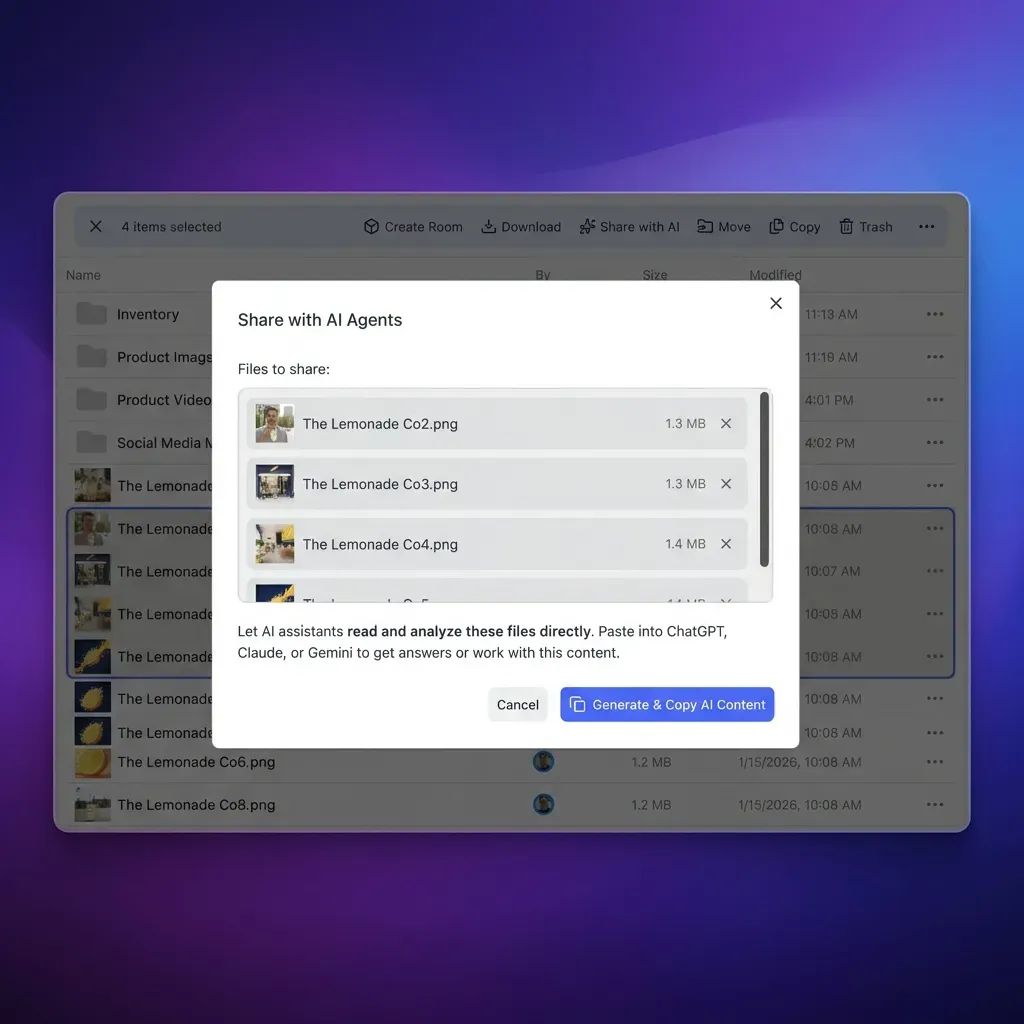


Track and share AI code review results in one workspace
A collaborative workspace with audit trails, version history, and Intelligence Mode for searching code review reports once enabled.
Choosing the Right AI Code Detector
The best detector depends on your workflow and budget.
Enterprise engineering teams should start with Span. Its independently validated accuracy, multi-model training, and adoption analytics give engineering leaders the data they need to manage AI tool usage across the organization. The enterprise pricing reflects the depth of analytics.
Development teams focused on code review will get the most value from Codespy. Its VS Code extension and GitHub App make detection part of the existing review workflow rather than a separate step. Start with the 3 free monthly scans to evaluate before committing to a paid plan.
Universities and CS programs should look at Copyleaks CodeLeaks or CodeGrade. Both integrate directly with major LMS platforms and handle the specific patterns of student submissions, including cross-semester comparison and logic-level analysis.
Teams handling sensitive or proprietary code should consider AICodePlag. Its auto-delete model means your code is never retained on external servers.
Budget-conscious teams can get started with AICodeDetector.org for unlimited free scans, then upgrade to a paid tool when detection becomes part of their formal workflow.
One practical approach: run two detectors. Use a primary tool like Span or Codespy for your regular workflow and a free tool like AICodeDetector.org as a cross-check. No single detector is perfect, and agreement between two independent tools is stronger evidence than either one alone.
Sources
References used to verify factual claims in this guide.
-
GitHub Copilot generates an average of 46% of code written by its users, with Java developers reaching 61% 92% of U.S.-based developers use AI coding tools both in and outside of work
-
Students including AI-generated text in assessed work rose from 3% in 2024 to 12% in 2026
-
span-detect-1 achieves 95% accuracy at 3,000-character chunk sizes with a 5% abstain rate, validated on approximately 45,000 balanced samples
Frequently Asked Questions
Can AI-generated code be detected?
Yes, but with important caveats. Code-specific detectors analyze patterns in abstract syntax trees, variable naming conventions, comment density, and import ordering to distinguish AI output from human work. Purpose-built tools achieve 90-95% accuracy on independent benchmarks. Detection becomes harder when humans edit AI output or when code follows highly standardized patterns like boilerplate configuration files. No tool is 100% reliable, and results should inform human review rather than replace it.
What is the most accurate AI code detector?
Based on independent validation, Span's span-detect-1 model achieves 95% accuracy at 3,000-character chunk sizes, tested against roughly 45,000 balanced datasets. Codespy and Copyleaks claim higher rates (98-99%), but Span's research found that at least one competitor's 98% claim did not hold up under controlled testing conditions. Accuracy varies significantly by programming language, code length, and whether the code was edited after generation.
How do universities detect AI-generated code in assignments?
Most universities use platforms like CodeGrade or Copyleaks CodeLeaks that integrate directly with learning management systems such as Canvas and Moodle. These tools compare submissions against known AI patterns, check for cross-semester reuse, and analyze code logic rather than just string matching. Some institutions require students to submit AI usage declarations alongside their code. Detection is typically one part of a broader academic integrity process, not a standalone judgment.
Is using AI to write code considered plagiarism?
It depends on context. In academic settings, most universities now set specific policies on AI code generation. Some ban it for certain assignments, while others allow it with proper attribution. In professional settings, using AI coding assistants is widely accepted, but some organizations require disclosure for compliance, security review, or intellectual property reasons. The key distinction is between using AI as a development tool versus submitting AI output as entirely your own original work.
How do AI code detectors differ from general AI text detectors?
General text detectors measure perplexity (how surprising word choices are) and burstiness (variation in sentence complexity). These metrics work for essays but fail for code, because programming languages are intentionally predictable and structured. Code-specific detectors instead analyze abstract syntax trees, function naming patterns, import organization, comment placement, whitespace conventions, and error handling styles. They are trained on datasets of real developer code paired with AI-generated equivalents from specific models like Copilot, Claude, and ChatGPT.
Related Resources

Track and share AI code review results in one workspace
A collaborative workspace with audit trails, version history, and Intelligence Mode for searching code review reports once enabled.