Best AI Chatbots for Business in 2026: 9 Platforms Compared
AI chatbots now handle the majority of routine customer interactions, but choosing one for your business means evaluating deployment features that most roundups ignore: CRM integration, human-agent handoff, multi-channel support, and per-resolution pricing. This guide compares nine platforms across those dimensions, organized by business size and use case, so you can pick the right tool without overpaying for features you won't use.


Why Picking the Right Chatbot Matters More Than Ever
AI-handled customer service tickets now cost between $0.50 and $1.05 each, while human-handled tickets run $8 to $12 per interaction. That gap explains why IBM found that businesses deploying AI chatbots for tier-one support cut operating costs by 30% on average. But the savings only materialize when the chatbot actually fits your workflow.
The problem with most "best chatbot" lists is they lump consumer AI assistants (ChatGPT, Claude, Gemini) together with purpose-built business platforms (Intercom, Zendesk, Freshdesk). These are different categories solving different problems. A marketing team evaluating ChatGPT Enterprise for internal productivity needs a completely different feature set than a support team deploying Intercom Fin to deflect 10,000 tickets a month.
This comparison focuses on what matters for business deployment: how the chatbot connects to your CRM, whether it can hand conversations to a human agent mid-thread, what channels it covers, and what you actually pay per interaction or per seat.
Related guides
- 9 Best AI Customer Service Agent Platforms in 2026AI customer service agents now resolve 55-70% of support tickets without human help. This guide compares nine platforms...
- 10 Best AI Chatbot Apps in 2026, Ranked by What You Can Actually Do With ThemMobile-only AI chatbot users in the U.S. jumped from 13 million to 110 million in under two years, yet most roundups...
- PolyAI Review 2026: Voice AI Agents for Customer ServicePolyAI raised $86 million in late 2025 at a $750 million valuation, making it one of the best-funded voice AI startups...
- Best Free AI Agent Tools 2026: Top 12 Platforms ComparedBuilding autonomous agents doesn't have to be expensive. The free AI agent ecosystem now offers professional frameworks...
- Best AI for Math in 2026: 9 Solvers, Tutors, and Chatbots ComparedPhotomath has 220 million downloads, but pointing your phone at a math problem won't help when you need to understand...
- Best AI Platforms in 2026: 9 Options Compared for Developers and TeamsOpenAI's API now processes over 15 billion tokens per minute, yet most platform comparison guides still only cover LLM...
More on this subject: AI Tool Directories and Comparisons (231 guides)
How We Evaluated These Platforms
We scored each platform across five criteria that determine real-world business value:
CRM integration depth. Does the chatbot read from and write to your CRM natively, or does it require middleware like Zapier? Native integrations reduce setup time and keep customer data in sync.
Human handoff quality. When the bot hits its limits, how smoothly does the conversation transfer to a live agent? The best platforms pass full conversation context so the customer never repeats themselves.
Multi-channel coverage. Can you deploy the same bot across your website, email, WhatsApp, Slack, and SMS without rebuilding it for each channel?
Analytics and reporting. Can you measure resolution rates, customer satisfaction, and cost per interaction without exporting data to a separate BI tool?
Pricing transparency. Per-seat, per-resolution, or usage-based? We flagged platforms where the sticker price hides significant add-on costs.
The 9 Best AI Chatbots for Business
Here is a quick comparison before the detailed reviews:
1. Intercom Fin
Intercom Fin is the strongest option for teams that want a chatbot handling customer support at scale. Fin charges $0.99 per successful resolution, meaning you pay only when the bot actually solves a customer's problem, not when it merely responds.
Fin resolves an average of 67% of conversations without human involvement across Intercom's 7,000+ customers. The platform includes built-in handoff workflows that pass full conversation context to human agents when the bot cannot resolve an issue. Fin supports deployment across web chat, email, WhatsApp, SMS, and social channels from a single configuration.
The catch: Fin requires at least one paid Intercom seat ($29-$139/month) when used inside Intercom. Running Fin standalone with other platforms like Salesforce or Zendesk requires a minimum of 50 resolutions per month ($49.50).
Best for: Mid-to-large support teams handling 500+ conversations per month who want predictable per-outcome pricing.
2. Zendesk AI Agents
Zendesk's AI agents are built into every Suite and Support plan, starting at $19/agent/month. Each agent gets a free monthly allocation of automated resolutions (typically 5-15 per agent). Additional resolutions cost $2.00 each.
The real cost driver is the Advanced AI add-on at $50/agent/month. Without it, you miss intelligent triage (auto-classifying tickets by intent, language, and sentiment), AI-generated replies from your help center content, and the agent copilot features. For a 10-person support team, that is an additional $500/month on top of base seats.
Zendesk's advantage is its existing ecosystem. If your team already uses Zendesk for ticketing, adding AI agents requires no migration. The bot reads your existing help center articles and learns from resolved tickets.
Best for: Teams already on Zendesk who want to automate without switching platforms.
3. Freshdesk Freddy AI
Freshdesk offers the most accessible entry point for teams watching their budget. Base plans start at $15/agent/month, and Freddy AI is a $49/month add-on to the Pro plan ($47/agent/month). The add-on includes 100 AI agent sessions per month, with additional sessions available for purchase.
Freddy handles ticket routing, sentiment analysis, and chatbot automation. The Freddy Copilot feature ($29/agent/month separately) gives human agents real-time AI assistance during live conversations, suggesting replies and surfacing relevant knowledge base articles.
The limitation is sophistication. Freddy's conversational AI is less capable than Intercom Fin or Zendesk's Advanced AI at handling multi-turn conversations with nuanced intent. For straightforward FAQ deflection and ticket triage, it performs well at a fraction of the cost.
Best for: Small teams (under 20 agents) that need basic AI automation without enterprise pricing.
4. ChatGPT Enterprise
ChatGPT Enterprise is not a customer-facing chatbot in the traditional sense. It is an internal productivity tool that gives your team access to GPT-5.5 (launched April 2026) with enterprise security controls.
The Business plan (renamed from "ChatGPT Team" in August 2025) costs $20/seat/month on annual billing and includes shared workspaces, SAML SSO, SOC 2 Type II compliance, and a guarantee that business data is not used for model training. Enterprise pricing is custom (industry estimates range from $60-$100+/seat/month) and adds SCIM provisioning, encryption key management, custom data retention policies, and advanced analytics.
Where ChatGPT Enterprise shines is internal use: drafting customer communications, summarizing meeting notes, analyzing sales data, and generating reports. It integrates with 60+ apps including Slack, Google Drive, and Salesforce. But it does not natively deploy as a customer-facing chat widget.
Best for: Organizations that want AI-powered internal productivity with enterprise-grade data governance.
5. HubSpot Chatbot
HubSpot's chatbot builder is free and included with the HubSpot CRM. You get a visual workflow builder for lead qualification, meeting scheduling, and answering common questions. The bot connects directly to HubSpot's contact records, deals, and tickets without any additional configuration.
For teams that need AI-powered responses (not just rule-based flows), HubSpot's Service Hub Professional starts at $100/seat/month and includes Breeze, HubSpot's AI assistant. Breeze can draft replies, summarize conversations, and surface relevant knowledge base articles.
The free chatbot is surprisingly capable for inbound marketing workflows. It can qualify leads based on form responses, route conversations to the right sales rep based on territory or deal size, and book meetings directly on a rep's calendar. The trade-off is that the free tier uses rule-based logic, not generative AI, so conversations follow pre-defined paths.
Best for: Sales and marketing teams already using HubSpot CRM who want chatbot functionality without a separate vendor.
6. Tidio
Tidio targets small businesses and e-commerce stores that need a chatbot running in minutes, not weeks. The free plan includes basic live chat and chatbot features. Paid plans start at $29/month (Starter) and $59/month (Growth). Lyro, Tidio's AI chatbot, is available as an add-on from $24.17/month.
Lyro uses your existing support content to generate conversational responses. It integrates natively with Shopify, WooCommerce, and WordPress, which makes it popular with online stores. The platform includes a no-code chatbot builder, mobile apps for managing conversations on the go, and seamless handoff to live agents.
Tidio's analytics are more limited than enterprise platforms, and its CRM integrations rely on Zapier rather than native connections. But for a business doing $50,000 to $5 million in annual revenue that needs a chatbot on their website and Shopify store, Tidio delivers the fastest time to value.
Best for: E-commerce businesses and small teams that want a quick, affordable chatbot with Shopify or WooCommerce integration.
7. Pluno
Pluno works in the same space as Intercom Fin and Zendesk AI Agents, but Pluno says it is built for B2B companies with technical products, where customer issues need troubleshooting rather than FAQ answers. Instead of replacing your help desk, it runs inside the one you already use. Pluno says it resolves tickets on its own, drafts replies for human agents, reviews conversations for quality, and escalates engineering issues with the context attached. Its main knowledge source is your team's resolved tickets, alongside help center articles, uploaded files, Confluence, Notion and live data from your own APIs.
On CRM integration, Pluno's documentation lists Zendesk, Intercom, Salesforce Service Cloud, HubSpot, Jira Service Management and Freshdesk as supported help desks. It writes replies, internal notes, tags and ticket fields back into that system, and the docs say your existing setup and reports stay in Salesforce or HubSpot. Salesforce, HubSpot and Jira Service Management are set up together with the Pluno team on an onboarding call.
Human handoff is covered in detail in the docs. Pluno escalates when it cannot find a complete answer, when information is missing, ambiguous or contradictory, or when a request needs a business decision such as a refund. The ticket goes back to your queue with an internal note on the customer's problem, what Pluno found and, when it is confident, the next steps. Pluno stops answering once a human agent replies publicly. The docs also say there is no built-in rule for customers who ask for a person, so you add a workflow for that. For bugs, Escalation Copilot sends a written report to Slack, Jira, Linear, Microsoft Teams or incident.io and syncs engineering's updates back to the ticket.
For channels, the docs list email, web forms, chat, WhatsApp and other messaging channels, the web widget, and phone calls through call transcripts. Pluno's home page adds Discord and Telegram communities, and a separate Product Agent answers inside your own product. Pluno's setup guide says chat deflection in Zendesk needs a plan with the Conversations API (Suite Professional or higher). For analytics, a reporting dashboard counts AI-resolved, team-handled and escalated tickets with filters by channel, brand and ticket form, and a Topics & Trends view groups tickets by subject. Quality Assurance, which scores every solved ticket against your own criteria, is a paid add-on.
Pricing is published, in euros. A base fee scales with monthly ticket volume, starting at €249/month for under 500 tickets (€210/month billed annually), plus €49 per seat per month for AI Copilot and €0.90 per resolved ticket for Deflection AI. Pluno says escalations never count as resolutions, a ticket counts as resolved after 72 hours with no customer reply to Pluno's answer, and every AI-resolved ticket is tagged in your help desk so you can check the bill. Quality Assurance (€35 per agent per month) and the Troubleshooting Agent (from €99/month) cost extra. Pluno's customers page lists Innovorder, Kojo and Smartness among its case studies, and Pluno says Innovorder resolves 67% of its chat tickets with AI.
Best for: B2B support teams with technical products who want AI that learns from past tickets and hands bugs to engineering, without leaving the help desk they already use.
Enterprise Platforms: Salesforce and Ada
Two platforms deserve separate mention because they operate at a different scale and price point.
Salesforce Agentforce (formerly Einstein Bots) is the native chatbot for Salesforce Service Cloud. Einstein Bots are included in the Unlimited edition ($350/user/month). For Enterprise edition ($175/user/month), bots are an add-on. The bot reads customer data directly from Salesforce objects, routes conversations based on case fields, and logs every interaction as a Service Cloud case.
If your organization already runs on Salesforce, Agentforce eliminates the integration question entirely. The bot has full access to your customer records, knowledge base, and case history. The downside is cost: even at the Enterprise tier, you are paying $175/user/month before the chatbot add-on. For a 50-person support org, that is a significant commitment.
Ada is an enterprise automation platform built for organizations handling tens of thousands of support conversations monthly. Pricing is custom, with annual contracts typically starting around $30,000 and scaling into six figures for high-volume deployments. Ada charges $1.00 to $3.50 per successful resolution.
Ada's strength is its automation depth. The platform can handle complex, multi-turn conversations across channels and provides detailed analytics on deflection rates, customer satisfaction, and cost per resolution. It integrates with most major CRMs and helpdesks via API.
Best for: Large organizations (500+ employees) with established Salesforce or high-volume support operations.



Give Your Team a Document-Aware AI Layer
Fastio indexes your business files for RAG-powered search and chat with citations. generous storage.
Where Business Chatbots Fall Short
Even the best chatbot platforms share common limitations that you should plan around.
File and document handling is limited. Most chatbots answer from a knowledge base or help center, and some, such as Pluno, can also draw on uploaded files. Few are built to search across all of your business documents, extract specific data points, or answer questions about any file's contents with citations. If a customer asks "What does section 3.2 of my contract say about renewal terms?", traditional chatbots cannot help.
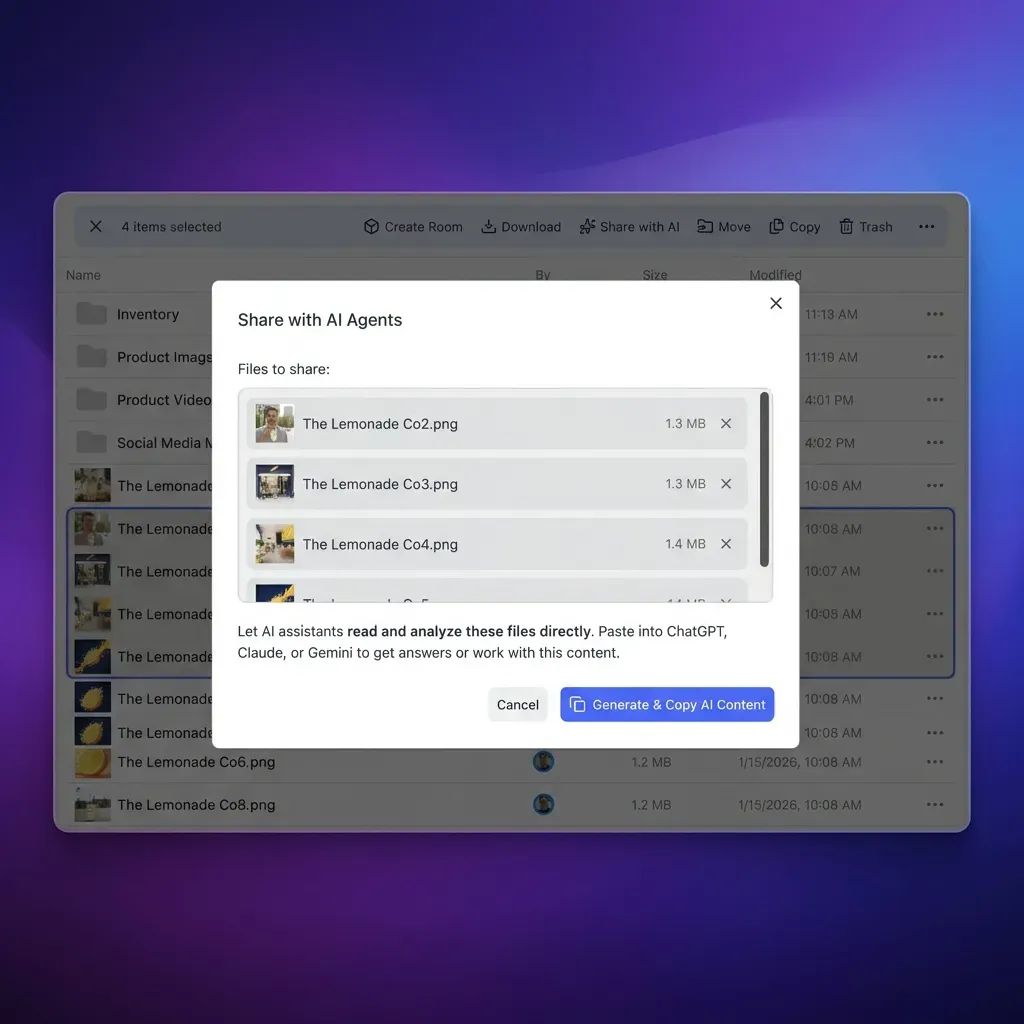
This is where workspace intelligence platforms fill the gap. Fastio, for example, indexes uploaded documents and enables RAG-powered chat with page-level citations. An agent or team member can ask questions about files in a workspace and get answers grounded in the actual document content, not just pre-written help articles. The Intelligence Mode auto-indexes files when they are uploaded, so there is no separate configuration step.
For teams that need their chatbot to reference real business documents (contracts, proposals, invoices, technical specs), the combination of a customer-facing chatbot for routine queries and a workspace intelligence layer for document-specific questions covers more ground than either approach alone. Fastio's Business Trial includes generous storage and monthly credits during the trial, making it straightforward to test whether document-aware AI chat fits your workflow.
Human handoff still needs work. Even Intercom and Zendesk, which have the most mature handoff features, occasionally lose conversation context during transfers. Train your team to review the bot transcript before responding, and set up automated summaries that get attached to the handoff.
Multi-language support is inconsistent. Most platforms claim multi-language support, but the quality of AI-generated responses drops significantly outside English, Spanish, French, and German. If you serve customers in languages like Japanese, Korean, or Arabic, test thoroughly before committing.
How to Choose the Right Chatbot for Your Business
Start with your conversation volume and existing tech stack, not feature lists.
Under 500 conversations per month: Tidio or HubSpot's free chatbot. You do not need per-resolution pricing at this scale, and both platforms get you running in a day. If you are on Shopify, Tidio is the faster path. If you use HubSpot CRM, the native chatbot avoids adding another vendor.
500 to 5,000 conversations per month: Intercom Fin or Freshdesk Freddy. At this volume, per-resolution pricing starts to matter. Intercom Fin at $0.99/resolution is cost-effective if the bot resolves 60%+ of conversations. Freshdesk Freddy is the budget alternative if you need basic automation without premium pricing.
5,000+ conversations per month: Zendesk AI Agents (if you are already on Zendesk), Salesforce Agentforce (if you are on Salesforce), or Ada (if you need a standalone platform with deep customization).
Technical B2B support with complex tickets: Pluno, if you want to keep your current help desk and add AI that learns from past tickets and escalates bugs to engineering with context. If you are already on Intercom or Zendesk and want the AI built into the help desk itself, Fin or Zendesk AI Agents avoid adding a second vendor.
Internal productivity, not customer-facing: ChatGPT Enterprise or Business plan. Use it for content drafting, data analysis, and internal Q&A. For document-specific intelligence across your business files, pair it with a workspace platform like Fastio that indexes and makes files queryable.
Before signing an annual contract, run a 30-day pilot with your actual support data. Measure three things: resolution rate (what percentage of conversations the bot handles without a human), customer satisfaction score on bot-handled conversations, and cost per resolution compared to your current human-agent cost. Those three numbers tell you everything you need to know about whether the investment pays off.
Sources
References used to verify factual claims in this guide.
-
AI-handled tickets cost $0.50 to $1.05 each, while human-handled tickets cost $8 to $12
-
Businesses deploying AI chatbots for tier-one support cut operating costs by 30%
-
67% of consumers have interacted with a chatbot for customer support in the past year
-
Intercom Fin resolves an average of 67% of conversations without human involvement across 7,000+ customers
-
ChatGPT Business plan costs $20/seat/month on annual billing as of April 2, 2026
-
Zendesk additional automated resolutions cost $2.00 each
Frequently Asked Questions
What is the best AI chatbot for small business?
Tidio and HubSpot's free chatbot are the strongest options for small businesses. Tidio works best for e-commerce stores on Shopify or WooCommerce, with AI capabilities starting at $24.17/month via the Lyro add-on. HubSpot's chatbot is free and connects directly to the HubSpot CRM for lead qualification and meeting scheduling. For businesses under 500 monthly conversations, either platform delivers enough automation without enterprise pricing.
How much does a business AI chatbot cost?
Pricing varies widely by model. Free options exist (HubSpot chatbot, Tidio free tier). Per-seat pricing ranges from $15/agent/month (Freshdesk) to $175+/user/month (Salesforce). Per-resolution pricing runs $0.99 (Intercom Fin) to $3.50 (Ada) per successful outcome. ChatGPT Business costs $20/seat/month for internal use. Enterprise platforms like Ada start around $30,000/year. The total cost depends on your conversation volume, team size, and whether you need add-ons like advanced AI triage.
Can AI chatbots replace customer service agents?
Not entirely. The best-performing chatbots resolve 60-70% of customer conversations without a human, but complex issues, emotional situations, and multi-step problems still need human agents. IBM data shows businesses cut customer service costs by 30% with AI chatbots, but that reduction comes from handling routine queries (order status, password resets, FAQ lookups) more efficiently, not from eliminating support staff. Most organizations redeploy freed-up agents to handle higher-value interactions.
Which chatbot integrates with Salesforce?
Salesforce Agentforce (formerly Einstein Bots) is the native option, included in the Unlimited edition or available as an add-on for Enterprise. Intercom Fin also integrates with Salesforce and can run as a standalone bot connected to your Salesforce data, with a minimum of 50 resolutions per month ($49.50). Zendesk AI Agents and Ada both offer Salesforce integrations through their respective platforms.
What is the difference between a business chatbot and ChatGPT?
ChatGPT is a general-purpose AI assistant used for conversation, writing, and analysis. Business chatbots like Intercom Fin, Zendesk AI Agents, and Freshdesk Freddy are customer-facing platforms designed for deployment on websites and messaging channels. Business chatbots include features that ChatGPT lacks: CRM integration, human-agent handoff, multi-channel deployment, conversation analytics, and per-resolution pricing. ChatGPT Enterprise is closer to a business tool, but it is designed for internal team productivity rather than customer-facing support automation.
Related Resources

Give Your Team a Document-Aware AI Layer
Fastio indexes your business files for RAG-powered search and chat with citations. generous storage.