How to Design and Build Scalable AI Workflows
AI agents perform up to 4x better when equipped with persistent memory interfaces. This guide explains how to design and build scalable AI workflows around a centralized company brain, using structured schemas and human-in-the-loop review gates.


Why Scalable AI Workflows Require Persistent Memory
AI agents perform up to 4x better when equipped with persistent memory interfaces [Gartner 2026 Research]. The performance gap highlights the core limitation of stateless pipelines: without persistent memory, workflows collapse under the burden of context limits. Developers attempting to deploy autonomous systems often run into the context tax, where entire message histories must be repeatedly passed to the model, leading to ballooning latency and token costs.
To solve this, developers are designing architectures around persistent storage states. AI workflows are structured sequences of tasks executed by one or more AI agents, relying on persistent storage to maintain context, pass files, and log intermediate steps. Rather than treating memory as a local database key or a transient memory buffer, scalable systems treat the filesystem as the central source of truth.
Traditional approaches to agent memory rely on local disk storage, which fails when scaling across multiple cloud containers or serverless execution units. When an agent runs on a local computer, it can easily write context to a local database. However, once you deploy that agent to a distributed host, keeping that local state in sync becomes difficult. This is where centralized workspace storage becomes necessary, providing a single endpoint that agents read from and write to across sessions.
Centralized storage prevents state fragmentation. When multiple agents collaborate on a single task, they must pass files and state logs between each other. Passing files as raw JSON payloads or base64 strings inside chat messages quickly exhausts the context window. By storing files in a shared workspace, the agents pass simple file paths instead of the raw data. This preserves the context window for reasoning tasks and allows the agents to handle large files, including images, videos, and multi-page PDFs, without running out of tokens.
Related guides
- How to Build Persistent Storage for Agentic WorkflowsAgentic workflow storage lets autonomous agents maintain state, share files, and persist progress across long-running...
- How to Handle File Storage in n8n AI Agent Workflowsn8n AI agents need persistent storage to save files between workflow runs.
- How to Set Up File Storage for n8n AI Workflowsn8n AI workflows need persistent file storage to save documents, process AI outputs, and build RAG pipelines. This...
- How to Store CI/CD Build Artifacts Using the Fastio APIThis Fastio API guide shows you how to works alongside platforms like GitHub Actions and GitLab CI. Adding the Fastio...
- How to Build a Multi-Agent RAG System with Shared Workspace StorageMulti-agent architectures address the limitations of single-agent RAG systems by distributing tasks among specialized...
- How to Build Audio Transcription Agent Workflow StorageAudio transcription agent workflow storage manages the full data pipeline from audio file ingestion through...
More on this subject: Agent Memory and Storage (261 guides)
How to Design a Resilient Pipeline for AI Workflows
Building a production-ready AI workflow requires moving away from simple prompt chains. A reliable agentic pipeline consists of input validation, state storage, review gates, and final output delivery. This structured pipeline prevents agents from executing tasks on corrupt inputs or passing malformed outputs downstream.
The first stage is input validation. Before an agent begins processing, an automated step checks the input format and filters out invalid requests. This prevents downstream LLM calls from processing garbage data, which saves costs and prevents unexpected loops.
The second stage is state storage. As the agent moves through a multi-step task, it writes intermediate outputs to a persistent storage directory. If the agent fails at step three, it does not need to restart from step one. Instead, it inspects the state directory, reads the checkpoint, and resumes execution. This checkpointing process requires structured database tables or versioned document workspaces.
The third stage is the human-in-the-loop review gate. High-value workflows cannot run completely unsupervised. When an agent finishes drafting a document or generating code, the system writes the file to a pending folder and triggers an approval request. Only after a human approves the document does the workflow proceed to the final delivery stage. This review process provides a critical safety buffer, preventing hallucinations or logic errors from reaching the client.
The final stage is output delivery. Once approved, the system generates secure, external-facing links to hand off the deliverables to clients. In traditional pipelines, developers build custom sharing portals or use raw bucket policies on cloud object storage like Amazon S3 or Google Cloud Storage. While cloud buckets provide low-level security, they require writing complex access policies and building custom download pages for clients.
Fastio workspaces offer a structured alternative for this delivery phase. Instead of writing custom sharing code, agents can programmatically generate branded shares directly from the workspace. These shares can be configured as durable or expiring links, restricting access to approved domains. The entire process is logged, giving teams a clear audit log of when files were uploaded and when clients downloaded them.
Developing automated workflows cuts operational cycle times by up to 50% [ISG One 2026 Study]. Implementing structured review gates and persistent checkpoints ensures that these efficiency gains do not come at the cost of quality or security. Teams can test the pipeline on sample inputs before pushing it to production, keeping the entire process predictable and safe.
Compare AI Workflow Tools: Zapier, n8n, and Fastio
When selecting AI workflow tools, developers must balance ease of use with programmatic control. Traditional automation tools like Zapier or Make excel at simple event-driven routing. They allow non-technical teams to quickly connect an email trigger to an LLM step. However, these tools are built on rigid, sequential logic. They struggle when an agent must execute complex loops, write code, or self-correct based on error logs.
For developer-led workflows, platforms like n8n or Pipedream provide better flexibility, allowing custom JavaScript or Python scripts to run alongside visual blocks. When building reasoning-heavy agentic workflows, developers often turn to AI-native builders like Gumloop, which are designed specifically for LLM-based reasoning and data processing.
Yet, even when using advanced tools like n8n or Gumloop, a major bottleneck remains: file storage and context sharing. AI workflows produce large volumes of unstructured data, including text files, CSV files, and PDFs. Most workflow builders treat files as transient email attachments or require writing scripts to save them to external cloud folders.
This is where Fastio workspaces function as a shared substrate. While external automation tools handle process logic, Fastio provides the persistent storage layer where agents and human teams store and access files. Instead of moving transient files across scattered silos, developers connect external workflows directly to the workspace where files live, preserving version history and audit trails. Learn more on the Fastio Workspaces page.
This integration simplifies multi-agent pipelines. For example, a research agent can write its raw findings directly to a shared workspace folder. Downstream agents can poll the realtime activity feed or connect to the WebSocket events feed to detect the update and process the document. Throughout the entire process, all files remain in one secure space, preserving full version history with restore capabilities and maintaining a detailed activity log of actions by people and agents.
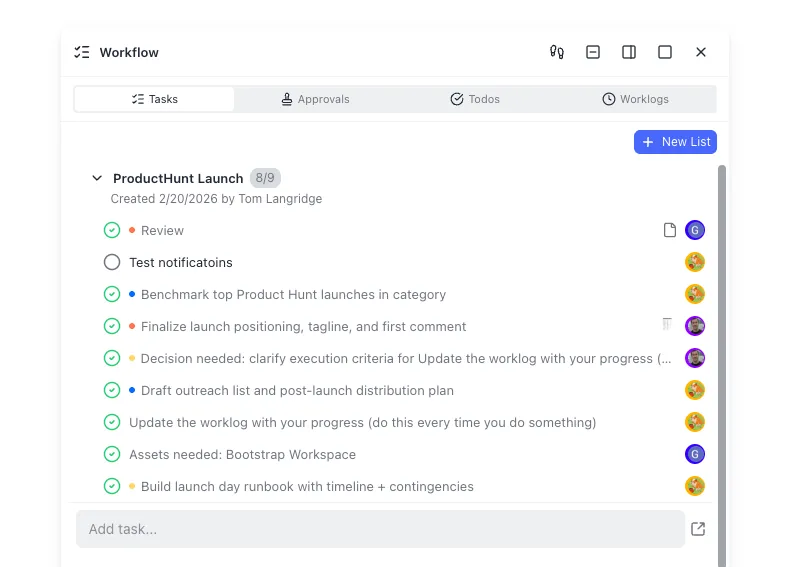


Build scalable agentic workflows
Provide your AI agents with a persistent workspace for structured data extraction, versioning, and shared context. Monthly plans start with a Business Trial of up to 14 days (credit card required); annual plans have no trial.
How to Build a Company Brain for Shared Agent Context
The most effective way to scale AI workflows is to build them around a centralized repository of organizational knowledge, known as a company brain. When humans and agents work from the same files, folders, and shared context, they avoid duplicating research and coordinate more efficiently. Fastio serves as this centralized company brain, acting as a single secure platform where organizational data is stored and accessed by both people and autonomous tools.
In traditional setups, building a retrieval-augmented generation (RAG) system requires a complex developer stack. Developers must deploy a vector database, write scripts to extract text from PDFs, split the text into chunks, generate embeddings, and write custom query code. This multi-step process takes weeks to configure and requires ongoing maintenance to keep the vector database in sync with the primary file storage.
With Fastio, setting up a company brain takes about ten minutes. When you create a workspace and enable Intelligence Mode, files are indexed once Intelligence is active. This indexing process supports keyword matching and semantic meaning-based search, allowing users to query document contents using natural language. When Ripley, the built-in AI assistant, answers questions, it provides page-level citations pointing back to the specific source documents.
This shared company brain is accessible to both humans and programmatic agents. While team members query the brain through the web interface, external coding agents like Claude Code, Cursor, Codex, Gemini, or OpenClaw connect via the Fastio MCP server. Using the Model Context Protocol, these agents query the workspace, read files, and write new reports. The MCP server exposes streamable HTTP endpoints at /mcp and legacy Server-Sent Events at /sse, allowing any model to access the organization's files according to the MCP server documentation at mcp.fast.io/skill.md.
For example, a marketing team can upload their launch kits, competitive intelligence briefs, win-loss analyses, and investor updates to the workspace. A human editor can ask Ripley to summarize recent market trends across the documents. At the same time, an autonomous agent can query the MCP server to extract competitive details and write a weekly brief. Both humans and agents work from the exact same file context, ensuring consistency across all company communications.

Guide to Structured Document Extraction with Metadata Views
While semantic search is valuable for answering qualitative questions, scaling AI workflows often requires structured data. AI agents must extract specific dates, amounts, and statuses from thousands of documents to drive downstream databases. Instead of forcing agents to parse raw text files or write custom regex rules, developers can turn to automated document extraction.
Fastio provides structured extraction through a capability called Metadata Views. This feature allows teams to turn unstructured documents into a live, queryable database. Rather than configuring complex optical character recognition (OCR) templates, users describe the columns they want to extract in natural language. The system designs a typed schema, scans the workspace, matches relevant files, and populates a sortable, filterable spreadsheet.
The system supports seven distinct field types: Text, Integer, Decimal, Boolean, URL, JSON, and Date & Time. Because the extraction layer is managed at the workspace level, agents can query the metadata grid directly through the Fastio API or MCP server. This allows agents to filter files using structured values, such as finding all unsigned documents or extracting policy limits from a specific date range, without downloading and reading every file.
Consider how this structured approach applies across different industries:
Legal Operations: A legal operations agent can parse a folder of contracts to extract governing law, counterparty names, effective dates, and renewal terms. Instead of manually inspecting every page, the agent queries the Metadata View to generate a compliance report. For more details on legal document workflows, view the Metadata Views page.
Insurance Workflows: Insurance operations rely on extracting details from policy documents. By setting up columns for policy numbers, coverage limits, and named insureds, teams can populate a structured policy database. Agents can then query this grid to flag policies nearing expiration.
Financial Audits: Financial automation requires extracting transaction details. By setting up columns for line items, total amounts, and payment terms, a financial workflow can process incoming invoices, match them with purchase orders, and flag discrepancies for human review.
Media Tagging: In media production workflows, files are tagged with subjects, setting descriptions, and dominant colors. This metadata allows teams to organize thousands of assets without manual tagging, helping media teams quickly search and find specific files.
Handoff Steps and Concurrent Agent Management
When deploying multiple agents in parallel, developers must address write conflicts and project handoffs. If a research agent and a writing agent attempt to update the same project report simultaneously, local file writes can overwrite each other, leading to data loss.
Fastio handles concurrent access through automated per-file version history. Every time an agent updates a file, the workspace saves the change as a new version. If an agent writes incorrect data, a human administrator can inspect the version history and restore a prior version with a single click. This keeps agent actions auditable without requiring custom Git integration for document files.
This versioning works in tandem with secure cloud imports. Instead of download and upload loops, agents can pull files directly from Google Drive, Dropbox, OneDrive, or Box using OAuth-based Cloud Import. This preserves the original folder structure, allowing agents to ingest client data without local disk I/O.
Once the AI workflow is built and tested, developers need a way to hand over the organization to the client or business owner. Fastio supports formal ownership transfer. A developer can create an organization with a 14-day Business Trial, build the workspace, configure the MCP tools, and set up the extraction schemas.
When the setup is complete, the developer sends an ownership transfer link to the client. The client accepts the transfer, registers the organization, adds a credit card, and selects a paid plan. Fastio offers three subscription plans: Starter for $9.99 per month, Business for $49.99 per month, and Enterprise for $199.99 per month. Monthly plans start with a Business Trial of up to 14 days (credit card required); annual plans have no trial. View the options on the pricing page.
Following the transfer, the client owns the organization and manages billing, while the developer's agent retains administrative access to run tasks via the MCP server. This division of labor separates system administration from operational execution, keeping the agent focused on task automation while the client maintains control over billing and data governance.
Sources
References used to verify factual claims in this guide.
-
Developing automated workflows cuts operational cycle times by up to 50%.
-
AI agents perform up to 4x better when equipped with persistent memory interfaces.
-
Fastio offers three subscription plans: Starter for $9.99 per month, Business for $49.99 per month, and Enterprise for $199.99 per month. Monthly plans start with a Business Trial of up to 14 days (credit card required); annual plans have no trial.
Frequently Asked Questions
What are AI workflows?
AI workflows are structured sequences of tasks executed by one or more AI agents, relying on persistent storage to maintain context, pass files, and log intermediate steps.
How do you build an AI agent workflow?
To build a reliable agent workflow, you should design a structured pipeline consisting of input validation, state storage, review gates, and final output delivery. This separates reasoning tasks from data persistence and keeps outputs predictable.
What tools are used for AI workflow automation?
Common AI workflow tools include Zapier and Make for simple routing, n8n and Pipedream for developer-led scripts, and Gumloop for reasoning-heavy pipelines. Fastio acts as the centralized workspace where those automations store and share files.
Related Resources

Build scalable agentic workflows
Provide your AI agents with a persistent workspace for structured data extraction, versioning, and shared context. Monthly plans start with a Business Trial of up to 14 days (credit card required); annual plans have no trial.