How to Store CI/CD Build Artifacts Using the Fastio API
This Fastio API guide shows you how to works alongside platforms like GitHub Actions and GitLab CI. Adding the Fastio API to your CI/CD pipelines gives you scalable, globally distributed storage for build artifacts and deployment logs. Learn how to bypass native storage limits and give AI agents access to your build data.

Why Centralize Your Build Artifacts?
Build artifacts include the compiled files, binaries, container images, and test logs generated during your CI/CD process. Managing these files is necessary to keep delivery pipelines fast and reliable.
When teams rely strictly on the native storage of their CI runner, they often hit retention limits and storage quotas. Test reports and binaries get trapped inside the CI environment. That makes it hard for QA engineers, outside stakeholders, or AI agents to review the outputs without specialized access.
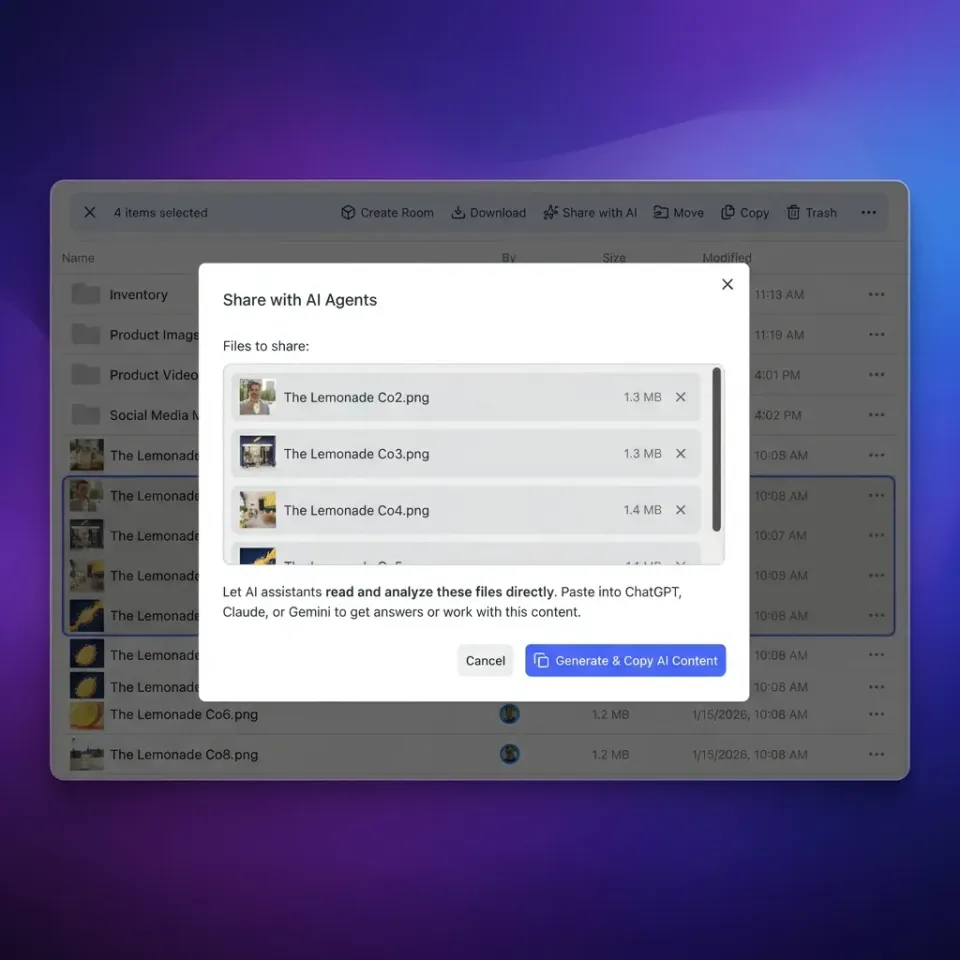
Moving your artifacts to a dedicated workspace decouples the build process from storage. This prevents redundant compilation and speeds up execution. Instead of rebuilding the same dependency tree or binary across multiple stages, your pipeline can pull the verified artifact directly from the workspace. This keeps things consistent across all deployment environments. Centralizing your artifacts also creates a single source of truth for debugging and auditing.
Helpful references: Fastio Workspaces, Fastio Collaboration, and Fastio AI.
Related guides
- How to Create Fastio Workspaces Programmatically via APIProgrammatic workspace creation allows developers to dynamically spin up isolated, intelligence-ready Fastio...
- AI Automation Storage API: Persistent Storage for Autonomous AgentsAn AI automation storage API provides programmatic access to persistent file storage that autonomous agents can use to...
- How to Extract Metadata from Google Workspace Files via APIGoogle Workspace files live entirely in the cloud, so there is no local file to parse with traditional metadata tools....
- How to Automate Fastio Workspaces with GitHub ActionsSetting up test environments manually slows down your deployment cycle. By using GitHub Actions to provision Fastio...
- How to Add File Storage to OpenAI Agents SDK ProjectsThe OpenAI Agents SDK gives you tools, handoffs, and guardrails for building multi-agent systems, but it has no...
- How to Build a RAG Pipeline with Fastio APIBuilding a reliable Retrieval-Augmented Generation pipeline often involves managing complex infrastructure. A RAG...
More on this subject: Agent Memory and Storage (261 guides)
What to check before scaling Fastio API guide for CI/CD artifact storage
Most modern CI/CD platforms include some form of native artifact storage. But these built-in solutions are usually designed for short-term convenience over long-term reliability or advanced workflows. For instance, GitHub Actions artifact storage defaults to a multiple-day retention policy and imposes overall repository storage limits.
If you exceed those limits, your older artifacts are automatically deleted. That becomes a major problem if you need to roll back to a previous software version or investigate an old bug. Sharing these native artifacts also requires granting users access to your version control repository. You cannot easily send a securely linked test log to a contractor without exposing your source code.
The biggest limitation is the lack of intelligence. Native storage solutions act as passive file directories. They do not index the contents of your test logs or make them searchable for automated debugging. As development teams increasingly rely on AI to speed up incident resolution, passive storage creates a bottleneck in the automation loop.
Benefits of Using Fastio Over Native GitHub Actions Storage
Fastio offers distinct advantages for teams building complex or agentic workflows, especially compared to the storage bundled with your code repository.
- Built-in Intelligence and RAG: Fastio serves as an intelligent workspace rather than a passive file directory. Once Intelligence is enabled for the workspace, Intelligence Mode indexes uploaded test logs and deployment manifests. This built-in Retrieval-Augmented Generation (RAG) means you do not need a separate vector database to make your build data searchable by AI agents.
- Capacity and Persistence: Fastio plans include persistent storage starting at 250 GB on Starter, with a 14-day Business Trial. This handles large compiled binaries and heavy debug logs that would otherwise exhaust native CI quotas.
- Agentic Handoffs and Ownership Transfer: Because Fastio supports ownership transfer, an automated agent can create a dedicated incident workspace, compile the logs, and then transfer ownership of that workspace to the engineering lead.
- Live activity and audit logs: After an artifact lands, long-poll
GET /current/activity/poll/{entityId}?wait=95&lastactivity={timestamp}or searchGET /current/events/search/to confirm the new file, then start the next pipeline stage or ask Ripley to summarize the log.


Give Your AI Agents Persistent Storage
Create an intelligent workspace to store your build outputs, manage pipeline logs, and give your AI agents access to build data. Built for fast api guide artifact storage workflows.
Architectural Patterns for Artifact Storage
Before writing your pipeline scripts, you need to decide how to organize your build outputs within the Fastio workspace. A clear directory hierarchy makes it easier for both humans and AI agents to locate the right files.
We recommend using a pattern that incorporates the repository name, branch, and commit hash. For example, a reliable directory path might look like /builds/api-service/main/a1b2c3d4/. Organizing your uploads with dynamic variables like the Git commit hash keeps a clean and traceable history of every pipeline execution.
For release candidates, you can adopt a semantic versioning structure like /releases/v1.2.4/. This separation keeps ephemeral pull request artifacts from cluttering the directory of production-ready binaries. Upload each artifact with POST https://api.fast.io/current/upload/ and set folder_id to the destination folder's node_id (or root for the workspace root) so your storage layout stays aligned with your branching strategy.
Understanding the Fastio API and Authentication
To configure your pipeline, you need to establish secure programmatic access to your Fastio workspace. The platform uses standard HTTP protocols, making it compatible with any environment that supports web requests.
First, generate an API key in Settings > Devices & Agents > API Keys, or with POST https://api.fast.io/current/user/auth/key/. Store this token securely in your CI platform's secret manager, such as GitHub Secrets or GitLab CI/CD variables. Never commit this token to version control, because it grants write access to your workspace.
The Fastio API uses standard REST conventions. To upload an artifact, send a multipart/form-data POST to https://api.fast.io/current/upload/. Include Authorization: Bearer {api_key} and the fields name, size, chunk (the file bytes), action=create, instance_id (your workspace ID), and folder_id (use root for the workspace root). A successful small upload returns HTTP 201 with result, id, and new_file_id. For heavy container images or database snapshots, start a chunked session: POST the same form without chunk to receive an upload id, send each piece to POST /current/upload/{id}/chunk/?order=N&size=N, finish with POST /current/upload/{id}/complete/, then read GET /current/upload/{id}/details/?wait=60 for session.status and session.new_file_id.
Setting Up Fastio with GitHub Actions
GitHub Actions is a common CI platform, and integrating it with Fastio takes just a few lines of YAML. In this example, we compile a sample application and use a command-line HTTP client to upload the resulting binary to a Fastio workspace.
This YAML example demonstrates a standard GitHub Actions workflow:
name: Build and Upload Artifact
on:
  push:
    branches: [ main ]
jobs:
  build:
    runs-on: ubuntu-latest
    steps:
      - name: Check out repository
        uses: actions/checkout@v3
      - name: Compile application
        run: |
          mkdir -p build
          echo "Compiled binary data" > build/app-binary.tar.gz
      - name: Upload artifact to Fastio
        env:
          FASTIO_API_KEY: ${{ secrets.FASTIO_API_KEY }}
          WORKSPACE_ID: ${{ secrets.FASTIO_WORKSPACE_ID }}
          COMMIT_HASH: ${{ github.sha }}
        run: |
          ARTIFACT="build/app-binary.tar.gz"
          curl -X POST "https://api.fast.io/current/upload/" \
            -H "Authorization: Bearer ${FASTIO_API_KEY}" \
            -F "name=app-binary-${COMMIT_HASH}.tar.gz" \
            -F "size=$(wc -c < ${ARTIFACT} | tr -d ' ')" \
            -F "chunk=@${ARTIFACT}" \
            -F "action=create" \
            -F "instance_id=${WORKSPACE_ID}" \
            -F "folder_id=root"
This configuration uploads the binary after every push to main. The filename includes the commit hash so you can retrieve the exact binary for testing or rollback. The workflow relies entirely on native shell commands, so you do not need to install custom plugins or dependencies.
Setting Up Fastio with GitLab CI
If your team uses GitLab CI, the setup is similar. GitLab uses a .gitlab-ci.yml file to define pipeline stages. The following YAML example shows how to package your build output and transfer it securely to Fastio.
stages:
  - build
  - archive
build_app:
  stage: build
  script:
    - echo "Building the application..."
    - mkdir -p bin
    - echo "Application executable" > bin/release.bin
  artifacts:
    paths:
      - bin/
upload_to_fastio:
  stage: archive
  script:
    - echo "Uploading to Fastio workspace..."
    - |
      curl -X POST "https://api.fast.io/current/upload/" \
        -H "Authorization: Bearer ${FASTIO_API_KEY}" \
        -F "name=release-${CI_COMMIT_SHORT_SHA}.bin" \
        -F "size=$(wc -c < bin/release.bin | tr -d ' ')" \
        -F "chunk=@bin/release.bin" \
        -F "action=create" \
        -F "instance_id=${FASTIO_WORKSPACE_ID}" \
        -F "folder_id=root"
  only:
    - main
In this workflow, the build stage creates the artifact, and the archive stage handles the external transfer. Storing the Fastio credentials in GitLab's CI/CD variables ensures the pipeline runs securely without exposing sensitive keys. The only: - main directive pushes only production-ready builds to the permanent release folder.
Empowering AI Agents with CI/CD Data
Storing artifacts in Fastio opens up new workflows because the platform acts as an intelligent workspace where humans and AI collaborate. Fastio offers a consolidated MCP toolset via Streamable HTTP and SSE, mapping user interface capabilities to agentic tools.
When your pipeline fails, it typically generates hundreds of lines of error logs. By uploading these logs to Fastio, an AI assistant connected via OpenClaw can review the data right away. You can instruct the agent to analyze the error log, cross-reference it against recent code changes, and summarize the root cause of the failure.
Because Fastio supports ownership transfer, an automated agent can create a dedicated incident workspace, compile the logs and error reports into a readable summary, and then transfer ownership of that workspace back to the engineering lead. This reduces the time engineers spend hunting for debugging information and speeds up incident resolution. Storing your CI/CD artifacts in Fastio gives your entire team, human or AI, direct access to build data and deployment logs.

Managing Access and Security
Security is a top priority when handling proprietary source code and deployment binaries. Your artifact storage strategy needs to prevent unauthorized access while remaining open to your deployment scripts.
Fastio provides granular access controls for complex team structures. You can configure your workspaces so that CI runners have append-only permissions. This means they can upload new artifacts but cannot overwrite or delete historical builds. This immutability helps with auditing and compliance, ensuring that a compromised CI runner cannot alter past releases.
Since Fastio works securely with enterprise environments, you can invite external QA contractors or security auditors into the workspace without issuing them native CI credentials. They can view the test reports and binaries in an isolated environment. To coordinate concurrent automated processes, Fastio provides advisory file locks so an agent or script can acquire a lease before modifying a shared configuration file, while version history preserves every revision regardless.
Sources
References used to verify factual claims in this guide.
-
Fastio provides persistent storage starting at 250 GB on Starter, with a 14-day Business Trial.
-
Fastio offers a consolidated MCP toolset via Streamable HTTP and SSE
Frequently Asked Questions
How to store build artifacts in Fastio?
You can store build artifacts in Fastio by adding a multipart POST to https://api.fast.io/current/upload/ in your CI/CD pipeline. Authenticate with Authorization: Bearer {api_key} and send name, size, chunk, action=create, instance_id (the workspace ID), and folder_id (use root for the workspace root).
Can Fastio be used with GitLab CI?
Yes, Fastio works directly with GitLab CI. You can configure a pipeline stage in your .gitlab-ci.yml file to execute a secure API call, transferring artifacts to a Fastio workspace using CI/CD environment variables for authentication.
What happens if my build artifact is large?
Fastio is designed to handle files that often exceed native CI storage limits. For larger binaries, create a chunked session. POST /current/upload/ without the chunk field, POST each piece to /current/upload/{id}/chunk/?order=N&size=N, POST /current/upload/{id}/complete/, then GET /current/upload/{id}/details/?wait=60 for session.status and session.new_file_id.
How can AI agents interact with my test logs?
Because Fastio workspaces feature built-in auto-indexing, any test log you upload is immediately searchable. AI agents can use Fastio's MCP tools to query these logs, extract error messages, and automatically generate debugging summaries.
Related Resources

Give Your AI Agents Persistent Storage
Create an intelligent workspace to store your build outputs, manage pipeline logs, and give your AI agents access to build data. Built for fast api guide artifact storage workflows.