AI Tools List 2026: A Practical Guide to Every Category
The number of active AI tools hit 14,200 in 2026, but the average company uses fewer than five. This directory covers the tools that matter across eight categories, from general-purpose assistants and coding tools to automation and file collaboration, with pricing and recommendations for each.


The 2026 AI Tools Landscape
The number of active AI tools reached 14,200 in early 2026, a 68% jump from the year before, according to SearchLab's AI Tools Index. Yet the average US company uses just 4.1 of them. The problem isn't supply. It's discovery: finding the right tool for a specific job without testing dozens that overlap.
This directory covers eight categories with the tools knowledge workers and development teams actually rely on. Each entry includes pricing, strengths, trade-offs, and a one-line recommendation for who should use it.
How We Evaluated
We weighted four factors when selecting and ranking tools:
- Capability depth: How well does the tool handle its primary use case compared to alternatives?
- Free tier quality: Can you get real work done without paying?
- Integration breadth: Does it connect to the tools teams already use?
- Active development: Is the product shipping meaningful updates in 2026?
Tools that excel in a specific niche rank higher than tools that do everything adequately. Price alone doesn't determine ranking, but a generous free tier signals that the company expects the product to retain users on merit.
Related guides
- Best AI Assistants for Business in 2026: 8 Tools We Actually Tested91% of Fortune 500 companies now run at least one generative AI project in production, yet most teams still struggle to...
- Autonomous AI Agent Tools: Essential Software for Building AI AgentsAutonomous AI agent tools are software platforms that enable developers to build, deploy, and manage self-directed AI...
- Best AI Dropshipping Tools in 2026The global dropshipping market reached $543 billion in 2026. Sellers who automate product research and fulfillment with...
- AI Tools for Beginners: Where to Start in 2026Only one in five American workers uses AI on the job, even though the best tools are free and require no technical...
- How to Integrate Keycloak with AI AgentsSecuring AI agents requires more than just API keys. As agent fleets grow, managing individual access becomes a complex...
- How to Build AI Agents for Batch ProcessingBatch processing lets AI agents handle repetitive work across thousands of files without you having to watch over them....
More on this subject: AI Agents: General Guides (190 guides)
What Sets the Leading AI Assistants Apart?
The four leading assistants each own a distinct lane. Choosing between them depends on your workflow more than on any benchmark score.
ChatGPT
OpenAI's assistant has 320 million monthly active users, making it the most widely adopted AI tool in the world. It handles writing, code, image generation via GPT Image, web search, and file analysis in one interface.
Key strengths:
- Broadest feature set across text, image, voice, and file analysis
- Largest plugin and integration ecosystem
- $8/month Plus tier makes paid features broadly accessible
Limitations:
- Long-form writing can sound formulaic without careful prompting
- Context window smaller than Claude or Gemini
Best for: Teams that want one tool covering the widest range of daily tasks.
Pricing: Free tier available. Plus $8/mo, Pro $20/mo, Team $25/user/mo.
Claude
Anthropic's Claude leads the enterprise coding market with 54% share in early 2026. Claude Opus 4.6 tops coding benchmarks, and Claude Code handles multi-file development tasks end to end.
Key strengths:
- Strongest writing quality and instruction following among frontier models
- 200K-token context window for large documents and codebases
- Claude Code is a standalone coding agent for terminal-based development
Limitations:
- No built-in image generation
- Fewer third-party integrations than ChatGPT
Best for: Developers, writers, and teams working with complex code or long documents.
Pricing: Free tier available. Pro $20/mo, Team $25/user/mo.
Google Gemini
Gemini works alongside Gmail, Drive, Docs, and Google Workspace natively. Gemini 3 Pro topped the LMArena leaderboard at launch and offers the largest context window at 1 million tokens.
Key strengths:
- Deep Google Workspace integration across email, docs, and calendar
- 1M-token context window for processing massive documents
- Strong multimodal support for text, image, audio, and video
Limitations:
- Reasoning consistency varies between model versions
- Requires Google ecosystem buy-in for the best experience
Best for: Teams already in Google Workspace who want AI built into their existing tools.
Pricing: Free tier available. Google One AI Premium $19.99/mo.
Perplexity
A search-first assistant that returns cited, sourced answers instead of generating from training data alone. For research and fact-checking, nothing else on this list matches it.
Key strengths:
- Every response includes clickable source citations
- Real-time web search built into every query
- Clean, focused interface for information retrieval
Limitations:
- Not designed for long-form content creation
- Daily search limits on the free tier
Best for: Anyone who needs sourced, verifiable answers quickly.
Pricing: Free tier with limited searches. Pro $20/mo.
Best Creative AI Tools for Writing, Design, and Video
Creative AI tools moved from novelty to production-grade faster than any other category. The tools below produce professional-quality output across text, image, and video.
Writing and Content
Grammarly goes beyond spell-check with tone detection, rewriting suggestions, and a writing assistant embedded in browsers, email clients, and document editors. It has the lowest friction of any writing tool on this list.
Jasper targets marketing teams with brand voice training, campaign templates, and integrations that pull from existing brand guidelines and past content to keep messaging consistent.
Notion AI adds Q&A, summarization, and writing assistance directly inside Notion workspaces. Teams already running projects in Notion get AI features that feel like a natural extension rather than a separate product.
Pricing range: Grammarly $12/mo, Jasper $39/mo, Notion AI $10/member/mo.
Image Generation
Midjourney produces the highest-quality artistic images and leads for illustration, concept art, and stylized visuals. It runs through Discord, which is either convenient or clunky depending on your team.
Canva AI wraps image generation inside the full Canva design suite. If you need polished layouts, presentations, or social graphics rather than standalone images, Canva is the better pick.
Recraft is the one of the few tools that generates vector (SVG) art for free, producing icons, logos, and illustrations that scale without pixelation.
Pricing range: Midjourney $10/mo, Canva Pro $13/mo, Recraft free tier available.
Video
Runway leads AI video generation with its Gen-3 model and adds professional editing features like background removal, inpainting, and motion tracking. New users get 125 free credits, enough for roughly five 4-second clips.
Synthesia specializes in talking-head videos with AI avatars for training content, product walkthroughs, and internal communications. No production crew needed.
Pricing range: Runway $12/mo, Synthesia $22/mo.
Developer and Automation Tools
Coding and automation tools saw the sharpest productivity gains in 2026. Developers using AI-assisted coding report saving 8 to 12 hours per week, and the tools below account for most of that.
Coding
Cursor is an AI-native IDE built on VS Code that handles completion, generation, and multi-file editing with full codebase awareness. It understands project structure and makes changes across related files at the same time.
GitHub Copilot runs as an extension inside VS Code, JetBrains, and other editors. It autocompletes code, explains existing functions, and generates tests. The tight integration with GitHub's repository ecosystem gives it an edge for teams already using GitHub for version control.
Claude Code is a terminal-based coding agent from Anthropic that operates across entire codebases rather than single files. It handles multi-file refactors, debugging, and architectural decisions, making it better suited for large-scale changes than autocomplete-style tools.
Pricing range: Cursor $20/mo, Copilot $10/mo (Individual), Claude Code included with Claude Pro $20/mo.
Automation
Zapier connects over 8,000 apps with a no-code builder.
If you need a working automation in 15 minutes, Zapier is usually the fast path from idea to production.
Make provides a visual drag-and-drop canvas with 2,000+ integrations. Its Maia AI assistant builds automations from plain-language descriptions, lowering the barrier for non-technical users.
n8n is open source and self-hostable. Version 2.0, released in January 2026, added native LangChain integration, 70+ AI nodes, and persistent agent memory. It is the top pick for developers and regulated industries that need full control over their automation infrastructure.
Pricing range: Zapier $19.99/mo, Make $9/mo, n8n self-hosted free or cloud $20/mo.



Give your AI agents a workspace that persists
Generous storage with built-in RAG, a consolidated MCP toolset, and ownership transfer so agents can build what humans receive.
Research and Collaboration
Most AI tools generate content. The tools below help you work with content you already have, whether that means searching a document library, extracting structured data from papers, or giving AI agents a place to store and retrieve their output.
Knowledge and Research
Gemini Notebook (formerly NotebookLM) lets you upload PDFs, audio files, and web pages, then ask questions grounded only in those sources. The free tier is generous: 100 notebooks, 50 sources per notebook, up to 500,000 words each. For deep research on a specific set of documents, this is the most useful free AI tool available right now.
Elicit automates academic literature review by searching, summarizing, and extracting structured data from published research. If your work involves screening evidence from papers, Elicit cuts hours of manual effort.
File Management and Agent Collaboration
Cloud storage like Google Drive, Dropbox, and Box handles basic sync and sharing. None of them index your files for AI-powered search out of the box.
Notion AI combines project management, documentation, and AI-powered Q&A in one workspace. Teams already using Notion get summarization, writing help, and knowledge retrieval without switching tools.
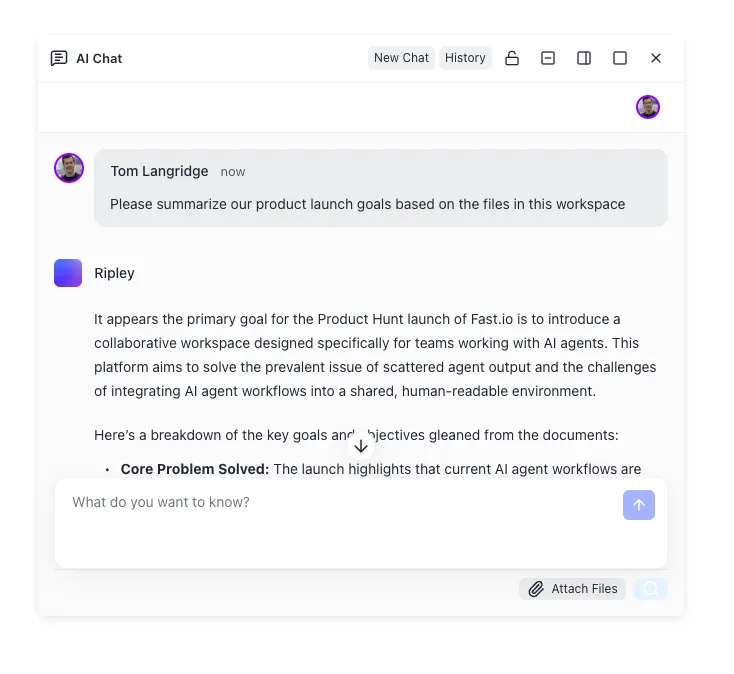
Fastio is built for teams where AI agents work alongside humans. Files in a workspace can be indexed for semantic search and AI chat through Intelligence Mode. Agents connect through a remote MCP server providing a consolidated toolset, and ownership transfer lets teams hand a workspace to a human collaborator.
Key strengths:
- Built-in RAG with citations, no separate vector database required
- MCP-native access for any LLM: Claude, GPT-4, Gemini, or local models
- 14-day Business Trial: Evaluate workspaces with persistent storage, included credits, and full MCP access (requires credit card)
Limitations:
- Not a general-purpose assistant (focused on file-centric workflows)
- Best suited to document-heavy workspaces
Best for: Development teams running AI agents that need persistent file storage with semantic search, or creative teams managing large asset libraries.
How to Pick the Right AI Tool Stack
No single AI tool covers everything well. The best setup for most teams in 2026 is a stack of two to four tools, each strong in its lane. Start by identifying the category where you spend the most time, pick the best option there, and expand only when a real gap appears.
A few practical guidelines:
- Try free tiers first. Almost every major tool offers one. Give it two weeks of real work before committing. Tools that feel impressive in a demo can disappoint in daily use, and vice versa.
- Match the tool to the task. ChatGPT is the best generalist, but Perplexity is better for research, Cursor is better for code, and Midjourney is better for images. Specialists outperform generalists in their own lane.
- Consider the integration. A tool that fits into your existing workflow (Gemini for Google Workspace, Copilot for GitHub, Notion AI for Notion) will get used more than a technically superior tool that lives in a separate tab.
- Watch for overlap. If you pay for ChatGPT Pro and Grammarly and Jasper, you are probably paying for three tools that share 60% of the same capabilities. Audit your stack every quarter.
The AI tools landscape will keep growing. The 14,200 tools available today will be well past 20,000 by the end of the year. But the best approach hasn't changed: find the tool that solves your specific problem, learn it well, and ignore the rest.
Sources
References used to verify factual claims in this guide.
-
14,200+ active AI tools available worldwide, a 68% increase from 2025 Average US company uses 4.1 AI tools ChatGPT has 320 million monthly active users Knowledge workers save 6.4 hours per week using AI tools
-
Claude holds 54% of the enterprise coding market
-
n8n 2.0 released January 2026 with native LangChain integration and 70+ AI nodes
Frequently Asked Questions
How many AI tools are there in 2026?
There are approximately 14,200 active AI tools worldwide as of early 2026, representing a 68% increase from the previous year. Broader counts that include beta, inactive, and niche products put the number closer to 47,000 across directories like There's An AI For That. The gap reflects how many tools launch, get listed, and then go dormant within months.
What are the main categories of AI tools?
AI tools fall into eight broad categories: general-purpose assistants (ChatGPT, Claude, Gemini), writing and content creation, image generation, video production, coding and development, workflow automation, research and knowledge management, and file management and collaboration. Most tools are strongest in one category, though some general-purpose assistants span several.
What is the most popular AI tool?
ChatGPT is the most widely used AI tool with 320 million monthly active users as of early 2026. Google Gemini follows at 180 million, Microsoft Copilot at 95 million, and Claude at 75 million. Popularity varies by use case: Cursor and Claude Code lead among developers, while Midjourney dominates image generation.
What major AI tools offer free plans?
Most major AI tools offer permanent free tiers. ChatGPT, Claude, Gemini, and Perplexity all have free plans with usage limits. Gemini Notebook provides a generous free research tool with 100 notebooks. For design, Canva and Recraft offer free plans. GitHub Copilot has a free tier with limited completions.
Related Resources

Give your AI agents a workspace that persists
Generous storage with built-in RAG, a consolidated MCP toolset, and ownership transfer so agents can build what humans receive.