How to Export AI Agent Conversation History
AI agent conversation history export is the process of extracting, formatting, and storing an agent's interaction transcripts so they can be reviewed, searched, or handed off to humans. This guide covers export formats, compliance requirements, storage strategies, and how to build a reliable export pipeline for production agent systems.

Why Conversation History Export Matters
Most AI agent frameworks treat conversations as ephemeral. The agent processes a prompt, generates a response, and the interaction lives in memory until the session ends. For a demo, that works fine. For production systems handling customer data, financial analysis, or legal research, it creates a serious gap.
Organizations need conversation exports for three reasons:
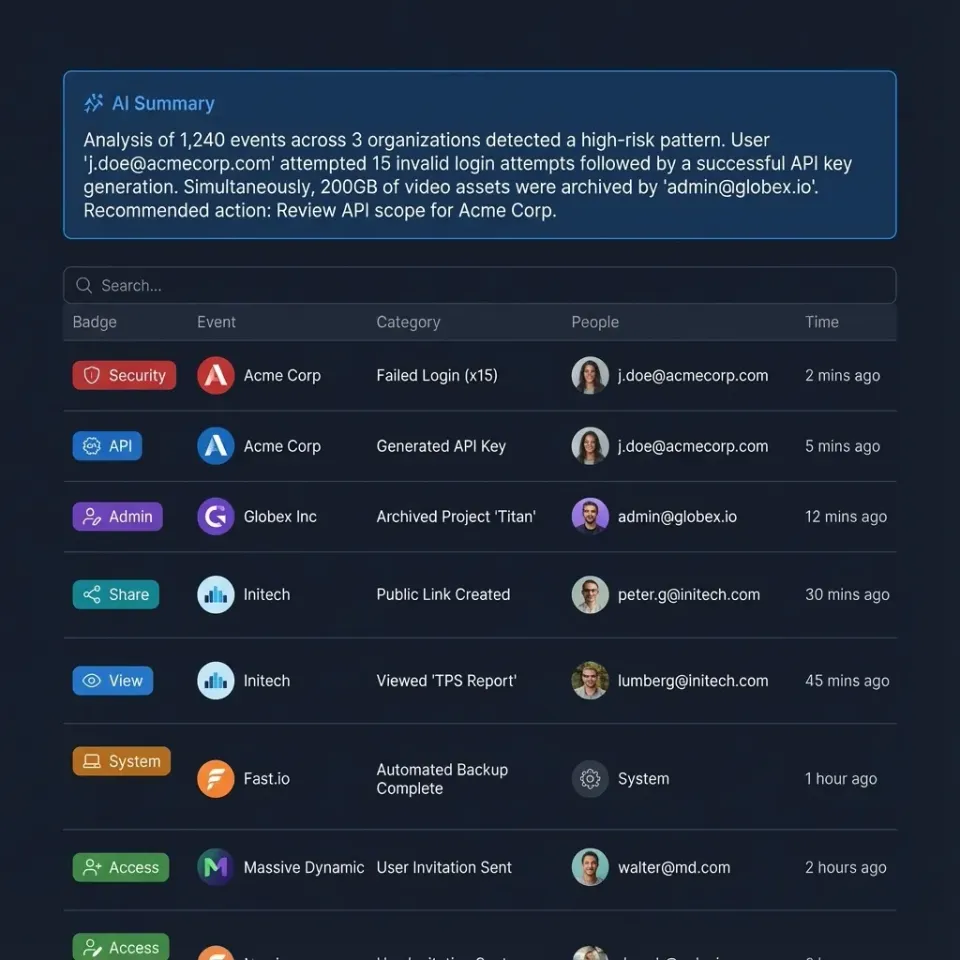
- Compliance and audit trails. The EU AI Act reaches full enforcement in August 2026. High-risk AI systems must maintain technical documentation ready for inspection, including records of what the agent said and why. The Colorado AI Act takes effect June 30, 2026 with similar requirements. Without exportable conversation history, you cannot produce these records.
- Training data and quality improvement. Exported transcripts become the raw material for fine-tuning, prompt optimization, and failure analysis. Teams that review real agent conversations catch hallucinations, tone problems, and reasoning errors that automated evals miss.
- Human handoff and continuity. When an agent escalates to a human, the full conversation context needs to travel with it. A customer support agent that hands off to a specialist without the conversation history forces the customer to repeat everything.
ChatGPT alone processes roughly 2.5 billion prompts per day. Even a mid-size enterprise running internal agents can generate thousands of conversations daily. The question is not whether to export, but how to do it without creating a maintenance burden.

Related guides
- How to Set AI Agent Data Retention PoliciesData retention policies define how long AI agents store files, logs, and artifacts. Proper lifecycle management reduces...
- SI vs AI: What the Federal "Super Intelligence" Rename Means for Teams and ContractorsThis guide covers SI in its U.S. federal sense: "Super Intelligence", the term executive branch agencies use in place...
- ChatGPT Conversation Too Long: Fixes, Limits, and Context WorkaroundsThe conversation too long error in ChatGPT occurs when an ongoing thread exceeds the model working memory context...
- How to Integrate Keycloak with AI AgentsSecuring AI agents requires more than just API keys. As agent fleets grow, managing individual access becomes a complex...
- Autonomous AI Agent Tools: Essential Software for Building AI AgentsAutonomous AI agent tools are software platforms that enable developers to build, deploy, and manage self-directed AI...
- How to Build AI Agents for Batch ProcessingBatch processing lets AI agents handle repetitive work across thousands of files without you having to watch over them....
More on this subject: AI Agents: General Guides (190 guides)
What to check before scaling ai agent conversation history export
Choosing the right export format depends on what happens after the export. Each format serves different downstream workflows.
JSON is the default for programmatic pipelines. Platform-native exports from OpenAI, Anthropic, and CustomGPT.ai all use JSON as their primary format. JSON preserves the full metadata structure: message roles (user, assistant, system, tool), timestamps, model version, conversation IDs, and tool call records. If you plan to re-import conversations into another system, feed them into an analytics pipeline, or use them as training data, JSON is the right choice. The downside is readability. A raw JSON transcript is painful for a non-technical compliance reviewer to scan.
Markdown strikes the best balance between human readability and structure preservation. Code blocks, tables, and formatting survive the export. Markdown files import cleanly into documentation tools like Notion, Obsidian, and Confluence. Browser extensions like SaveAI and YourAIScroll both support Markdown export from ChatGPT, Claude, Gemini, and other platforms. For knowledge base archiving, Markdown is hard to beat.
CSV works when you need to run analytics across hundreds or thousands of conversations. Each row represents a message with columns for timestamp, role, content, session ID, and any metadata you want to track. CustomGPT.ai's dashboard export offers CSV alongside JSON and Excel formats, filtered by team member or anonymous sessions. CSV is the weakest format for preserving rich content like code blocks or nested tool calls, but the strongest for spreadsheet-based compliance review.
PDF serves formal recordkeeping. Legal teams, auditors, and non-technical stakeholders often need a visual, print-ready record. Browser extensions handle PDF generation well for individual conversations, but PDF is a poor choice for bulk processing since the format is effectively write-only.
HTML preserves the visual layout of the original conversation, including syntax highlighting and LaTeX rendering. YourAIScroll supports HTML export with full formatting for ChatGPT Canvas and Claude Artifacts. HTML exports are useful for archiving exactly what the user saw, but they are heavier than Markdown and harder to parse programmatically.
For most production pipelines, export to JSON as your canonical format and generate Markdown or PDF views on demand.
Platform-Native Export Methods
Before building custom export infrastructure, check what each platform already provides.
OpenAI (ChatGPT) offers a built-in export through Settings, then Data Controls, then Export Data. The system generates a ZIP archive containing JSON files for all conversations. Processing takes 20 to 30 minutes and the download link arrives by email with a 24-hour expiry. For API customers, OpenAI retains inputs and outputs for 30 days by default, with a zero-retention option available. ChatGPT Team and Enterprise plans add configurable auto-delete schedules at 7 or 30 day intervals.
Anthropic (Claude) launched a Compliance API in March 2026 for Enterprise customers. It provides programmatic access to usage data, audit log events, chat data, and file content through an elevated compliance API key. Individual users can delete conversations, which Anthropic removes from servers within 30 days. The Compliance API does not retroactively reconstruct historical data, so organizations need to enable it before they need the records.
Google Gemini lets users configure auto-deletion at 3, 18, or 36 month intervals, or disable history saving entirely. Workspace administrators control these settings through the Admin Console. Google also launched a memory import feature in April 2026 that lets users bring conversation history from other AI tools into Gemini.
CustomGPT.ai provides a dashboard export under their "Ask Me Anything" section. You can filter by team member or anonymous user sessions, then export as JSON, XLSX, or CSV. Exports are processed in the background and delivered by email. A Zapier integration adds a programmatic "Export a conversation" action for automated workflows.


Store and Search Your Agent Conversation Archives
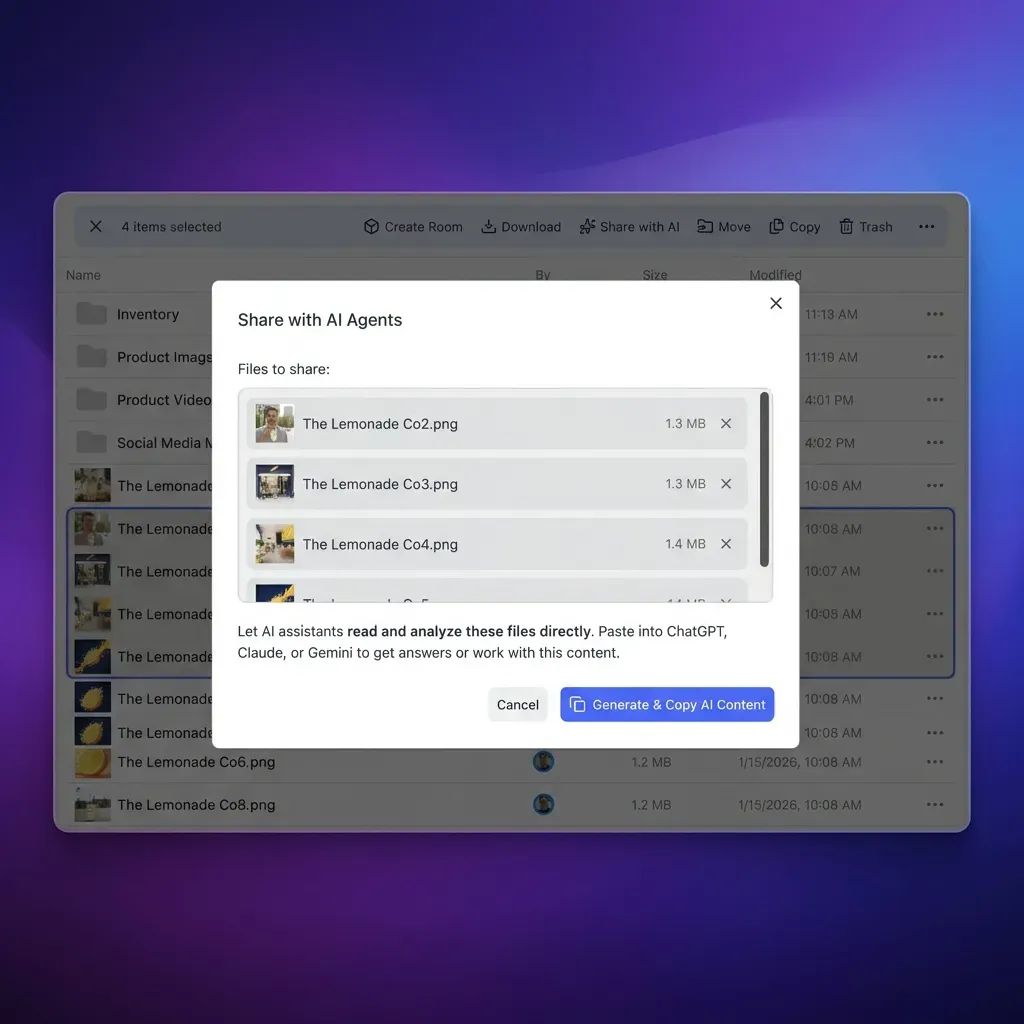
Upload conversation exports to Fastio workspaces with built-in semantic search and RAG chat. generous storage. Built for agent conversation history export workflows.
Building a Conversation Export Pipeline
Platform-native exports work for occasional review, but production systems need an automated pipeline. Here is how to build one.
Capture at the source
The best time to capture a conversation is when it happens, not after the fact. If you are building agents with the OpenAI API, Anthropic API, or any LLM framework, add a logging layer between your application and the model provider. Every request and response should be written to a durable store before the response reaches the user.
A minimal capture record includes:
- Conversation ID (UUID you generate, not the provider's internal ID)
- Timestamp (ISO 8601, UTC)
- Message role (system, user, assistant, tool)
- Message content (full text, including tool call arguments and results)
- Model identifier and version
- Token counts (prompt and completion)
- Session metadata (user ID, agent name, environment)
Choose your storage layer
Raw conversation logs need a home. The options range from simple to sophisticated:
Local filesystem or object storage. Write JSON files to disk or S3. Simple to implement, but searching across thousands of conversations requires additional indexing. Fine for small-scale deployments or batch processing.
Database storage. PostgreSQL with JSONB columns handles conversation data well. You get full-text search, relational queries across metadata, and transactional guarantees. SQLite works for single-agent systems.
Cloud workspaces with built-in search. Platforms like Fastio combine file storage with automatic indexing. Upload conversation exports to a workspace with Intelligence Mode enabled, and the files become searchable by meaning, not just keywords. You can ask questions across all exported transcripts using the built-in RAG chat, which returns answers with citations pointing to specific conversations. This approach works well for teams that need both storage and retrieval without managing a separate vector database.
Dedicated observability platforms. Tools like LangSmith, Langfuse, and Helicone are purpose-built for LLM conversation logging. They capture traces, token usage, latency, and evaluation scores alongside the conversation content. These are the strongest option for teams focused on model performance optimization.
Format and partition
Structure your export files for efficient retrieval later:
- Partition by date:
exports/2026/04/13/conversation-{id}.json - Include a manifest file listing all conversations in each partition
- Compress older partitions to cold storage after a retention period
- Keep the most recent 30 to 90 days in hot storage for fast access
Automate the lifecycle
Set up retention policies that match your compliance requirements. privacy requirements-related records typically need 2 to 3 years of retention. Financial services may require 7 or more years. Healthcare deployments under strict security requirements have their own timelines. Write-once, read-many (WORM) storage protects against tampering for legally significant conversations.
Browser Extensions for Quick Exports
Not every conversation needs a full pipeline. For ad-hoc exports, review sessions, and personal archives, browser extensions handle the job.
SaveAI (saveai.net) supports over 10 platforms including ChatGPT, Claude, Gemini, DeepSeek, GitHub Copilot, Grok, and Perplexity. Export formats include PDF, Markdown, JSON, TXT, and images. All processing happens locally, so conversations never leave your device. The extension also syncs to Notion for team knowledge bases. It is free as of early 2026, with premium tiers planned.
YourAIScroll (youraiscroll.com) covers ChatGPT, Claude, Gemini, DeepSeek, Perplexity, Poe, Copilot, Kimi, and Mistral across Chrome, Firefox, and Edge. It handles advanced content types that simpler exporters miss: ChatGPT Canvas, Claude Artifacts, code blocks, LaTeX equations, and Mermaid diagrams. Export formats include JSON, Text, Markdown, HTML, PDF, and clipboard copy.
chatgpt-exporter (open source on GitHub, by pionxzh) focuses specifically on ChatGPT. It is lightweight, well-maintained, and useful if you only need exports from one platform.
These tools fill an important gap. Enterprise compliance APIs exist for ChatGPT Enterprise and Claude Enterprise, but most individual users and small teams lack programmatic access to their conversation history. Extensions give them a practical workaround.
The limitation is scale. Extensions work conversation by conversation, or in small batches. If you need to export thousands of conversations across an organization, you will need the API-based approach described in the previous section.
Storing and Searching Exported Conversations
Exporting conversations is only half the problem. The other half is finding what you need six months later when a compliance auditor asks for every conversation that discussed a specific customer, or when your ML team wants to pull all conversations where the agent used a particular tool.
Full-text search is not enough
Keyword search works for simple lookups. But conversations are messy. Users misspell names, use abbreviations, and refer to concepts indirectly. An agent discussing "the quarterly report" might never mention the client name that the auditor is searching.
Semantic search solves this by indexing the meaning of conversation content, not just the words. Upload your JSON or Markdown exports to a workspace with semantic indexing enabled, and you can search by intent: "conversations about budget overruns" returns results even if those exact words never appeared.
Fastio workspaces with Intelligence Mode do this automatically. Upload conversation exports and they are indexed on arrival. The RAG chat feature lets you ask natural language questions across your entire conversation archive, with citations that point to the specific file and passage. No separate vector database or embedding pipeline required.
Access control for sensitive transcripts
Conversation histories often contain sensitive information: customer PII, financial data, internal strategy discussions. Your storage solution needs granular permissions.
Store transcripts in workspaces with role-based access. Compliance officers get read access to everything. Team leads see their team's conversations. Individual contributors see only their own. Fastio's permission model covers org, workspace, folder, and file-level access, which maps naturally to conversation archive hierarchies.
Handoff to humans
One of the highest-value uses for conversation exports is the agent-to-human handoff. When an AI agent escalates an issue, the receiving human needs the full transcript, not a summary that might omit critical details.
Build this into your export pipeline: when an agent flags a conversation for escalation, export the transcript to a shared workspace where the human team member already has access. Fastio's ownership transfer feature works here too. An agent can build a workspace full of conversation exports and client materials, then transfer the entire workspace to a human when the engagement is complete.

Sources
References used to verify factual claims in this guide.
-
ChatGPT processes approximately 2.5 billion prompts per day
-
EU AI Act reaches full enforcement August 2, 2026
-
Anthropic launched Compliance API in March 2026 for Enterprise customers
-
Colorado AI Act takes effect June 30, 2026
Frequently Asked Questions
How do I export AI agent conversations?
The method depends on your platform. ChatGPT offers a built-in export through Settings that delivers a ZIP of JSON files by email. Claude Enterprise provides a Compliance API for programmatic access. For other platforms, browser extensions like SaveAI and YourAIScroll export conversations to JSON, Markdown, PDF, and other formats. For custom agents built on LLM APIs, add a logging layer that captures every request and response to a database or file store as conversations happen.
Can you save ChatGPT or Claude conversation history?
Yes. ChatGPT has a native export under Settings, Data Controls, Export Data, which generates a ZIP archive of JSON files. Claude Enterprise customers can use the Compliance API launched in March 2026 for programmatic access. Individual Claude users can request data through Anthropic's support. Browser extensions like SaveAI and YourAIScroll also export from both platforms to PDF, Markdown, JSON, and other formats with local-only processing.
What format should AI agent transcripts use?
JSON is the best primary format because it preserves full metadata including message roles, timestamps, model versions, and tool call records. Export to JSON as your canonical format, then generate Markdown views for human review and PDF for formal compliance records. CSV works well for analytics across large numbers of conversations but loses rich formatting like code blocks.
What should an AI conversation audit trail include?
A complete audit trail captures: who interacted with the agent (identity and timestamp), the exact prompt text, what grounding data the agent retrieved, the full response generated, all tool calls and their results, the model version, and any guardrail decisions. Store these records in immutable, write-once storage to prevent tampering.
How long should I retain AI agent conversation data?
Retention periods depend on your regulatory environment. privacy requirements-related records typically require 2 to 3 years. Financial services may need 7 or more years. The EU AI Act requires technical documentation for high-risk systems to be available for inspection. Set up automated lifecycle policies that move older exports to cold storage and enforce deletion when the retention period expires.
Are browser-based AI chat exporters safe to use?
Extensions like SaveAI and YourAIScroll process conversations locally in your browser, so the content never leaves your device. Check the extension's privacy policy and permissions before installing. For enterprise environments with strict data handling requirements, API-based export methods or platform-native exports are preferable since they operate within your existing security perimeter.
Related Resources

Store and Search Your Agent Conversation Archives
Upload conversation exports to Fastio workspaces with built-in semantic search and RAG chat. generous storage. Built for agent conversation history export workflows.