Paralegal Technology: Modern Tech Stacks for Legal Support
Paralegal technology encompasses the integrated software platforms, cloud workspaces, and collaborative tools legal assistants use to manage case files, organize discovery, and coordinate with attorneys. Rather than relying on scattered email attachments and isolated desktop drives, modern legal support teams build modular stacks across practice management, structured document workspaces, and client portals. Here is how to evaluate and assemble the essential layers of technology for paralegals.

How Modern Paralegal Technology Stacks Are Structured
When a litigation paralegal coordinates twenty active matters across local desktop folders, email attachments, and legacy on-premises servers, administrative cohesion collapses at the seams. An attorney requests the latest revised exhibit list for an impending deposition, but the updated file sits marooned on a staff member's disconnected hard drive, forcing the litigation team to reconstruct previous edits from scratch. The primary operational bottleneck in modern legal support is not legal acumen; it is file fragmentation and siloed tooling that turn routine document retrieval into hours of administrative friction.
Paralegal technology encompasses the integrated software platforms, cloud workspaces, and automated workflows that legal assistants use to manage case documents, organize discovery, and coordinate with attorneys. Historically, legal support staff relied on isolated desktop utilities: a local word processor, a generic PDF viewer, an on-premises billing console, and email for file distribution. That fragmented model created severe data silos, untracked document revisions, and security risks during file exchange.
Modern legal practices assemble a cohesive, modular technology stack built around five distinct functional layers:
- Practice and Case Management Systems: Platforms such as Clio, MyCase, or Smokeball serve as the administrative core of the firm. These systems track client contact details, court docketing deadlines, master litigation calendars, conflict-of-interest checks, and matter status milestones.
- Centralized Document Workspaces: Cloud workspaces such as Fast.io, NetDocuments, or iManage provide structured repositories organized by client and matter. These platforms deliver granular access permissions, automated file indexing, per-file version history, and real-time document collaboration.
- eDiscovery and Litigation Review Platforms: Specialized review software such as Logikcull, Everlaw, or Relativity handles the ingestion, deduplication, search filtering, Bates stamping, and production of electronic records during civil litigation or regulatory investigations.
- Client Intake and Secure Delivery Portals: Dedicated file exchange channels replace vulnerable email attachments. Legal support staff use branded portals and scoped file shares to collect sensitive records from clients and deliver discovery productions to co-counsel.
- Legal Billing and Accounting Tools: Platforms such as TimeSolv, Tabs3, or LeanLaw handle billable time tracking, expense logging, trust accounting compliance, and electronic invoice generation.
By organizing software around these five pillars, legal administrators eliminate redundant file copies, maintain clean evidentiary trails, and give paralegals the operational foundation required to support complex casework.
Related guides
- Legal Tech Solutions: The Modern Law Firm Technology GuideLegal tech solutions encompass software applications and digital platforms engineered to coordinate legal operations,...
- iManage File Size Limits: Workarounds for Large Legal FilesAn iManage file size limit refers to the maximum allowed file transfer threshold enforced by iManage Work desktop...
- ContractWorks Review: Secure Contract Repositories and Milestone TrackingContractWorks provides a dedicated contract repository focused on legal agreement storage, automated milestone alerts,...
- Law Firm Data Security: Operational Guide to Protecting Matter Files and Client DataLaw firm data security requires strict technical controls, matter-level workspace isolation, and encrypted document...
- Law Firm Workspace: Centralizing Matter Files, Client Portals, and Team CollaborationManaging active legal matters requires a unified digital environment where attorneys, paralegals, and clients...
- Essential Legal Software Programs: The Modern Law Firm Tech GuideModern law firms rely on specialized legal software programs to eliminate administrative overhead, protect client...
More on this subject: Legal Teams (197 guides)
Why Matter-Centric Workspaces Outperform Generic Cloud Storage
Generic cloud storage utilities frequently fail legal practices because they were designed for casual personal syncing rather than legal defensibility. When a law firm uses standard consumer cloud storage, staff encounter recurring hazards: accidental file overwrites, inconsistent folder nesting, uncontrolled link sharing, and duplicate files labeled with conflicting version tags. When multiple team members concurrently edit a motion for summary judgment across unsynced desktop drives, reconciling the changes requires hours of manual comparison.
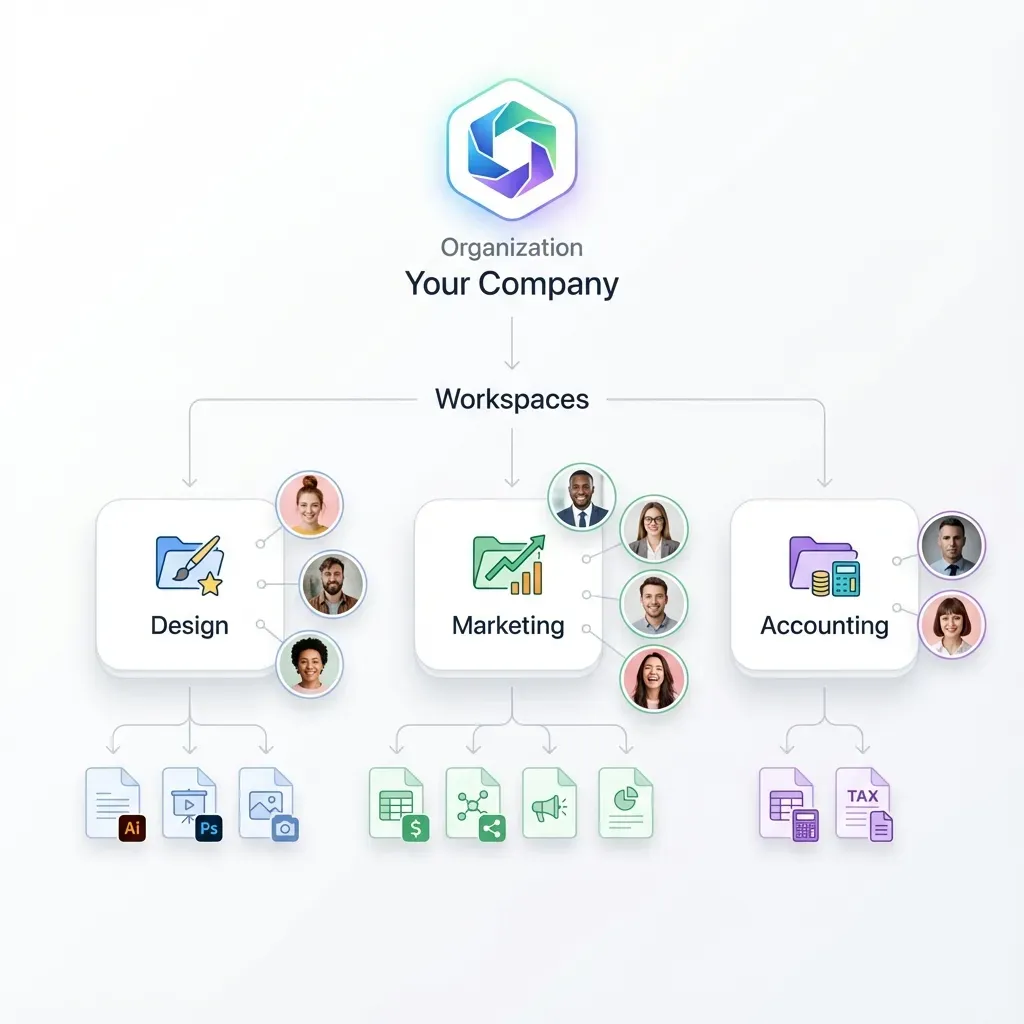
A professional legal support stack relies on matter-centric workspace architecture. Under this model, every client matter receives an isolated workspace or dedicated root directory structured around a standardized folder taxonomy:
01_Pleadings_and_Filings: Summons, complaints, answers, formal motions, affidavits, and court orders.02_Discovery_and_Exhibits: Written interrogatories, document requests, deposition notices, subpoena returns, and marked exhibits.03_Client_Intake_and_Records: Client intake questionnaires, initial engagement agreements, tax filings, and original evidence provided by the client.04_Correspondence_and_Transcripts: Formal attorney correspondence, court reporter transcripts, and audio-video deposition files.05_Work_Product_and_Drafts: Research memoranda, trial briefs, deposition outlines, and collaborative attorney notes.06_Production_and_Settlement: Bates-stamped outbound discovery productions, settlement releases, and closing documents.
Within this matter architecture, per-file version history protects the integrity of every document. Fast.io maintains full per-file version history automatically. Whenever a paralegal updates a draft pleading or an attorney revises an exhibit schedule, the platform records the new revision while preserving every prior iteration. Legal assistants can compare prior drafts, inspect which team member authored specific modifications, and restore an earlier version if necessary, without littering the folder with duplicate files.
For teams integrating agentic tools or multi-user editing, Fast.io provides advisory per-file leases through MCP actions (lock-acquire and lock-release on storage tools). These locks signal to colleagues and connected agents that a file is actively being updated, while version history preserves concurrent writes so work is never lost.
Real-time collaboration also extends to case notes. Fast.io Collaborative Notes enable legal teams to co-edit deposition preparation outlines, case strategy documents, and witness interview summaries simultaneously in the browser. To keep litigation records orderly, law firms deploy structured matter workspaces paired with real-time document collaboration across the entire legal team.
When migrating from legacy document repositories, law firms can deploy Fast.io Cloud Sync for Google Drive, OneDrive, Box, and Dropbox. Cloud Sync operates one-way or two-way, running on a schedule or on demand. Law firms with archives in Google Drive can use cloud import to pull matter records into the workspace directly without consuming local bandwidth.
How AI Metadata Extraction Replaces Manual Document Indexing
Paralegals have traditionally spent a substantial portion of their working hours performing repetitive data entry: reviewing scanned contracts to record expiration dates, manually indexing discovery disclosures, and typing docket metadata into spreadsheets. Modern legal technology transforms this workflow. Rather than delegating complex legal analysis to software, legal support teams deploy artificial intelligence to automate structured data extraction and rapid factual retrieval across massive document sets.
Fast.io Metadata Views turn unstructured case files into live, queryable databases. Instead of building rigid optical character recognition templates that fail when document layouts vary, legal staff describe the information they require in plain language. For example, a paralegal managing commercial contract disputes can specify: "Extract the counterparty legal names, execution dates, governing law jurisdiction, termination notice requirements, and liability limitation clauses."
Fast.io automatically constructs a typed schema (supporting Text, Integer, Decimal, Boolean, URL, JSON, and Date & Time data types), evaluates matching files within the workspace, and populates an interactive, filterable spreadsheet. This extraction operates across varied file formats, including scanned PDFs, Word documents, TIFF images, presentation slides, and handwritten records. If litigation counsel later requests an additional data point, such as identifying indemnification caps, the paralegal simply adds the new column to the Metadata View. The system extracts the new property without requiring manual reprocessing of the entire document collection.
Complementing structured extraction, Fast.io Intelligence Mode provides deep semantic search across matter repositories. Once Intelligence Mode is enabled on a matter workspace, files are indexed for both full-text keyword matching and semantic context. Paralegals can query the workspace using natural conversational prompts, such as: "What discussions occurred regarding delayed component deliveries in May?" The search engine retrieves relevant paragraphs across thousands of pages of correspondence and discovery records, providing direct citations linked to the underlying source documents.
Organizations access these workspace capabilities through transparent monthly subscriptions that include team seats, cloud storage, and AI processing credits. Monthly plans start with a fourteen-day free trial that requires a credit card, allowing firms to test matter workspaces and metadata extraction on live case files. Fast.io credits meter AI work such as semantic indexing and Metadata View extraction, while document storage, team seats, and e-signatures come included with each organization subscription tier across Starter, Business, and Enterprise plans.



Modernize your paralegal technology stack
Organize matter files in structured workspaces with automated metadata extraction, per-file version history, and secure client delivery. Starts with a 14-day free trial on monthly plans, credit card required.
Steps for Preserving Evidence Integrity and Chain of Custody
Modern litigation frequently involves large electronic evidence formats that overwhelm standard corporate email systems. Email servers routinely reject large file attachments, failing on voluminous multimedia records. Yet legal support teams regularly handle substantial litigation files: videotaped deposition sessions, digital audio recordings, surveillance camera footage, forensic computer images, high-resolution medical radiology files, and extensive email mailbox archives.
Fast.io accommodates heavy legal assets with generous file size allowances across its Starter, Business, and Enterprise tiers. Through chunked uploads, large files transfer reliably without corruption if an internet connection momentarily drops. Furthermore, Fast.io provides native HTTP Live Streaming (HLS) for video files. Legal teams can preview and review recorded video depositions directly inside the browser interface, eliminating the need to download massive video files to local workstations.
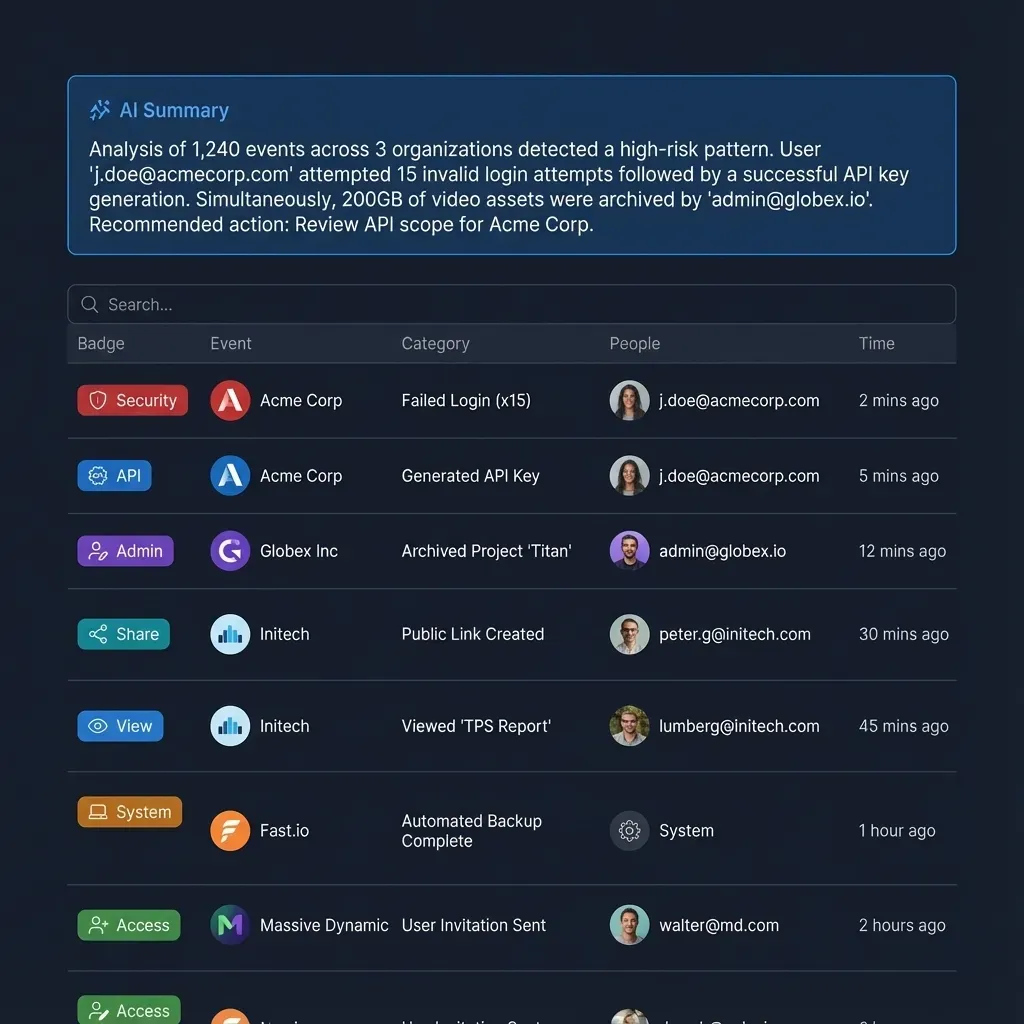
Evidence integrity requires a defensible chain of custody. When opposing counsel questions whether a document was altered after receipt, the law firm must demonstrate unbroken evidentiary handling. Fast.io maintains a detailed activity log that captures every interaction within the workspace: file uploads, views, downloads, renaming, folder movements, and permission adjustments. Each activity entry includes an immutable timestamp and the identity of the user or agent responsible. Legal administrators can subscribe to the workspace activity feed via WebSocket or long-poll connections to monitor matter updates as they occur.
Controlling external file exchange is equally critical when sharing files with outside experts, joint defense groups, or opposing counsel. Fast.io allows legal teams to configure granular permissions at four distinct tiers: organization, workspace, folder, and file level.
To distribute discovery productions securely, paralegals create branded shares through client portals. A share can be configured with password protection, strict expiration dates, per-recipient access tracking, and disabled file downloads for view-only document inspections. Conversely, when collecting records from clients during initial intake, paralegals generate a branded Receive share. The client opens the link in any mobile or desktop web browser and uploads bank statements, tax returns, or incident photographs directly into the designated matter folder, without creating an account or navigating a login barrier.
What Core Technical Competencies Modern Legal Support Requires
As law firms adopt modern cloud architecture and data extraction systems, the paralegal profession requires specialized technical competencies. While core legal research, citation formatting, and civil procedure remain fundamental, high-performing legal support specialists distinguish themselves through operational fluency across digital workspace tools.
Modern paralegals cultivate technical mastery across five key operational domains:
- Taxonomy Governance and Directory Architecture: Establishing disciplined folder structures and standardized file-naming protocols across all active matters. Proficient paralegals apply standardized date conventions so files sort chronologically regardless of local operating system settings.
- Metadata Engineering and Schema Design: Formulating precise field definitions for automated data extraction platforms. Paralegals learn to identify high-value legal fields across diverse transaction documents and audit automated extraction outputs against source records.
- Information Governance and Access Management: Enforcing strict access controls on sensitive matter materials. Paralegals manage external share expirations, assign folder-level view rights to consulting experts, and review audit logs to verify that discovery materials remain protected throughout the litigation lifecycle.
- Electronic Signature and Document Execution: Managing client retention agreements, witness declarations, and settlement releases through digital signature platforms. Fast.io includes integrated electronic signatures on every plan. Legal assistants can dispatch documents for signature directly from the matter workspace, establish sequential or parallel signing workflows, apply optional one-time passcodes for signer identity verification, obtain a tamper-evident audit certificate, and have the executed agreement filed directly back into the matter repository.
- eDiscovery Production Coordination: Operating litigation support tools to ingest electronic files, apply objective coding, manage Bates stamp numbering sequences, redact privileged information, and export production volumes adhering to court-mandated specifications.
Firms looking to upgrade their legal support infrastructure with dedicated legal solutions should evaluate their current tooling against a pragmatic checklist:
- Does the document platform organize files by matter with full per-file version history?
- Can the team extract structured tabular data from unstructured PDFs without manual data entry?
- Can the system store and stream large deposition videos without crashing desktop storage?
- Are external client file requests handled through branded upload links without login friction?
- Does every file action generate an immutable audit log entry to support evidentiary chain of custody?
Upgrading from fragmented desktop folders to an integrated legal workspace allows paralegals to spend less time tracking down missing documents and more time assisting attorneys with trial preparation, client communication, and substantive case analysis.
Frequently Asked Questions
What technology is most used by paralegals?
Paralegals rely on a core software stack that includes legal practice management systems, centralized document workspaces, eDiscovery review platforms, PDF manipulation utilities, and legal research databases. Practice management systems manage firm calendars, docket deadlines, and client billing, while dedicated document workspaces handle matter-centric file organization, per-file version history, metadata extraction, and client file delivery.
How is AI changing the role of paralegals?
Artificial intelligence shifts paralegals from manual administrative data entry to higher-level document analysis and validation. Instead of manually retyping dates, counterparties, and clause terms into spreadsheets, paralegals use AI metadata extraction tools to generate structured summaries across hundreds of contracts or discovery files. Paralegals then audit extracted data, analyze factual patterns, and prepare materials for attorney review.
What tech skills should a modern paralegal have?
A modern paralegal requires skills in digital file taxonomy design, cloud workspace administration, metadata extraction configuration, eDiscovery processing, and electronic signature coordination. Paralegals must know how to organize matter folders, configure granular access permissions, handle large discovery files like deposition video, and evaluate audit trail records for evidentiary defensibility.
What is the difference between legal practice management and document workspaces?
Legal practice management software manages firm administration, including billable time tracking, court calendaring, trust accounting, and contact management. Document workspaces manage the actual files: structured folder hierarchies, per-file version history, granular access controls, large file transfers, and metadata extraction. Many law firms pair practice management platforms with dedicated document workspaces to manage heavy litigation files and client intake.
How should law firms organize digital matter files for paralegals?
Law firms should structure digital matter files using a standardized folder taxonomy organized by Client and Matter ID. Each matter workspace should contain consistent subfolders for Pleadings, Discovery, Client Intake, Correspondence, Work Product, and Production. Files should follow consistent date-first naming standards, and per-file version history should manage document revisions instead of creating duplicate files.
Related Resources

Modernize your paralegal technology stack
Organize matter files in structured workspaces with automated metadata extraction, per-file version history, and secure client delivery. Starts with a 14-day free trial on monthly plans, credit card required.