OpenClaw A2A Protocol: Agent-to-Agent Communication for Multi-Agent Workflows
The A2A protocol hit 150 supporting organizations in its first year, but native OpenClaw support was closed as "not planned" in February 2026. Community plugins already bridge the gap. This guide covers how A2A works, what the OpenClaw a2a-gateway plugin actually does, and how to handle file persistence when agents start delegating work across servers.

The Gap Between A2A Adoption and OpenClaw Support
One year after Google launched the Agent-to-Agent (A2A) protocol in April 2025, over 150 organizations have joined the standard through the Linux Foundation, including AWS, Microsoft, Google, IBM, Salesforce, and SAP. The core repository passed 22,000 GitHub stars. SDKs ship in five languages. Version 1.0 is stable.
OpenClaw is not one of those 150 organizations. In February 2026, a community member opened GitHub issue #6842 proposing native A2A support. The maintainers closed it as "not planned." That left the OpenClaw community to build the bridge themselves, and several groups have done exactly that.
The disconnect matters because OpenClaw already handles multi-agent routing. It connects chat apps like WhatsApp, Telegram, Discord, and Slack to AI agents, managing sessions and tool calls across conversations. But its agent-to-agent communication stays inside the OpenClaw ecosystem. A2A would let OpenClaw agents discover and delegate to agents built on entirely different frameworks, like Google's Agent Development Kit, LangChain, or CrewAI, without custom integration code.
This guide covers what A2A actually is, how the community plugins work, and what you need to think about when OpenClaw agents start producing output that needs to persist beyond a single session.
Related guides
- Cline Multi-Agent Workflows: How to Coordinate Agent TeamsWorkplace usage of AI agents among developers nearly doubled year-over-year from 31% in 2025 to 59% in 2026 [Stack...
- How to Orchestrate Multi-Agent Workflows in Claude CodeMulti-agent Claude Code workflows coordinate specialized agent instances across parallel tasks to accelerate complex...
- How to Build Custom Agents in OpenClawOpenClaw hit 3.2 million monthly active users in April 2026, yet most deployments still run a single default agent...
- How to Build Multi-Agent Workflows in OpenClawOpenClaw multi-agent workflows let multiple agents coordinate on tasks like data processing or report generation....
- How to Set Up OpenClaw Multi Agent WorkspacesOpenClaw agents share files, context, and tasks in Fastio multi-agent workspaces. Access consolidated MCP tools for...
- MCP Skills: How Agent Skills Extend the Model Context Protocol in OpenClawSix major coding tools now implement the SKILL.md format because giving an agent access to MCP tools is not the same as...
More on this subject: OpenClaw Setup and Guides (199 guides)
What A2A Is and How It Differs from MCP
A2A (Agent-to-Agent) is an open protocol for multi-agent communication that lets agents discover, delegate to, and receive results from other AI agents. Unlike MCP, which connects agents to tools and data sources, A2A connects agents to each other.
The protocol operates through three mechanisms:
Agent Cards are JSON metadata documents that each A2A-capable agent publishes at a standard endpoint. A card describes the agent's identity, capabilities, supported formats, and authentication requirements. A client agent reads another agent's card to decide whether that agent can handle a specific task before sending any work.
Tasks are the unit of work. A client agent creates a task and sends it to a remote agent. That task moves through a defined lifecycle, from submitted through working to completed or failed. State transitions can trigger notifications, so the client stays informed without polling.
Messages and Artifacts carry the actual content. Agents exchange messages during execution and produce artifacts as final output. Both can contain text, files, or structured data.
The practical distinction from MCP is straightforward. MCP is vertical: one agent connects to its own tools. A2A is horizontal: multiple agents coordinate with each other. In a production system, a single agent uses MCP to access a database or file storage, and uses A2A to ask a specialist agent on a different server to handle a subtask. The two protocols are complementary layers, not competitors. The Linux Foundation maintains both projects.
How the OpenClaw A2A Gateway Plugin Works
The most complete community implementation is the openclaw-a2a-gateway plugin, which implements A2A protocol v0.3.0. It installs as a standard OpenClaw plugin and does two things. First, it exposes an A2A-compliant endpoint on your OpenClaw instance, so agents on the network can send tasks to your agent using standard A2A calls. Second, it publishes an Agent Card that advertises your agent's capabilities for peer discovery.
The plugin supports multiple transport layers with automatic fallback and streaming for long-running tasks where the remote agent needs to push status updates back to the caller.
Discovery works on local networks through standard service advertisement, so agents find each other automatically. For agents across networks, you configure explicit peer URLs pointing to each agent's published Agent Card.
Security includes token-based authentication with rotation support and URI allowlisting to restrict which external agents your instance can contact. The plugin's routing layer scores peer agents by skill match, latency, and historical success rate, so delegation decisions happen automatically based on which peer agent fits best rather than which one responded first.
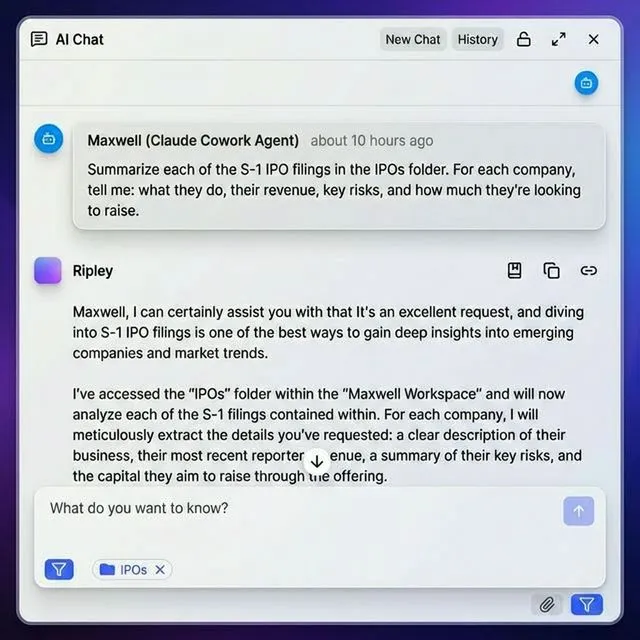


Persist multi-agent output in one shared workspace
Shared storage, an MCP server for agent file operations, and automatic indexing so your team can find what agents produce. Starts with a 14-day free trial.
Architecture Patterns for OpenClaw A2A Workflows
The FreeCodeCamp guide on OpenClaw A2A architecture recommends treating OpenClaw as an A2A client rather than a server. The reasoning: your personal OpenClaw instance stays private while it reaches out to external A2A agents for specialized tasks. You control what leaves your boundary.
The key mapping looks like this:
- An OpenClaw session maps to an A2A context ID, so repeated delegations from one conversation maintain the same remote context
- An OpenClaw tool call maps to an A2A SendMessage, which is the delegation entry point
- A remote agent's output maps to an A2A Artifact, which carries the task result back
This session-to-context mapping solves a real problem. Without it, every delegation would start a fresh context on the remote agent, losing conversation history. With it, you can ask a remote research agent to "dig deeper on the third point" and it knows which third point you mean.
A production plugin would need four components. An a2a_delegate tool provides the entry point for explicit delegation. A gateway method handles diagnostics and health checking. An HTTP route enables callbacks and webhooks. A background service handles cache warming and stale-peer cleanup.
The security model matters here. Your OpenClaw instance and the external A2A ecosystem are separate trust domains. The FreeCodeCamp guide recommends a controlled relay with allowlists that restrict which remote agents your instance can contact and what data it can send. This is not paranoia: agent-to-agent communication across organizational boundaries means your agent is potentially executing instructions from systems you do not control.
One pattern that works well for teams: run a dedicated OpenClaw instance as the A2A relay, separate from the instances team members use for daily work. The relay handles all cross-boundary communication, and internal agents talk to the relay through a restricted internal A2A channel. This gives you a single point for logging, rate limiting, and access control.
Persistent Storage for Multi-Agent Output
When OpenClaw agents start delegating tasks through A2A, output management becomes a real concern. A remote agent produces an artifact, maybe a report, dataset, or generated code file. That artifact lives in the A2A response payload. If nothing catches it, it disappears when the session ends.
Local file systems work for single-machine setups, but A2A workflows span multiple servers and organizations. You need a shared persistence layer that every agent in the chain can write to and every human stakeholder can access.
S3 and similar object stores handle raw file storage, but they lack workspace semantics. You get a bucket of files with no built-in search, no access audit, and no way for a human to browse and review agent output without additional tooling.
Fast.io provides workspaces designed for exactly this scenario. Agents and humans share the same workspace, with the same files, permissions, and audit trail. When an OpenClaw agent receives an A2A artifact from a remote agent, it can upload that artifact to a Fast.io workspace using the MCP server or REST API. The file is immediately indexed by Intelligence Mode for semantic search and RAG queries. Team members can find the output by asking questions in natural language rather than hunting through folder hierarchies.
Plans bundle storage, monthly credits, and workspaces scaled to each tier, and monthly plans start with a trial of up to 14 days. For A2A workflows that generate moderate output volumes, the trial is enough to get a production pipeline running before you commit.
Ownership transfer adds another useful layer. An agent can build out a complete workspace with organized folders, curated shares, and structured output, then transfer ownership to a human manager. The agent retains admin access for ongoing automation, but the human owns the workspace and controls who else can see it. This matters in A2A workflows where the agent producing the output is not the same agent (or even the same organization) that owns the final deliverable.
For teams using Fast.io's Metadata Views, the persistence layer goes further. Agents can extract structured data from uploaded documents, turning raw A2A artifacts into a queryable database of contract dates, invoice totals, or whatever fields the workflow requires. No OCR templates, no manual data entry.
Current Limitations and What Comes Next
The OpenClaw A2A story has clear gaps worth understanding before you commit to this architecture.
The a2a-gateway plugin implements A2A v0.3.0, while the protocol itself has reached v1.0 with signed Agent Cards, multi-tenancy, and web-aligned architecture improvements. The plugin will need updates to match the stable specification. Check the plugin repository for version compatibility before deploying.
Native OpenClaw support is not on the roadmap. The maintainers closed the feature request without indicating future plans. That means the community plugin path is the foreseeable integration approach, with the maintenance risks that implies. If the plugin author stops updating, the community needs to fork or rebuild.
A2A's task lifecycle assumes agents can handle long-running operations with status callbacks. OpenClaw's session model was originally designed for conversational exchanges, not multi-hour background tasks. The a2a-gateway plugin bridges this with SSE streaming, but complex workflows that span hours or days may hit timeout or session-management edge cases that need custom handling.
Discovery is another consideration. DNS-SD and mDNS work well on local networks, but cross-network discovery requires manual peer configuration. For teams running agents across cloud providers, you will need to maintain a registry of peer Agent Card URLs rather than relying on automatic discovery.
What is encouraging: the broader A2A ecosystem is maturing fast. SDKs in Python, JavaScript, Java, Go, and .NET mean any framework can participate. The Agent Payments Protocol (AP2), backed by 60+ payment industry organizations, suggests that A2A is expanding beyond task delegation into financial transactions between agents. As more agents in the ecosystem speak A2A, the value of connecting OpenClaw to that network increases, whether through community plugins or eventual native support.
For teams evaluating this today, start with the a2a-gateway plugin in a staging environment. Test peer discovery on your network, run a few delegated tasks, and verify that the output lands where it needs to. Use a shared workspace like Fast.io for persistence from the beginning, even during testing, so you do not have to retrofit file management later.
Sources
References used to verify factual claims in this guide.
-
Over 150 organizations supporting the A2A standard through the Linux Foundation A2A core repository passed 22,000 GitHub stars with SDKs in five production-ready languages Agent Payments Protocol (AP2) backed by 60+ payment industry organizations
-
openclaw-a2a-gateway plugin at v1.4.0 implementing A2A v0.3.0 with 527 GitHub stars
-
OpenClaw A2A feature request (issue #6842) closed as not planned
-
Google announced A2A in April 2025 with over 50 launch partners
Frequently Asked Questions
What is the A2A protocol?
A2A (Agent-to-Agent) is an open protocol maintained by the Linux Foundation that standardizes how AI agents discover and communicate with each other. It uses Agent Cards for capability advertisement, a task lifecycle model for work delegation, and JSON-RPC over HTTP for transport. Over 150 organizations support the standard, including Google, Microsoft, AWS, and IBM.
How is A2A different from MCP?
MCP (Model Context Protocol) connects an agent to its tools and data sources. A2A connects agents to other agents. They work at different layers: an agent uses MCP to read files from a workspace and uses A2A to delegate tasks to a specialist agent on another server. The two protocols are complementary and both maintained under the Linux Foundation.
Does OpenClaw support A2A natively?
Not currently. A community feature request (GitHub issue #6842) was closed as 'not planned' in February 2026. The community has built plugins to bridge the gap, with the openclaw-a2a-gateway plugin being the most mature option at v1.4.0.
What are Agent Cards in A2A?
Agent Cards are JSON metadata documents that each A2A-capable agent publishes at a well-known URL. They describe the agent's identity, capabilities, supported input and output formats, endpoint location, and authentication requirements. Client agents read these cards to determine which remote agent can handle a specific task before initiating communication.
How do I connect two OpenClaw agents using A2A?
Install the openclaw-a2a-gateway plugin on both instances. The plugin publishes Agent Cards and supports automatic peer discovery via DNS-SD on local networks. For agents on different networks, configure explicit peer URLs. Once discovered, agents can exchange tasks using the standard A2A JSON-RPC protocol with bearer token authentication.
Where should multi-agent A2A output be stored?
A2A artifacts need a shared persistence layer accessible to all agents and human stakeholders. Fast.io workspaces handle this with automatic file indexing, semantic search, audit trails, and ownership transfer. Plans include workspace storage and MCP server access for agent file operations, and monthly plans start with a trial of up to 14 days.
Related Resources

Persist multi-agent output in one shared workspace
Shared storage, an MCP server for agent file operations, and automatic indexing so your team can find what agents produce. Starts with a 14-day free trial.