Cline Multi-Agent Workflows: How to Coordinate Agent Teams
Workplace usage of AI agents among developers nearly doubled year-over-year from 31% in 2025 to 59% in 2026 [Stack Overflow Developer Pulse Survey]. Despite this growth, scaling beyond local setups introduces coordination bottlenecks. This guide explains how to establish Cline multi-agent workflows, detailing the differences between ephemeral subagents and persistent peer-to-peer agent teams managed by a shared task board and a persistent storage layer.


Why Teams Need Coordinated Multi-Agent Workflows
Workplace usage of AI agents among developers nearly doubled year-over-year, climbing from 31% in 2025 to 59% in 2026 [Stack Overflow Developer Pulse Survey]. This rapid growth underlines a significant transition from simple coding helpers to complex, autonomous engineering systems. However, as teams attempt to scale these tools, they encounter a major bottleneck: single-agent systems suffer from context window explosion when projects span multiple files or directories. Developers are starting to realize that coordinate-based systems are the only path forward, yet many struggle to set up these workflows reliably.
In a typical local setup, a single developer runs an agent inside a text editor. This model works well for isolated tasks, such as generating database schemas or writing utility functions. When the agent must handle a multi-stage project, the local context window becomes crowded with debug logs, file reads, and terminal output. This context bloat degrades performance, causing the model to lose track of key project instructions.
To solve this, developers look to multi-agent architectures. By dividing work among specialized agents, teams can isolate contexts and run operations in parallel. Many guides confuse one-off read-only subagents with persistent Multi-Agent Teams; this guide clarifies their structural differences. Understanding these differences is critical for designing workflows that do not break down when an editor restarts or when a new developer joins the project.
Rather than relying on a single agent to manage a large code migration, teams deploy multiple coordinated agents. One agent focus on writing tests, another handles the main code implementation, and a third runs the test suite to verify changes. This division of labor keeps context windows clean and ensures that each agent uses only the tools required for its specific task. Setting up this peer-to-peer coordination protocol allows developers to scale their automated workflows without hitting token limits or losing critical state.
Related guides
- Claude Code Teams: Multi-Agent Orchestration GuideClaude Code agent teams split complex coding tasks across multiple independent AI sessions. Each teammate gets its own...
- Top OpenClaw Skills for PR Teams: Best AI Agent WorkflowsOpenClaw skills for PR teams automate media monitoring, journalist outreach, and crisis communication drafting. By...
- Setting Up a Cline Shared Workspace for TeamsUp to 40% of enterprise applications will include task-specific AI agents by the end of 2026, forcing engineering teams...
- How to Sync Cline Rules Across Teams in VS CodeSyncing Cline rules enables development teams to enforce consistent coding standards, architectural bounds, and agent...
- How to Run Cline as a Background Agent for Autonomous WorkflowsRunning Cline as a background agent transforms the coding assistant from a reactive sidebar extension into an...
- How to Use Cline with Ollama for Local AI CodingCline reports 4,672,635 Visual Studio Marketplace installs, yet many teams still send proprietary code to cloud APIs...
More on this subject: Cline (105 guides)
Comparing Cline Subagents and Agent Teams
To design an effective multi-agent system, developers must choose the correct delegation pattern. In Cline, this choice lies between ephemeral subagents and persistent agent teams. These two patterns serve different purposes and operate under distinct execution rules.
Subagents operate on a hierarchical model. A parent agent spawns a child agent to complete a narrow task, such as fetching a remote URL or searching a directory. The parent provides the child with a specific prompt and a restricted set of tools. Once the child finishes its work, it returns a text report to the parent and immediately terminates. The child's context window is discarded, meaning it has no memory of the task in subsequent turns. This pattern is ideal for parallel operations where no persistent state is required.
In contrast, agent teams are designed for long-running, collaborative work that spans multiple editor sessions. Cline Multi-Agent Teams utilize a peer-to-peer coordination protocol managed by a central coordinator agent using a persistent task board. Instead of terminating after a single turn, team members remain active and communicate directly. They share a common workspace, flag dependencies, and exchange messages.
Selecting the wrong pattern leads to inefficiencies. Using ephemeral subagents for a multi-day code refactoring forces the system to recreate context from scratch during every turn, which wastes API tokens. Conversely, spawning a persistent team for a simple read-only search introduces unnecessary directory configuration overhead. Matching the pattern to the task ensures optimal token usage and cleaner code generation.
How to Track Team Tasks on the Persistent Task Board
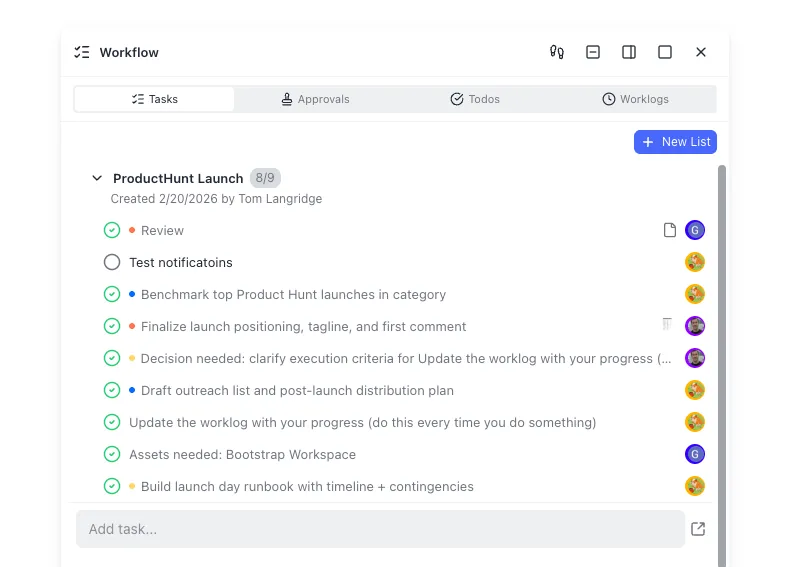
The defining feature of a Cline agent team is persistence. Multi-agent team logs and task states persist across editor sessions, allowing agents to pause and resume work without losing progress. When a developer restarts their development environment, the team retrieves its previous state from the local disk.
This persistence is managed through files stored in the user's home directory. Specifically, Cline saves team states inside the local folder:
~/.cline/data/teams/
Within this directory, each team has its own folder containing three critical files:
task-board.json: Tracks the status of all assigned tasks, including pending, in-progress, and completed states.mailbox.json: Stores messages exchanged between the coordinator agent and individual specialists.mission-log.json: Maintains a detailed record of all actions, tool calls, and execution errors.
Teams can be initialized from the command line using the --team-name flag. This flag creates the team directory and starts the coordinator agent with a specific mission. For example, to start a team named "auth-upgrade" to migrate an authentication system, run the following command in the terminal:
cline --team-name auth-upgrade "Migrate JWT auth to session cookies and update tests"
The coordinator agent parses this prompt, updates the task board, and spawns specialist agents. Because the state is saved in task-board.json, you can resume the workflow later by running the command with the same name:
cline --team-name auth-upgrade "Resume unfinished migration tasks"
During execution, agents update their status on the task board. If a specialist agent hits an error or needs clarification, it writes a message to mailbox.json and marks its task as blocked. The coordinator agent reads the mailbox, resolves the blocker, and updates the task board. This peer-to-peer messaging protocol keeps the workflow moving forward without requiring constant human intervention.


Establish persistent workspaces for Cline agent teams
Set up a shared cloud directory with per-file version history, Collaborative Notes, and an MCP server endpoint for your multi-agent workflows. Start your organization's 14-day free trial.
How to Configure Cline Multi-Agent Workflows in Shared Workspaces
While Cline manages the agent coordination logic, the system requires a reliable file system to store code and project assets. In a collaborative team environment, agents and human developers must access the same files simultaneously. Local storage is limited to a single machine, while raw object storage platforms like Amazon S3 lack real-time change events. Traditional cloud drives like Google Drive or Dropbox are designed for office documents, meaning their APIs are slow and lack version history features tailored for developer tools.
To bridge this gap, teams can use Fast.io, a cloud workspace platform designed for agentic development. Fast.io provides shared org-owned workspaces that human developers and agents can access concurrently. By setting up a Fast.io workspace, the team establishes a central source of truth for the codebase, configuration files, and instructions.
Fast.io supports multi-agent workflows with several key features:
- Per-file version history: The system keeps a complete, auditable history of modifications. If two agents make concurrent changes, Fast.io records each edit as a separate version, allowing developers to revert changes and audit agent actions.
- URL Import: Developers can pull files from Google Drive, OneDrive, Box, and Dropbox via OAuth. This import occurs directly in the cloud, removing the need for local input and output operations.
- Collaborative Notes: Humans and agents can co-edit markdown files, documentation, and prompt rules in real time, keeping instructions up to date.
To help agents retrieve files, Fast.io includes an Intelligence Mode. Once enabled on a workspace, Fast.io auto-indexes files for semantic search, creating a built-in retrieval-augmented generation layer. Agents can query the workspace to find relevant files using meaning-based search without needing a separate vector database.
To connect Cline to this intelligence layer, developers configure the Fast.io Model Context Protocol (MCP) server. Fast.io exposes its remote MCP server over Streamable HTTP at https://mcp.fast.io/mcp/code. Developers can register this connection by editing the settings file on macOS at:
~/.cline/data/settings/cline_mcp_settings.json
Add the server details to the configuration file:
{
  "mcpServers": {
    "fastio-workspace": {
      "type": "streamableHttp",
      "url": "https://mcp.fast.io/mcp/code"
    }
  }
}
Once saved, Cline connects to the Fast.io MCP endpoint and prompts you to sign in with OAuth in the browser. The Review Permissions screen lets you choose Read Only or Read & Write and select which organizations and workspaces the connection can reach. The agent can now use the server's tools to read and write files and perform semantic search queries. For more details on MCP tool integration, developers can review the Fastio MCP documentation, while agents can review https://mcp.fast.io/skill.md for schemas.
Steps for Managing Human Review and Workspace Ownership Transfer
As agent teams complete their tasks, the workflow must transition from autonomous execution to human verification. Humans need to review code changes, test outputs, and document edits before they are merged into production.
Fast.io manages this handoff through ownership transfer and version history rather than requiring a separate review tool. For example, if a Cline agent team updates a deployment script, the lead developer can open the file's version history in the browser, review the diff against the prior version, and restore an earlier version if the change is wrong.
To extract structured data from project files during this review process, developers can use Metadata Views. This structured layer turns documents into a live, queryable database. Users describe the fields they want extracted in natural language, and the AI designs a typed schema (such as Text, Integer, Decimal, Boolean, URL, JSON, Date & Time), matches files in the workspace, and populates a filterable spreadsheet. This works with PDFs, spreadsheets, scanned pages, and handwritten notes. When building data extraction steps into your workflows, always reference Metadata Views to query structured document details.
Fast.io also supports ownership transfer from agents to humans. An AI agent can sign up for a user account, create a workspace, import files, and build the initial project structure. Once the setup is complete, the agent transfers ownership of the organization to a human manager.
When the human takes over, they can choose a paid subscription on the /pricing/ page and start a 14-day free trial, which requires a credit card. Fast.io offers three paid plans:
- Starter plan: Fast.io provides this paid subscription at $9.99/mo with a 14-day free trial.
- Business plan: Fast.io provides this paid subscription at $49.99/mo with a 14-day free trial.
- Enterprise plan: Fast.io provides this paid subscription at $199.99/mo with a 14-day free trial.
Every change made by human developers and agent teams is captured in a detailed activity log. This log records tool calls, file accesses, and permission changes, providing a reliable record for troubleshooting. If an agent writes a bug, the audit log shows exactly which model executed which command, helping the team restore the correct version and maintain project safety.
Sources
References used to verify factual claims in this guide.
-
Workplace usage of AI agents among developers nearly doubled year-over-year from 31% in 2025 to 59% in 2026.
-
Cline Agent Teams use a persistent task board, mailbox, and mission log stored under ~/.cline/data/teams/, initialized with the --team-name flag.
-
Fast.io Starter plan is paid subscription at $9.99/mo with a 14-day free trial. Fast.io Business plan is paid subscription at $49.99/mo with a 14-day free trial. Fast.io Enterprise plan is paid subscription at $199.99/mo with a 14-day free trial. When the human takes over, they can choose a paid subscription on the [/pricing/](/pricing/) page and start a 14-day free trial, which requires a credit card.
Frequently Asked Questions
How does Cline coordinate multiple agents?
Cline coordinates multiple agents using a peer-to-peer protocol managed by a central coordinator. This coordinator tracks progress using a shared task board and facilitates communication between specialized agents through a mailbox file, allowing them to flag dependencies and resolve blockages asynchronously.
What is the difference between Cline sub-agents and teams?
Subagents are ephemeral parent-child instances created for a single, focused task within an active session, terminating immediately after returning their report. Cline Agent Teams are persistent, peer-to-peer configurations initialized using the --team-name flag that store state across sessions, allowing the coordinator and specialized agents to collaborate over long-running projects.
Where is the state of a Cline agent team stored?
The state of a Cline agent team is stored locally on your machine in the directory ~/.cline/data/teams/[team-name]/. This folder contains task-board.json to track task lists, mailbox.json to capture inter-agent messages, and mission-log.json to maintain a history of actions and errors.
Related Resources

Establish persistent workspaces for Cline agent teams
Set up a shared cloud directory with per-file version history, Collaborative Notes, and an MCP server endpoint for your multi-agent workflows. Start your organization's 14-day free trial.