Design Patterns for Effective Multi-Agent Orchestration
Graph-based multi-agent orchestration projects have increased by 150% year-over-year, showing a clear shift from simple linear agent scripts to complex stateful workflows [IBM 2026]. Despite this growth, orchestrating multi-agent systems introduces bottlenecks like context window saturation and write collisions. This guide explains sequential, hierarchical, and graph patterns, and how to coordinate them in a shared team workspace.

Why Enterprise Teams Need Multi-Agent Orchestration
Graph-based multi-agent orchestration projects have increased by 150% year-over-year, reflecting a market transition toward structured systems for complex engineering tasks [IBM 2026]. This growth highlights the limitations of single-agent setups, which frequently fail when projects require coordinating multi agent systems across files. When developers deploy independent agents without a coordinating framework, they face context window exhaustion, cascading errors, and race conditions. Managing these problems requires an intentional approach to multi agent swarm orchestration.
To understand why this transition is happening, we must define the core terms. Multi-agent orchestration is the coordination of multiple specialized AI agents executing tasks in a defined sequence or dynamic network to achieve a complex goal. While a single agent acts as a generalist assistant, a multi-agent system divides work among specialized roles. For instance, a software development workflow might employ a research agent, a writing agent, a testing agent, and a deployment agent. Each agent possesses a narrow prompt, a specific set of tools, and a focused context window.
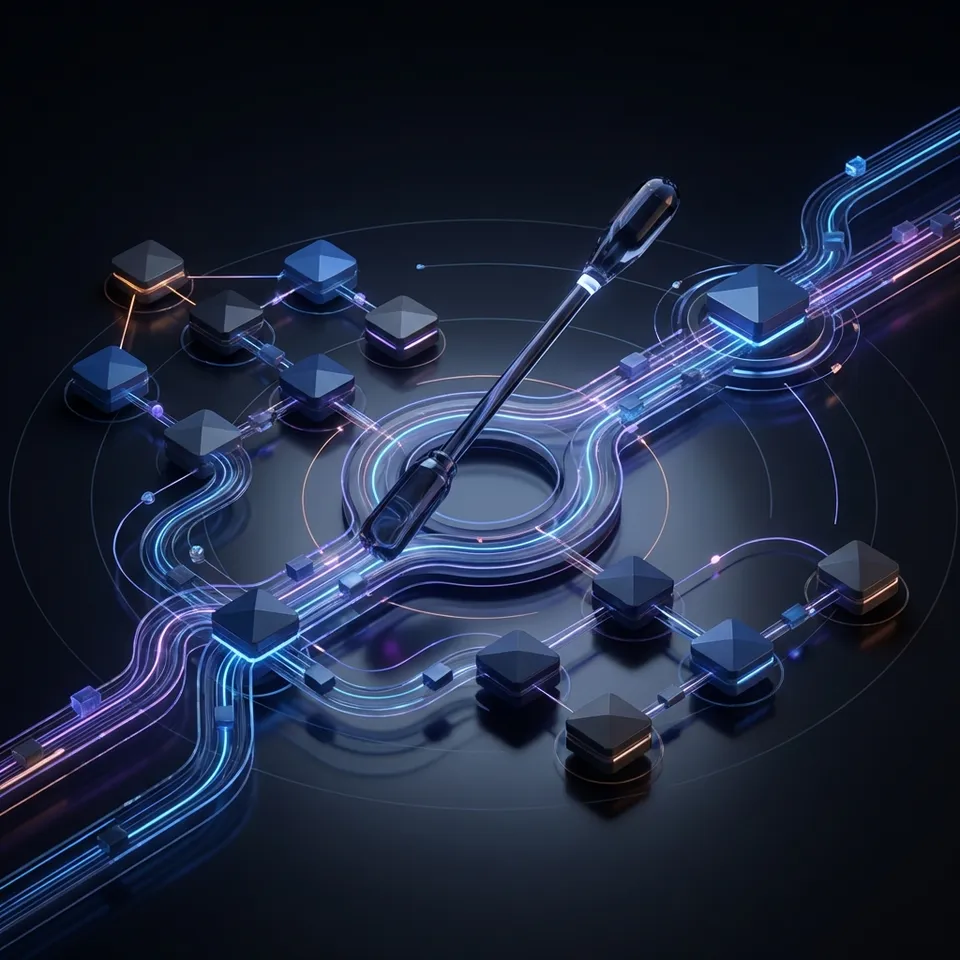
Without an orchestrator, specialized agents operate in isolation, leading to a phenomenon known as agent sprawl. A multi agent system orchestrator solves this by serving as the central control plane. It manages three key primitives: task decomposition, agent routing, and state tracking. The orchestrator receives a high-level goal, breaks it down into subtasks, assigns those subtasks to the appropriate specialist agents, and aggregates the outputs. This approach keeps individual agent context windows clean, reduces API token consumption, and prevents agents from drifting away from the primary objective.
Enterprise systems require more than basic Python loops that run agents in a simple sequence. Production environments demand fault tolerance, error handling, and auditability. When a specialist agent fails to complete a task, the orchestrator must detect the error, capture the failure state, and decide whether to retry the task, route it to a different agent, or halt execution for human review. Implementing this level of control requires developers to move away from ad-hoc scripts and adopt formal orchestration design patterns.
Related guides
- Agentic Architectural Patterns for Building Multi-Agent SystemsDecoupling agent communication through a decentralized blackboard architecture yields a 30% speedup in parallel...
- How to Design a Multi-Agent Architecture for Enterprise WorkflowsMigrating from monolithic agent designs to a modular multi-agent system architecture improves task execution efficiency...
- Selecting an Enterprise AI Agent Orchestration PlatformEnterprise buyers require systems to coordinate multiple autonomous agent teams safely. This guide provides an...
- How to Choose the Best AI Agent Orchestration FrameworkAn AI agent orchestration framework manages execution, communication, and state tracking for multi-agent workflows....
- How to Establish Closed-Loop Communication in Multi-Agent SystemsIn multi-agent systems, unverified agent coordination introduces a major failure risk. While typical peer-to-peer...
- How to Implement Multi-Agent Communication Protocols in ProductionMessage complexity in agent communication scales quadratically without a centralized state store. This guide covers how...
More on this subject: Multi-Agent Systems (62 guides)
How to Choose the Right Control Flow Model for Agent Swarms
Selecting the correct control flow model determines how agents communicate and pass data. Developers must balance trade-offs in execution speed, API costs, and system complexity. The industry has settled on three primary patterns for managing the execution path: sequential chains, hierarchical routing, and graph networks.
A bulleted list explains the three main models of multi-agent control flow:
Sequential Chains: These run in a linear sequence where agent A sends its output directly to agent B. This is ideal for static, step-by-step processes like pulling data and formatting it, though it offers no path to loop back on error.
Hierarchical Routing: This model uses a manager agent that acts as a supervisor, delegating tasks to specialists and combining the results. It works well for complex tasks that can be split into independent pieces, but the manager agent can become a bottleneck or a single point of failure.
Graph Networks: These structures model agents as nodes and transitions as edges, allowing cycles, loops, and dynamic paths. This is the most flexible approach for complex engineering tasks that require continuous feedback, but it demands state management to avoid infinite loops.
In a sequential chain, the orchestrator routes tasks along a fixed path. This is a linear pipeline. For example, a content generation pipeline runs from a research agent to a writer agent, then to an editor agent. The simplicity of this pattern makes it easy to debug, but it cannot handle unexpected outcomes. If the writer agent discovers that the research data is incomplete, a linear pipeline cannot loop back to the research stage. It either halts or produces a low-quality draft based on incomplete data.
Hierarchical routing introduces a supervisor agent to manage this complexity. The supervisor acts as a router, inspecting the input, deciding which specialist agent is best suited for the task, and directing the work. When the specialist completes the task, it returns the output to the supervisor. This supervisor-worker pattern allows for dynamic task assignment, but it introduces context limitations. The supervisor must ingest all subtask outputs, which can quickly saturate its context window and lead to information loss.
Graph networks resolve these limitations by modeling the workflow as a directed graph. Each agent is a node, and the communication paths are edges. This structure permits cycles, allowing agents to collaborate dynamically. If a testing agent finds a bug in code generated by a writing agent, the graph routes the code back to the writer node with a bug report. Graph-based orchestration provides the flexibility needed for open-ended tasks, but it requires stateful tracking to prevent infinite loops where agents pass errors back and forth indefinitely.
How to Manage State and Avoid Read-Write Conflicts
When orchestrating multi agent systems in production, maintaining a consistent state is the primary engineering challenge. In basic setups, developers rely on local memory or simple text files. These options do not scale. Local memory disappears when a script terminates, while shared text files lead to write collisions and race conditions when multiple agents attempt to modify the same file at the same time. Traditional cloud storage platforms like Google Drive or Dropbox are designed for human office files. Their APIs are slow, lack real-time events, and do not track version history in a format suitable for developer tools. Raw object storage like Amazon S3 provides persistence but lacks built-in semantic search, live workspace intelligence, and collaboration tools.
To coordinate effectively, agents need a shared substrate that manages state, tracks modifications, and resolves conflicts. Fast.io solves this by providing shared org-owned workspaces where humans and agents collaborate. Instead of treating storage as a passive bucket, Fast.io serves as an active coordination layer. When an agent writes to a file, the platform records a complete, per-file version history. If two agents make concurrent changes, the system preserves both edits as separate versions. This allows developers to audit agent actions, trace errors, and restore prior versions.
Conflict avoidance is achieved by defining clear folder boundaries and using structured context files. Developers can assign agents to specific subdirectories within a Fast.io workspace. For example, a research agent writes its raw data to a research/ folder, while a writer agent reads from that folder and saves drafts to a drafts/ folder. This structural isolation prevents agents from overwriting each other's files. Additionally, agents can co-edit files in real time using Collaborative Notes. In Collaborative Notes, humans and agents act as first-class editors with visible cursors, making it easy to update prompt templates and project guidelines without file conflicts.
To read and write files programmatically, agents connect to the workspace through the Fast.io Model Context Protocol (MCP) server. Fast.io exposes action-based MCP tools through Streamable HTTP at /mcp and Server-Sent Events (SSE) at /sse. Third-party developer tools like Claude Code, Codex, Cursor, Gemini, and OpenClaw can participate in these workspaces via the MCP server. When an agent connects, it can search files, read contents, and upload results. For RAG workflows, developers can enable Intelligence Mode on the workspace. Fast.io automatically indexes files on arrival for semantic and metadata-based search. This means agents can query the workspace to find files based on meaning, rather than relying on exact keyword matches.


Coordinate Multi-Agent Pipelines in Shared Workspaces
Provide persistent cloud storage, per-file version history, and built-in semantic search for your agent swarms. Start your organization's 14-day Business Trial today.
Steps for Implementing Human-in-the-Loop Approval Gates
Including human-in-the-loop approval gates inside the orchestration pipeline increases accuracy to over 98% [IBM 2026]. Fully autonomous agent swarms can quickly drift from the main task, propagate errors, or overwrite critical code. By establishing checkpoints where execution pauses for human verification, organizations can maintain control while retaining the speed of automation. This pattern is essential for high-stakes workflows like code deployments, financial reporting, and legal document reviews.
Fast.io supports this pattern through shared workspaces, granular permissions, per-file version history, and anchored comments. When an agent saves an updated draft or code diff, it creates a new file version in the shared workspace. A lead developer reviews the diff directly in the web interface using in-browser previews, adds anchored comments on specific lines or regions, and verifies the output. The system records every human and agent action in a detailed activity log, retained according to your plan, showing who did what and when.
During the review process, developers often need to extract structured data from files to verify agent compliance. Fast.io supports this with Metadata Views. This structured data extraction layer turns unstructured files into a live, queryable database. Users describe the fields they want extracted in natural language, and Fast.io designs a typed schema. The schema supports seven field types, including Text, Integer, Decimal, Boolean, URL, JSON, and Date & Time. The AI matches files in the workspace and populates a filterable spreadsheet, extracting information from PDFs, scanned images, and handwritten notes.
For example, in a legal workflow, Metadata Views can automatically extract contract effective dates, counterparties, and renewal terms. Agents can create schemas, trigger extraction, and query results programmatically through the MCP server. This structured layer is distinct from Intelligence Mode. While Intelligence Mode handles unstructured RAG search and summarization, Metadata Views provides the structured extraction layer needed for data-driven validation. Using these views, developers can ensure that agents extracted the correct figures before giving final approval.
Guide to Transferring Agent Workspace Ownership to Human Teams
A common challenge in multi-agent development is transitioning from the initial agent-driven build phase to human operational management. In traditional cloud setups, agents require high-privilege credentials that are difficult to revoke safely, or files must be manually copied from the agent's environment to a corporate server. This manual transfer is slow, breaks file version histories, and removes the context needed for ongoing work.
Fast.io addresses this challenge with its native ownership transfer protocol. An AI agent can sign up for a user account, create an organization, configure workspaces, set up directories, and import initial files. Because the workspace auto-indexes files, the agent can build a functioning project structure autonomously. Once the setup is complete or the initial setup is complete, the agent generates an ownership transfer link. The agent hands this link to a human manager, who clicks the link to take ownership of the organization.
The human manager can then choose a paid subscription on the /pricing/ page and start a 14-day Business Trial, which requires a credit card. Fast.io offers three paid plans with seats included:
- The Starter plan provides 250 GB of storage and 100,000 credits for $9.99/mo ($99/year).
- The Business plan provides 5 TB of storage and 600,000 credits for $49.99/mo ($499/year).
- The Enterprise plan provides 25 TB of storage and 3,000,000 credits for $199.99/mo ($1,999/year).
After ownership transfer, the human manager can retain the agent as an administrator or workspace member. This allows the agent to continue executing tasks, while the human retains control over billing, memberships, and permissions. All actions are logged in the activity log. The audit log records file operations, membership changes, billing events, and agent file operations. If an agent writes a bug or misconfigures a workspace, the audit log shows exactly which model performed the action. This history helps the team restore the correct version and maintain project safety without resetting the workspace.
Sources
References used to verify factual claims in this guide.
-
Graph-based multi-agent orchestration projects have increased by 150% year-over-year, reflecting a market transition toward structured systems for complex engineering tasks [IBM 2026]. Including human-in-the-loop approval gates inside the orchestration pipeline increases accuracy to over 98% [IBM 2026].
-
The human manager can then choose a paid subscription on the [/pricing/](/pricing/) page and start a 14-day Business Trial, which requires a credit card. The Starter plan provides 250 GB of storage and 100,000 credits for $9.99/mo ($99/year). The Business plan provides 5 TB of storage and 600,000 credits for $49.99/mo ($499/year). The Enterprise plan provides 25 TB of storage and 3,000,000 credits for $199.99/mo ($1,999/year).
Frequently Asked Questions
What is multi-agent orchestration?
Multi-agent orchestration is the coordination of multiple specialized AI agents executing tasks in a defined sequence or dynamic network to achieve a complex goal. Unlike a single generalist agent, an orchestrated system divides work among specialized roles (such as research, writing, and testing agents) to keep context windows clean and improve execution accuracy.
How do you manage complex multi-agent workflows?
Managing complex multi-agent workflows requires a central orchestrator that handles task decomposition, agent routing, and state tracking. By using stateful control flows (such as graph networks) and establishing human-in-the-loop approval gates, developers can prevent cascading errors, race conditions, and context window exhaustion in production environments.
What is the difference between orchestration and choreography in agent swarms?
The difference lies in how coordination is directed. In orchestration, a central supervisor or control plane directs the execution sequence, delegates tasks to specialists, and manages the state. In choreography, agents interact peer-to-peer without a central controller, following local rules and triggers to coordinate their actions dynamically.
Related Resources

Coordinate Multi-Agent Pipelines in Shared Workspaces
Provide persistent cloud storage, per-file version history, and built-in semantic search for your agent swarms. Start your organization's 14-day Business Trial today.