How to Get a Manus AI Certification
Earning a Manus AI certification validates a user's competency in designing, debugging, and deploying autonomous AI agent workflows. This guide covers how to enroll in Manus Academy, complete the project-based requirements, and structure your GitHub repository for submission. We also look at how integrating persistent workspaces like Fastio can secure your agent's runtime outputs.

What Is the Manus AI Certification?
Build Club's 2026 enterprise survey shows that over 50% of companies have deployed autonomous agents in production. This shift from simple conversational interfaces to autonomous task completion has created a high demand for developers who can build reliable multi-agent systems. While interest in agentic tools has grown, verified production competence remains scarce. The certification program represents a direct response to this industry gap, offering a structured path to verify developer capabilities.
A Manus AI certification is a professional credential awarded by Manus Academy that validates a user's competency in designing, debugging, and deploying autonomous AI agent workflows. This project-based credential ensures that candidates can move beyond basic prompt engineering to build functional, resilient, and safe automations. Certified developers build end-to-end task chains verified by the Build Club ecosystem, proving their ability to design production-grade systems. Earning this credential indicates that a developer understands how to manage agent state, execute custom skills, and preserve output files across executions.
Related guides
- OpenClaw Certification Programs: Where to Get Certified in 2026OpenClaw has no official certification program. Every credential available in 2026 comes from third-party platforms,...
- GitHub Copilot Certification Study Guide: How to Pass Exam GH-300Passing the GitHub Copilot Certification exam (GH-300) requires mastering seven key domains, including responsible AI,...
- Is Manus AI Free? Free Plan, Credits, and LimitsManus AI is free to start on a limited-credit Free plan, but heavier autonomous agent work usually needs paid Pro or...
- Manus AI Pricing and Credit Consumption GuideManus AI pricing operates on a credit-based billing system across Free, Pro, and Team tiers, complemented by a...
- Manus AI vs Question AI: Choosing the Best AI for Academic ResearchIn 2025, overall adoption of artificial intelligence tools among researchers jumped from 57% in 2024 to 84% in 2025,...
- How to Set Up a Manus AI File Handoff WorkflowA Manus file handoff workflow is the automated pipeline that retrieves files from a completed agent task sandbox and...
More on this subject: Manus (53 guides)
How to Complete the Manus Academy Certification Path
To become a Manus certified professional, candidates follow a structured four-stage path: registration on the academy portal, completing 30+ hours of modular video content, building custom workflows for 20+ real-world use cases, and submitting verified project code. This comprehensive training program is designed to guide developers from foundational concepts to advanced agent choreography.
Registration and Portal Access
The first step is to create a candidate profile on the official Manus Academy portal at academy.manus.im. Once registered, you will gain access to the learning environment, progress tracking dashboard, and the student community channels.
The Curriculum Structure
The academy offers a progressive learning track designed in collaboration with Build Club:
- Manus Fundamentals: A beginner path covering the basics of agentic execution, prompt structures, and native tools.
- Manus Intermediate: Covers state management, error handling, and basic sandbox operations.
- Manus Advanced: Focuses on designing complex multi-agent systems, writing custom Python skills, and optimizing token consumption.
- Domain-Specific Tracks: Tailored modules for specific business roles, including Manus for Marketing, Manus for Business Analysts, Manus for Product Managers, and Manus for Finance.
Practical Workflows and Projects
The core of the certification requirements is the completion of build-along projects. Rather than taking multiple-choice tests, you must build working agents that solve real business problems. These projects cover twenty different use cases, such as automated market research, financial model generation, and marketing content pipelines. Candidates must execute these workflows in the Manus sandbox environment and record their output files for submission.
Steps to Structure Your Project Folders for Certification
A common gap in other guides is the omission of how to set up project folders to submit for certification. Build Club uses automated validation scripts to pull, build, and run your agent workflows in containerized test environments. If your repository folder structure does not conform to their specifications, the automated tests will fail, and your submission will be rejected.
To pass the review on your first attempt, organize your GitHub repository using the following directory layout:
my-manus-agent-submission/
├── .manus/
│   └── agent-config.json
├── config/
│   └── prompts.yaml
├── skills/
│   └── custom_data_exporter/
│       ├── SKILL.md
│       ├── pyproject.toml
│       └── main.py
├── workflows/
│   ├── pipeline.json
│   └── triggers.yaml
├── sandbox/
│   ├── Dockerfile
│   └── requirements.txt
├── data/
│   ├── input/
│   └── output/
└── README.md
Detailed Folder Contents and Files
The directory layout separates configurations, skills, and data. Build Club validators rely on this separation to run tests securely.
The Agent Configuration Folder
The .manus folder contains the entry point configuration for the agent runtime. The agent-config.json file defines the model configurations, maximum execution time limits, and memory depth parameters.
The Prompt Library Folder
The config folder isolates system instructions from executable code. Keeping your prompts in a dedicated file like prompts.yaml allows you to adjust the agent's behavior and system guidelines without altering the core codebase.
Reusable Custom Skills
The skills directory contains folders for each custom capability you write for the agent. In the Manus framework, skills are structured as standard Python packages. Each skill folder must contain:
SKILL.md: A metadata file that defines the skill's name, description, parameters, and return types. Manus reads this file to register the tool.pyproject.toml: The standard Python packaging file that specifies dependencies.main.py: The executable Python script that implements the tool's logic.
For example, a custom skill metadata file (SKILL.md) should look like this:
Custom Data Exporter Skill

Description:
Exports processed agent outputs from the local sandbox environment to external persistent folders.

Input Parameters:
- source_file (string): The path to the file inside the sandbox.
- destination_folder (string): The target directory path.

Outputs:
- status (string): Success or error message.
And the accompanying pyproject.toml file declares package info:
[project]
name = "custom-data-exporter"
version = "0.1.0"
description = "Exporter skill for Manus AI certification"
dependencies = [
    "requests>=2.31.0"
]
Workflow Orchestration
The workflows folder holds the visual DAG representations. The pipeline.json file contains the node-and-edge connection data that coordinates different agent tasks.
Sandbox Runtime Setup
The sandbox folder is critical for safe execution. Build Club validators build a Docker container using your Dockerfile and requirements.txt to execute your Python skills in isolation, ensuring that the required system libraries are installed.
Data Input and Output
The data folder contains input attachments and output directories. The agent writes final reports, tables, or database files to the output subdirectory during evaluation.
Why Ephemeral Sandboxes Need Persistent Storage
When building workflows for certification, you must account for the temporary lifecycle of the execution environment. Manus executes agent code inside isolated, ephemeral cloud sandboxes. While these sandboxes are ideal for running safe tests, their filesystems are temporary. Once a task terminates, the container is destroyed, and all locally generated files are wiped. Without a persistent storage strategy, your compiled reports, research datasets, and custom code artifacts will be lost.
To prevent this data loss, developers typically consider a few alternatives:
- Local Disk Storage: Writing files directly to a local development machine works for single-user debugging, but it lacks access controls and does not support multi-agent collaboration or client handoffs.
- Amazon Simple Storage Service: This cloud storage option offers durable object storage, but it requires writing complex credential management code, lacks content indexing, and is difficult for non-technical team members to access.
- Google Drive: Familiar for file sharing, Google Drive's API frequently rate-limits autonomous agents during high-frequency write operations, and it does not natively expose agentic tool protocols.
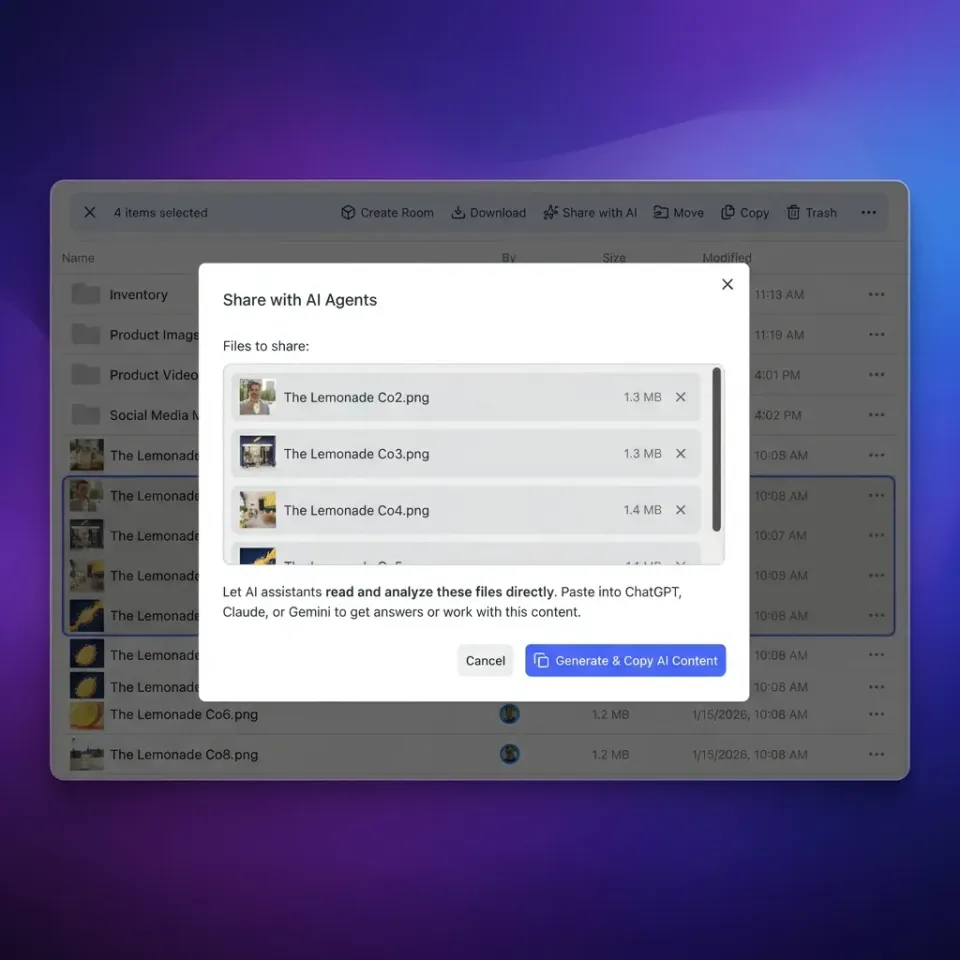
Fastio provides a dedicated persistent workspace where agents and humans share the same file context. Fastio plans include seats (3 on Starter, 10 on Business and 30 on Enterprise), making it cost-effective as you scale. Fastio is model-context-protocol-native, exposing action-based tools directly to Manus through Streamable HTTP at /mcp and legacy SSE at /sse. Learn more on the Fastio for Agents page. This means your agent can read, write, and manage workspace files using standard tool calls, without custom API middleware.
Fastio maintains a detailed per-file version history. Every file written to the workspace keeps its entire history, allowing human collaborators to review changes, track agent edits, and restore prior versions if an agent error occurs. This auditability ensures that automated loops remain safe and controllable.


Store Manus AI outputs in persistent workspaces
Provide your autonomous agents with a secure workspace. Connect the Fastio MCP server, preserve files with version history, and start your 14-day free trial.
Managing Shared Data with Metadata Views and Handoffs
For advanced agentic workflows, storing files is only the first step. Certified developers must show they can parse and extract structured data from documents. Instead of writing custom Python libraries for every file type, developers can use Fastio's data extraction capabilities.
Structured Extraction via Metadata Views
Fastio offers Metadata Views to turn unstructured files into a live, queryable database. Candidates can describe the fields they want extracted in natural language, and Fastio automatically generates a typed schema. This schema supports seven data types, including Text, Integer, Decimal, Boolean, URL, JSON, and Date & Time. Because no templates or parsing rules are required, Metadata Views works with PDFs, images, word documents, spreadsheets, presentations, and scanned pages. You can add new columns dynamically without reprocessing previous documents. Agents can programmatically query this structured grid via MCP tool calls to retrieve metadata values.
For example, if you are building an automated invoice parsing pipeline, you can define columns like:
VendorName(Text): The company issuing the invoice.InvoiceTotal(Decimal): The final balance due.DueDate(Date & Time): The payment deadline.IsPaid(Boolean): The payment status.
Differentiating Metadata Views and Intelligence Mode
It is important to understand how Fastio structures its workspace features. While Metadata Views serve as the structured extraction layer for queryable grids, Intelligence Mode provides the unstructured search and summarization capabilities. Enabling Intelligence Mode on a workspace automatically indexes files for semantic search and citation-backed RAG chat. This allows agents to answer complex questions using grounded workspace text, while Metadata Views extracts key data points into structured spreadsheets.
Organization Setup and Ownership Transfer
Once your agent has built a workspace and configured Metadata Views, Fastio supports ownership transfer to hand over administration and billing to a human client. The agent creates the organization during development, builds the workspaces, and then sends an ownership claim link to the human. Once the client accepts, they take over the subscription while the agent retains admin access to manage workflows.
Monthly plans start with a trial of up to 14 days (credit card required); annual plans have no trial. Fastio offers three subscription plans: Starter is priced at $9.99/mo, Business is priced at $49.99/mo, and Enterprise is priced at $199.99/mo [Fastio Pricing]. Check the Fastio Pricing page for subscription details. Read the agent onboarding guidelines to configure your workflows. This trial period gives developers ample time to configure, test, and validate their Manus AI workflows in a secure, persistent, and intelligent environment.
Submitting Your Project to the Build Club Ecosystem
Once you have structured your repository and configured your persistent storage, you are ready to submit your project. The evaluation process is managed through a collaboration between Manus Academy and Build Club, ensuring that your agent's performance meets enterprise standards.
Executing the Sandbox Verification Run
Before submitting, you must run a full test of your agent workflow. Manus executes your code inside its isolated sandbox using the configuration files in your .manus directory. The agent must complete the designated task chain (such as conducting market research on a company and compiling a report) from start to finish without human intervention. During this run, the agent must write its output files directly to your persistent Fastio workspace.
Linking Your Repository and Submitting
After validating the run locally, follow these steps to submit your work:
- Commit all code, configurations, and custom skills to a private GitHub repository.
- Go to the Manus Academy portal and connect your GitHub account.
- Select your submission repository and input your persistent workspace details.
- Submit the execution logs and the link to the generated output folder for evaluation.
Evaluation Criteria
Mentors from Build Club review your submission based on four key criteria:
- Resilience: The agent's ability to handle tool failures, recover from API errors, and complete the workflow without getting stuck in loops.
- Workflow Security: Ensuring that custom Python skills do not run unsafe shell commands or expose credentials.
- Data Structuring: Verification that output files are formatted correctly and structured data is extracted accurately using tools like Metadata Views.
- Task Success Rate: The percentage of intermediate steps executed successfully to produce the final output.
Frequently Asked Questions
Does Manus AI have a certification?
Yes, Manus Academy offers professional certifications in partnership with Build Club. These certifications are project-based and validate a developer's practical capability to design, debug, and execute autonomous AI workflows.
How do I become certified in Manus AI?
To become certified, you must register at the Manus Academy portal, complete the structured curriculum, build custom workflows for twenty real-world use cases, and submit a compliant project repository for review by Build Club validators.
Sources
References used to verify factual claims in this guide.
-
Build Club's 2026 enterprise survey shows that over 50% of companies have deployed autonomous agents in production.
-
A Manus AI certification is a professional credential awarded by Manus Academy that validates a user's competency in designing, debugging, and deploying autonomous AI agent workflows. Certified developers build end-to-end task chains verified by the Build Club ecosystem. To become a Manus certified professional, candidates follow a structured four-stage path: registration on the academy portal, completing 30+ hours of modular video content, building custom workflows for 20+ real-world use cases, and submitting verified project code.
-
Fastio offers three subscription plans: Starter is priced at $9.99/mo, Business is priced at $49.99/mo, and Enterprise is priced at $199.99/mo. Monthly plans start with a trial of up to 14 days (credit card required); annual plans have no trial.
Frequently Asked Questions
Does Manus AI have a certification?
Yes, Manus Academy offers professional certifications in partnership with Build Club. These certifications are project-based and validate a developer's practical capability to design, debug, and execute autonomous AI workflows.
How do I become certified in Manus AI?
To become certified, you must register at the Manus Academy portal, complete the structured curriculum, build custom workflows for twenty real-world use cases, and submit a compliant project repository for review by Build Club validators.
What is the best storage strategy for Manus Academy submissions?
The best storage strategy is to export all sandbox outputs to a persistent Fastio workspace. Because the Manus execution sandboxes are ephemeral and delete files automatically, connecting the Fastio MCP server ensures that your verification data is preserved.
Related Resources

Store Manus AI outputs in persistent workspaces
Provide your autonomous agents with a secure workspace. Connect the Fastio MCP server, preserve files with version history, and start your 14-day free trial.